The City of Akri

This is the other post I made on reddit today, this time on r/Twoshirts.


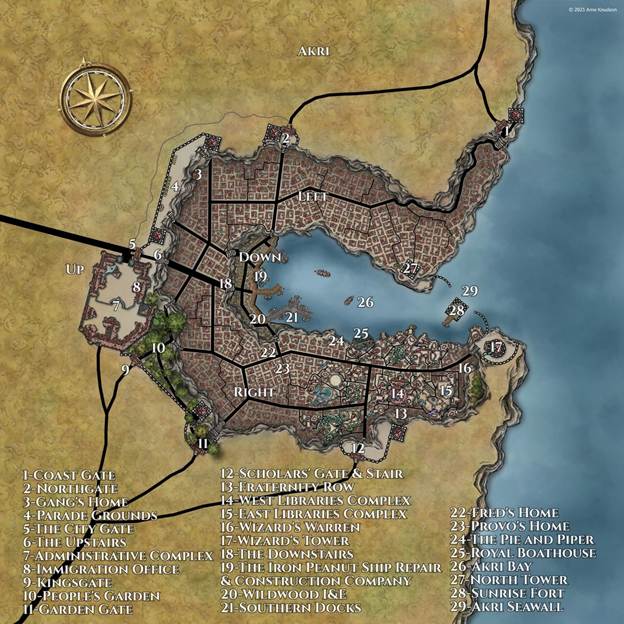
The Tale of Twoshirts happens within the city of Akri, on the coast of the Grimecian Empire.

I created this map in Inkarnate. It was originally for my D&D campaign (see my origin story post over on r/TheTaleofTwoshirts for more about that). I renamed and moved a few things for Twoshirts, but the city itself appeared there first. The description in the book – as Twoshirts and Angie stand on the Upstairs and look down over the city – is nearly a cut-and-paste from the description I gave the players in the campaign.

The main feature of the city is that it’s split into three levels. Akri is on the shores of the Abysmal Sea, which is a crater formed by a massive arcane explosion. On the crater rim, one of the ensuing landslides separated the three levels of what would eventually become the city of Akri: the high, surrounding plateau, a crescent-shaped middle level, and a small bit of land that became the wharves and docks.

Given that as a narrative starting point, I went to Inkarnate, and started dropping in assets. This image is the result, and I learned a lot once I started naming things and identifying important locations.

For example:

The gates: some are obvious, but Northgate plays on the fact that I’m from Seattle, and Northgate is both a neighborhood and a large mall (unsurprisingly, at the north end of the city).

The stairs & neighborhoods: the city is bifurcated by the road between the main gate and the docks, and I thought it would be a bit silly if they simply named the sections the Up, the Down, the Left, and the Right. Given this, naming the upper stairs the Upstairs, and the lower stairs the Downstairs, seemed the next obvious choice. I mean, if Seattle can name a northern neighborhood Northgate, and another neighborhood named Southcenter (guess where?), then why not?

The university and environs: starting with the Wizard’s Tower at the easternmost point (to observe the newly-formed sea), things grew organically from there. The research wizards constructed houses that became the Wizard’s Warren, then a few university buildings, then one library, and then a few more, followed by fraternity housing for all those annoying students, who definitely needed all-night greasy spoons like the Pie and Piper.

The Royal Boathouse: if there’s a small secluded place where someone can buy waterfront property, then a rich guy’s gonna do it. It’s called the Royal Boathouse for pretense, not due to ownership.

The Iron Peanut Ship Repair & Construction Company: Late in campaign 1, the (now-high-level) players wanted to buy a boat. I needed a place for them to buy it. I don’t know why or how I came up with this name, but it’s perfect for a whimsical cozy fantasy, and so it moved to Akri in this world.

Akri was fun to make back in the D&D campaign, and knowing what I knew about it, it was the ideal place for Twoshirts and Boggle to start their adventure together.

Posted in Twoshirts | Tagged , , , , , , , , , , , , , , , , , , , | Leave a comment

How Twoshirts All Began

Over on reddit, I’ve created r/Twoshirts and r/TheTaleofTwoshirts. This evening, I put up my first couple posts. I’m copying them here, but I also encourage everyone here to subscribe over there, and vice-versa. This is the first one, from r/Twoshirts.


In some ways, I blame Felicia Day, because it all started with The Guild. If you haven’t watched it, go watch it. Amazingly funny, inspired, and witty.

Watching The Guild led to watching Critical Role, because Felicia started Geek & Sundry, and gave Critical Role its original home.

Watching Critical Role reminded me that I used to play RPGs, all the way back to AD&D in the late 1970s, before I was even 10 years old. During middle school, every weekend, my gang of friends and I would sleep over at someone’s house. We’d play games like D&D, Champions, Paranoia, Toon, Battletech, Robotech, Call of Cthulhu, Twilight: 2000, and Bureau 13: Stalking the Night Fantastic (which inspired us to create our own parody RPG, titled Stalking the Stats Unrealistic). We rotated GMs and players – if someone had an idea, they ran a campaign for a weekend, or maybe a month. We came up with dozens of campaigns and worlds and stories and running jokes. And sometimes we just ran around shooting each other with nerf guns. It was awesome.

Decades later, I was watching Critical Role, and I realized that I had two kids that were about the same age as I was when I started playing D&D. I thought, what the heck, let’s give it a go and see if they like it, yeah? The wife was game to try, as well. I drew a map of a new continent on some graph paper. I picked a country, and then a city, baked some history, stir-fried some secret societies, and because all D&D campaigns start in a tavern, a caravan, or jail, I picked a tavern. I named it the Ivory Pound (with a proprietor named Rowlf, and go watch the Muppets to get that joke), and we were off.

My eldest still plays D&D with their friends in college. We lasted about a half-dozen sessions before my youngest made it clear he wasn’t interested in playing anymore.

A few years later, the creative itch was back, and I had this half-started campaign smoldering on a shelf in the library. I was working at Amazon, and I asked the wife if it’d be ok if I ran a D&D campaign one night a week, and she thought it was a great idea. I checked the Amazon wikis, signed up on an email list, and then sent an email asking if anyone was interested in joining a new campaign that I wanted to run. I was expecting 4 or 5 responses – hopefully enough to make a group.

I got just shy of 30 replies.

So… um… I guess a meeting? Where we figure out who wants to be in which campaign?

24 people showed up, and after sifting through what everyone wanted out of a campaign, we split into 4 or 5 groups, and six players joined mine.

We met weekly, after work, in one of the conference rooms. We played from 5:30 until 11pm… ish. We created minis in Hero Forge, and used wet erase mats for maps.

A year and a half later we were still going, and then COVID hit. We moved the game online. One player moved to the east coast; another to Michigan. But we kept playing, and 4 years later, we finished campaign 1, and started campaign 2.

I joined a friend’s game, as a player. Anyone who plays RPGs knows that you’re often thinking about new characters. So one day, I was fooling around with the idea of a goblin genie warlock, and wrote a backstory.

It’s weird when you read a little one-page story and realize that there’s a lot more “there” there. This little goblin boy wanted to tell me more, so I took him out of the character rotation, and started writing a book instead.

It’s also weird when you’re on a sabbatical, and you’re planning on finishing that book you started 10 years ago, but never finished, and this other little green guy waves his hand and beckons you in an entirely different direction.

I wrote 33,000 words in 8 days. At the end of those 8 days, I had a finished manuscript for a novella.

Some of Twoshirts’s backstory, and some of his world, is based on stuff I’d already written in campaign 1. Akri is a city from there, on the continent I sketched for my kids way back when.

But I knew Twoshirts was very distinct and different from D&D. I didn’t want monster-of-the-week. I wanted to focus on character and story. It was its own world, and thankfully, the fact that I’d done a fully-homebrew campaign was going to help with any copyright issues. So, similar to Critical Role, I went back and changed everything: new pantheon of gods, new rules for magic, and a new race, called the saurians.

I wanted to create a book, and a world, that was distinct, unique, humorous, and deep. I wanted to ask interesting questions. And I wanted to write a book that my kids might’ve wanted to read, when they started playing D&D. Or people that loved How to Train Your Dragon, or The Lord of the Rings, or anything on the Discworld or Xanth.

Twoshirts is – intentionally – NOT the kind of hero to save the world, and so the genre defaulted to cozy fantasy. But I wanted challenging problems in a complex world, so it needed to be small-e epic, rather than big-E Epic.

In other words, epic to Twoshirts. Not epic to everyone else.

Book 1 is pretty much done, and I’m querying agents and publishers. It’s at 47k words at the moment, and I’m trying to decide if I want to keep it as a novella – which nobody seems to want to publish – or expand it another 13k words to get it to the magic 60k threshold to call it a full novel.

Book 2 also has a full and finished manuscript. It’s currently at 55k words, which suggests that yeah, maybe I need to bulk up book 1 and flesh out book 2 a bit more.


For now, I’m trying to find people that are interested in the story. I’m going to talk about random stuff like D&D and movies and tropes over on r/Twoshirts, and specifically about the book series on r/TheTaleofTwoshirts. If you have any questions, ideas, or suggestions, feel free to reply here. I’m happy to answer & chat. My plan is to post once a week in each subreddit, and here on my website.

Thanks for reading, thanks for joining, and I hope one day you’ll get to read the books that I love to write.

Posted in Twoshirts | Tagged , , , , , , , , , , , , , , , , , , , | Leave a comment

New Thanksgiving Space Photos!

Over the Thanksgiving weekend, we had a couple of clear nights for the first time in more than a month, and so I had to get out the telescope, right?

It wasn’t perfect in terms of weather, but it was the best in a long time. I managed to get the following pictures. Each will be added to their respective pages (star clusters, galaxies, & nebulae).

One complaint (in case anyone from Unistellar is reading) – I have always disliked that in order to observe with your telescope, you have to update it first. The “watch” button is literally replaced with an “update” button. That means you have to spend time updating before you can play, and this time around, it failed the first four or five times I tried. I had to delete EVERYTHING off the telescope’s storage to be able to finally apply the update. They should give you the option to observe without updating, and they should make it clear that you need to clear your storage, and/or prompt you to do so, before trying to apply the update.

M45 – Pleiades Cluster

21m

2025-11-29

Something I knew: the Subaru logo is based on the Pleiades. What I learned: it also contains a reflection nebula of ionized hydrogen (often referred to as a H II region). Super cool!

M77

24m

2025-11-30

A compact spiral galaxy, not great for the eVscope, but still, a nice little blob with a very bright center. I think the fact that I’m in a city means I lose the subtle spirals, and so I’m only really getting a good image of the center of the galaxy.

M42 – Orion Nebula

12m

2025-11-30

I mean, when the Orion Nebula is up, you gotta get a picture of it. It’s one of the best things that you can capture with the eVscope.

M74

8m

2025-11-30

I only was able to get 8 minutes on this small galaxy, but it’s nice, given the dwell time. It’s one of the dimmest Messier objects that you can capture with the eVscope.

NGC 6888 – Crescent Nebula

23m

2025-11-30

I think the fact that I’m in a city means I lose a lot of the more diaphanous areas of this nebula, but it’s about the right size for the eVscope. I think if I can get to a dark rural area, I might come back to this one, and let it bake for a long time.

Posted in Space on the back porch | Tagged , , , , , , , , , , , , , , , | Leave a comment

Engineering Layoffs = More Free Cash Flow

So I was going to post a different article – had it all queued up and ready to go – but then came across this CNBC article about how 40% of the recent 14k layoffs were in engineering.

I think this further supports my hypothesis that the layoffs were about Free Cash Flow (FCF) and making sure they had cash-in-hand in the next 6-18 months. Engineers and engineering managers are among the highest paid at their level, so cutting them means saving more money relative to the size of the layoffs.

Similarly, I heard from someone still at Amazon that the layoffs targeted low performers and long-tenure / high-earning folks. That explains why I saw so many friends making “After 12 years” and “After 19 years” posts. And again, it’s consistent with Amazon’s tight-fisted approach to cash.

I was going to reach out privately to my Amazon friends and ask them, but I’ll ask ’em here: how bad was Q4 prep with fewer headcount? DM me if you want, or reply here if you’re feeling frisky.

One rule at Amazon that’s been true for 25+ years: scale only goes up. Unless you’ve made sure that your already-redlining service can add another 30%, you’re going to fall over and die come November.

Ergo, teams at Amazon work overtime during Q3 to make sure they’re scaled, WHILE STILL delivering critical feature X before the holidays or Re:Invent. It was bad in the past, when I had full teams; it’s gotta be terrifying, now, with fewer heads.

(Funny story, I was hired to lead the Email Platform team in August, and in my first Q4, the business decided to send a Black Friday email to every Amazon customer during the week before Thanksgiving. We weren’t prepared, the service fell over and died repeatedly for 3 days straight, and the first and only time Bezos ever spoke to me was asking me to explain why at the following WBR. Fun times! I got 16 more Q4s after that, so not so bad, right?)

I honestly wonder how many teams had to cut features in Q3. I suspect a lot, in order to ensure they could scale for Q4 peak. The alternative is they didn’t scale, and that’d be bad, in several different terrifying ways.

I guess we’ll know. If there’s a sudden spike in “Amazon is down” or “AWS is down” problems over the next 2 weeks, then … oopsie?

I’m genuinely curious about how things will go for Amazon this Q4. It sure seems they’re expecting to need a fair bit of cash in hand to deal with what’s coming.

Posted in Being a Good Leader | Tagged , , , , , , , , , , , , , , , , , | Leave a comment

So You Want To Be a Manager? What Do You Do If…

I’ve mentored several people that asked about moving from IC roles (like SDE or PM) to leadership roles (like SDM). When they do, I tell them this story:

“As a manager, you need to be comfortable answering the following question. I don’t need you to answer it; I just want you to talk about how comfortable you would be answering it. The question is:

“What do you do when someone comes into your office and tells you that their coworker smells?”

I ask them honestly, and let them respond. I prompt them to talk about their feelings, and their approach, rather than the answer itself.

Eventually I tell them: you need to be prepared for these kinds of problems, because once you accept responsibility for dealing with… well, basically any problem, you’re then going to have lots of problems to deal with. And I tell them that the “roommate smells” question is the easy, funny one; the hard one is when they tell you they’re being sexually harassed.

My advice, once you’re a manager? Talk to HR early on. Create a good relationship with them. It’s part of their job.

Next? Seek guidance, particularly if it’s your first time. Talk to your boss. Read your company’s harassment and discrimination policies, so you know what to do when they come into your office with that look on their face.

Lastly, and most importantly? Be supportive and honest with your people. Trust them when they say there’s a problem. When someone joins your team, tell them in your first one-on-one that you will listen to them and help them if they come with a complaint of sexual harassment, or racial bias, or anything similar. This is a HARD conversation, particularly with someone new to your team. You barely know them, they barely know you, and you’re telling them that if one of the worst possible work-related things happens to THEM, then they can come to you.

I’ve had that conversation enough times that I have a speech nearly memorized, but I always choke up a bit when I get into it, and I always feel uncomfortable. But it’s important, and it’s the right kind of uncomfortable.

I worried at first if this was the right thing to do, until one of my reports told me they appreciated not only that I’d done it, but that I did it in our first one-on-one. It showed them I trusted them, that I cared about these kinds of things, and that I wasn’t afraid to talk about the hard topics.

I felt even more validated when a second person, later in my career, did the same.

And finally, someone came to me, after they’d left my org and gone to another team, with this kind of a problem, because they trusted me more than their current leadership.

That’s when I knew, and that’s why I coach people to think about this story. Be brave in the face of your own discomfort, have the hard conversations, and be ready to deal with whatever happens.

Posted in Being a Good Leader | Tagged , , , , , , , , , , , , , , | Leave a comment

New Page: Twoshirts!

The observant may have noticed a new page in the header and new category in the right menu bar: Twoshirts!

The Tale of Twoshirts is the debut novella in a 5-book cozy fantasy series aimed at young adults and the young-at-heart. It’s been one of the major projects that I’ve been working on since June. The first book is done, the second has a full manuscript, and I’m currently querying agents and publishers. I went to the PNWA conference back in September, and I’ve participated in a couple of online pitch events, so I figured it’s about time that Twoshirts got his own page and category on this site.

Head on over to the page to learn about Twoshirts, Boggle, their friends, the city of Akri, and Professor Thumbwhistle.

Depending on what people want, I might post quotes and snippets, answer questions, or maybe the Prologue (and maybe even subsequent chapters, if people want). My goal is to get it published (in print, not self-published), and eventually maybe even an animated series or a movie (if I’m super lucky). For now, I want to get it out there, see if there’s interest, and launch this part of the marketing machine that it’s going to (hopefully) eventually need. I’ve learned that a lot of the work of being a writer has nothing to do with writing, and this is one example.

Thanks! Leave a comment if you’re interested, have some feedback or questions, or just want to offer some support.

Posted in Twoshirts | Tagged , , , , , , , , , , , | Leave a comment

About What Andy Said…

“The announcement that we made a few days ago was not really financially driven, and it’s not even really AI-driven, not right now at least. It’s culture.”

That’s what Amazon CEO Andy Jassy said after the layoffs last week. Ignoring its tone-deafness (for now), I want to question the “culture” bit.

Long ago, I worked in the same building as Jeff Wilke. We often chatted in the elevator, usually on the way up from the parking garage. He was the CEO of Amazon Retail, and the #2 Jeff at Amazon.

I attended Jeff Wilke’s seminal talk on “a culture of and.”

Most companies are cultures of or. Add new customers OR improve customer service. Create loyal customers OR charge for luggage. Companies that “are the industry’s best X” usually thrive by sacrificing one thing to be the best at another. Airlines are the obvious example. Cell phone companies. Grok. Starbucks. Krispy Kreme Donuts.

But Wilke believed that the most successful companies were the ones with a culture of and. That’s why Amazon wanted the best prices AND the fastest delivery AND the best customer service.

Wilke explained that Amazon’s leadership principles were intentionally constructed to create a culture of and. They’re SUPPOSED have tension.

Every single one contradicts at least one other. Some even contradict themselves. That’s the point.

Amazon pushed to do it all. Delivering results with low standards was as bad as not delivering results because we kept the standards high. Bias for action without diving deep was an anti-pattern, and a sign of a disengaged leader. Having backbone was actually bad if you wouldn’t also commit.

Last week, Andy said, “It’s culture.”

His culture isn’t the culture that I learned from Jeff Wilke.

If I were to chat with Andy in the elevator, I’d ask: where in the leadership principles does it say that leaders lead “the world’s largest startup?” Where is “flatness” mentioned?

I’d point out that leaders earn trust. I’d say that leaders hire and develop the best. I’d refer to being earth’s best employer, and how leaders shoulder the responsibility of being better, and doing better, for their employees.

I’d tell him that when I think about what Amazon culture used to be – the one that Wilke advocated for – it was about ALL of the leadership principles, and the culture of and.

And I’d tell him that the “culture” that he’s fostering is a culture of or, instead of a culture of and.

PS: I personally knew several 10- and 15-plus-year veterans that he laid off last week. I’d also mention that implying that they were somehow bad for Amazon’s culture is not only tone-deaf, but downright mean.About What Andy Said…

Posted in Being a Good Leader | Tagged , , , , , , , , , , , , , , , , , | Leave a comment

More on the Amazon Layoffs

So my last post went viral (thanks reddit!), and I appreciate the comments & feedback. Anyone looking for a good boss should check my post history on LinkedIn.

I received some interesting questions! Some I already answered on my website, arneknudson.com, but here’s one of the big ones:

If the reason for the layoffs isn’t post-COVID downsizing, and isn’t optimizations from AI, then what is it?

To answer that, a disclaimer first: This isn’t investment advice. Take no financial action based on this. It’s my opinion, with little actual evidence, and layered with dollops of speculation. E.g., I might WILDLY speculate that the cost of each corporate employee is $500k/year in salary+benefits+stock; ergo, cutting 30k of ‘em saves about $15BB/year.

So… why layoffs?

It comes down to Free Cash Flow (FCF). Amazon wants cash in hand.

First, GPUs are expensive. AWS is feverishly reallocating space to GPU racks. Tying up cash in infrastructure is a hefty negative to FCF, until you sell it.

Second, Trump’s economy is hurting both Amazon Retail and AWS.

Amazon Retail (both 1P and 3P) is disproportionately affected by tariffs. Case in point: when Trump eliminated the de minimis exemption, it destroyed the small 3P sellers. Amazon monitors 3P sales and, if sales are good, they’ll buy their own supply and undercut their price. But killing de minimis killed the small sellers. Amazon stopped competing, and entire product segments went “out of stock.”

Similarly, every time there’s a random tariff announcement, huge ships literally stop in the middle of the ocean and wait for Trump to go TACO. That’s a problem for the lean machine of Amazon Fulfillment.

As for AWS? It’s disproportionately affected by a downturn in the tech economy. When tech companies cut costs or go out of business, AWS’s YoY growth shrinks. Sure, AWS will be making money hand over fist on GPUs. But if AWS loses revenue from struggling non-AI businesses, they can now offset about $15BB of that. Why? So they can keep up their FCF.

Amazon released earnings last night. Mega profits, bigly sales, stock price go brrrt, yay! But check out this slide, which is slide 12 from Amazon’s Q3 2025 earnings call slide deck:

FCF is cratering, and if the trend continues, it’s going to be about $3.2B in Q4, and NEGATIVE $5.5BB in Q1’26. (To be clear, Amazon reported ~$61BB in cash & equivalent holdings; so a negative FCF means that number will start to go down, NOT that they’re going to go into debt.)

I believe the economy is hurting Amazon Retail and AWS. And while exploding GPU costs are a problem, I think the layoffs are mostly about offsetting the tariff-related costs in Retail, maintaining AWS’s high FCF, and maximizing cash in hand for the next 12-18 months.

And maximizing cash in hand NOW is a big ol’ red flag for what Amazon thinks about the economy.

Posted in Being a Good Leader | Tagged , , , , , , , , , , , , , , , , | 1 Comment

You Gotta Do What Makes You Happy

Apologies – this post originally went up on LinkedIn back in late August, and … then I left it in draft here, while publishing it there. Catching up!


Anyone that’s worked for me knows I have phrases that I say I lot. Maybe mantras, or if I’m being overly generous to myself, witticisms. But if you ask them, they’ll probably tell you my most repeated mantra is: “you gotta do what makes you happy.”

This has two distinct meanings. The first, which is from a personal standpoint, is that you should find something that you really enjoy doing. One way to know “is this what I want to do” is to ask yourself, “do I enjoy it even when I fail when doing it?” There’s usually a lot of ways to fail at something, but only a few ways to succeed. The people that really enjoy a job are the ones that aren’t afraid to experiment, and aren’t afraid to fail, because they get to learn more, so they can do even better (and have more fun!) next time. Another way to know is to consider whether you feel happy going to, or coming home from, work. Some people get a lot of happiness from accomplishment, and that’s great, because you should feel happy when you come home from work. But you should really find a job where you feel happy going into work. You should be excited about the possibilities, not just the consequences.

I used to feel happy going into Amazon, and being a leader, but a lot of senior leadership’s recent decisions made me unhappy about coming into work. I enjoyed helping people, I enjoyed getting releases out, and I enjoyed helping my team get to the lowest ops load in the org. But I didn’t feel proud, or happy, talking about the job with other people. It’s one of the reasons I left, and it’s also why I’m now writing more – I know I’m reasonably good at it, but even though I’m not the best, I’m enjoying doing it. I’m enjoying writing my blog and my books, and ultimately, it’s fine with me whether or not a lot of people read them.

The second meaning of “you gotta do what makes you happy,” which is from a leadership perspective, is that unhappy people are less productive. When people are unhappy, they’re going to seek out things to make themselves happy, which means they’ll be spending some of their time watching TikTok videos, going for long lunches, reading social media, or checking up on their fantasy football team. Those people will always be less productive than their own best selves. If they’re superstars (see my earlier post about how talent is a power curve), they may be more productive – even when distracted – than anyone else on the team. But our goal, as leaders, is to get the most out of every person on the team, over the long term.

So as a leader, one of the consequences of believing that I want my people to be happy is that I never begrudge someone leaving my team. If they do, it means (hopefully) that they’re trying to follow their passion, and therefore, I SHOULD HELP THEM DO IT. I tell people to not let the fear of change dissuade them from trying another team, or another role. I’ll have an article later about how not to be afraid, but for now, focus on whether your tentativeness about changing roles is fear of the unknown, or disinterest in the new challenge. The former is normal, and you should ignore it; the latter is bad, and you should listen to it.

I’ve helped many people on my teams move on, and I’ve kept good relationships with them afterwards. Some have even come back to work for me later!

Now, you might be thinking, “what if I don’t like how hard it’s gotten for me recently?” When people come to me with this issue, I first try to understand what’s causing the stress, and see what I can do to help. Depending on the circumstances, one possible piece of feedback that I give them is that you should NOT be afraid to stick it out when things get tough. If you search for articles related to “grit” and how perseverance can lead to better long-term mental health, you’ll find things like [https://www.sciencedirect.com/science/article/abs/pii/S0191886918304409], which found that “perseverance promotes greater resilience to depressive symptoms by enhancing positive self-conscious emotions (e.g., authentic pride) and positive self-valuation (e.g., sense of power).” Or, in [https://link.springer.com/article/10.1007/s10902-020-00343-4], where they found the “positive relationship between grit and subjective well-being is largely driven by the perseverance dimension of grit.”

In other words, if you like doing something, but it gets hard, you should try to push through it, and learn from it along the way. In the long run, you’ll probably end up happier, and proud of the fact that you persevered.

But on the other hand, if things are hard for reasons NOT related to the work, and grit’s not going to solve the problem, good leaders are able to listen, and ask good questions, and then act appropriately. Too many managers lean too heavily into the techbro-style leadership of “you just need to work harder” or “suck it up,” which can be incredibly damaging feedback.

So when I have my one-on-ones with the people that work for me, I often start with: “are you happy?” Good leaders need to create an environment where people are comfortable enough to respond with honesty. And when they ask the question, good leaders listen carefully and compassionately to the answer.

Posted in Being a Good Leader | Tagged , , , , , , , , , , , , , , , | Leave a comment

Another viral LinkedIn post

I’ve had another one of my posts on LinkedIn go viral: https://www.linkedin.com/feed/update/urn:li:activity:7388737736590909440/

Turns out, part of the reason why is because I’ve become internet famous: https://www.reddit.com/r/jobs/comments/1oicvgs/18year_amazon_veteran_ive_never_seen_layoffs_this/

I’m amused by the number of people that don’t believe that I’m as old as I am. Or that think that AI didn’t exist 25 years ago. It’s even more funny to me, because I often make the joke of saying “I graduated back in ’94, with a degree in AI, because that’s what they called it back then.” (Yes, it’s a nerd dad joke, but I’m a dad, and a nerd, so I get a pass.) It’s playing off the idea that the term “Machine Learning” didn’t exist until recently, but “AI” has been around for a long time. Neither of which is true, really; both terms were coined back in the 1950’s.

Maybe we should start an “I’m so old” contest in the comments? I’m so old that I still have my childhood Osborn 1 in my store room. I’m so old that the first computer game I 100%’d was Zork II. I’m so old I remember the smell of mimeograph ink. I’m so old that I know the tings and pings of a 1200 baud modem, and I know what baud means. And I’m so old that the textbook for my college AI class was a stack of laser printer printouts of a draft of the professor’s friend’s pre-print book, because there pretty much wasn’t any other AI textbooks available, yet.

My profile on LinkedIn is up to date and accurate, by the way (as of October 28, 2025). Maybe I should add “concentration in Artificial Intelligence” to my degree blurb?

I’m going to copy-paste the contents of the LinkedIn post below (obviously without the comments). I encourage civil discussion, and I’m happy to answer any questions. Enjoy!

And, because I’m fair and honest, I will concede one potential misstatement: my direct experience with layoffs at Amazon goes back as far as the financial crisis of 2008. But I also worked in tech during the .com bubble, and I did a lot of interviewing for Amazon in 2008. So when the 2008 crisis rolled around, and we had a hiring freeze, I asked my more wizened peers about the last time something like it had happened – which was the .com crash. They said it was bad, but only for a little while. So I concede: (1) my experience with how Amazon fared during the .com crash was first-order anecdotal (meaning I spoke to colleagues, who were there during the crisis, AFTER the crisis, about their memories of it); and (2) my direct experience started with the financial crisis in 2008.

I maintain that during my tenure (and based on first-order anecdotes from before it), and until now, I don’t believe that Amazon ever had a period where there were layoffs for multiple years running.


In my 18 years at Amazon, I went through a few layoffs and hiring freezes. This is the first time I’ve seen multiple years of significant layoffs essentially back-to-back. Even in the depths after the .com bubble, it wasn’t this bad. They’ve been laying people off now for almost 3 straight years.

The explanation that this is downsizing after hiring too many a the height of the pandemic doesn’t pass the smell test, at least to me. That was 3 years ago; they’re not that dumb to keep those people around for 3 extra years. Those folks were laid off back in ’22.

I’m also not convinced that this is optimizations due to AI. My degree’s in AI, and I worked on AI stuff at Amazon; I don’t think there’s enough automation yet, and it’s not accurate enough yet, to replace 30,000 people. The cost of inaccuracies seems too high. But I could be wrong; maybe they’ve gotten their false negative & false positive rates low enough to avoid too many region-wide AWS outages. (Or not.)

One of the articles I read said this was going to be in HR, and I can tell you as a former manager, my experience working with HR had been steadily worsening over the past 5-7 years. They outsourced so much of the work, overworked the people they had, and had such high turnover that I never knew who I was supposed to work with. When I needed to put someone on a performance plan or help a new hire receive some kind of accommodation, it seemed like it was a different person each time. If they really are laying off tens of thousands more HR folks, this is only going to get worse.

And, I suspect, it means they don’t plan on hiring MORE people – in any of the business units – for a year or more.

So, by the smell-o-meter, this seems more significant than streamlining workforce, improved AI, and “nah, we don’t need as many HR folks.”

If you’re an Amazonian, and find out tomorrow that you’re soon to be a former Amazonian, let me know, I’ll be happy to chat. It’s a weird world out there these days. Good luck, my friends!

Posted in Being a Good Leader | Tagged , , , , , , , , , , , , , , | Leave a comment