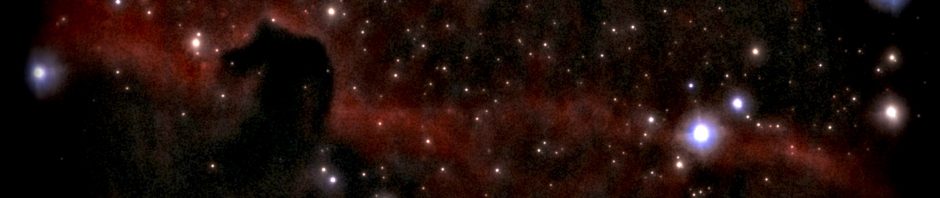
Unfortunately, it didn’t work out very well.
On July 18th, Titan passed between Saturn and the Sun, casting a shadow over the Saturnian cloud tops. Unistellar pitched this on their website as a viewing opportunity, and I figured, what the heck? Let’s give it a go. The Jupiter eclipse by Io was… okay? I knew that Saturn was both smaller and further away, but since Titan was relatively large, I thought maybe I could see it.
I set up to start taking pictures around 08:30 GMT (1:30am PDT), and took pictures at 08:28, 08:33, 09:10, 09:12, 09:13, 09:31, 09:32, and 09:54. Unfortunately, they were all pretty much the same, and came out like the one below.
Saturn
snapshot
2025-07-18
An attempt to capture Titan casting a shadow on Saturn. Unfortunately, the resolution isn’t high enough to make out the details.
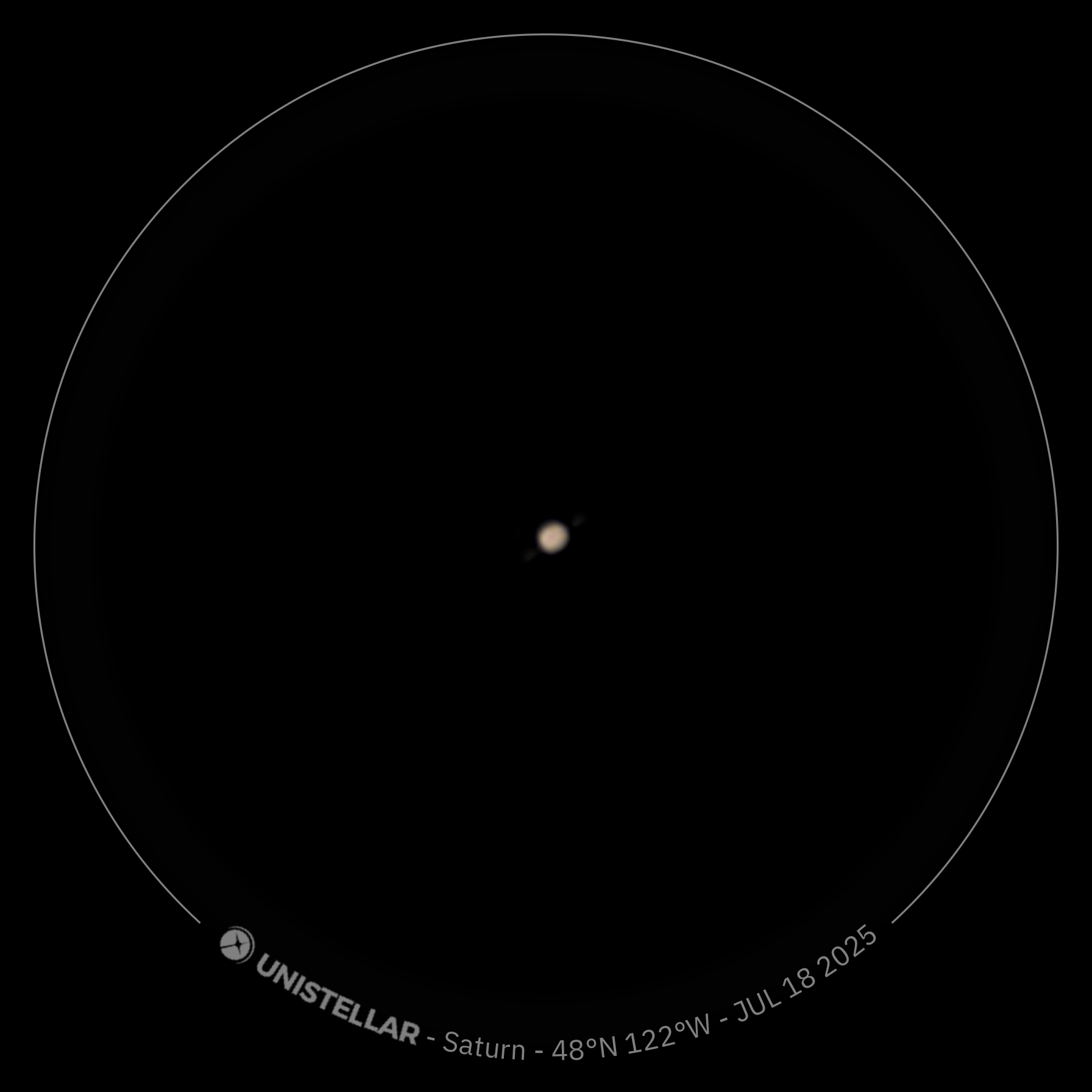
I tried dwell times of 10s, 20s, 30s, 4m, and even one that was about 20m. In truth, the best ones came at around 20 seconds – much shorter, and there were no details; much longer, and everything washed out into a blobby orange haze. None came out any better than the one above, which was the best of the bunch. You can’t make out any shadow from Titan, and you can barely make out the rings. I started to make a movie of the images, but once I imported them and started aligning them, I just gave up, because there just wasn’t anything to see.
I confirmed, again, what I’ve mentioned before – the Unistellar eVscope2 is a phenomenal telescope for capturing moon-sized dim objects like nebulae and galaxies, even within an urban environment. It’s a good telescope for capturing star clusters. But it’s not good at the solar system objects, given both the limitation on field size and an inability to zoom. And unless you’re really into post-processing and stitching your images (which I’ve not yet attempted), it’s not good for large objects like the Milky Way or the Andromeda Galaxy.
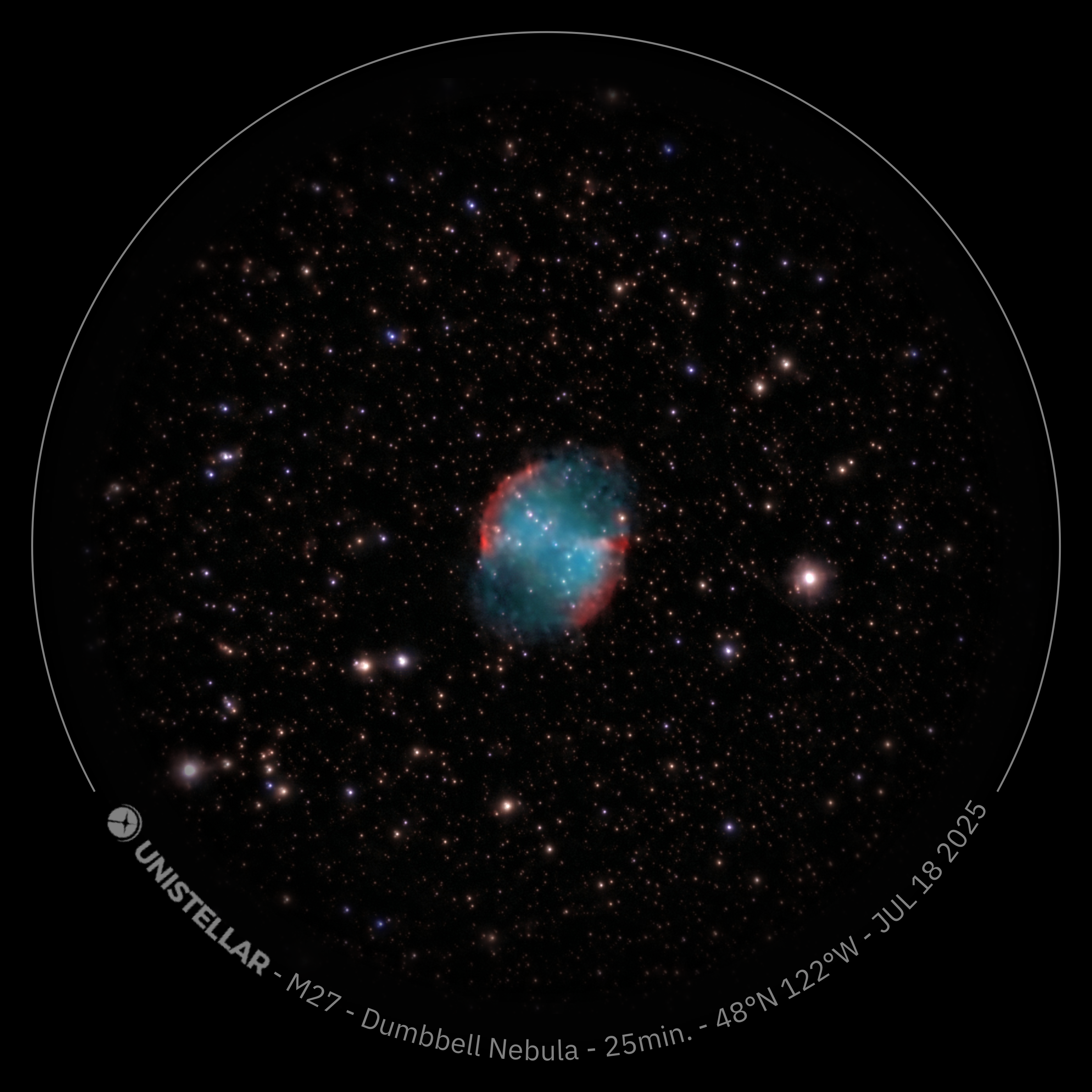
Since I didn’t want the evening to be a total loss, I did get a shot of the Dumbbell Nebula, which I thought came out quite well:
M27 – Dumbbell Nebula
25m
2025-07-18
I caught this the same night I was (unsuccessfully) attempting to capture Titan casting a shadow on Saturn. This was the best photo I took that night, unfortunately.
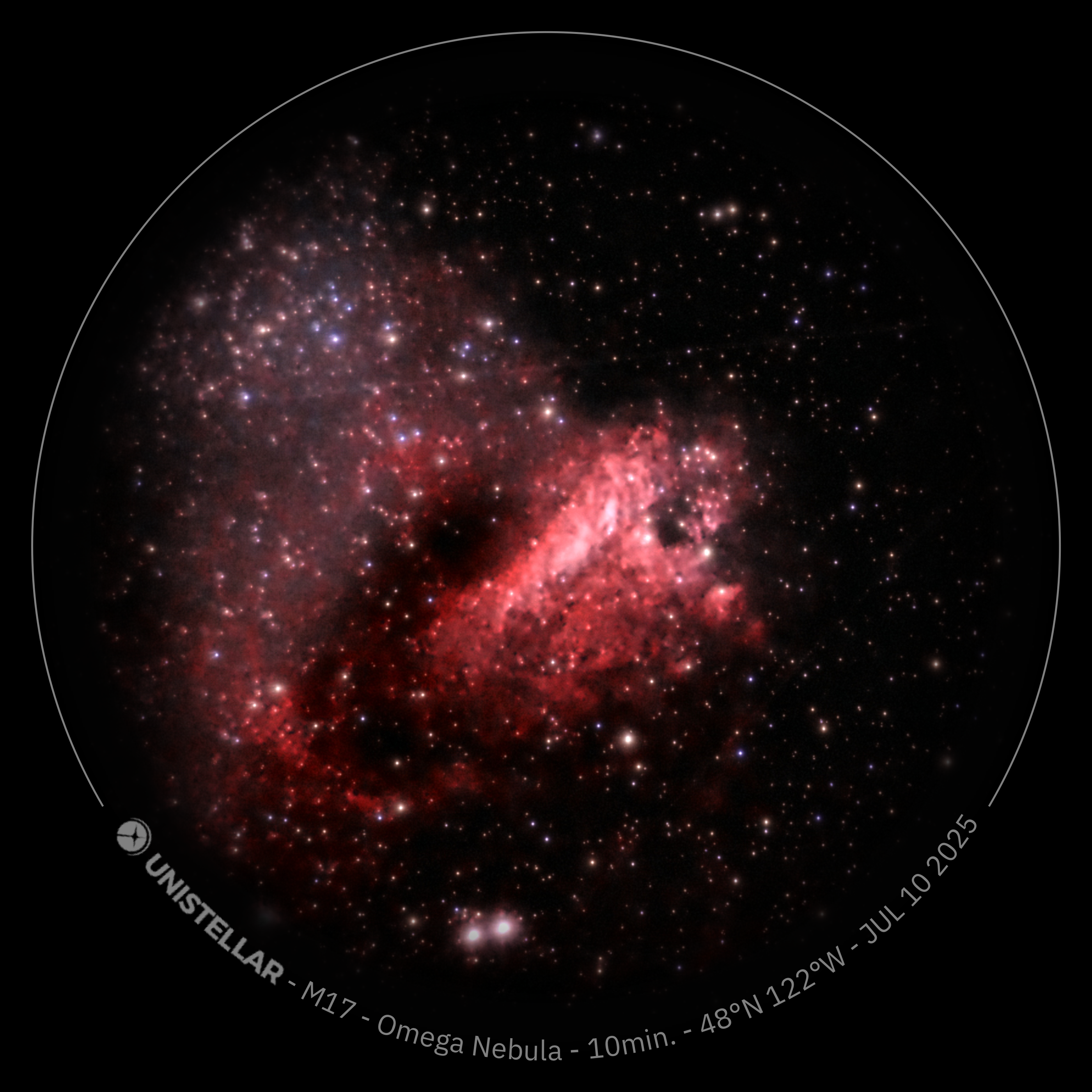
I did get the telescope out a few other times in the past couple weeks. We had a lot of nighttime high haze and thin clouds, as is common in Seattle in the summer, and so my telescope kept failing shots after only a few minutes. I did get two photos that I thought were worthy of posting:
M17 – Omega Nebula
10m
2025-07-10
A nice shot of the Omega Nebula, but it was cut short at only 10 minutes of dwell time due to high clouds.
NGC 6946
23m
2025-07-18
I wanted to revisit NGC 6946, to see whether the color stretching was bad in the first one, or it really is that red of a galaxy. Turns out, it’s really that red!
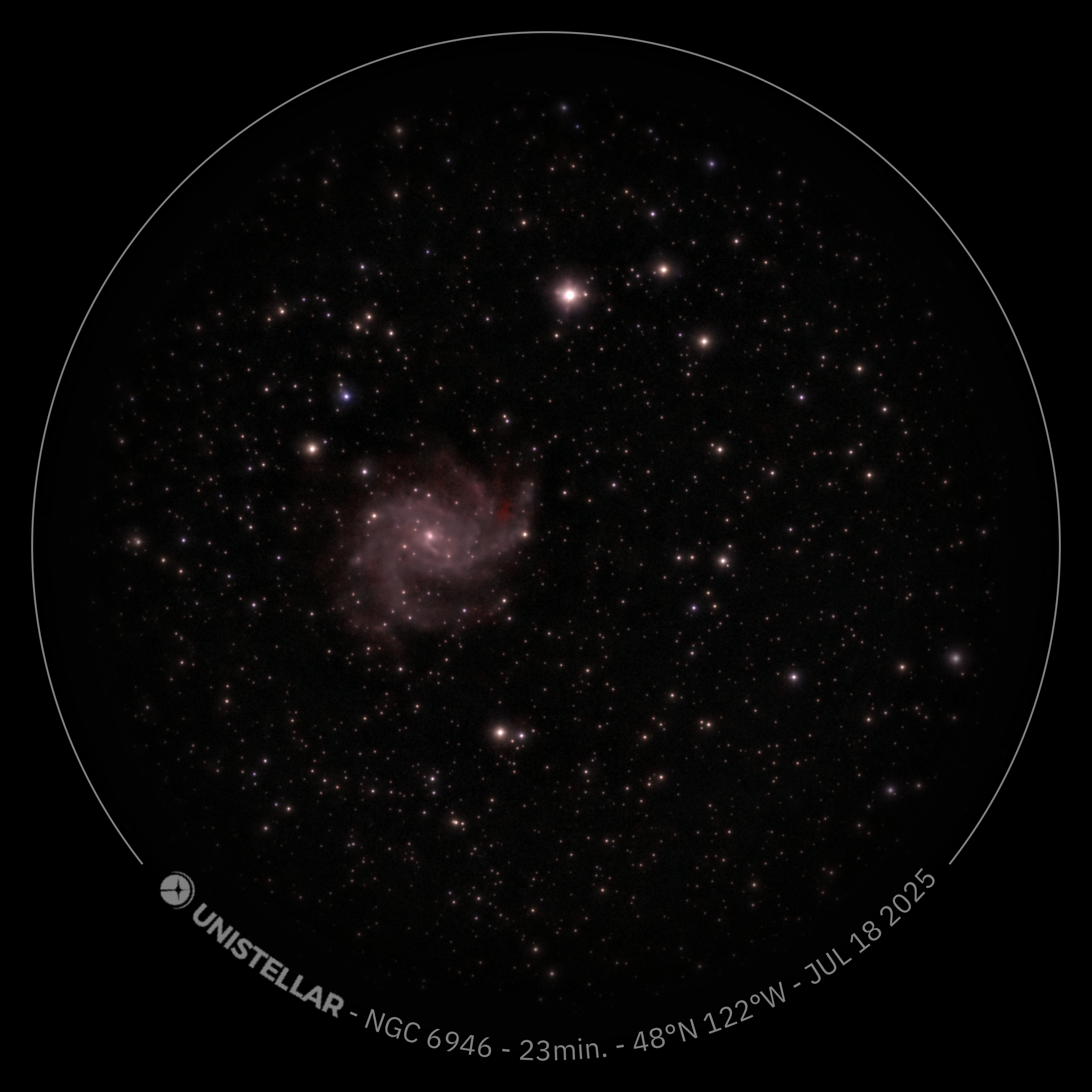
The last one was actually the night after the Saturn attempt – but Saturn was around 2:00 in the morning, whereas the photo of NGC 6946 was taken around 11pm the next evening.
All the above will be added to the Galaxies, Nebulae, and Solar System Objects pages as appropriate.
Discover more from Space on the back porch
Subscribe to get the latest posts sent to your email.

