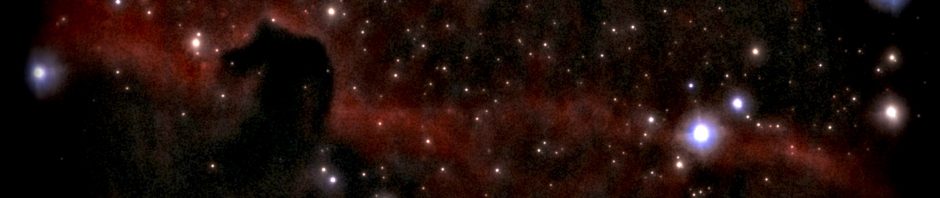
We finally got a clear night last night in Seattle. It’s been cloudy and rainy for a while, which is great for the plants, but bad for telescopes.
I started by trying to catch an old friend, the Pinwheel Galaxy, and only after it’d been running for a while did I notice the focus was slightly off.
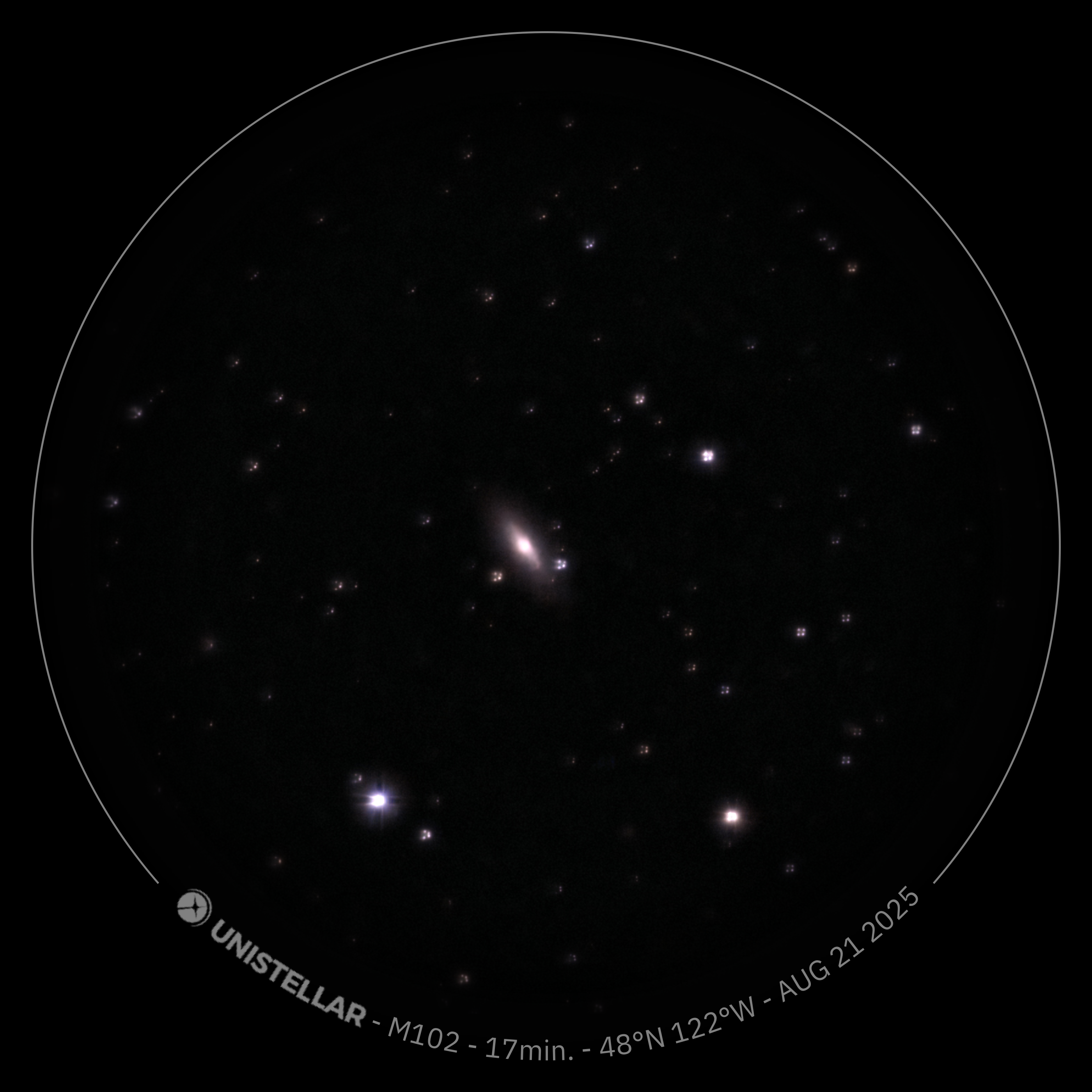
This emphasizes something I learned early on with the eVscope 2, but keep forgetting: tiny bumps to the focus knob (e.g. while moving it in or out of the house, or putting it away in your backpack or container) QUICKLY mess up your photos. I often don’t adjust focus before I start, and honestly, I should. These were adjustments that I was able quickly make with the Bahtinov mask, and I only needed a few millimeters of tweaks to get the focus dialed in. That’s how sensitive the telescope is: even though the focus for the images below were only a few millimeters off, … yuk.
So if you’re new to using an eVscope, or really any telescope, the process of getting set up should include a focus check. If you don’t, you’ll end up with a pictures like these:
M102
17m
2025-08-21
This is what happens if you take a picture when it’s out of focus.
M101 – Pinwheel Galaxy
19m
2025-08-21
Out of focus! Well, if you’re out of focus, it looks like this.

So… yeah. I’m not going to include these in the galaxies page, since they’re so bad. But I include them here as examples and reference, so you know what to do when your stars start looking like squares with crosses in the middle.
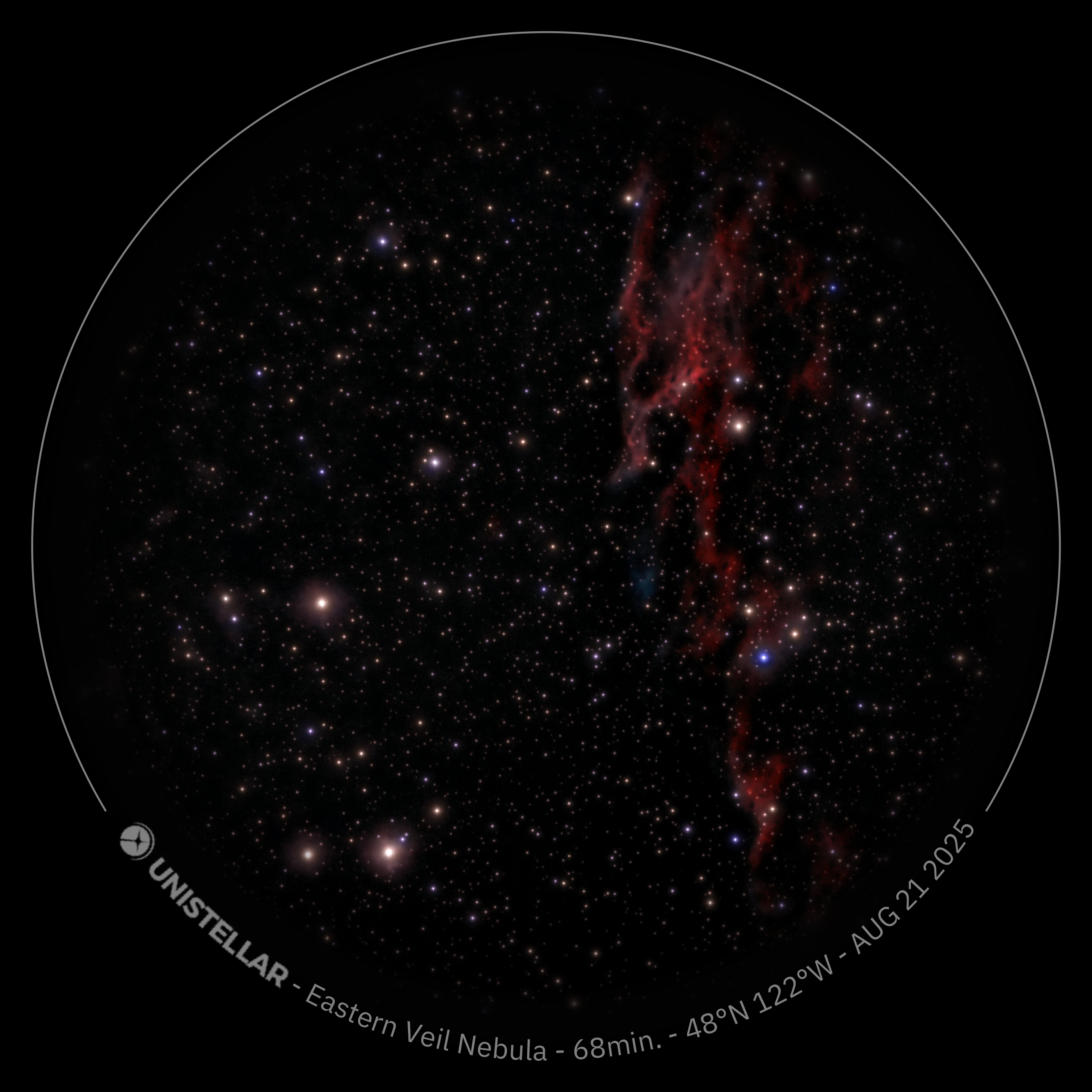
Once I fixed the focus, I decided to try for a new target – one that I’d read about, but I never remembered seeing on the eVscope list of available targets: the Veil Nebula. I don’t know why the Veil Nebula doesn’t appear on the list of available objects. If you search for “veil,” though, you’ll get 2 potential targets: the eastern veil nebula, and the western veil nebula. And then, when you pick one, the telescope complains that it’s not in the visible area. The elevation might be in the 30-60 degree range, with a reasonable azimuth, but the “visible during” is listed as “???”. But I encourage you to ignore the complaints, slew to the target, and start the dwell, because you end up with shots like these:
Eastern Veil Nebula
68m
2025-08-21
The Veil Nebula is the visible part of a huge complex called the Cygnus Loop, which is the remnants of a supernova from 10-20 thousand years ago. The Eastern Veil is one of the larger and brighter bits, and it only shows up faintly despite the long dwell time.
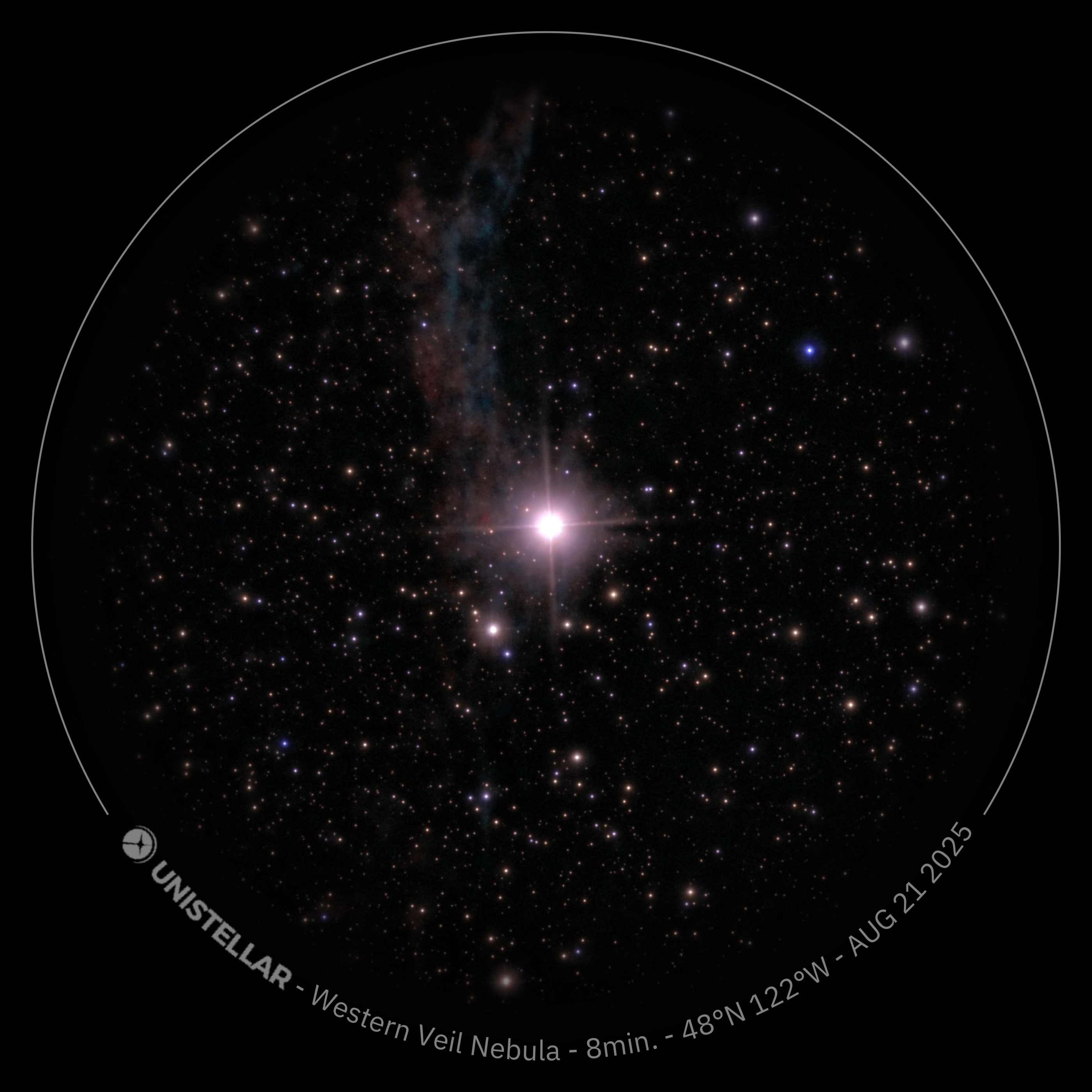
Western Veil Nebula
8m
2025-08-21
The Western Veil is another bright part of the Cygnus Loop. This shot got interrupted, but even though it’s only 8 minutes, I really like the fact you can clearly make out both blue and red elements of the cloud.
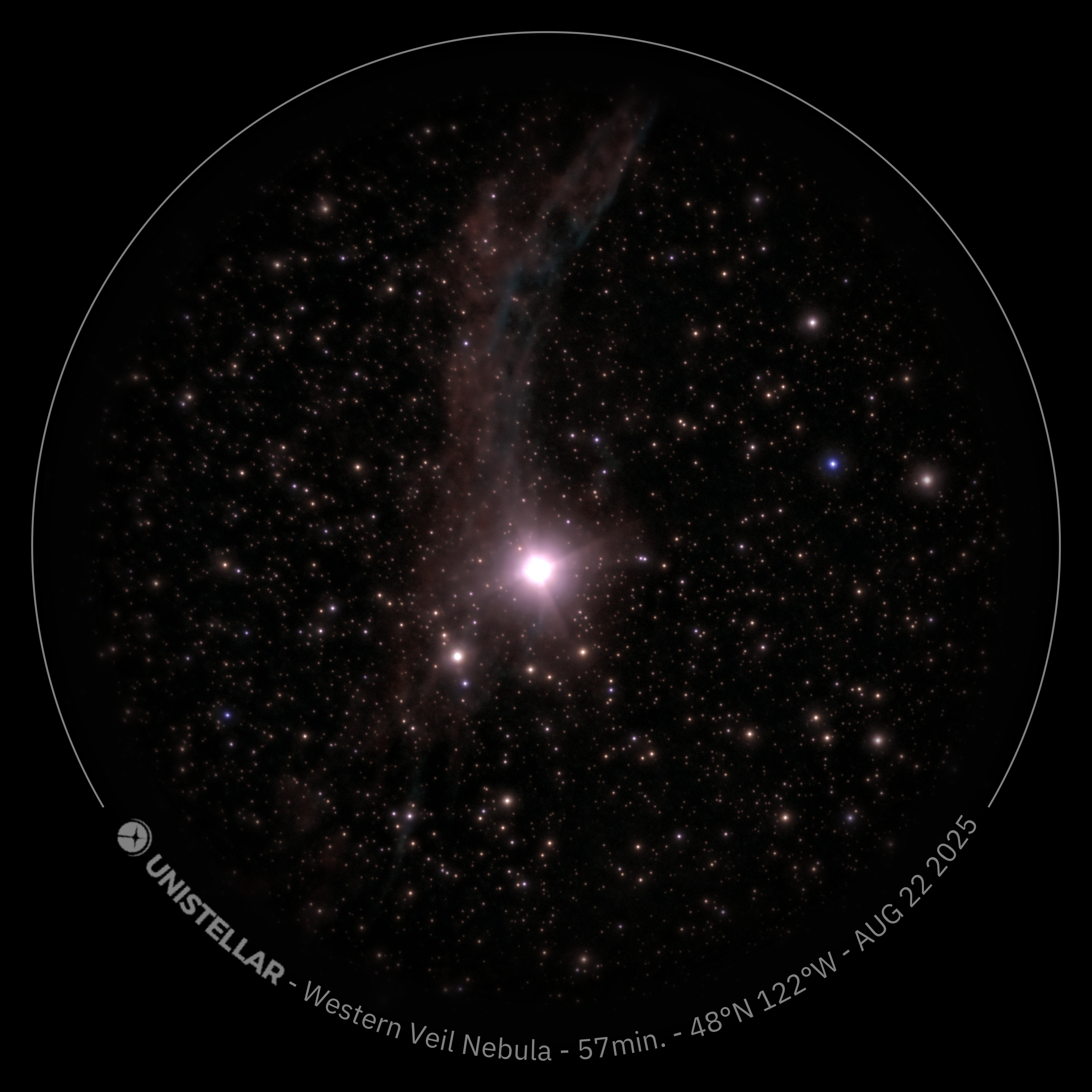
Western Veil Nebula
57m
2025-08-21
A longer shot of the western veil, and even though this was almost an hour, you can only make out faint elements. The bright star is 52 Cygni, which is what’s called a “foreground star.” The veil nebula is about 1,470 light years away, whereas 52 Cygni is only around 201 light years away.
Discover more from Space on the back porch
Subscribe to get the latest posts sent to your email.

