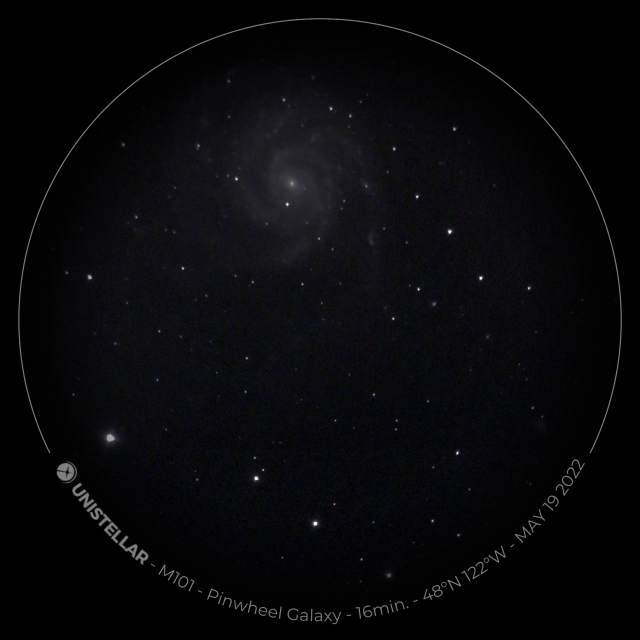
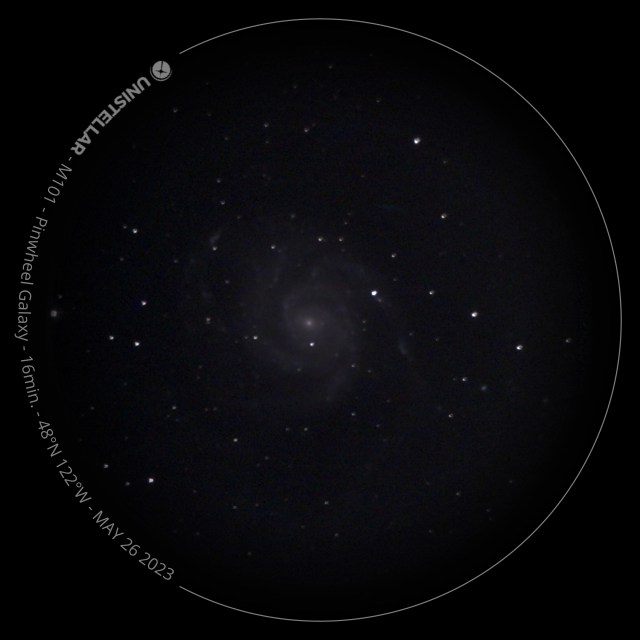
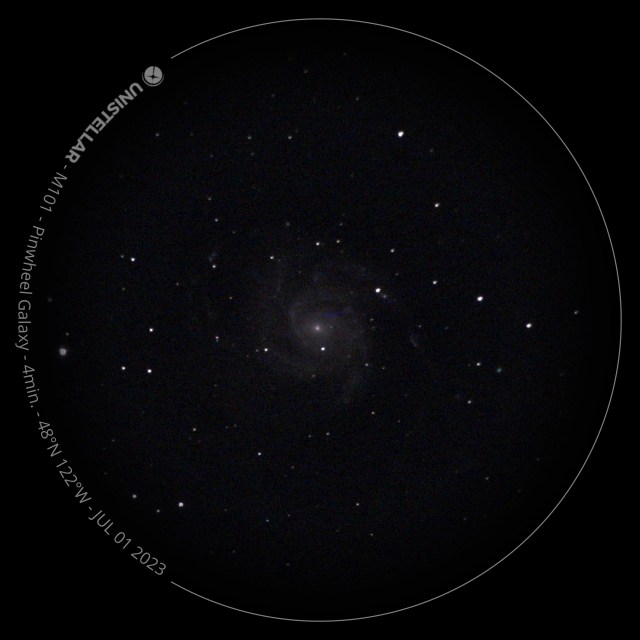
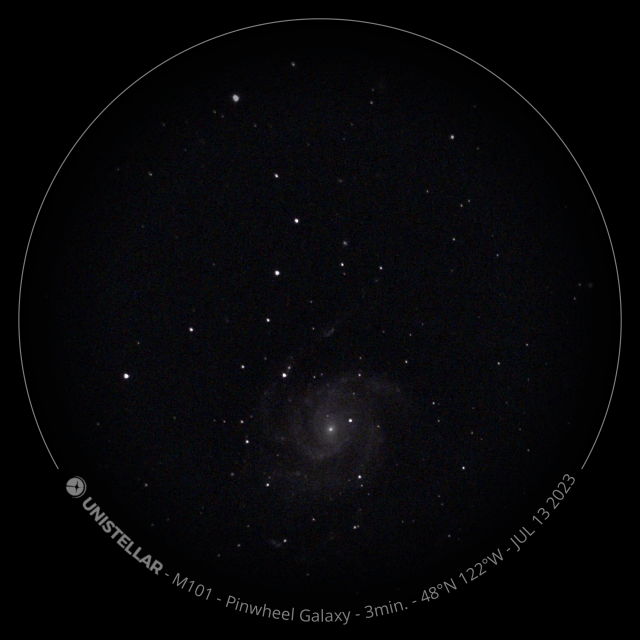
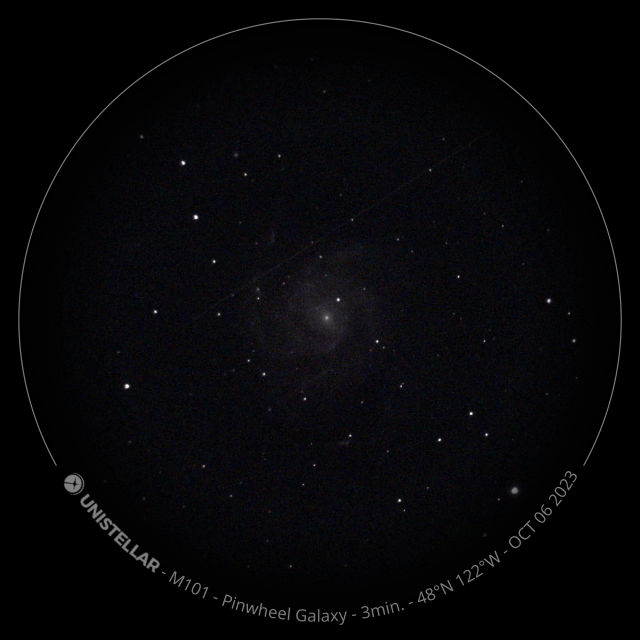
So one of my happiest sets of pictures is the supernova that happened in the Pinwheel Galaxy in 2023. Below is a sequence of 5 photos; they’re the same ones you can find on the Galaxies page. The first is May of 2022, a year before the supernova. Then May 26th, 2023, just after it happened. Next is a week later, on July 1st; and then almost 2 weeks later on July 13th; and then finally 3 months later, in October. Note that the position of the supernova changes relative to the camera. I’ve rotated the 2nd and 3rd image so they align with the orientation of the first image, but images 4 and 5 are rotated about 90 degrees counter-clockwise. The supernova appears in the top-right arm of image 2, at about position 2:00 on a clock (with up being 12 o’clock), and then images 4 and 5, that arm is around 10:30 on the same clock.
I don’t usually discuss scientific papers on this blog – it’s mostly about astrophotography using a cool telescope – but I first saw a video, and then skimmed the actual paper, about how weird this supernova actually was, and I wanted to share. The video is one of Anton Petrov’s: https://youtu.be/7KAurwygjgc?si=pYE0VyAQH39hieq5 (and he’s a great science communicator, check out his channel). The paper, referenced in the video, is here: https://iopscience.iop.org/article/10.3847/1538-4357/adea38/pdf – feel free to read it if you want. I only read the abstract, skimmed most the rest, and spent some time looking at the interesting graphs and pictures.
The short version of why this is weird is: this appears to be a case where two stellar objects – one, a large, bright star, about 10 times the mass of our sun, and the other, a black hole also about ten times the mass of the sun – spiraled into each other. It’s even possible that the black hole went inside the larger star! For the four to five years prior to the explosion, the spiraling black hole ripped off 2 different chunks of the star’s gas and spewed them into space, causing the apparent brightness of this star to grow. And when I say “chunks” getting spewed, I mean “about two or three solar masses of material,” each ripped away over the course of a few months to a couple years. And when I say “ripped away,” it’s possible this was caused by the black hole, or just instability of the star itself; either way, stuff got thrown into space.
Finally (and this is where the black hole may have actually gone into the big star), the black hole caused enough instability to make the star explode. The huge explosion of gas and dust then raced outwards, smashing into the closer bubble of previously-ejected material (causing the initial brightness spike), and then around 240 days later, hit the earlier-ejected material (causing a second brightness spike). Now, 240 days after May of 2023 is mid-January of 2024, and unfortunately, I have no pictures of this galaxy from around that time.
So the weirdness of this supernova comes from two things: one, the fact that those before-the-explosion events caused a brightening of this star for years beforehand; and two, the fact that this explosion was caused by instability due to interactions with a companion black hole, rather than the more humdrum stellar-collapse supernova, making it a type IIn supernova. Type IIn supernovae have been theorized, but Anton’s video seems to imply that this is the first time that a paper is claiming to have evidence for one.
It’s very cool that I got to take pictures of what may have been a previously-unobserved phenomenon!
Discover more from Space on the back porch
Subscribe to get the latest posts sent to your email.

