I got an eVscope2 from Unistellar back in 2022, and I’ve been taking pictures from my back porch ever since. These are the galaxies that I’ve managed to capture.
The eVscope2 specializes in larger, dim objects like galaxies and nebulae. Those two categories are the ones that I have the most and best pictures of.
One thing that amazes me is that many of these are about the size of the moon – and when I say size, I mean angular size, meaning they occupy about the same perceived space in the sky as the moon. The circle that’s around most of these images is only slightly larger than the full moon (see the Solar System Objects page for pictures of a lunar eclipse, for example). These objects are just up there in the night sky, waiting to be seen; they’re just too dim for our eyes to see them. There are probably nocturnal creatures that can look up and see Andromeda; but not us. This telescope brings out what’s already there.
The eVscope is great, but it is limited: it can’t zoom, and has a fixed viewing area. For most objects this is fine, but for small ones (like some of these galaxies, a few of the nebulae, and all of the planets), you’ll never get a higher resolution image that what it gives you. But at the other end of the size spectrum, it means you can’t get the Andromeda Galaxy (which is 6 times wider than the full moon) without stitching together multiple images in a panorama. I’ve not gotten around to doing that, but I hope to do so at some point.
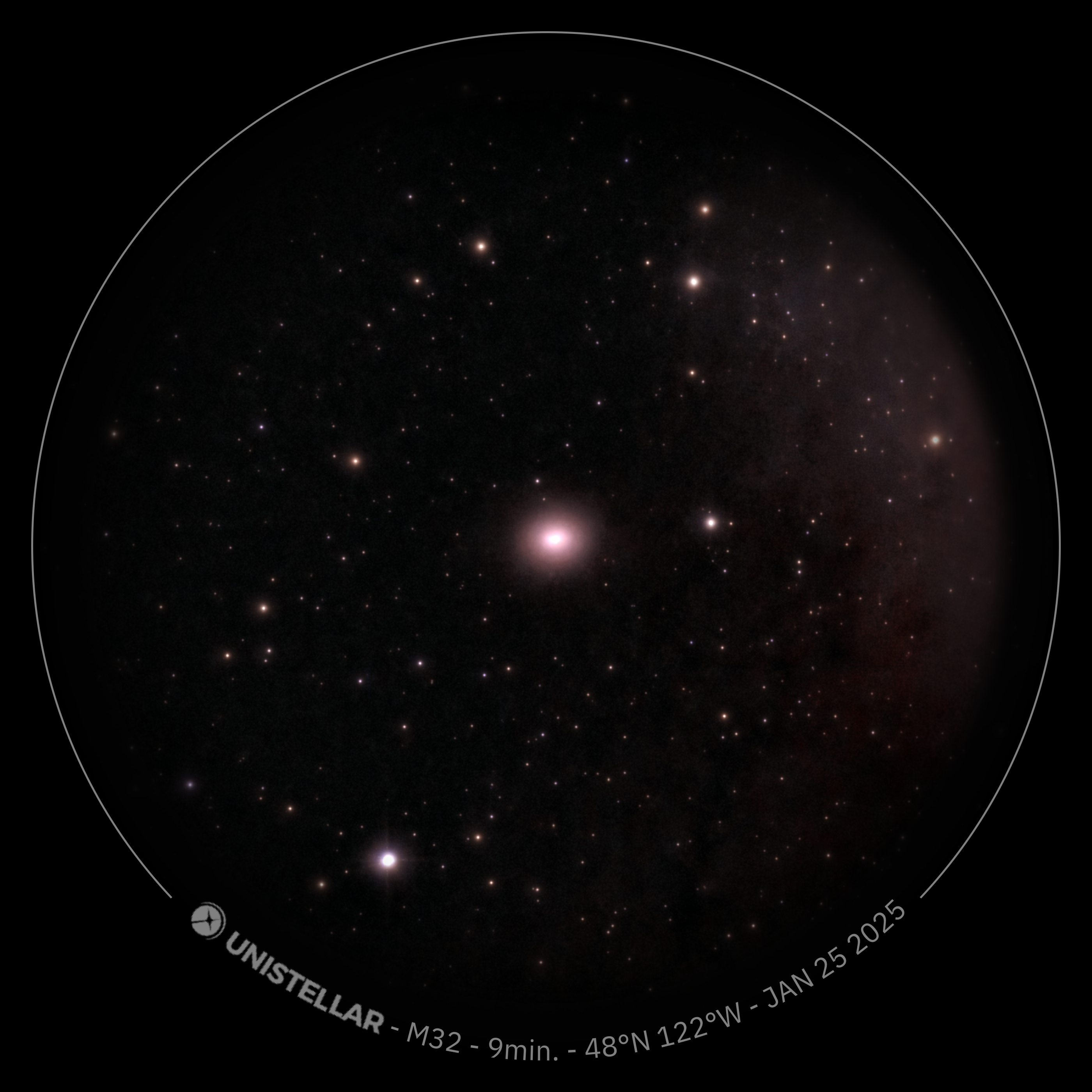
M32
9m
2025-01-25
M32 is a dwarf galaxy about 2.5 million light-years from Earth. It’s a satellite of the Andromeda Galaxy – you can see Andromeda’s hazy cloud of stars in the upper-right portion of this photo.
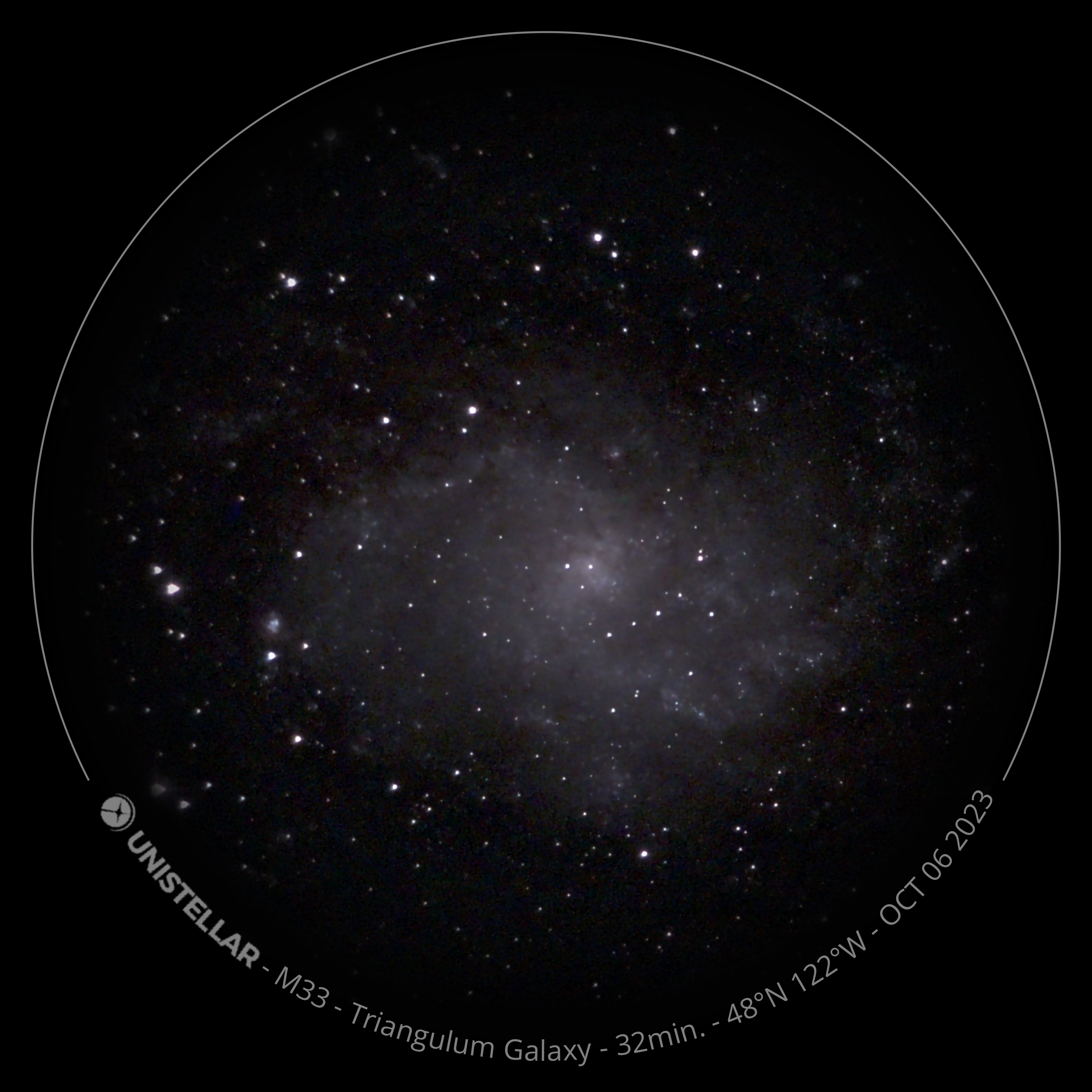
M33 – Triangulum Galaxy
32m
2023-11-06
Even before the VVT software update, a long dwell time could produce nice shots of the Triangulum.
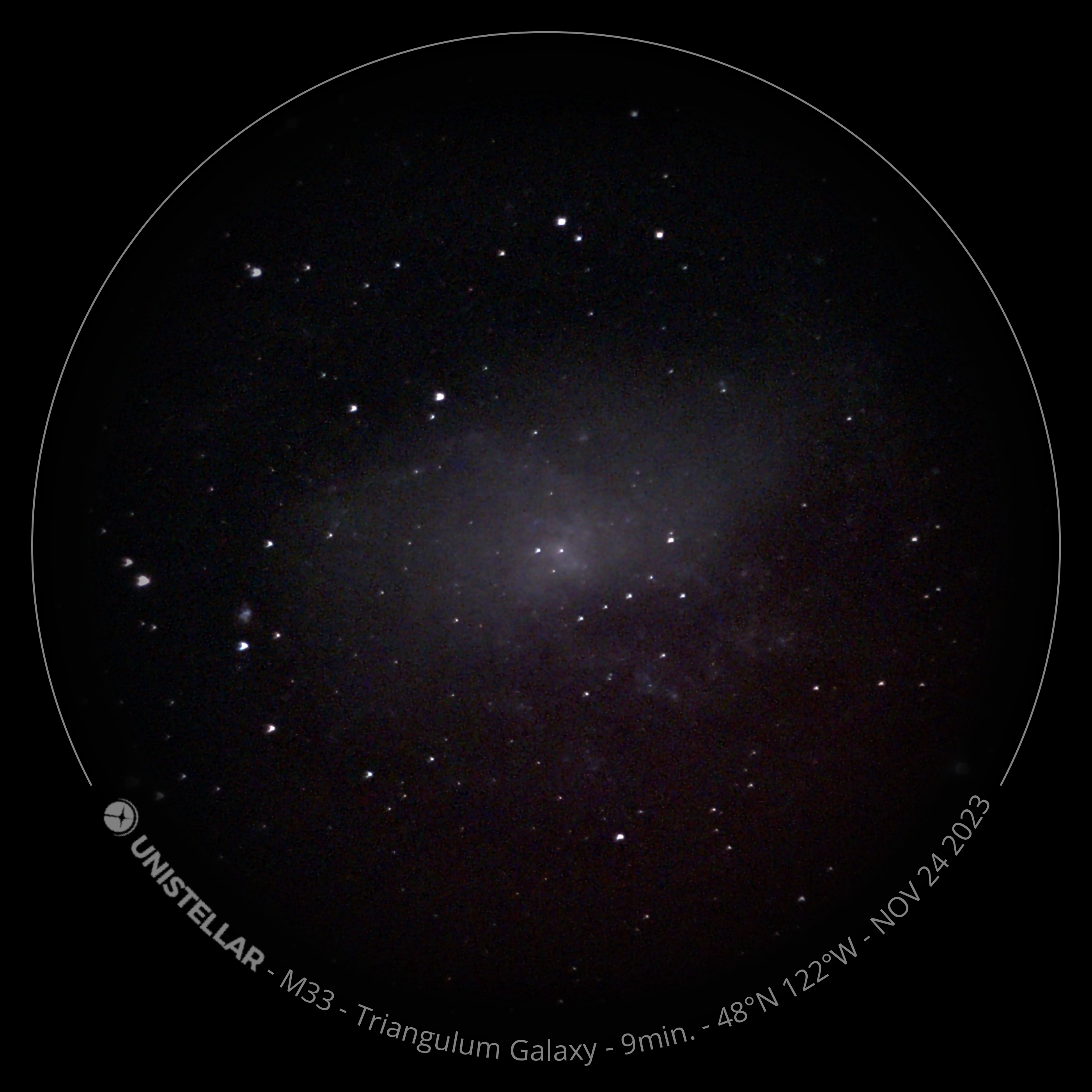
M33 – Triangulum Galaxy
9m
2023-11-24
The Triangulum Galaxy is big and dim, so short dwell times lose most of the details.
M33 – Triangulum Galaxy
35m
2024-12-09
This shows how much better the image is with the new software. I like how you can clearly see there are big red and big blue stars in a galaxy like this one.
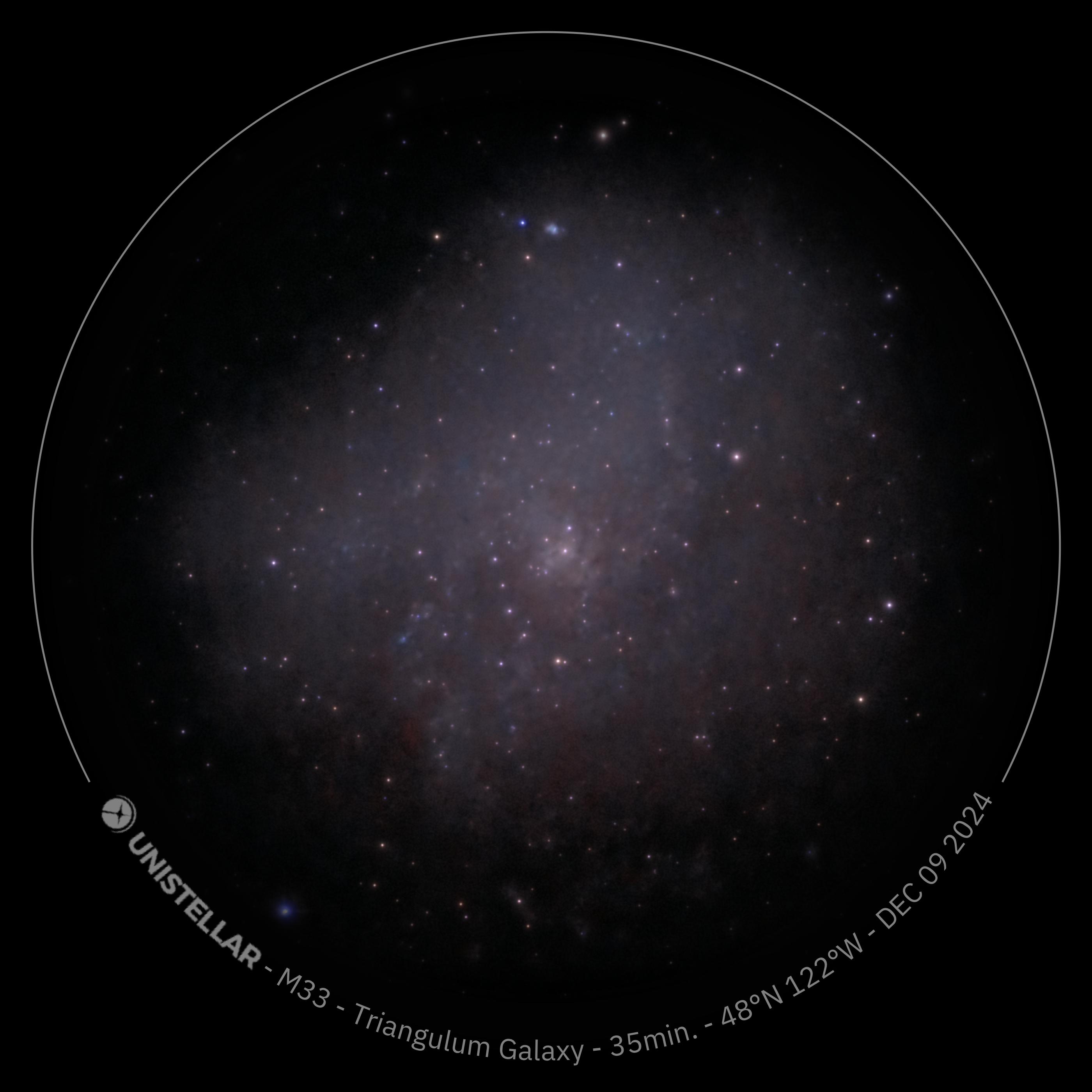
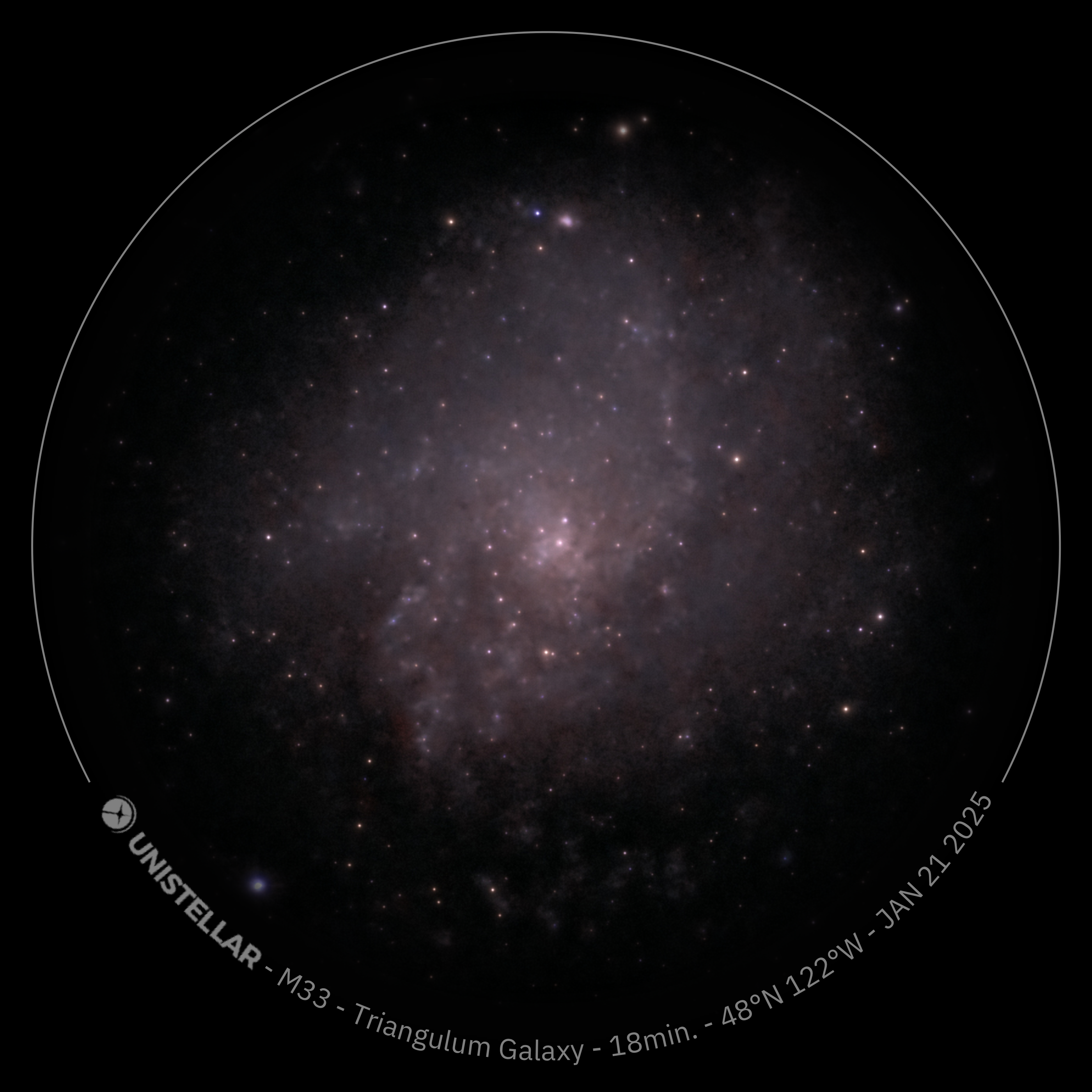
M33 – Triangulum Galaxy
18m
2025-01-21
I really like this picture. Bright individual stars, in a softly glowing group of diffuse spirals. I think it’s overly red, though, and the color stretching was a bit off.
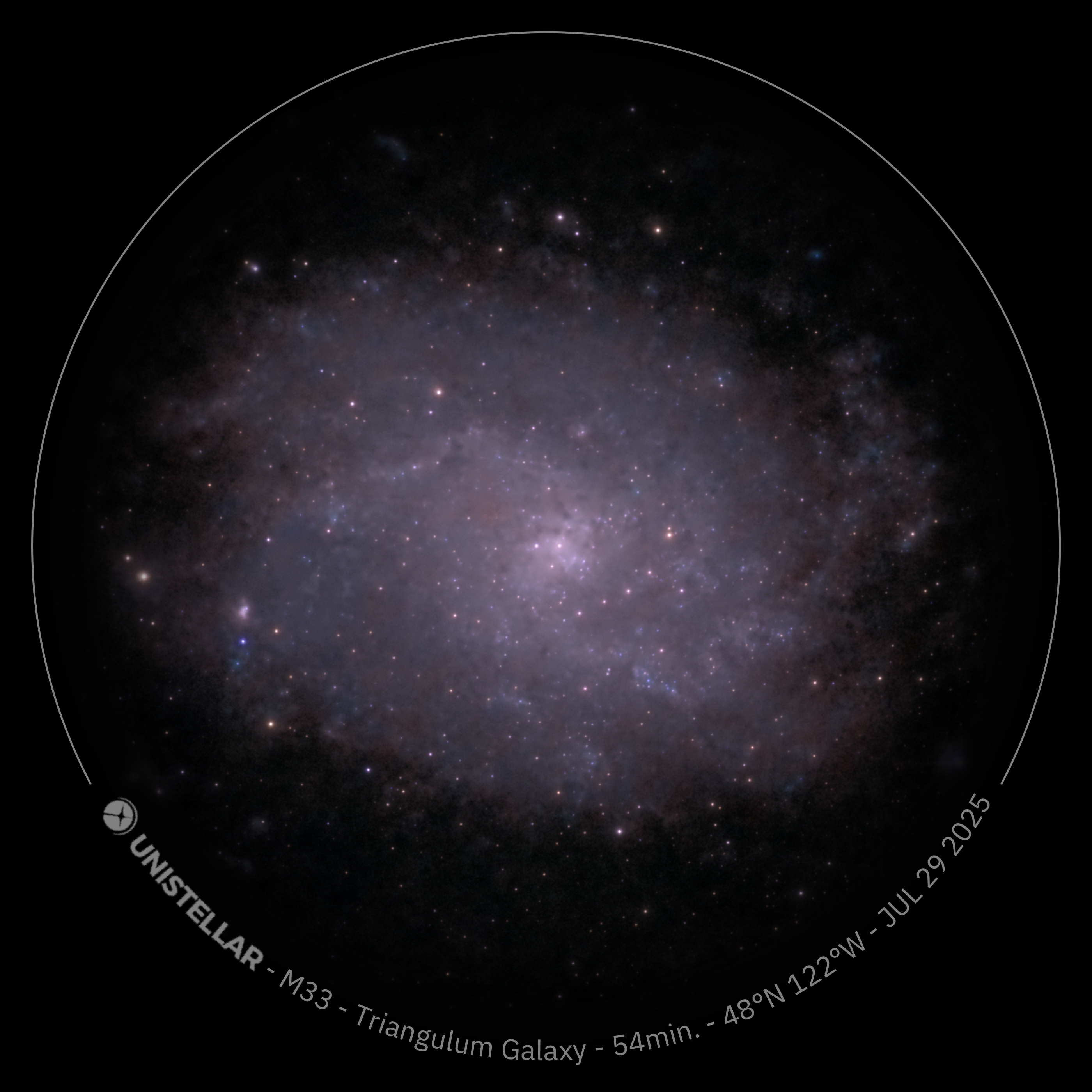
M33 – Triangulum Galaxy
2025-07-29
54m
I wanted to get a really long dwell time on the Triangulum, to get the dim glow of the diffuse arms, and to really highlight the bright giant stars in its arms. I love the different colors you can clearly make out.
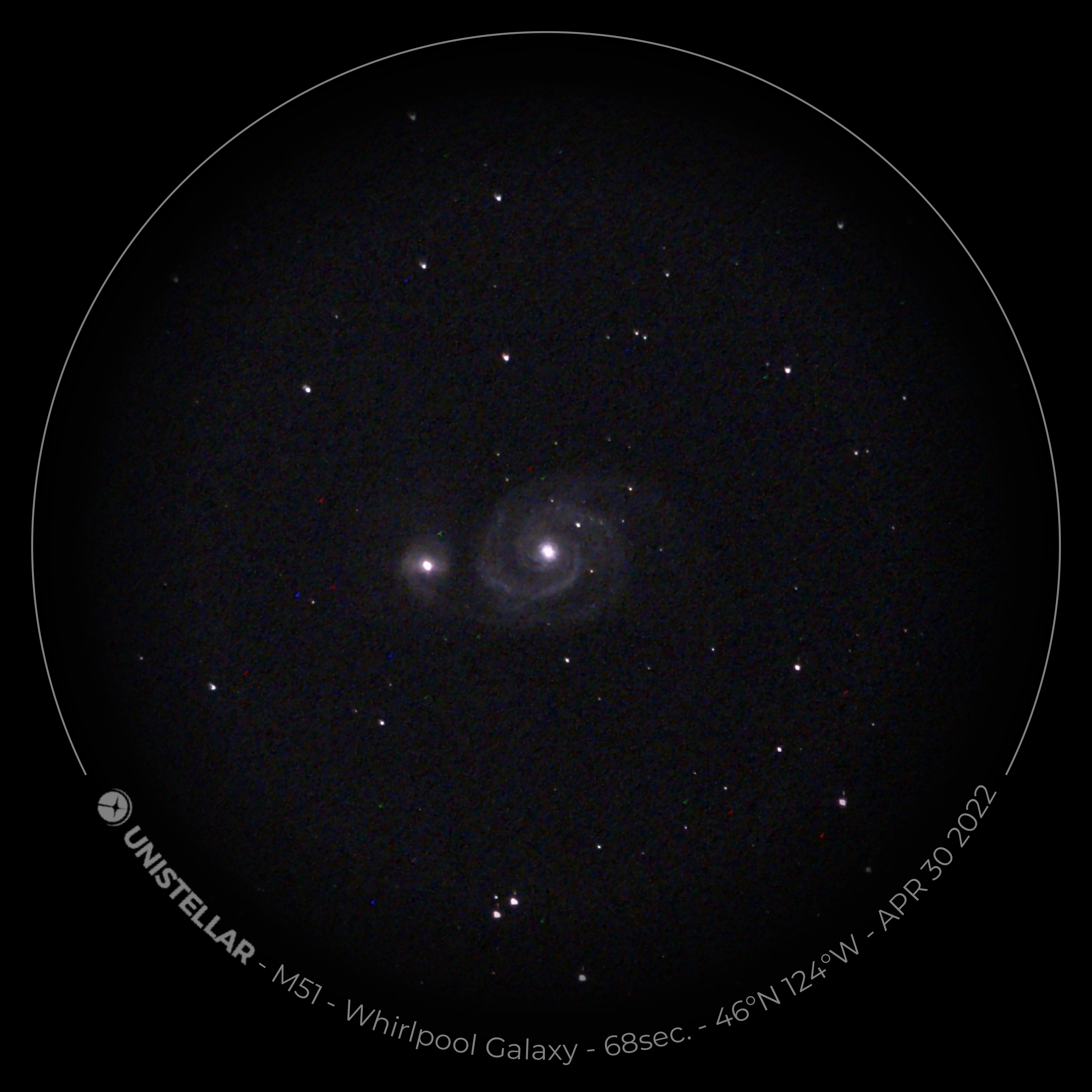
M51 – Whirlpool Galaxy
68s
2022-04-30
Other shots that I took on April 30th also had short dwell times – I think there were probably high clouds that disrupted the telescope’s ability to auto-track and stack the images.
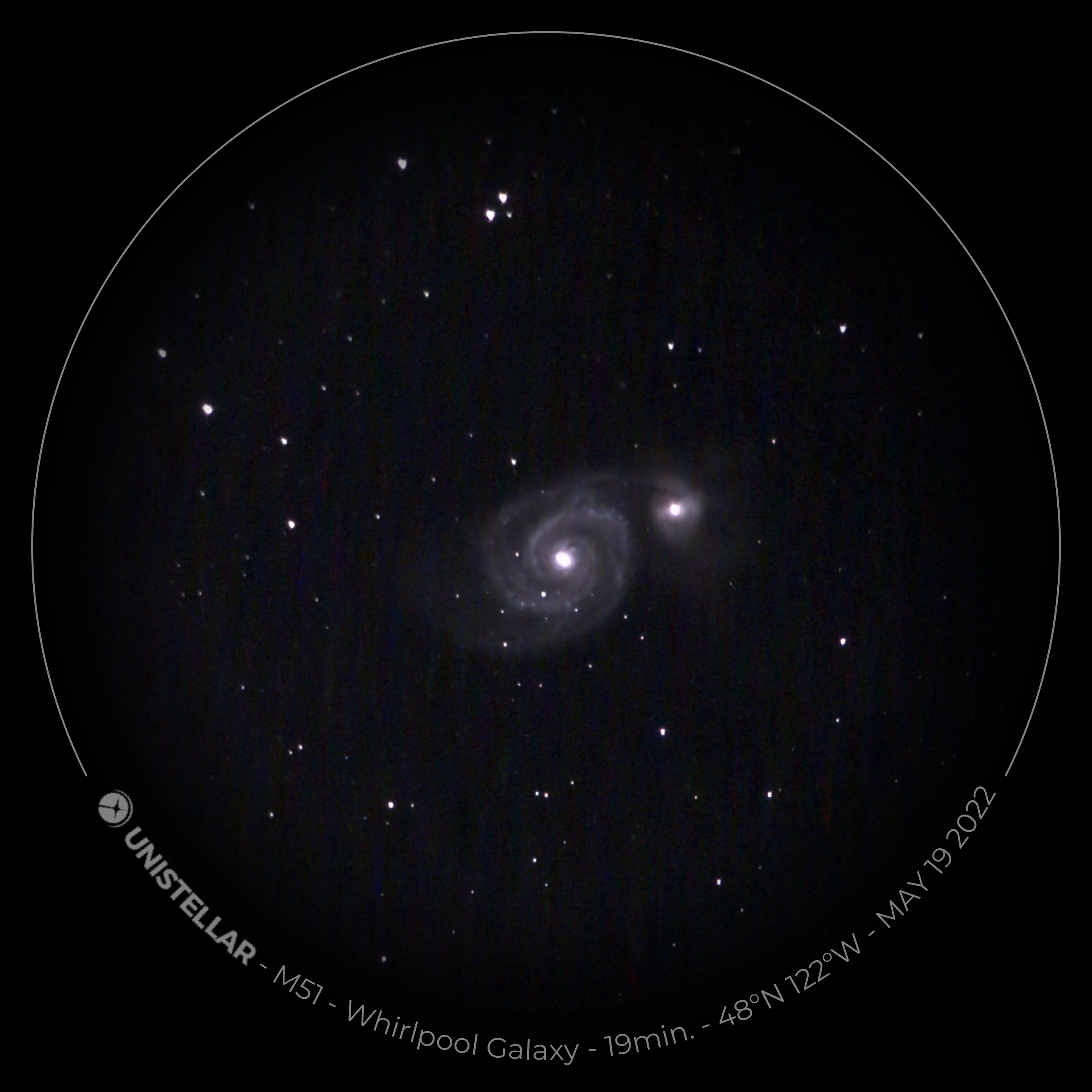
M51 – Whirlpool Galaxy
19m
2022-05-19
The Whirlpool Galaxy has long been one of my favorites with the eVscope, mostly because it can create pictures like this.
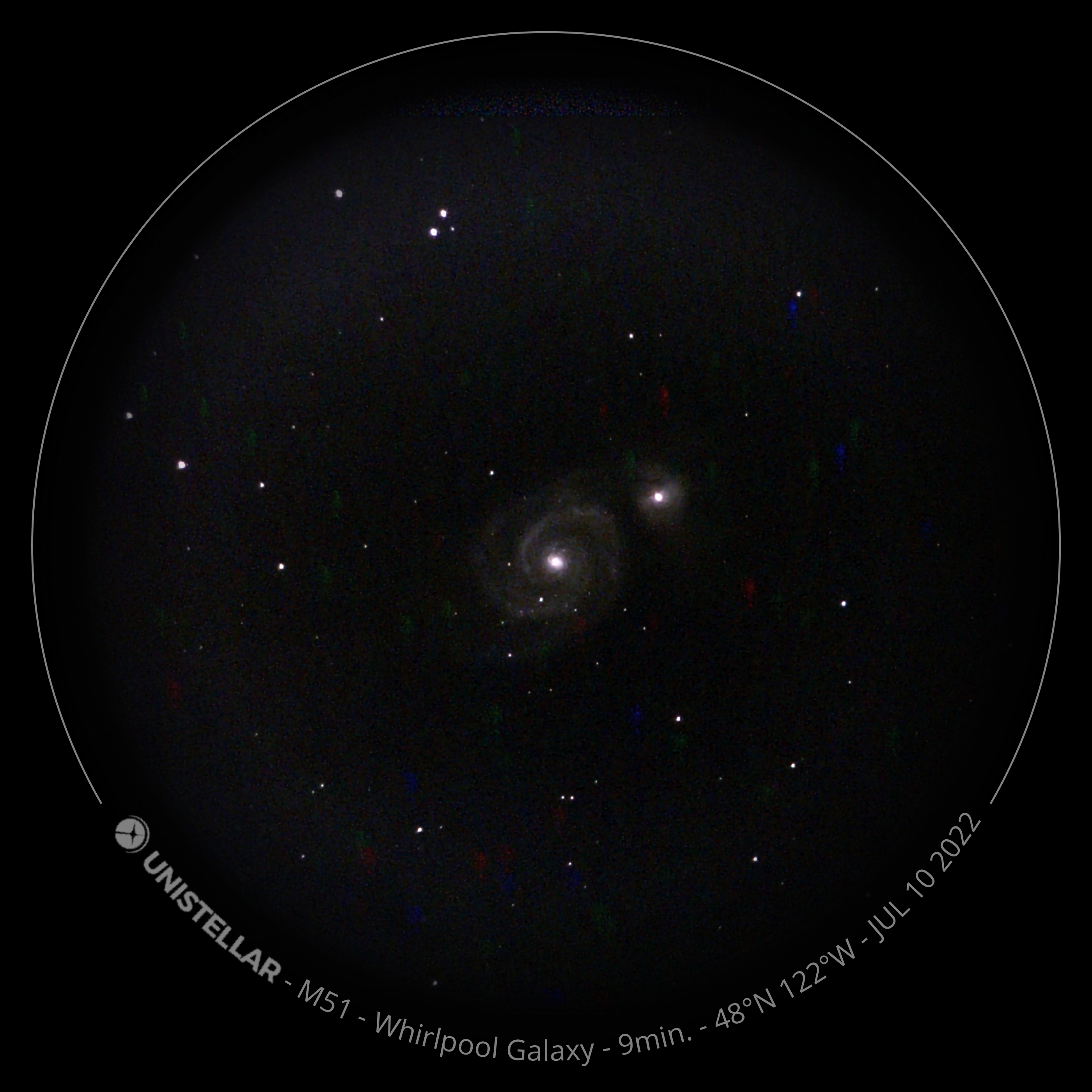
M51 – Whirlpool Galaxy
9m
2022-07-10
Shorter dwell times = less photons = weaker photos.
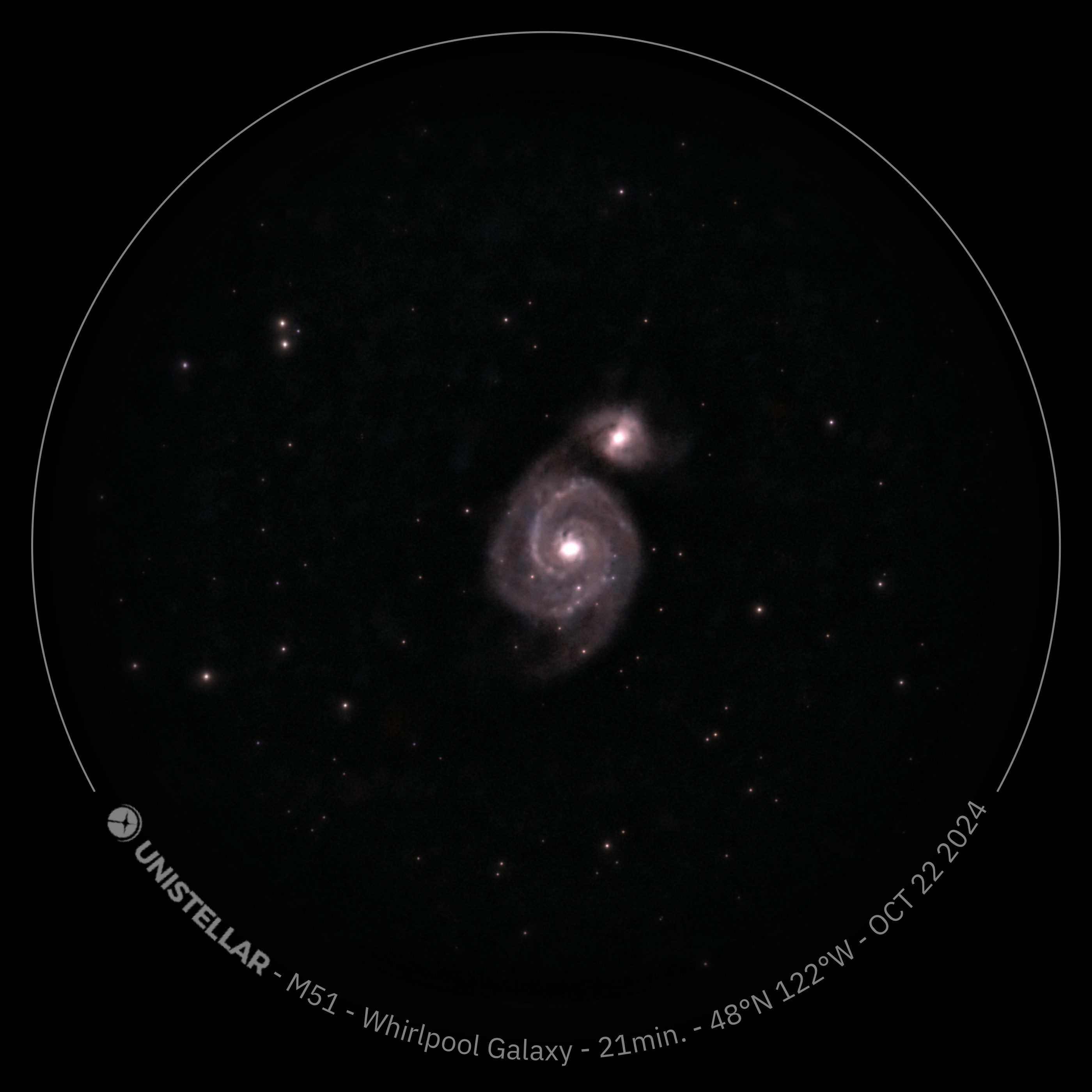
M51 – Whirlpool Galaxy
21m
2024-10-22
But long dwell times + new software = a lot more depth.
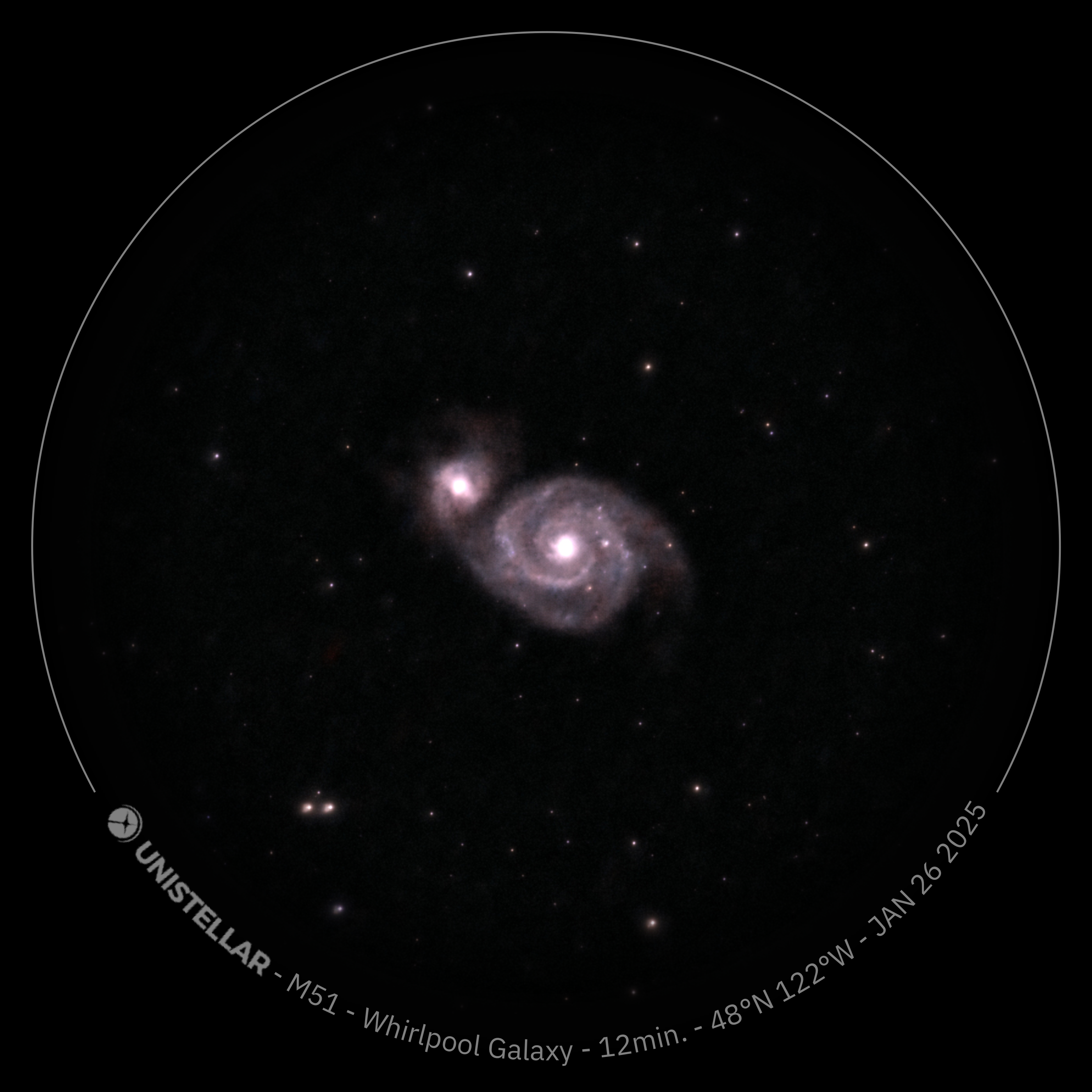
M51 – Whirlpool Galaxies
12m
2025-01-26
Another shot, and a pretty good one.
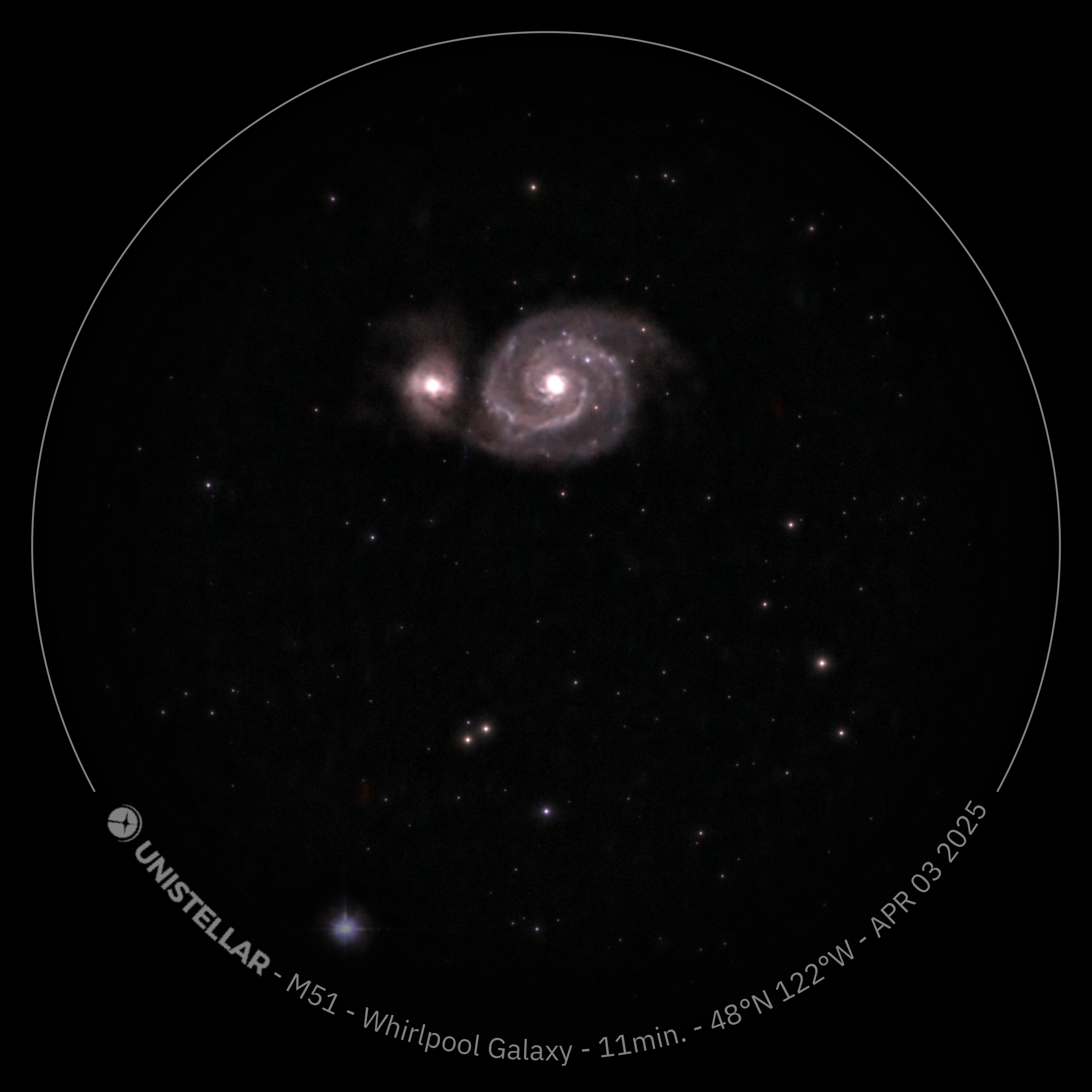
M51 – Whirlpool Galaxy
11m
2025-04-03
Of all the Whirlpools, I might like this one the best. Slightly off-center, with a bright star in the bottom-left that you usually don’t get in shots of this galaxy.
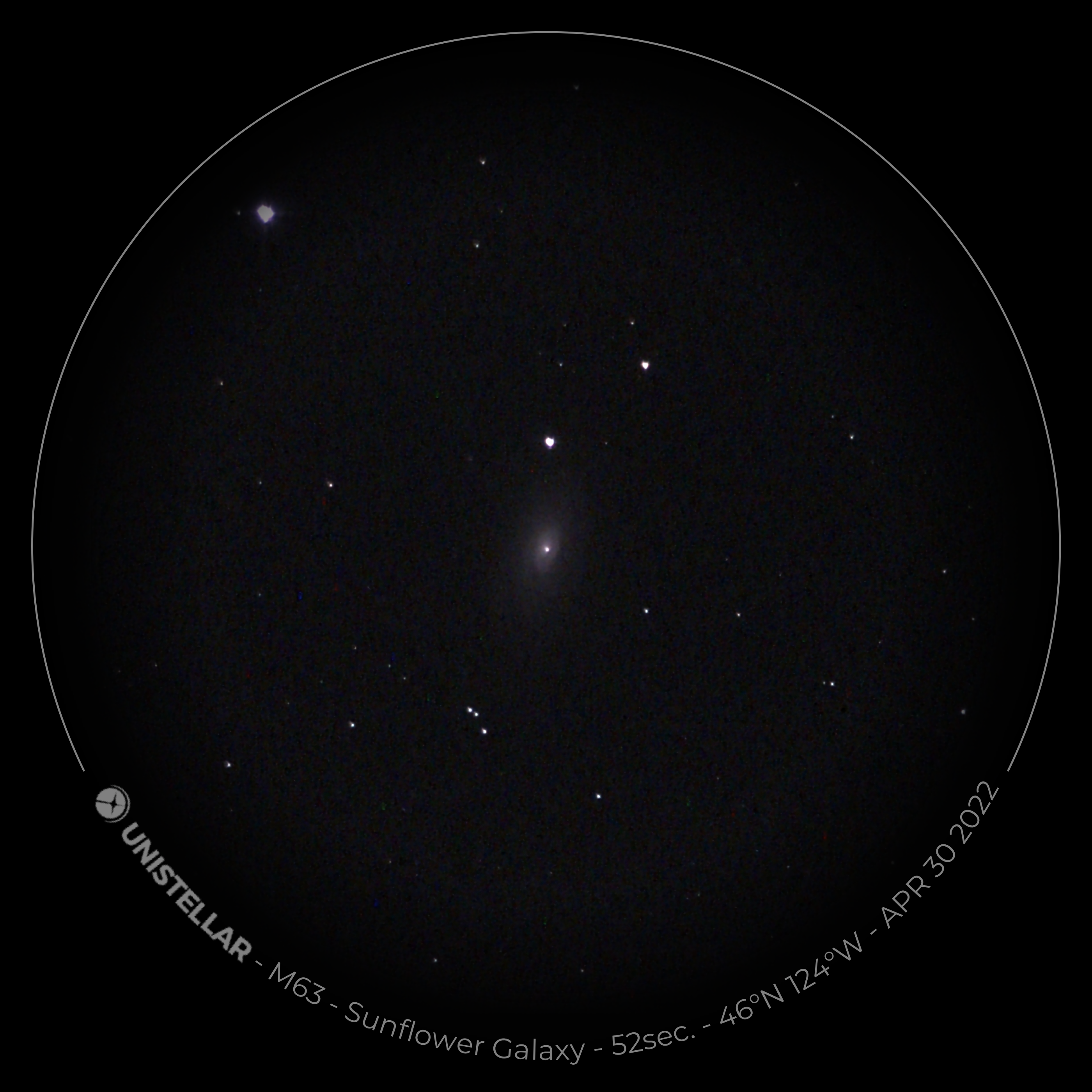
M63 – Sunflower Galaxy
52s
2022-04-30
Not very flowery, because not enough time on target. Probably a disrupted track.
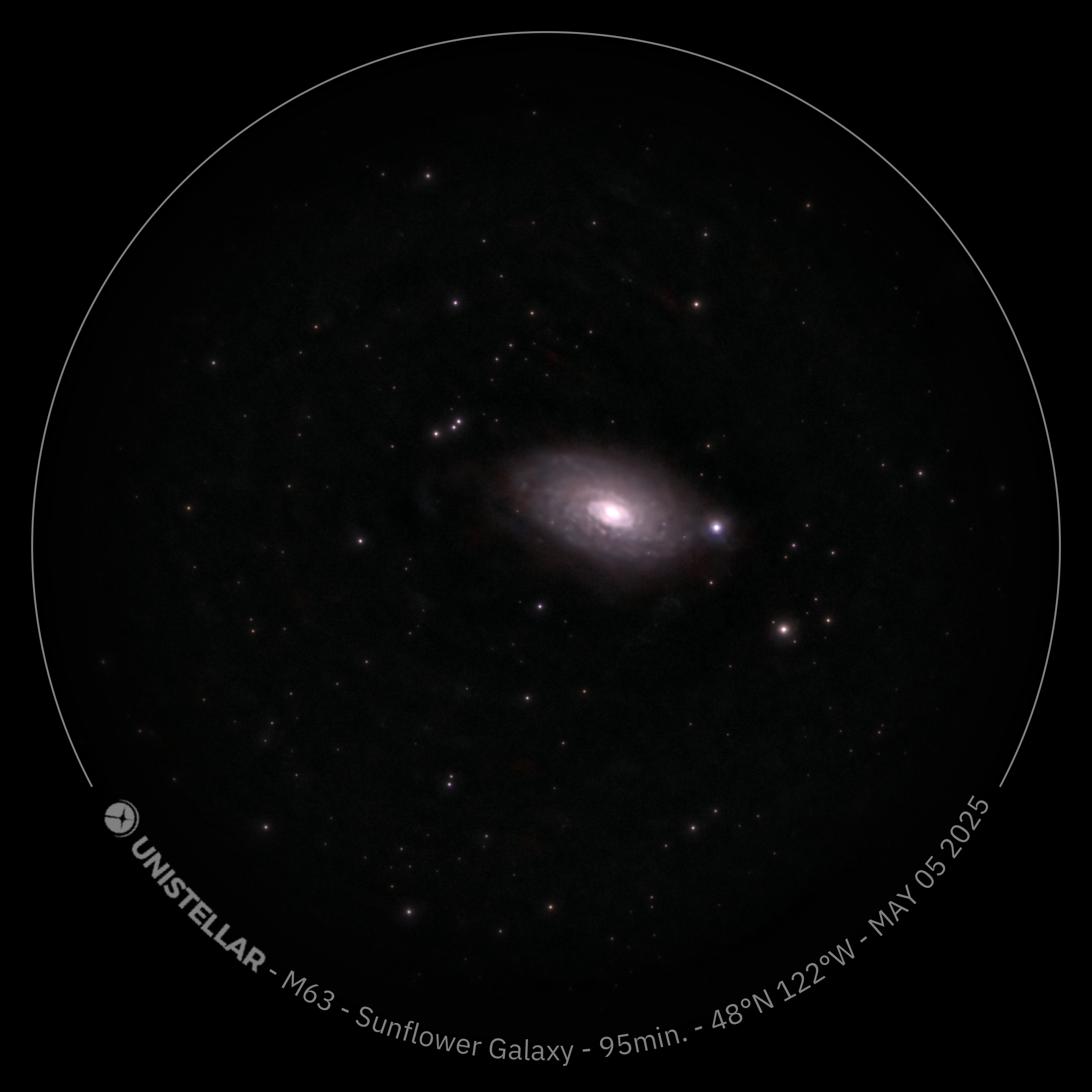
M63 – Sunflower Galaxy
95m
2025-05-05
Probably my longest shot, and boy, did it pay off. This is a beautiful shot, and you can clearly see the individual spirals. The color stretching and image sharpening really helped this image.
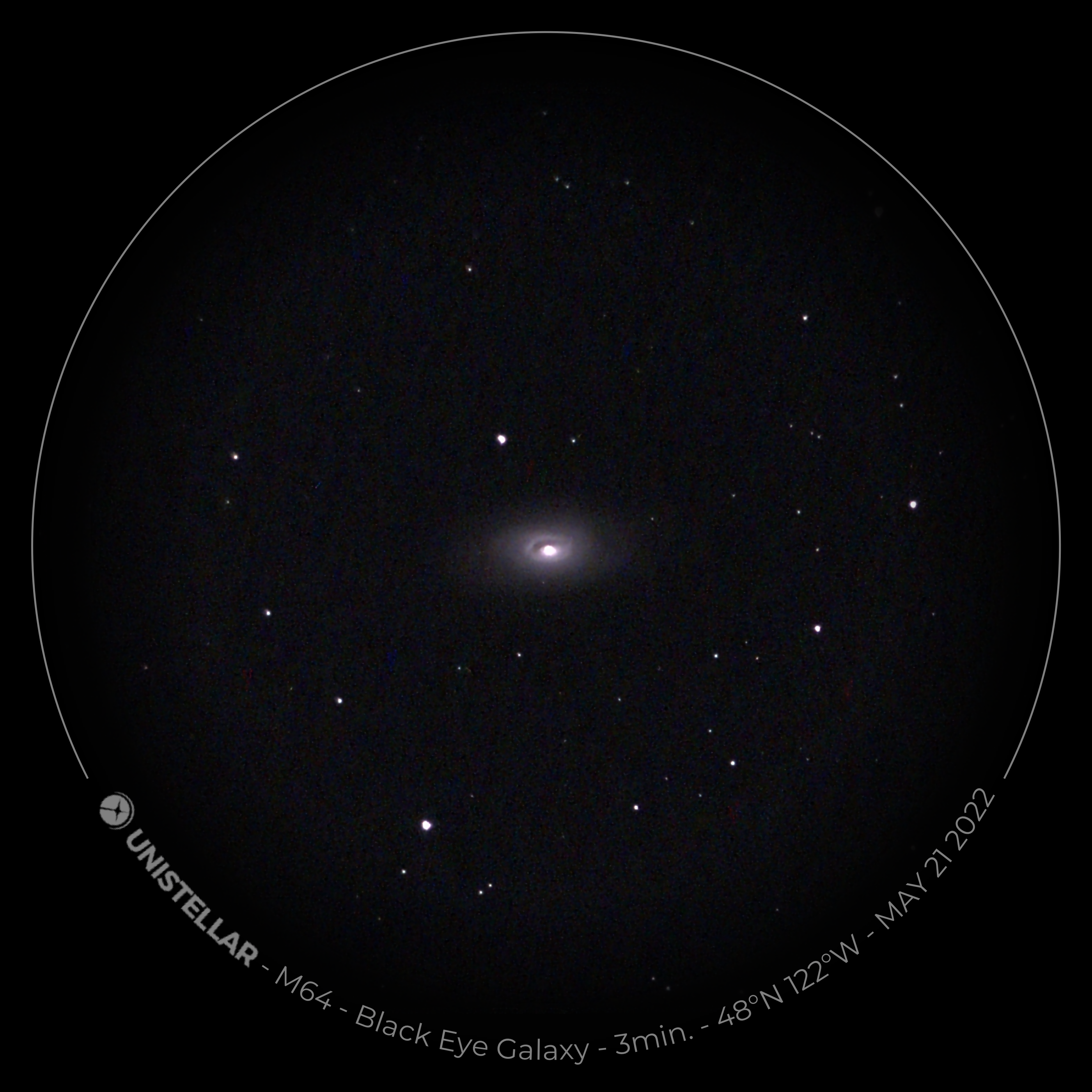
M64 – Black Eye Galaxy
3m
2022-05-21
This galaxy is interesting, due to the heavy dust cloud very close to the center of this galaxy. It obscures a lot of the light, giving it its distinctive appearance (and name).
M64 – Black Eye Galaxy
72s
2024-07-20
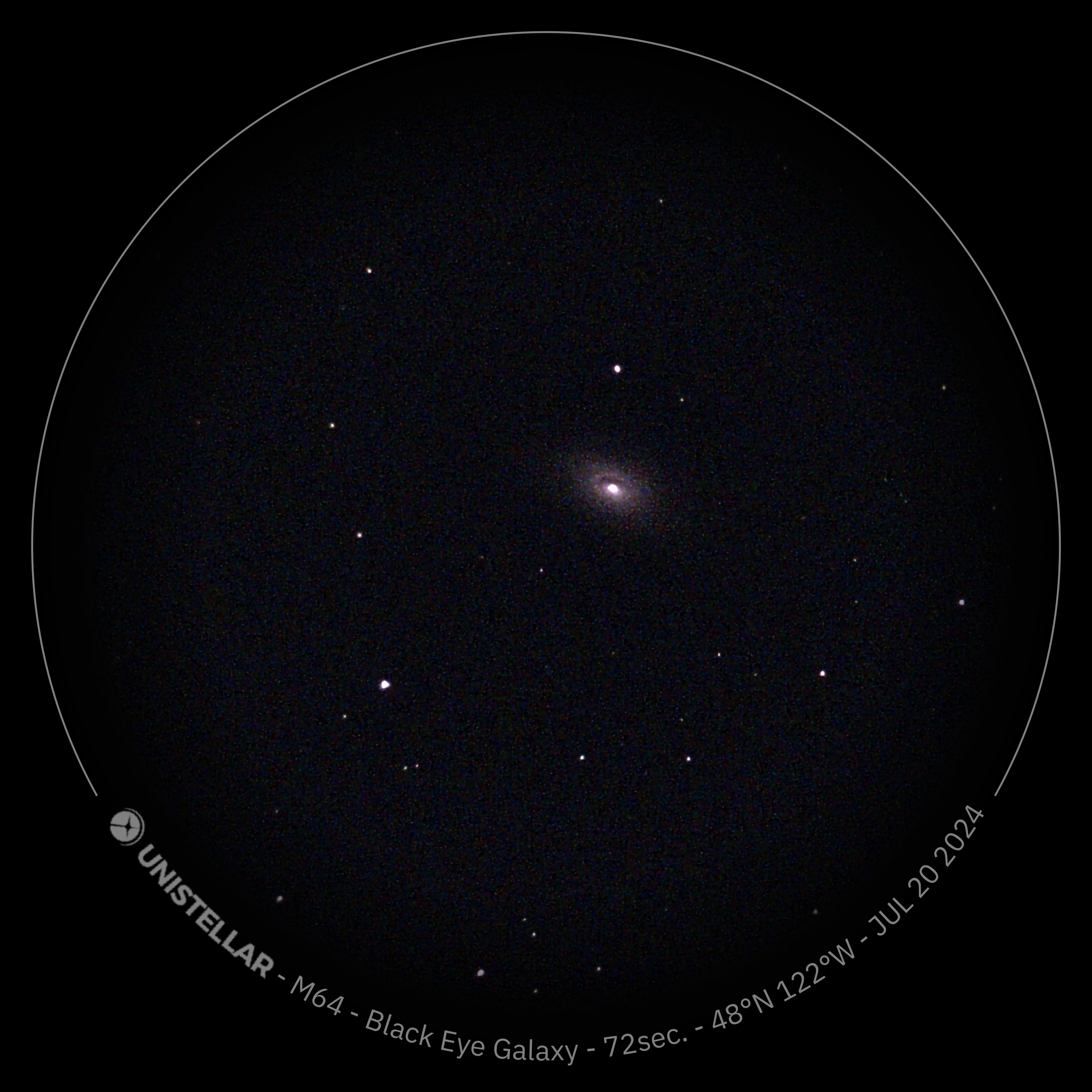
Both of my shots of the Black Eye Galaxy are too short. I need to go back.
M64 – Black Eye Galaxy
17m
2025-06-08
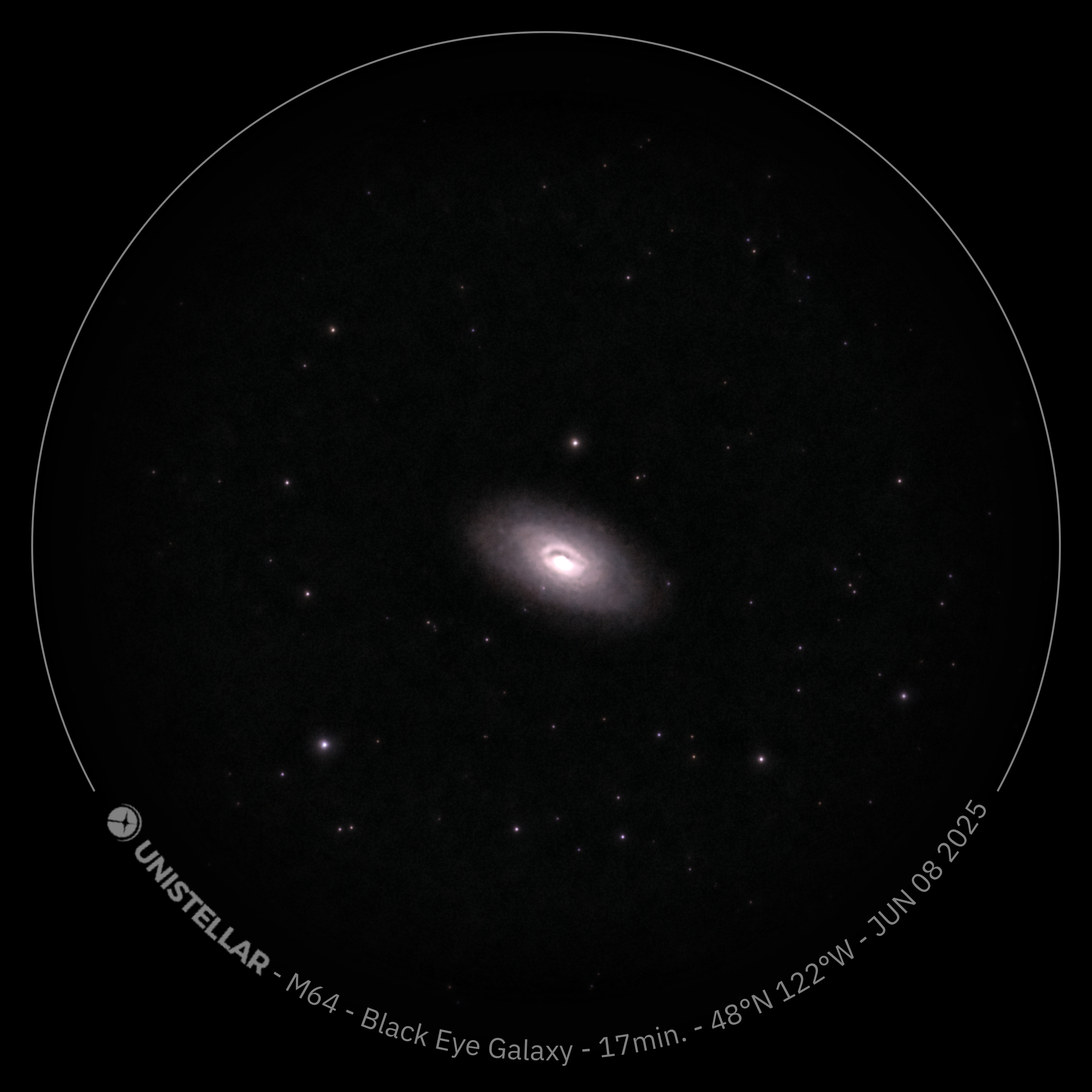
This was my 2nd attempt of the night; the first one lost tracking at under 2 minutes (I’m not going to bother uploading it), and this one failed at 17 minutes, so I called it a night & packed up. Not as long as I really want, but a longer dwell time still produced a very nice image.
M65
60s
2025-05-29
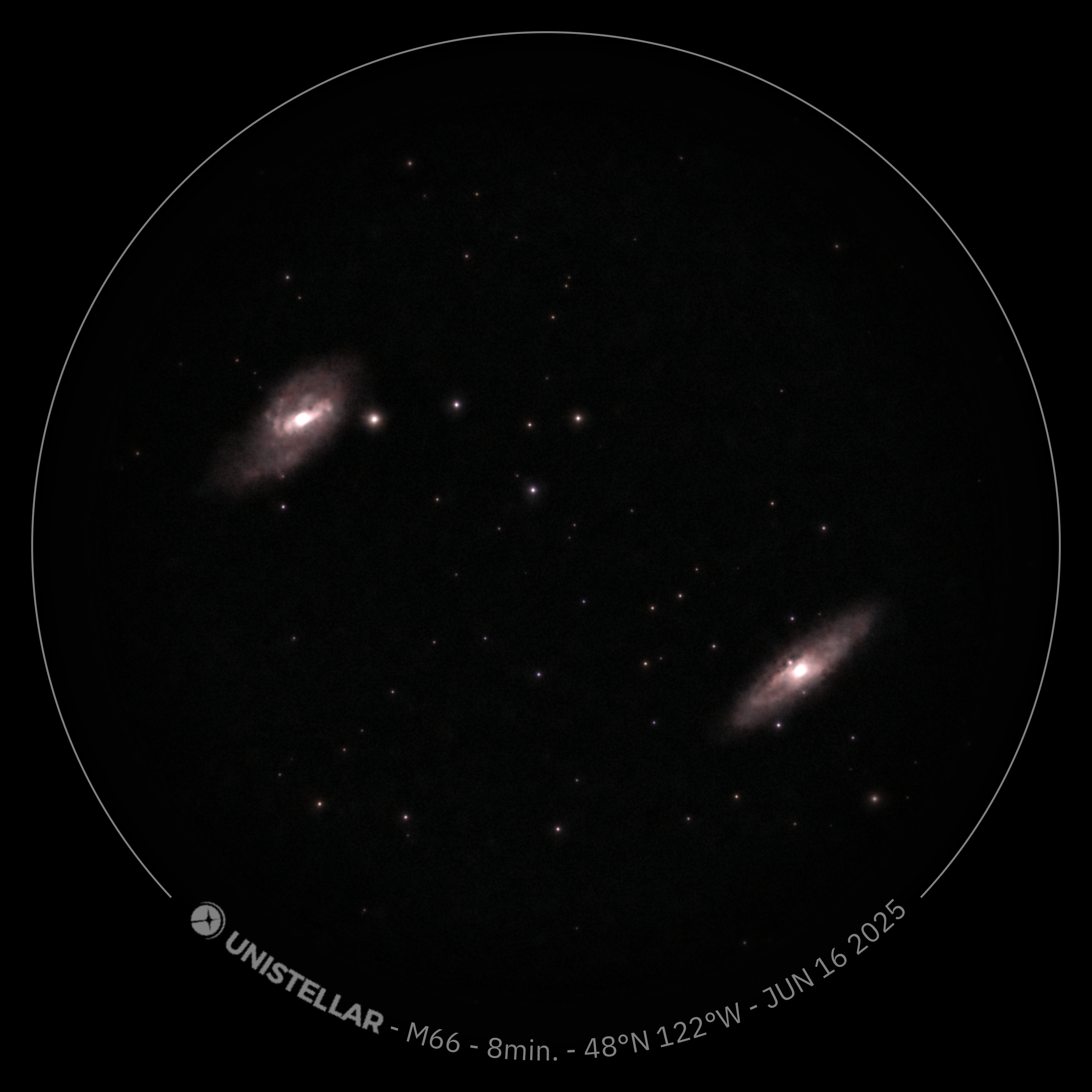
Several of my shots on May 29th appear to have aborted after only a minute or two, which happens if there are high clouds. This could probably use a re-visit.

M65 and M66
8m
2025-06-16
These are two of the three in the Leo Triplet, which also includes NGC 3628. Not a great night; I took 6 shots and all but one got interrupted due to high clouds. This was one that got interrupted. NGC 3628 remains the best of these three.
M66
60s
2025-05-29
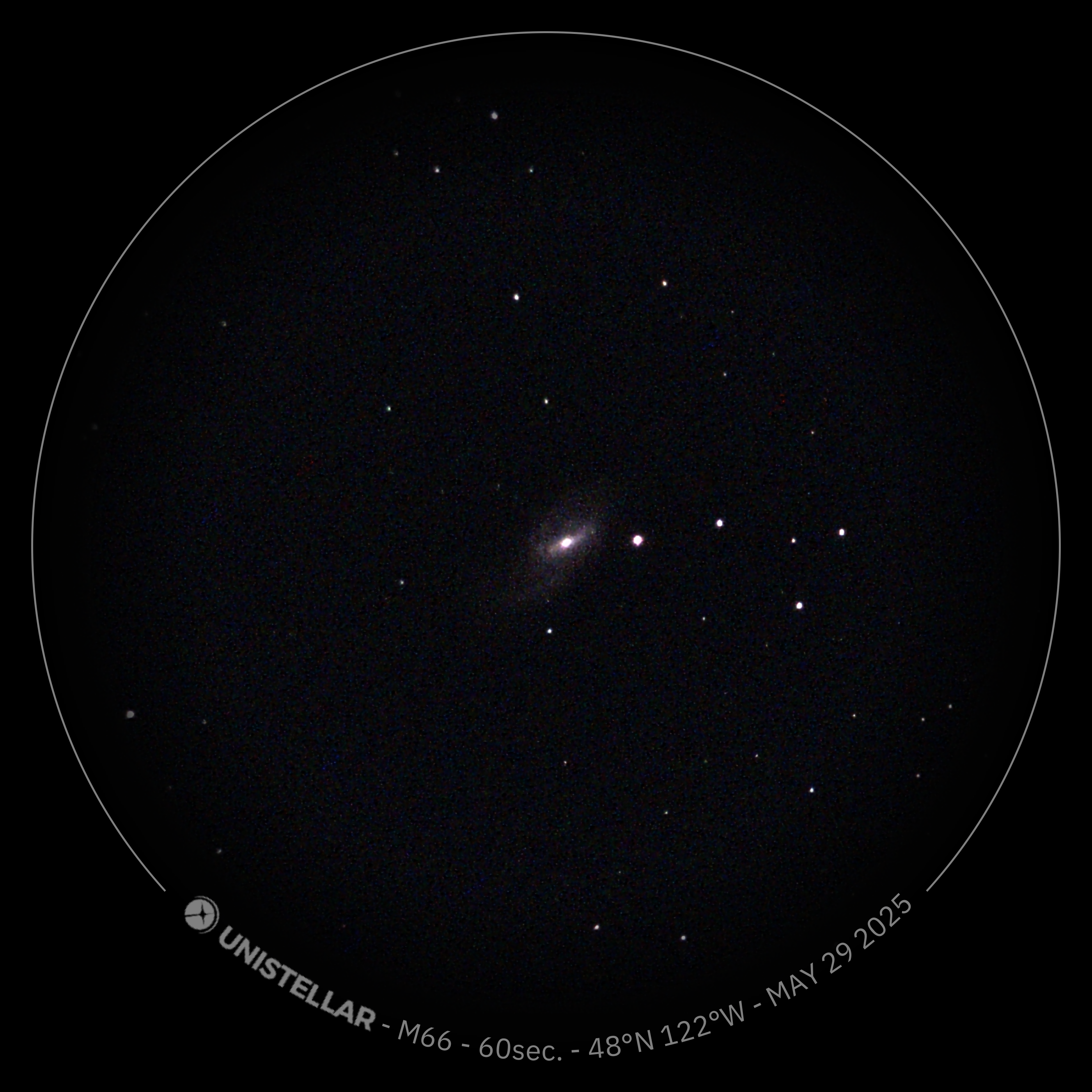
This was probably a failed track, since you can’t see much after only 60 seconds. I’ll hopefully visit it again soon.
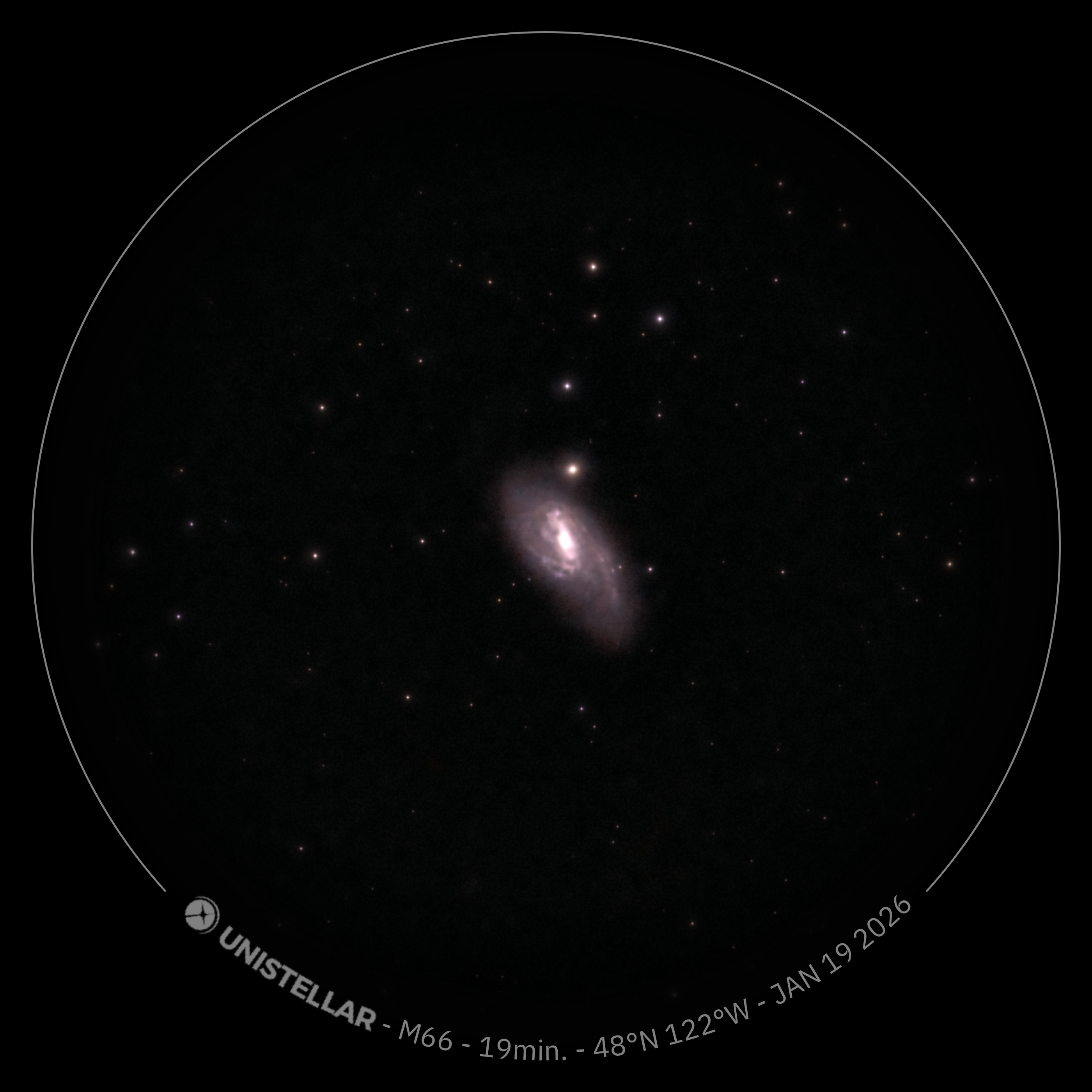
M66
19m
2026-01-18
The last photo I took that night (after midnight, hence the Jan 19 timestamp). I like this galaxy, an off-balance spiral that comes through reasonably well on the eVscope.
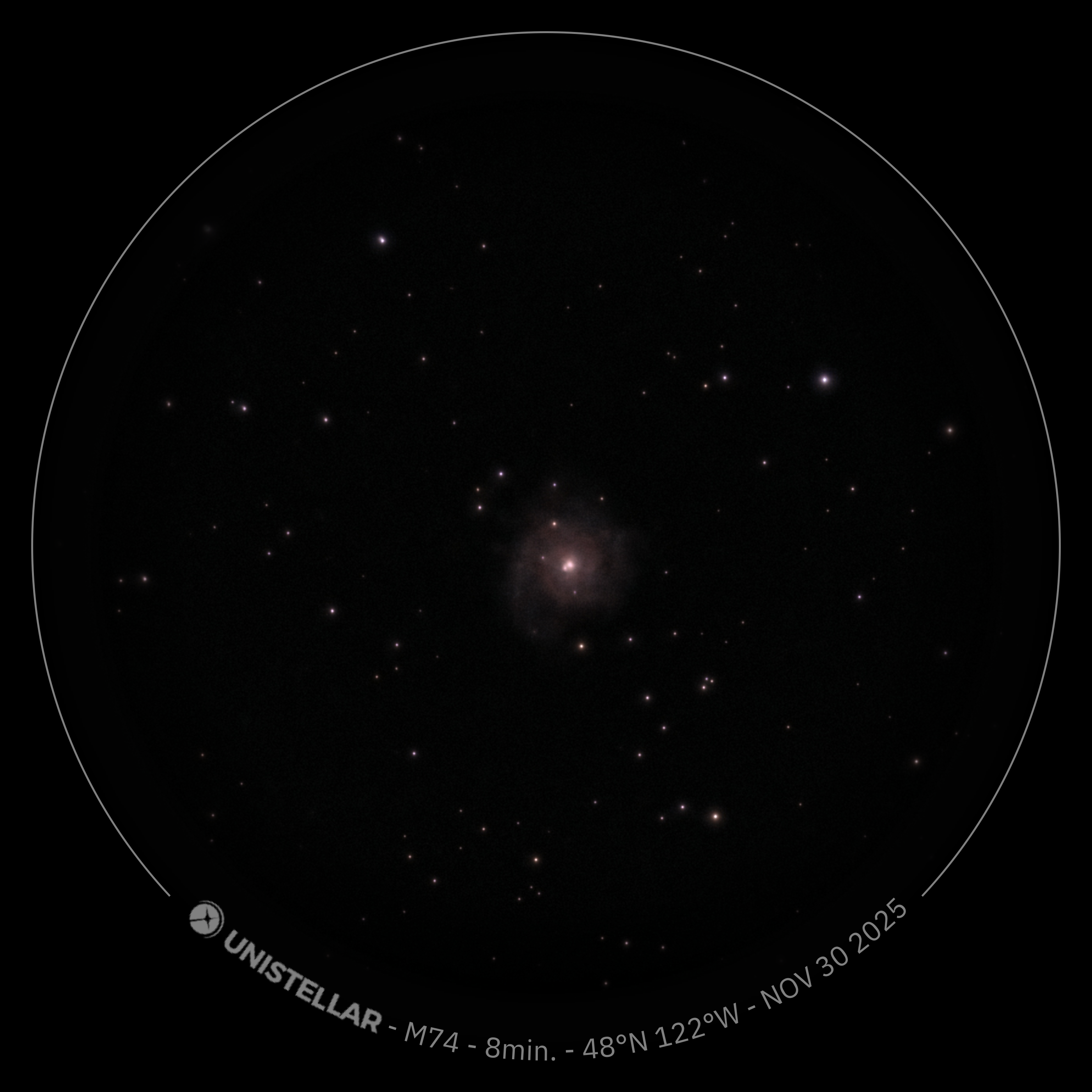
M74
8m
2025-11-30
I only was able to get 8 minutes on this small galaxy, but it’s nice, given the dwell time. It’s one of the dimmest Messier objects that you can capture with the eVscope.
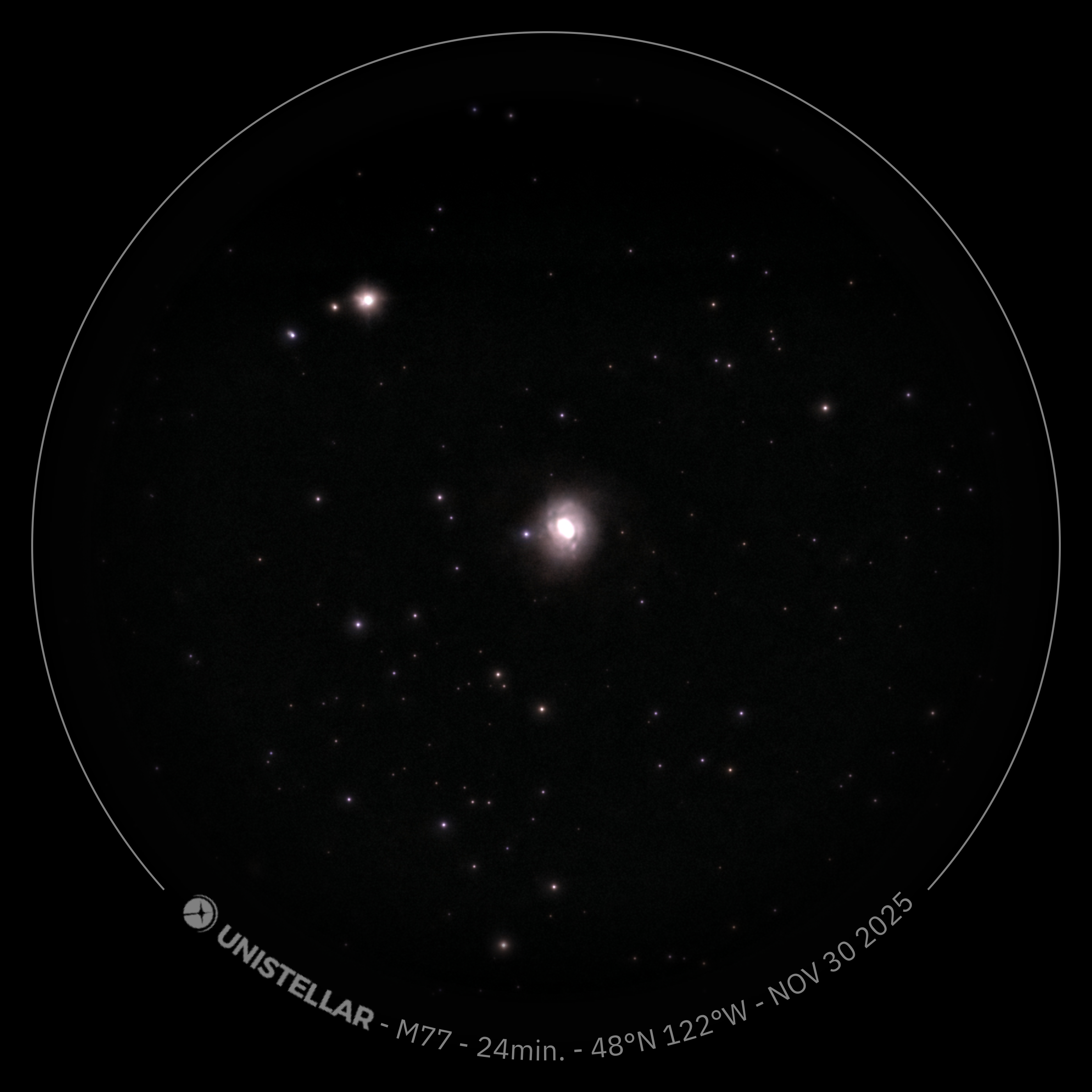
M77
24m
2025-11-30
A compact spiral galaxy, not great for the eVscope, but still, a nice little blob with a very bright center. I think the fact that I’m in a city means I lose the subtle spirals, and so I’m only really getting a good image of the center of the galaxy.
M81 – Bode’s Galaxy
3m
2022-05-20
Bode’s has a very bright center but dim arms, so 3 minutes isn’t enough time to get any detail.

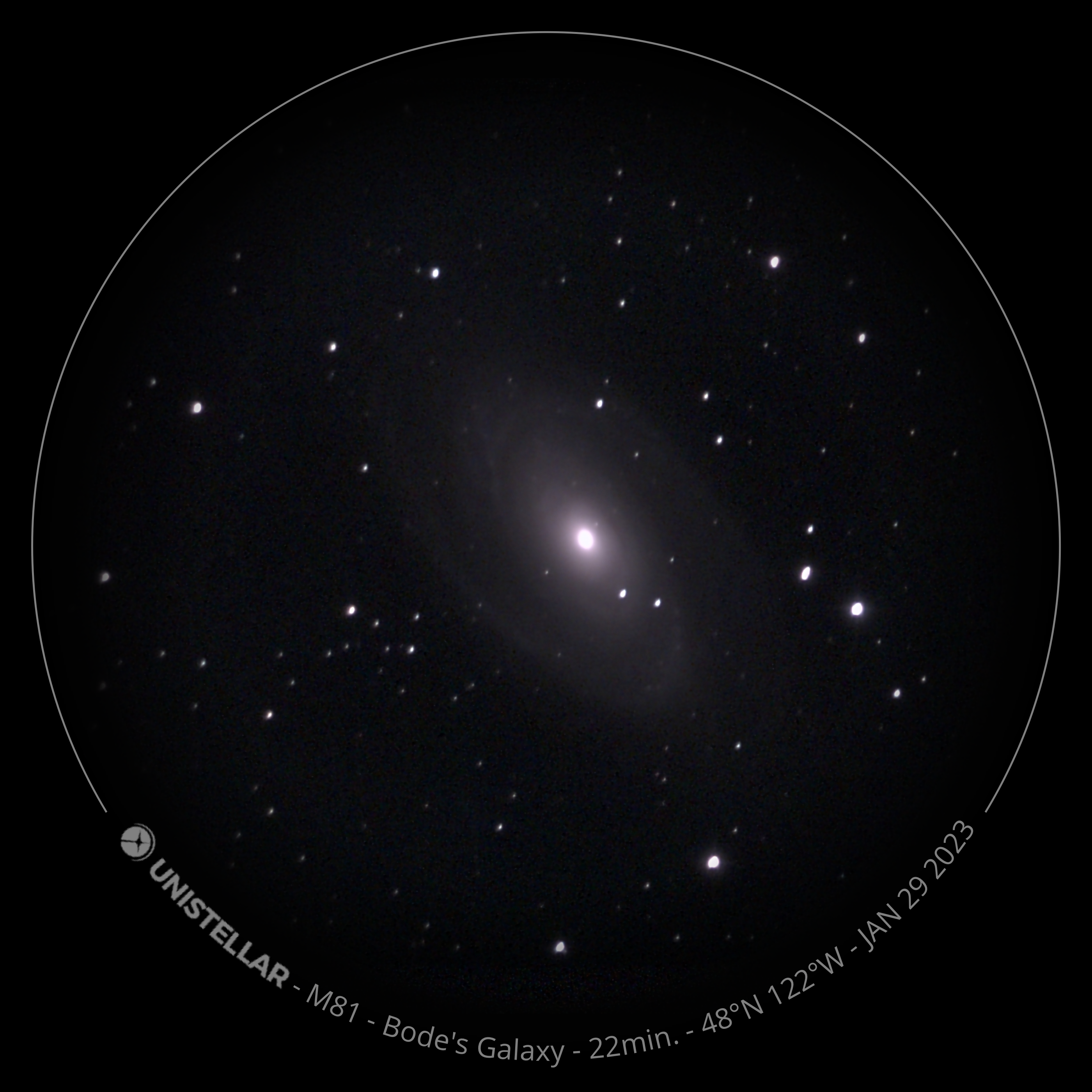
M81 – Bode’s Galaxy
22m
2023-01-29
Bode’s Galaxy is one that I think really benefited from the software update to sharpen and color-stretch the images. Before the update, you could get images like this with long dwell times – nice, but not amazing.
M81 – Bode’s Galaxy
18m
2024-10-06
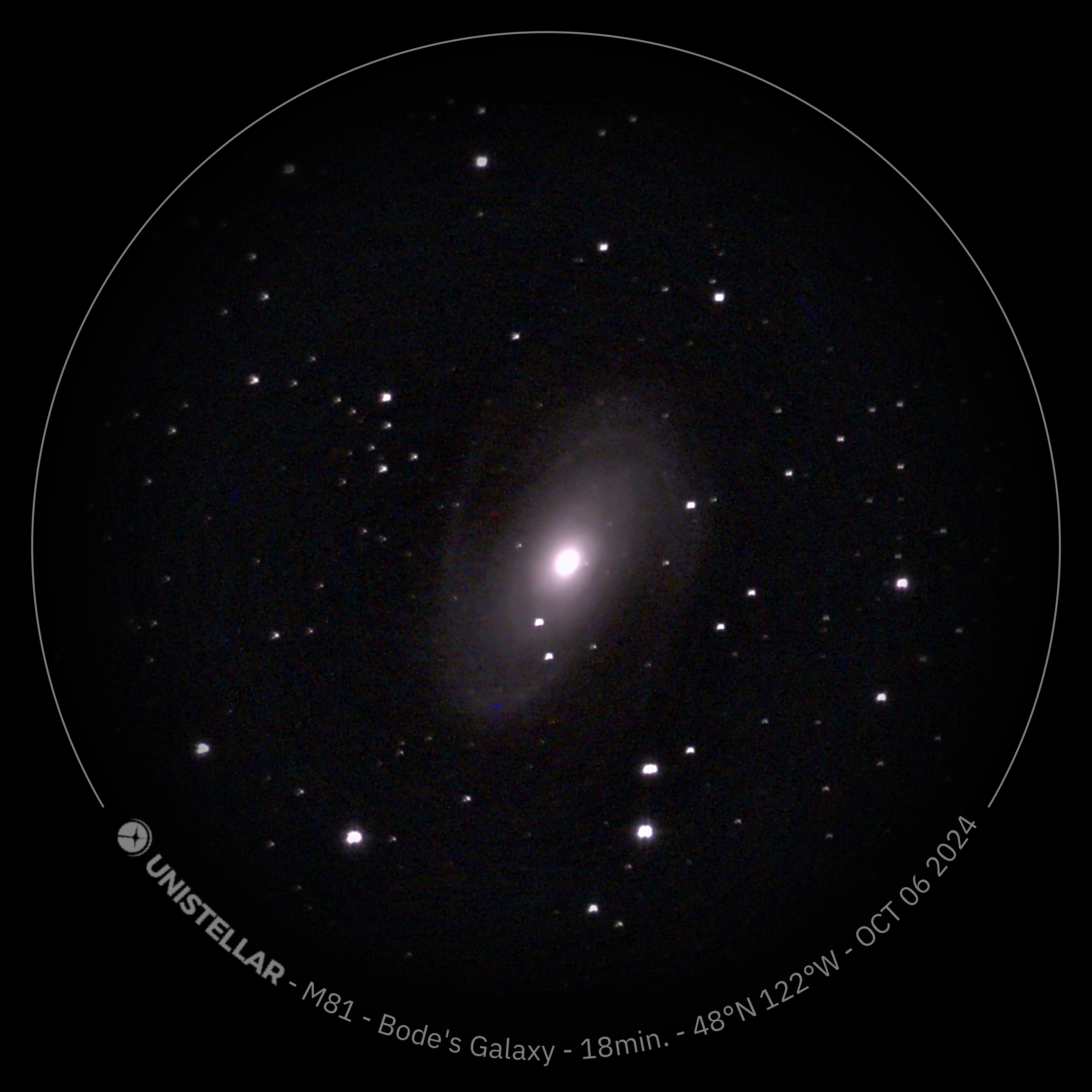
I think this was shortly before the new software update, so it doesn’t have the same color stretching and sharpness enhancements of later shots.
M81 – Bode’s Galaxy
22m
2025-01-19
Waaaay better. But while this is a great shot, the next one is the best.

M81 – Bode’s Galaxy
20m
2025-05-02
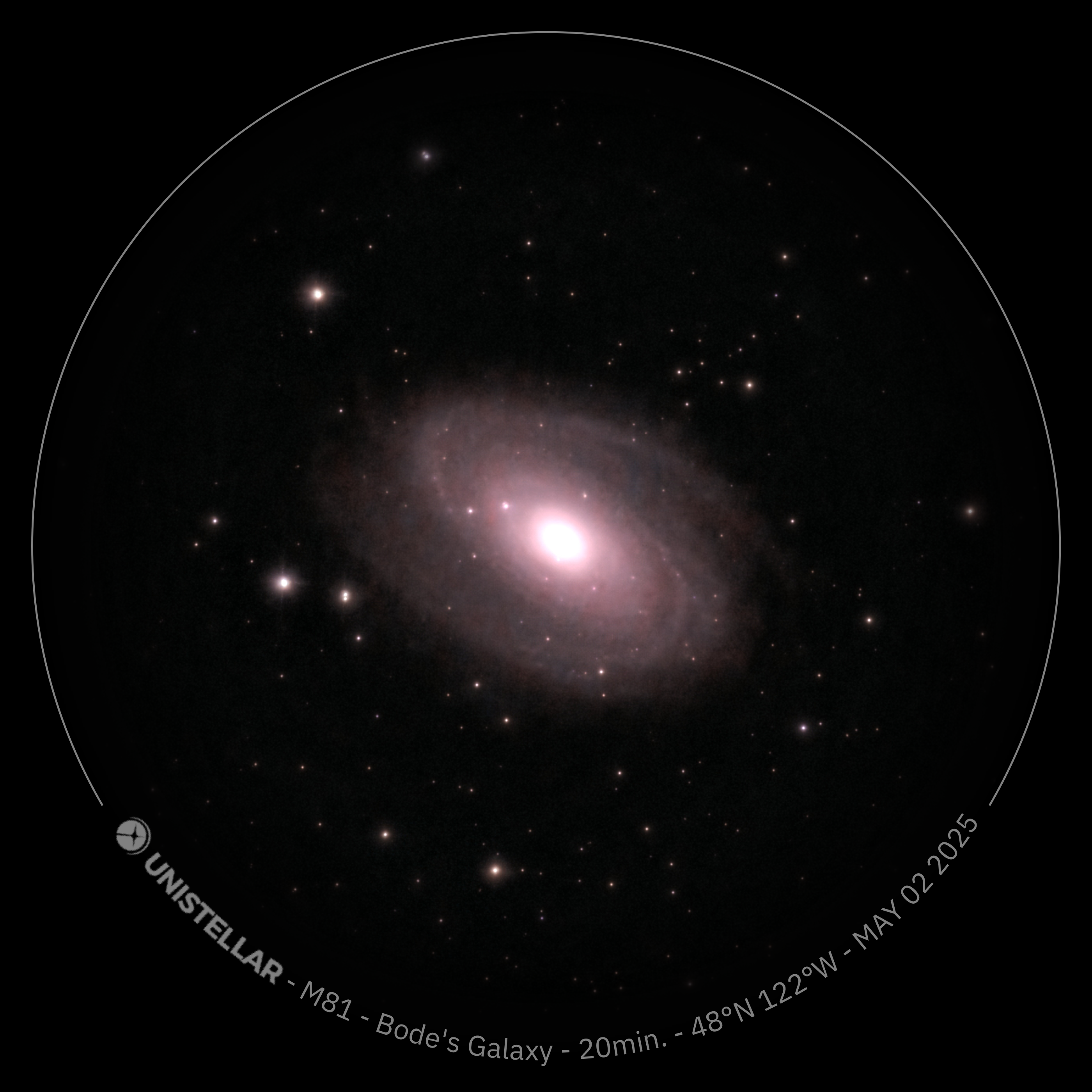
With the color-stretching software, Bode’s Galaxy almost jumps out at you. Probably one of my favorite pictures.
M82 – Cigar Galaxy
12s
2022-04-22
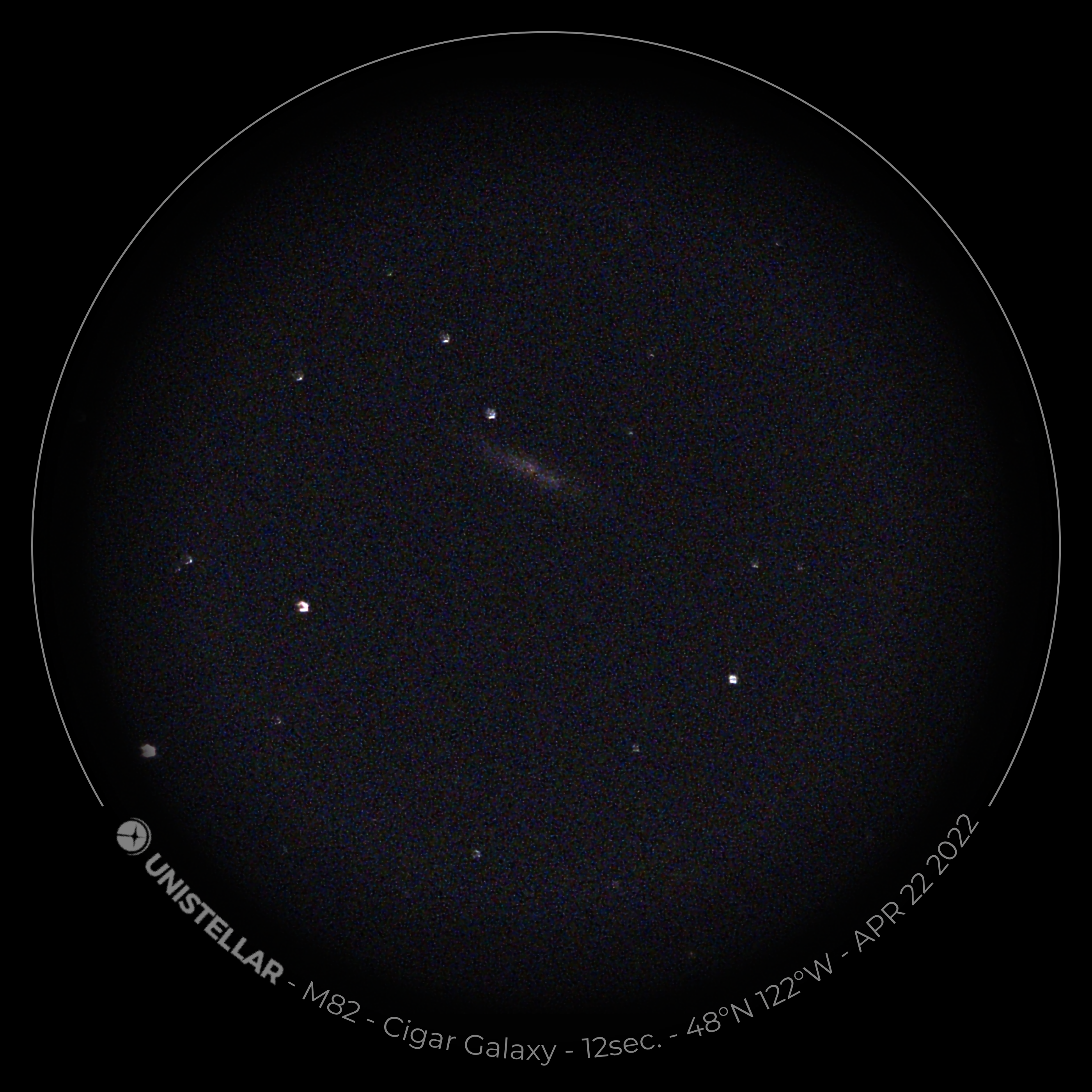
This may be the first image of a deep sky object on the telescope. I wanted to test and see what would work, and was blown away by what I could quickly and easily see.
M82 – Cigar Galaxy
33m
2022-04-22
After the first, short picture, this was my first long-dwell image with the telescope. I was super excited to watch it develop. Seeing all the stuff I’ve captured since, this one’s pretty weak. But for a first-ever deep-sky object? I was over the moon.

M82 – Cigar Galaxy
4m
2023-01-29
The Cigar Galaxy is one that looks significantly better online than from an eVscope. I wonder if the red colors in the center that you see online are actually outside the visible spectrum? Not sure. The eVscope doesn’t seem to pick them up, though, even after the software update.

M82 – Cigar Galaxy
14m
2024-10-22
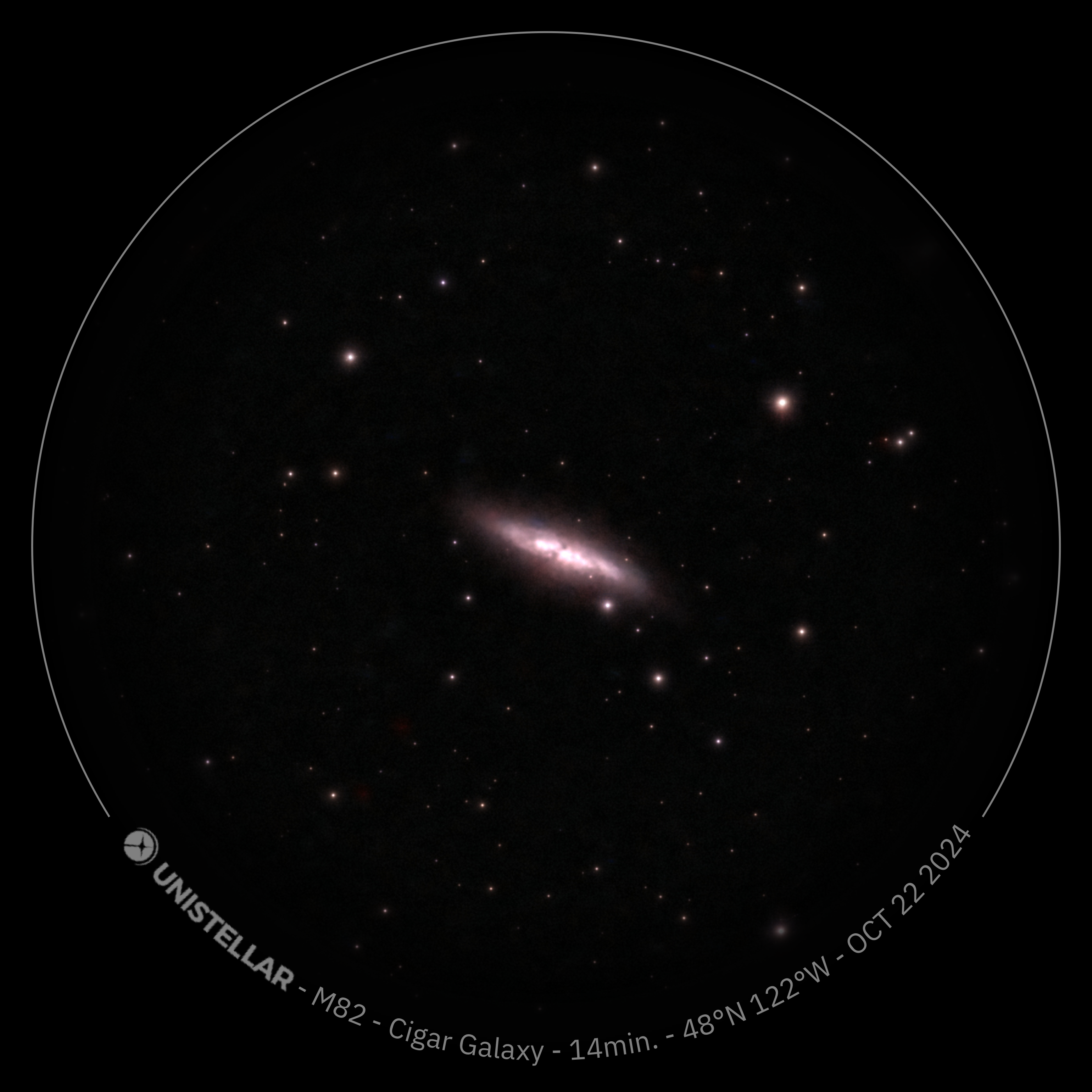
I wanted to try the Cigar Galaxy with the new software. Not bad!
M82 – Cigar Galaxy
14m
2025-01-19
Since the Cigar Galaxy was my first, I keep coming back to it. It’s definitely better, but I still don’t really see any pink-red stuff near the center.
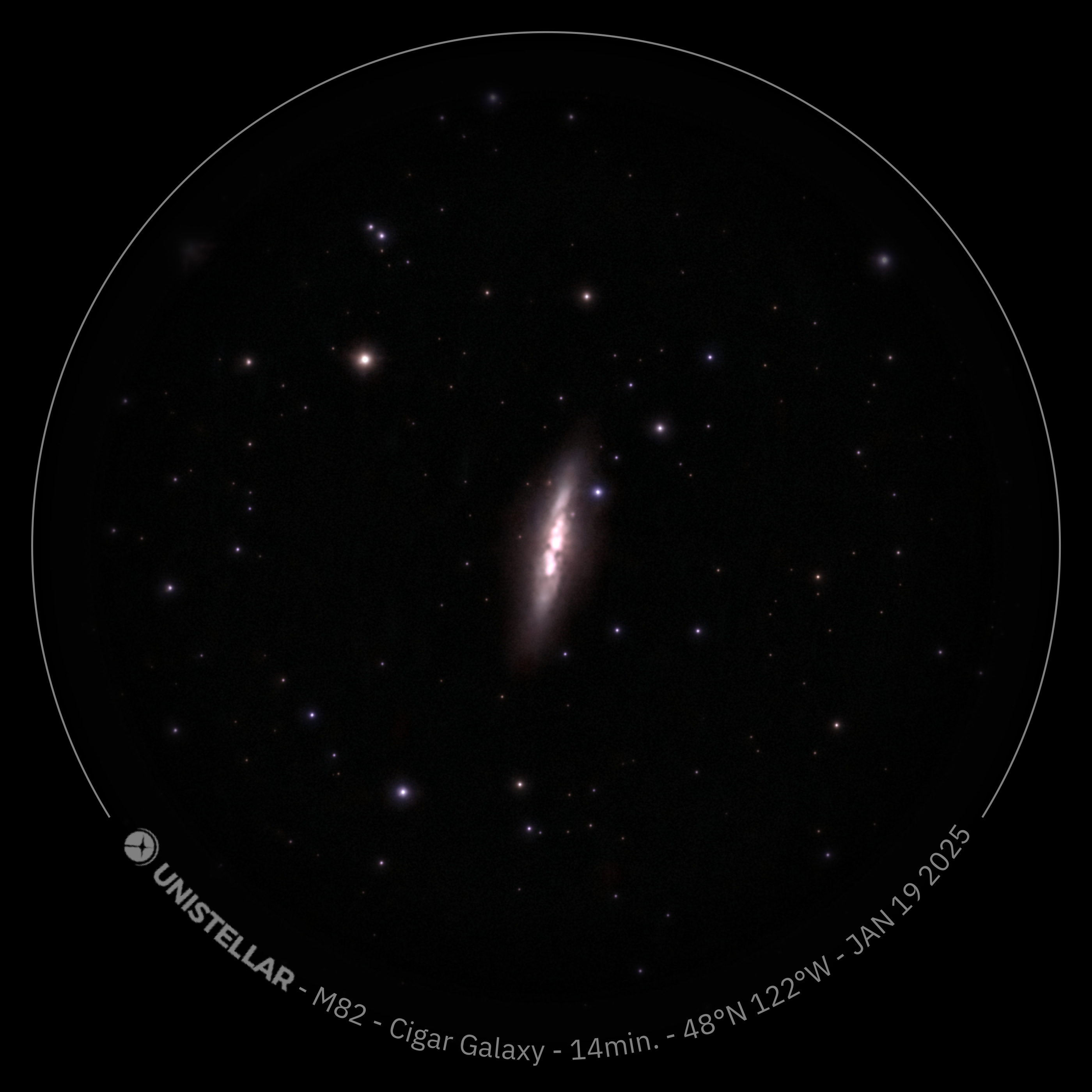
M94 – Cat’s Eye Galaxy
27m
2025-06-09
M94 is sometimes known as the Cat’s Eye Galaxy or the Croc’s Eye Galaxy, but it’s just M94 in the Unistellar catalog. I think this is one that could really benefit from a very dark night, from a high elevation, with no humidity. I was 0 for 3 last night, but still got a relatively nice image.
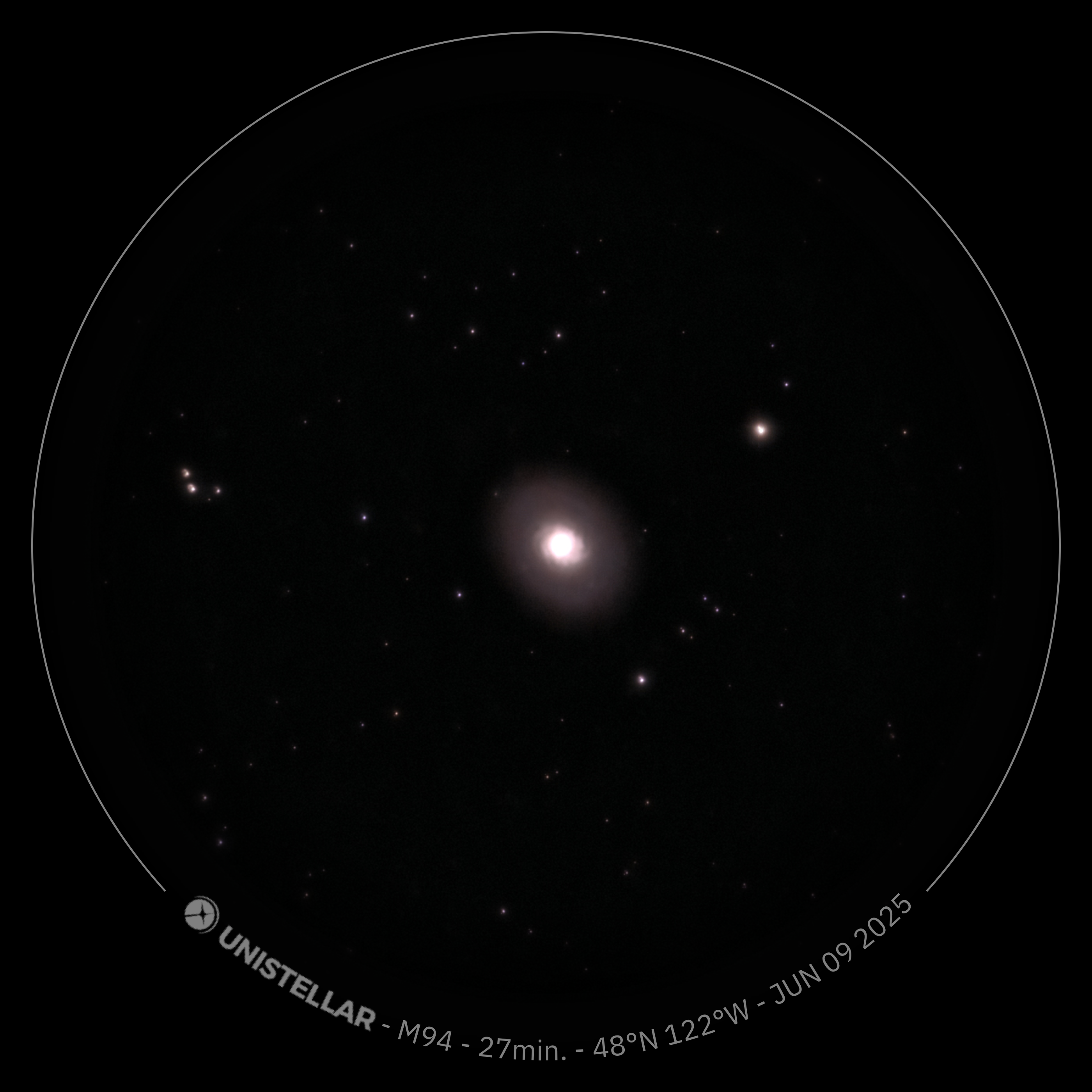
M98
14m
2025-06-09
Not a bad little spiral galaxy. The relatively short dwell time, high clouds, and three-quarters moon created a pretty poorly resolved image. Probably worth a re-visit.
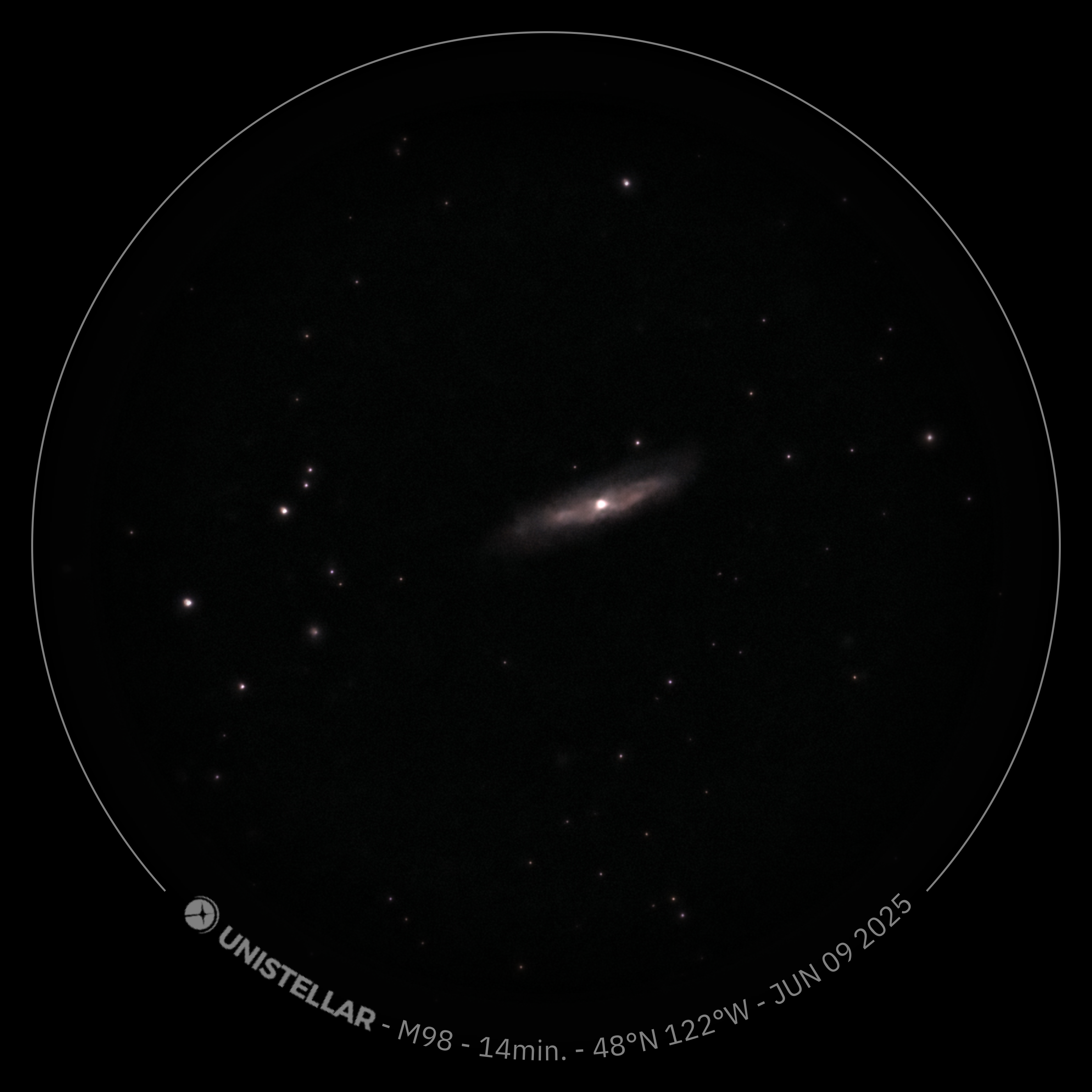
M100
10m
2025-01-20
A clearer, brighter image. Yay smart software!
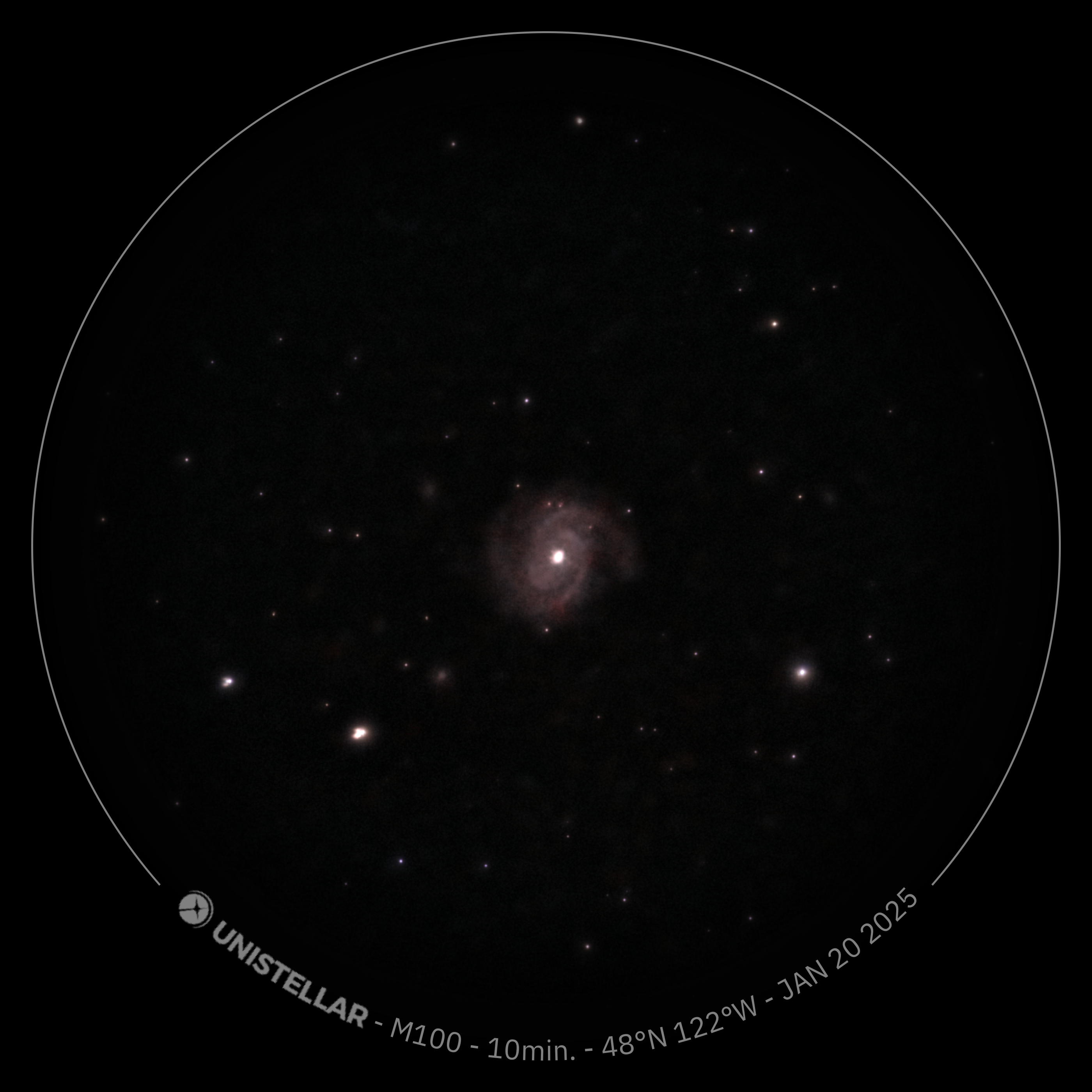
M100
18m
2025-05-01
A very nice picture of a small-ish galaxy. It was a pretty good night, that night.
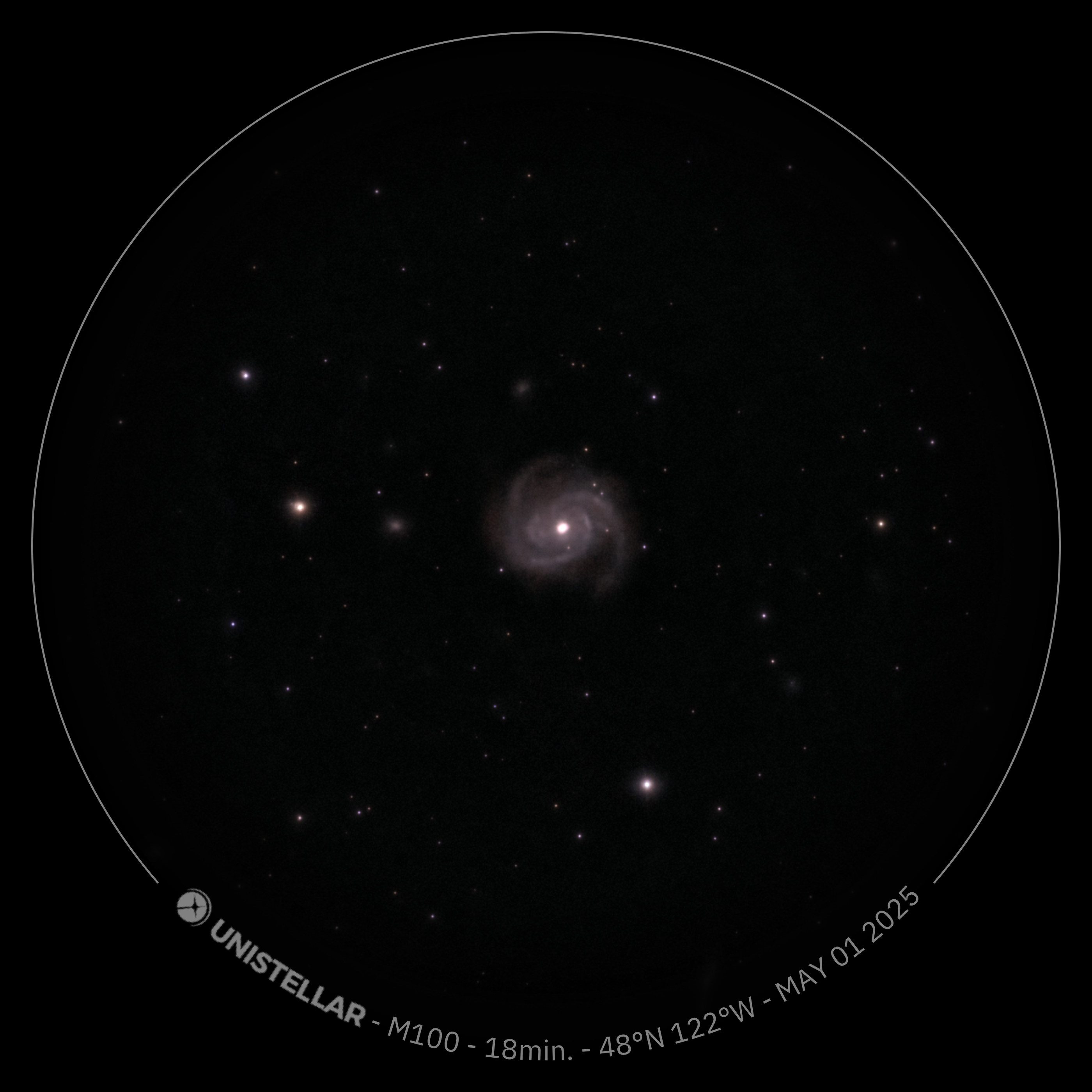
M100
24m
2025-06-02
M100 is small relative to many other visible galaxies, close to the edge of what the eVscope can usefully resolve. I think I had the augmented processing off for this image.
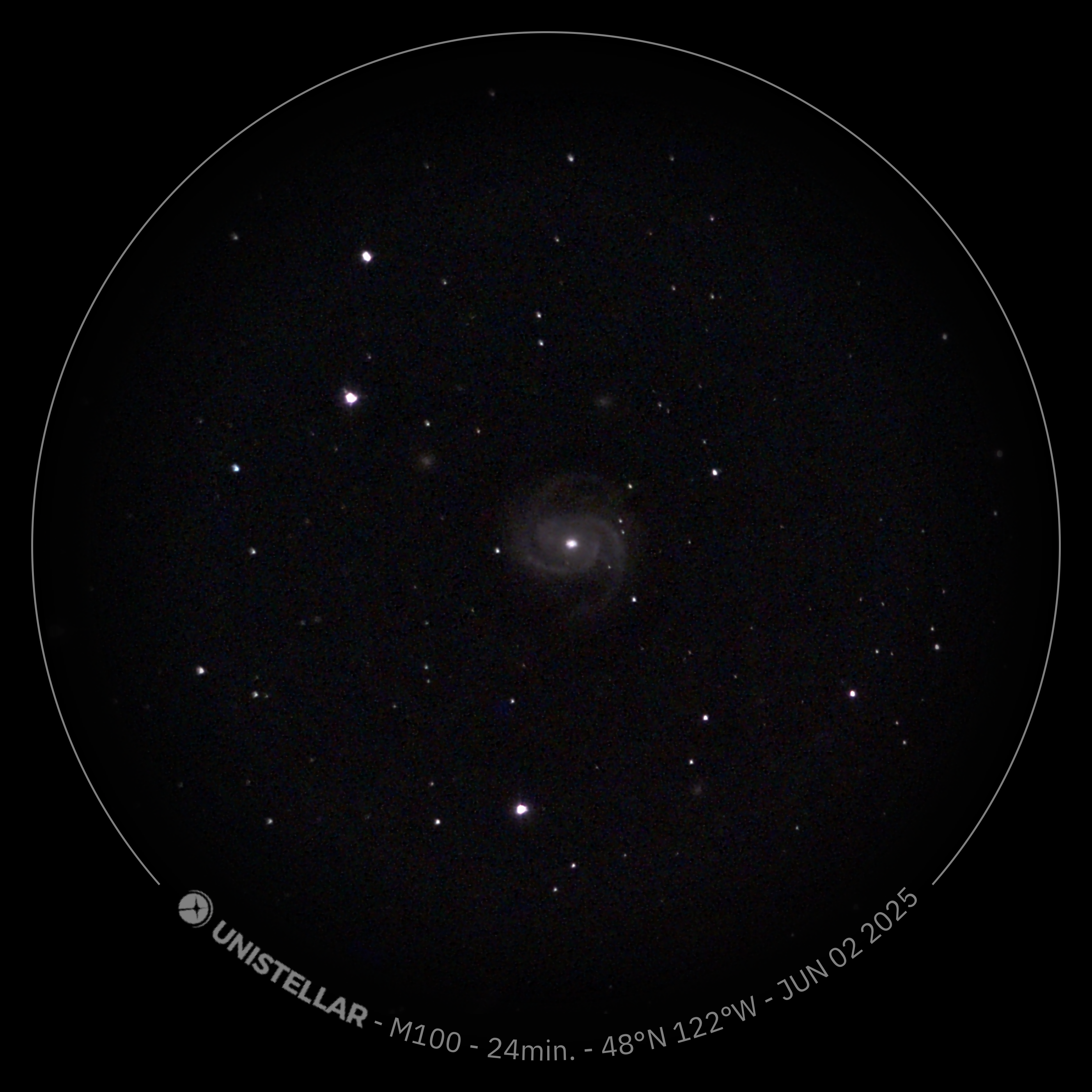
M101 – Pinwheel Galaxy
6m
2022-05-19
I happened to take two shots of the Pinwheel Galaxy on May 19th; this is the one with shorter dwell time, but the galaxy is more centered.
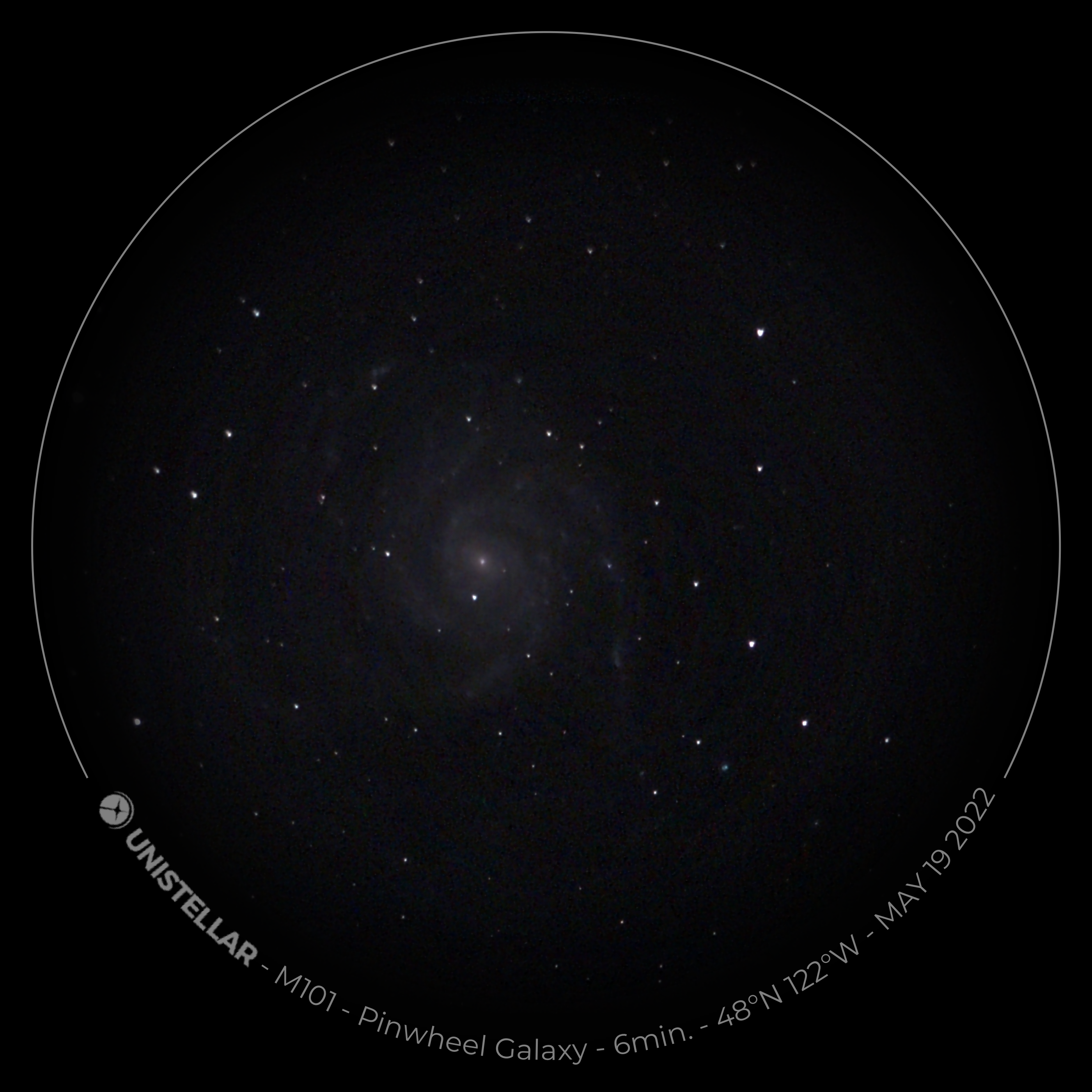
M101 – Pinwheel Galaxy
16m
2022-05-19
This is the “before” image in the animation in the first post. Compare this to the next photo…
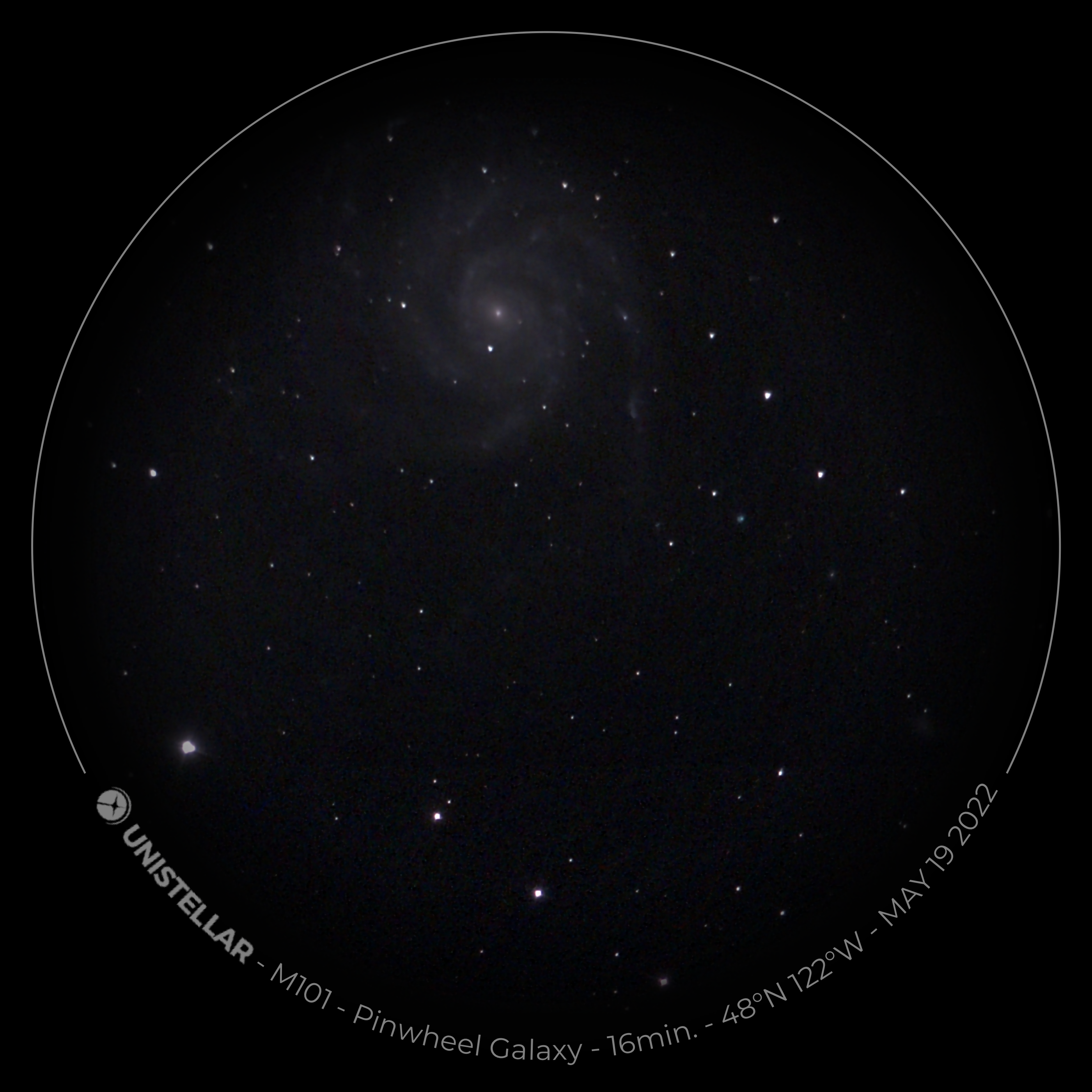
M101 – Pinwheel Galaxy
16m
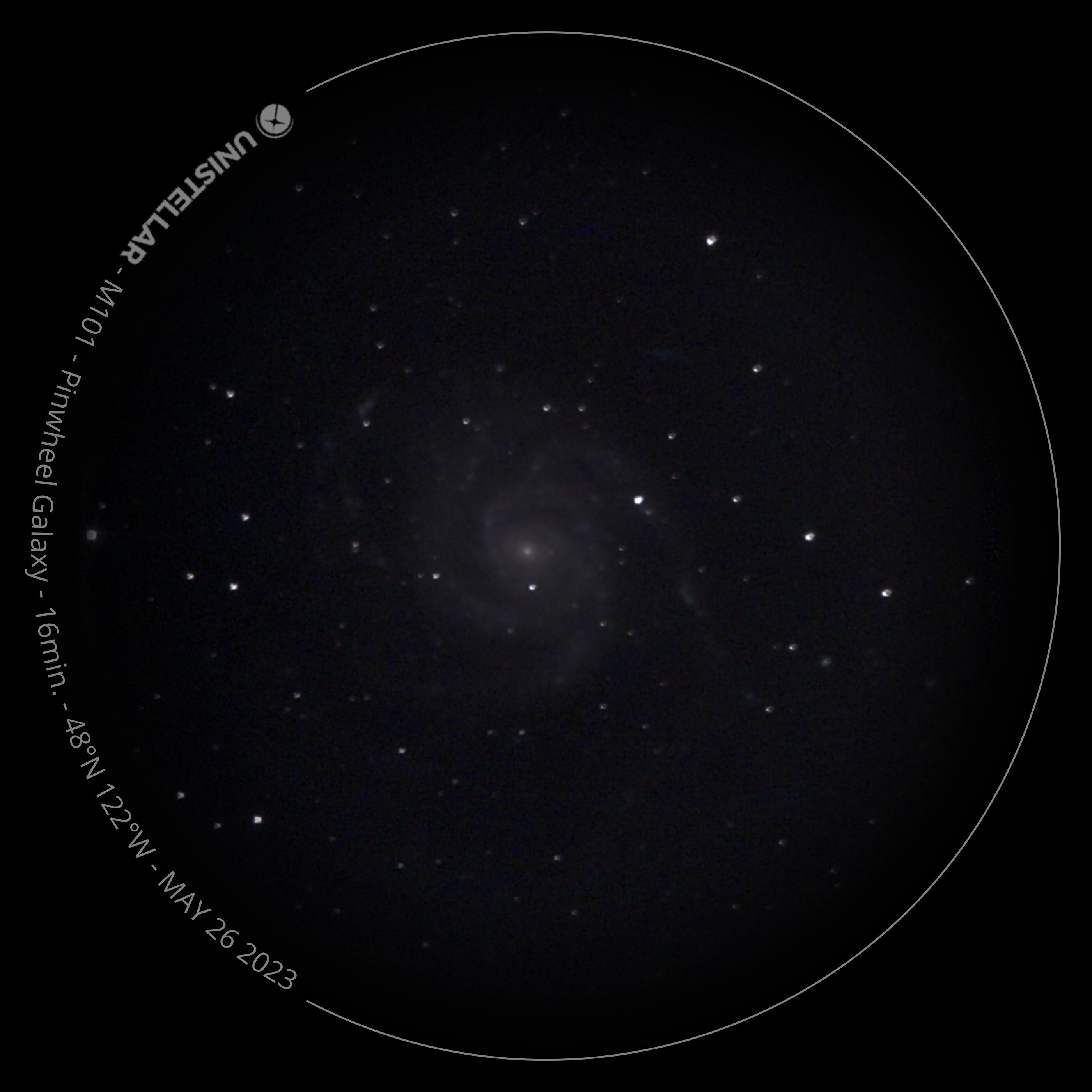
2023-05-26
Here’s my shot of the Pinwheel Galaxy after the supernova, and I’ve rotated it to have the same alignment as the “before” picture from 2022. The supernova is clearly visible in the upper-right arm.
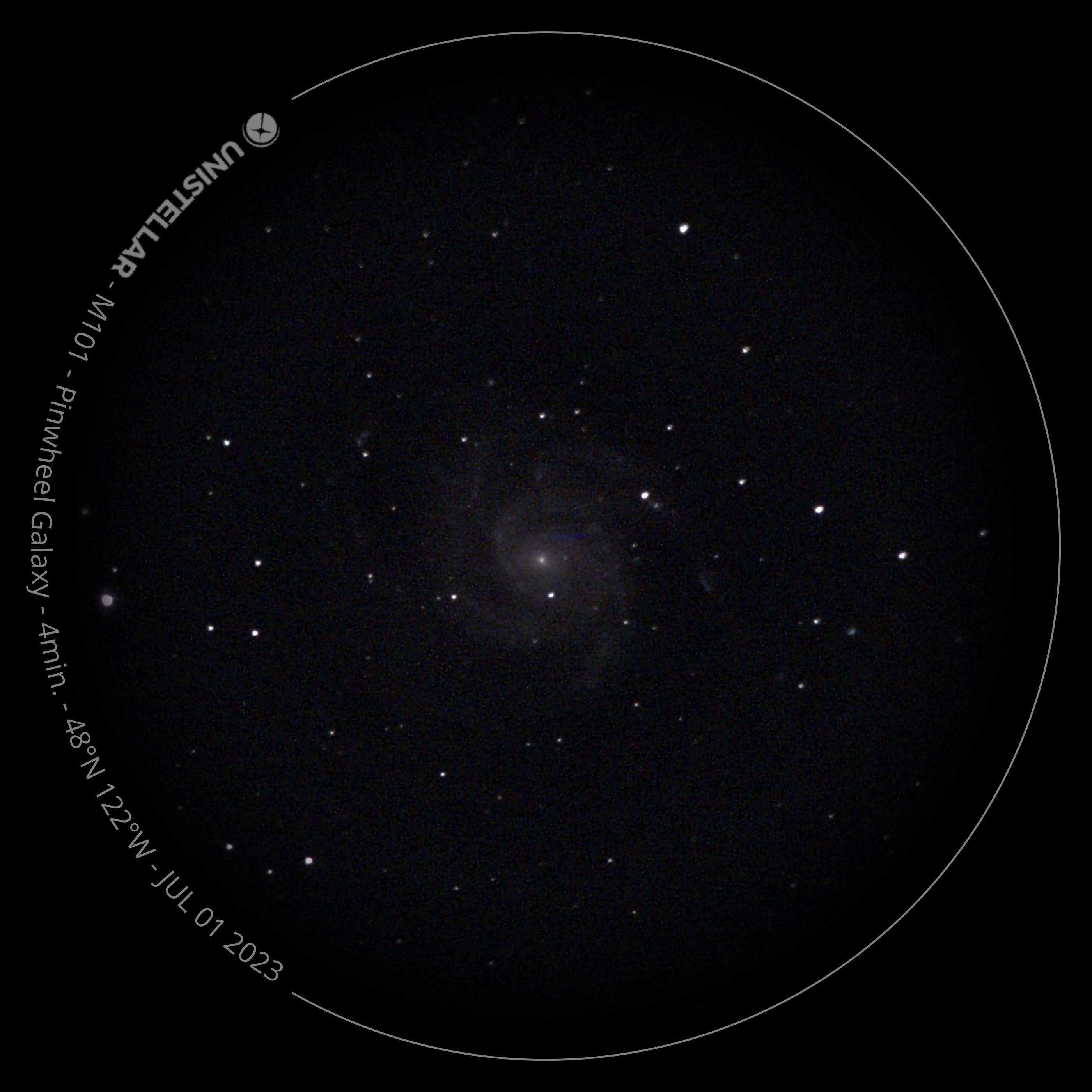
M101 – Pinwheel Galaxy
4m
2023-07-01
This is a rotated image of the Pinwheel Galaxy, about 2 months after the supernova first appeared. You can still see it distinctly in the upper-right spiral arm.
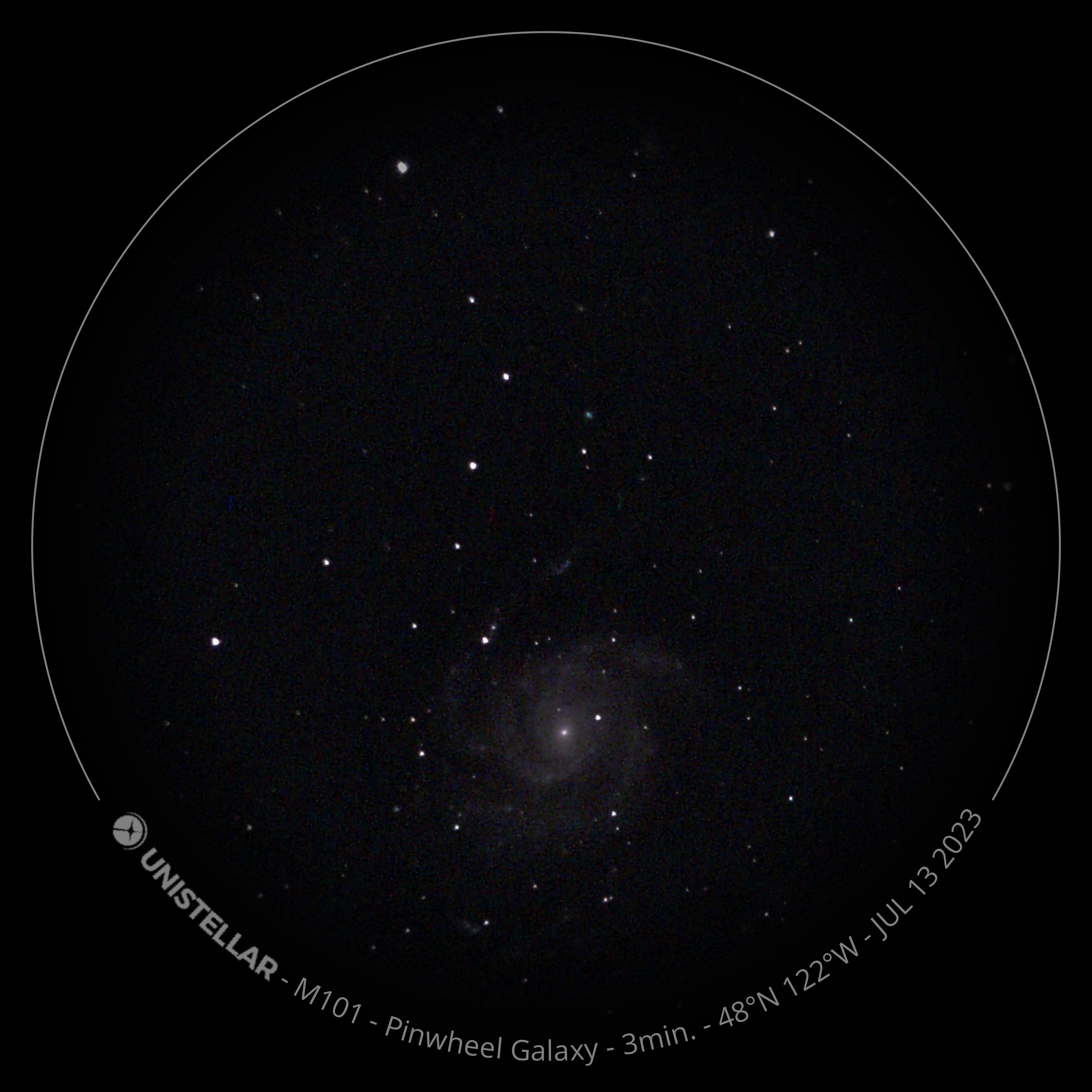
M101 – Pinwheel Galaxy
3m
2023-07-13
In this orientation, the supernova is still visible in mid-July, as the bright star in the top-left arm.
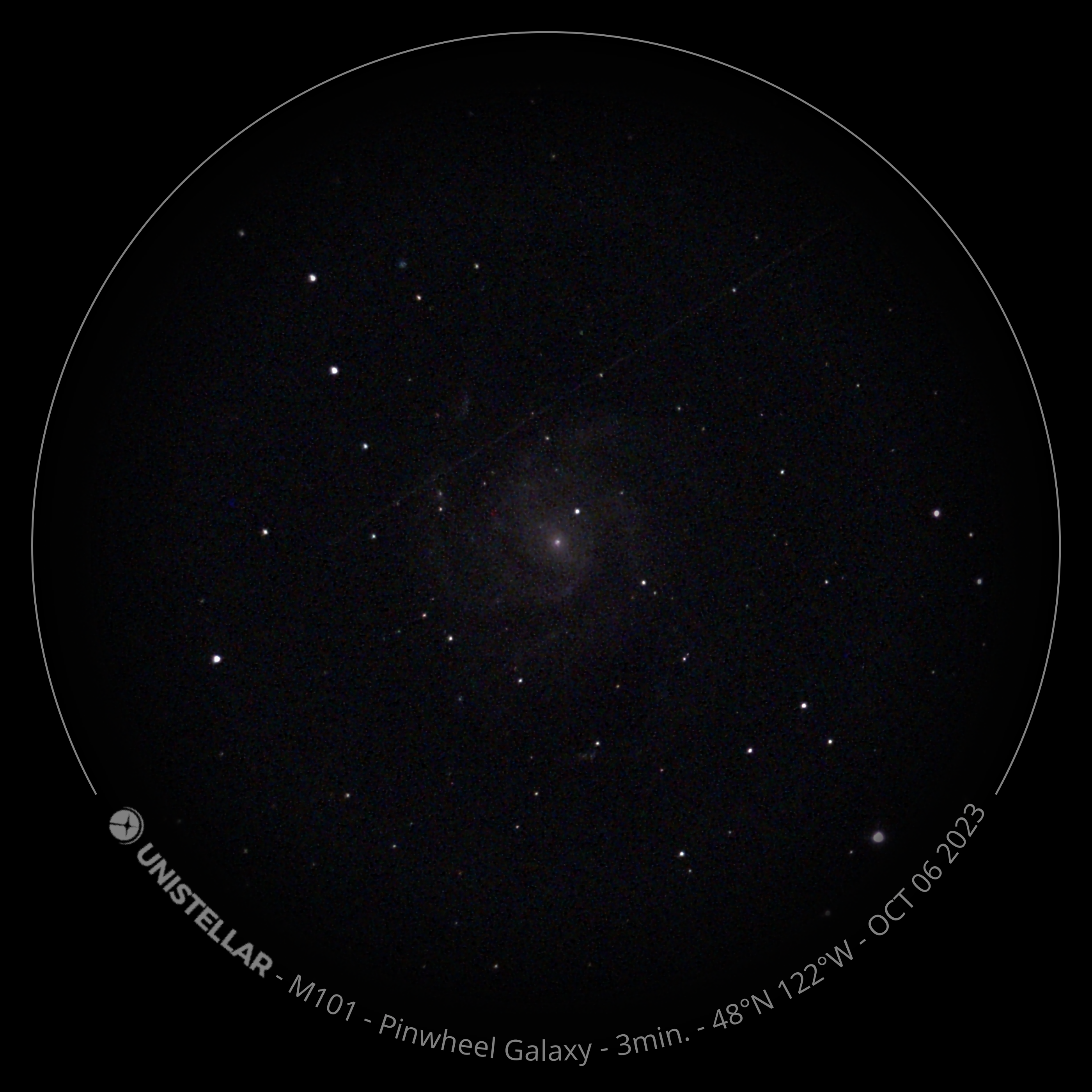
M101 – Pinwheel Galaxy
3m
2023-10-06
By October 2023, the supernova (which is in the left-most arm, in this orientation) is mostly gone. It’s the lower of the two dim stars, just below the satellite track.
M101 – Pinwheel Galaxy
44m
2025-06-03
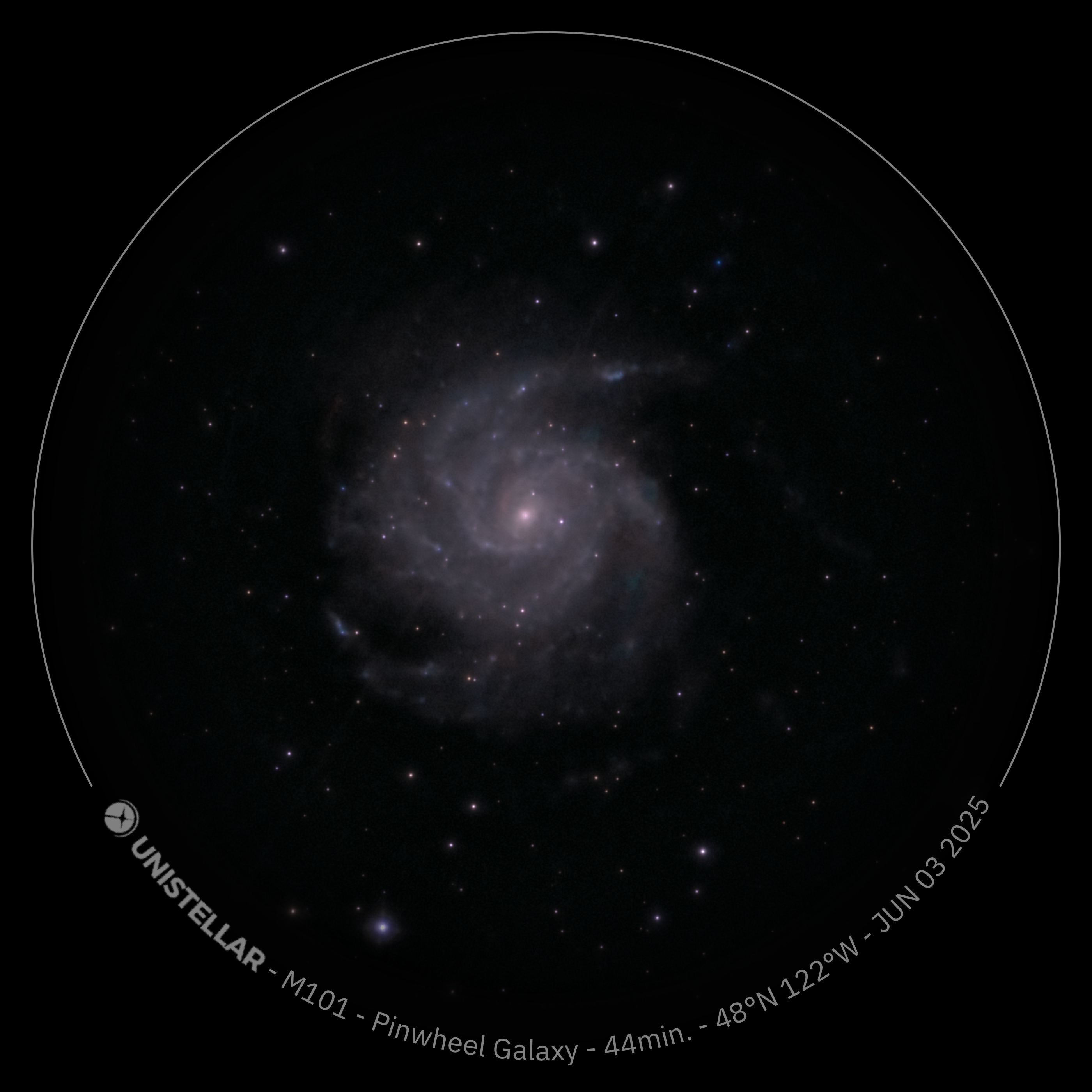
With a long dwell time and enhanced software, you can really appreciate how beautiful the Pinwheel Galaxy is. I wish I had this quality for the before-and-after supernova pictures. The new nebula, which is now expanding out of the remnants of the previous supernova, would be in the top-most arm of this picture, almost directly above the bright central core.
M102
18m
2022-07-12
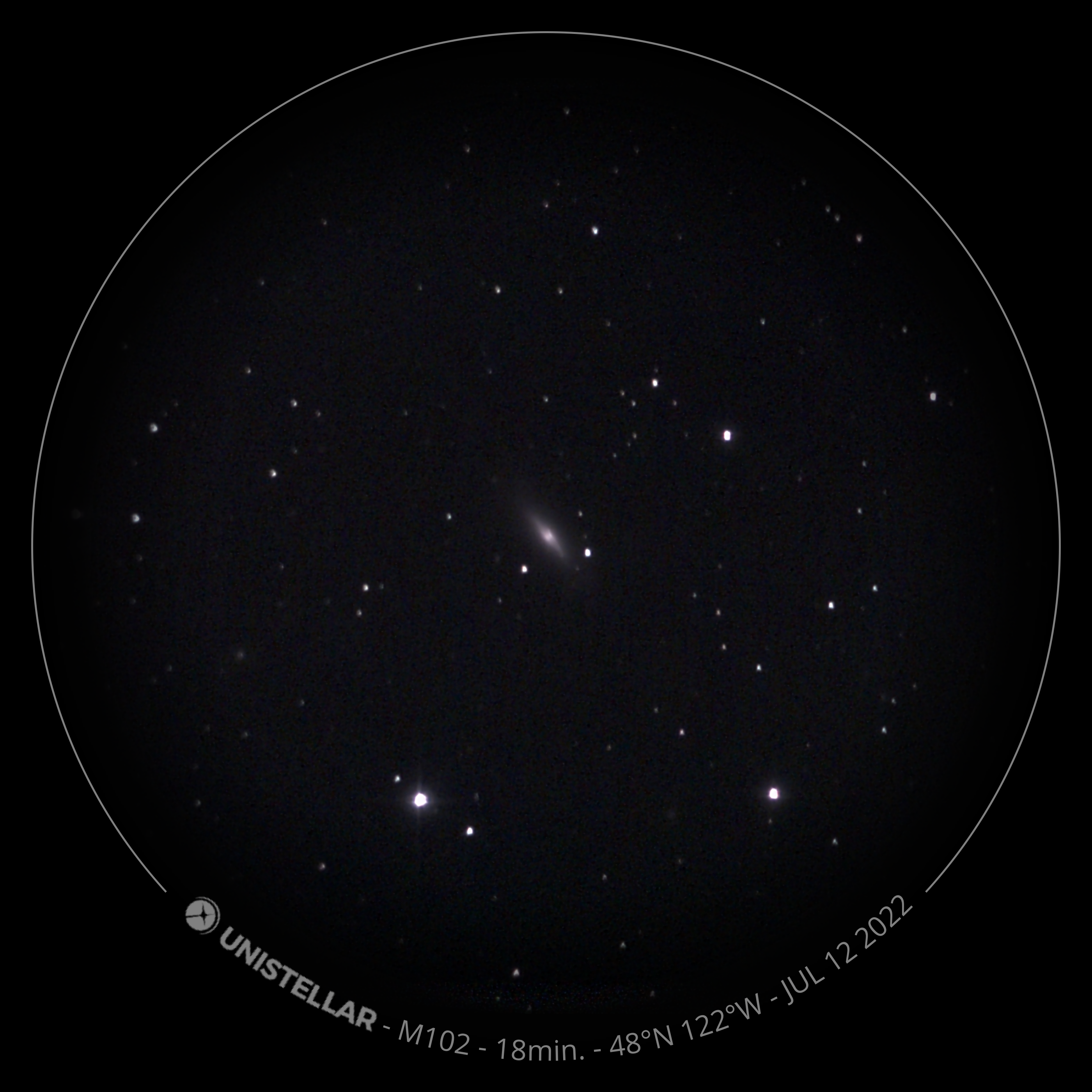
A small, faint galaxy.
M102
4m
2024-10-06
Even with the improved colors & sharpness, if you don’t take a long enough exposure, it’s not going to turn out well.

M102
18m
2025-01-25
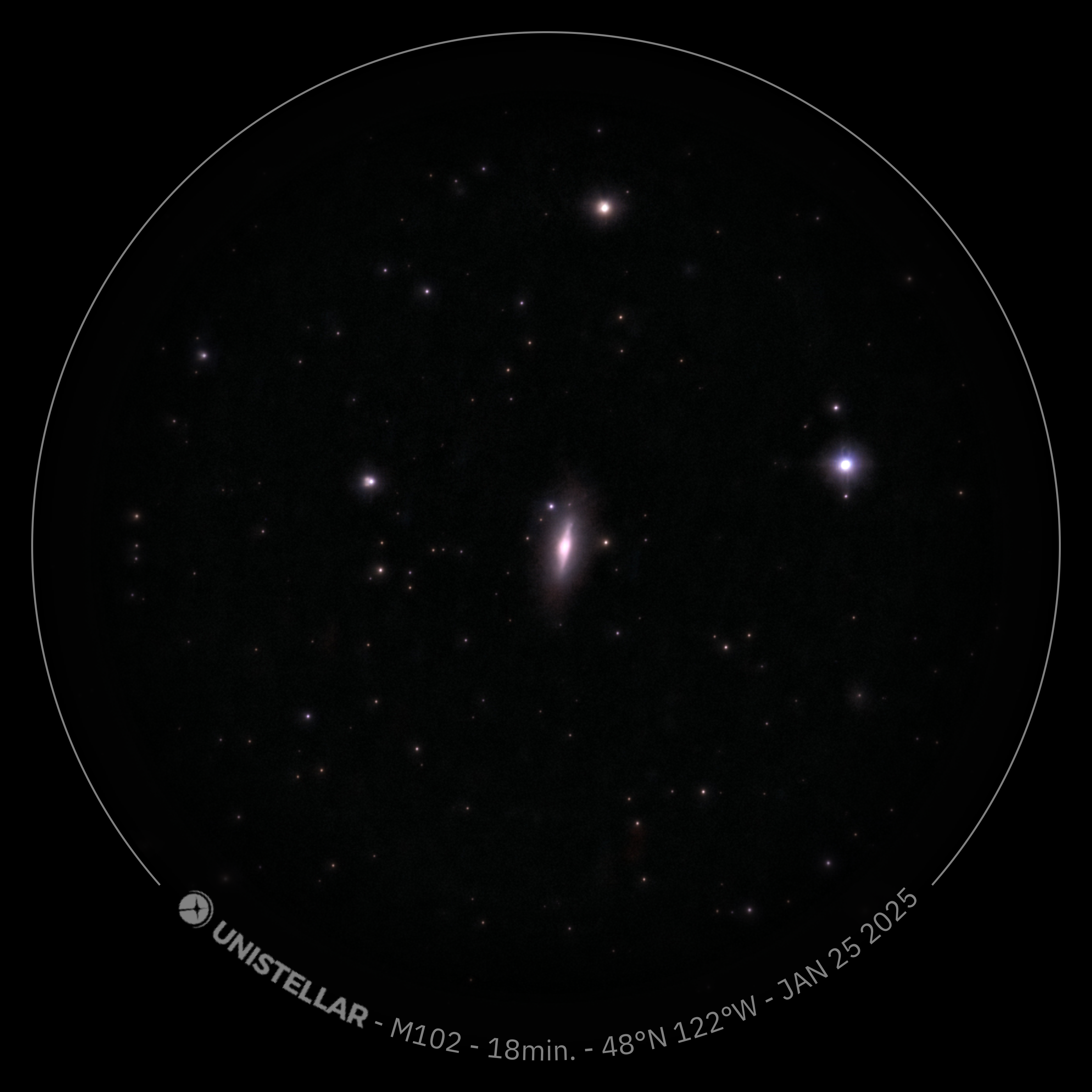
But with a good long exposure, M102 looks a lot better, with more details and colors.
M104 – Sombrero Galaxy
5m
2022-05-21
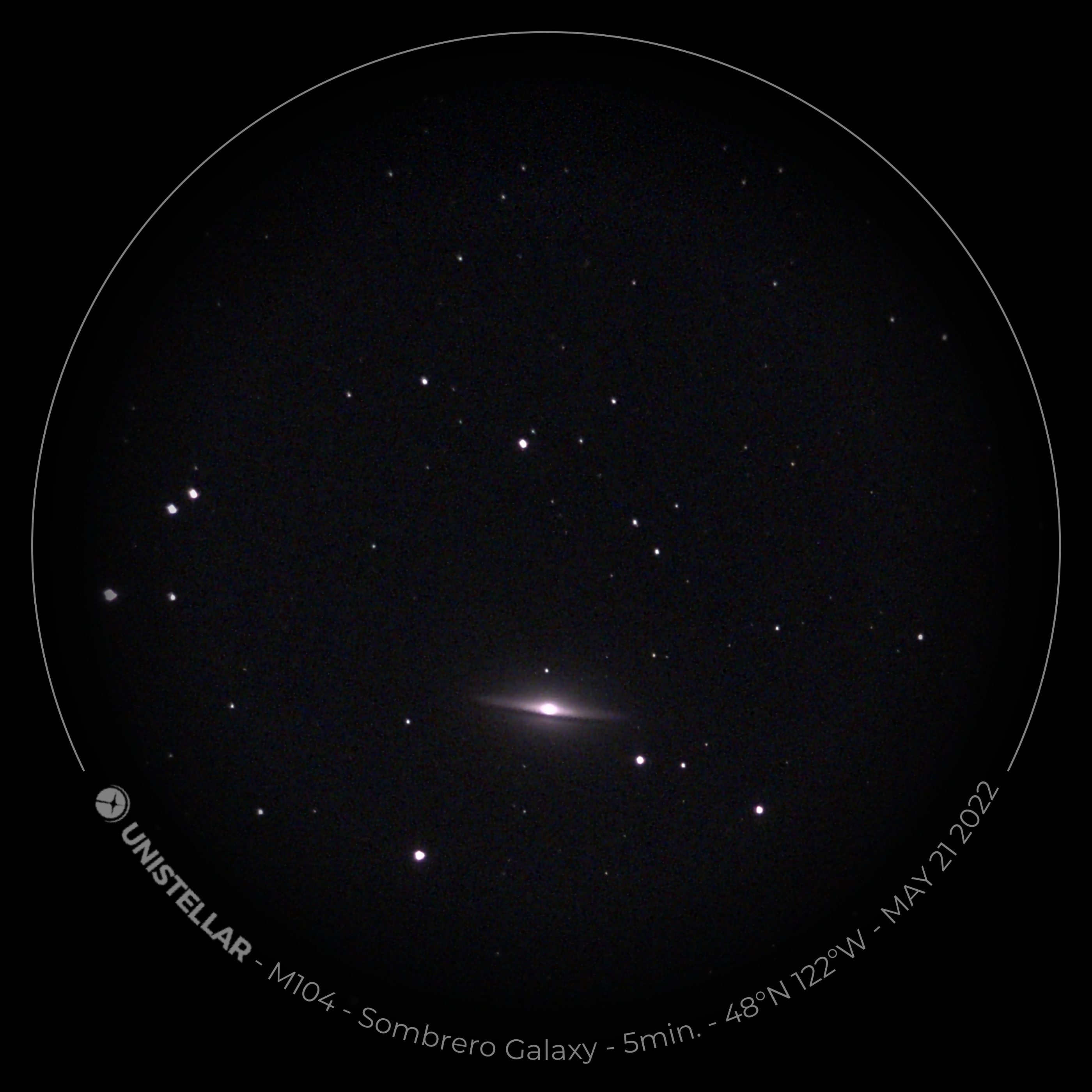
Before the update, the Sombrero Galaxy was pretty good, if you stayed on it long enough. (Five minutes isn’t long enough.) It’s an edge-on spiral galaxy, and the dark band is dust, at the furthest reaches of the spiral arms, obscuring the bright stars behind.
M104 – Sombrero Galaxy
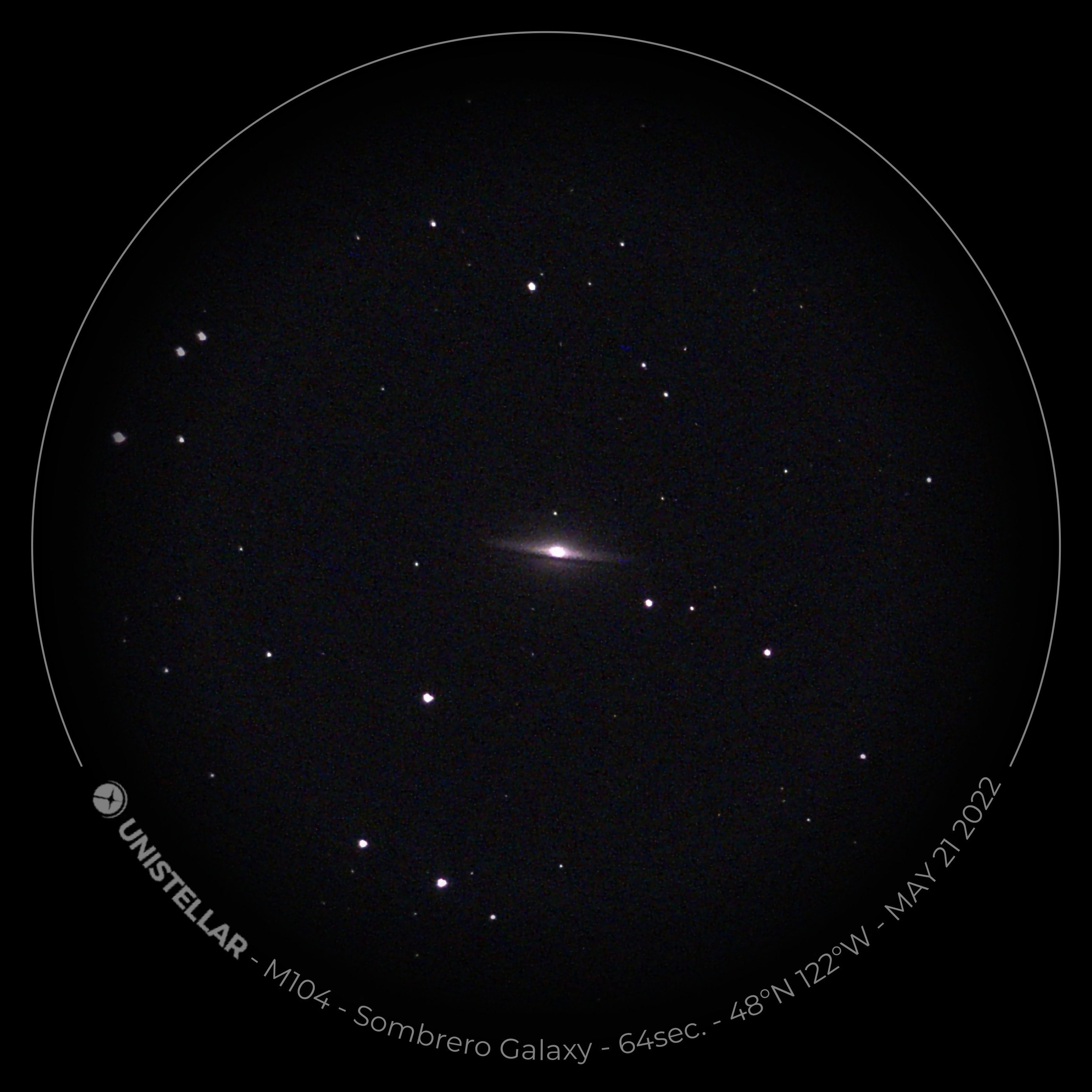
64s
2022-05-21
64 seconds also isn’t long enough.
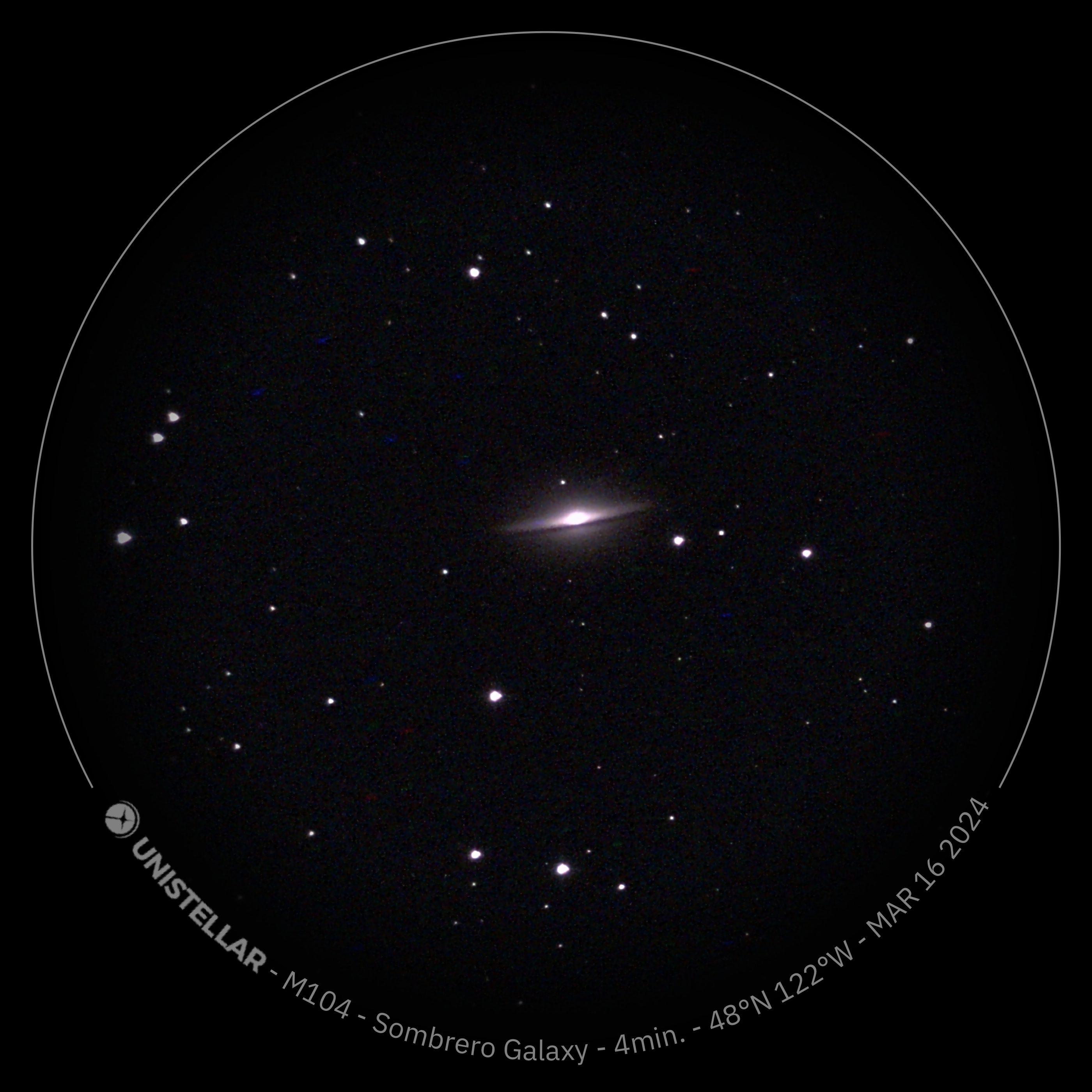
M104 – Sombrero Galaxy
4m
2024-03-16
4 minutes is … still not long enough.
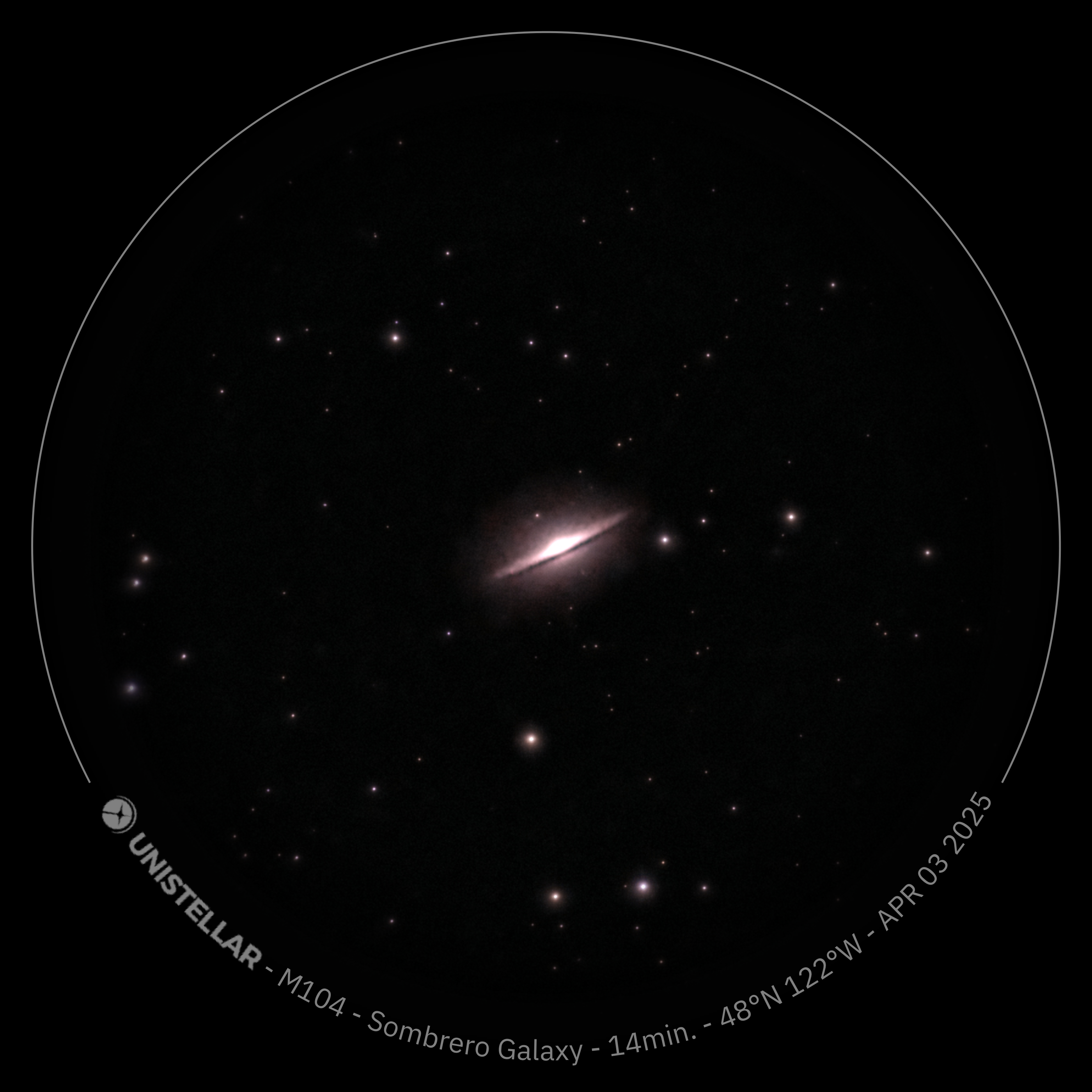
M104 – Sombrero Galaxy
14m
2025-04-03
But 14 minutes, with a software update? Definitely long enough.
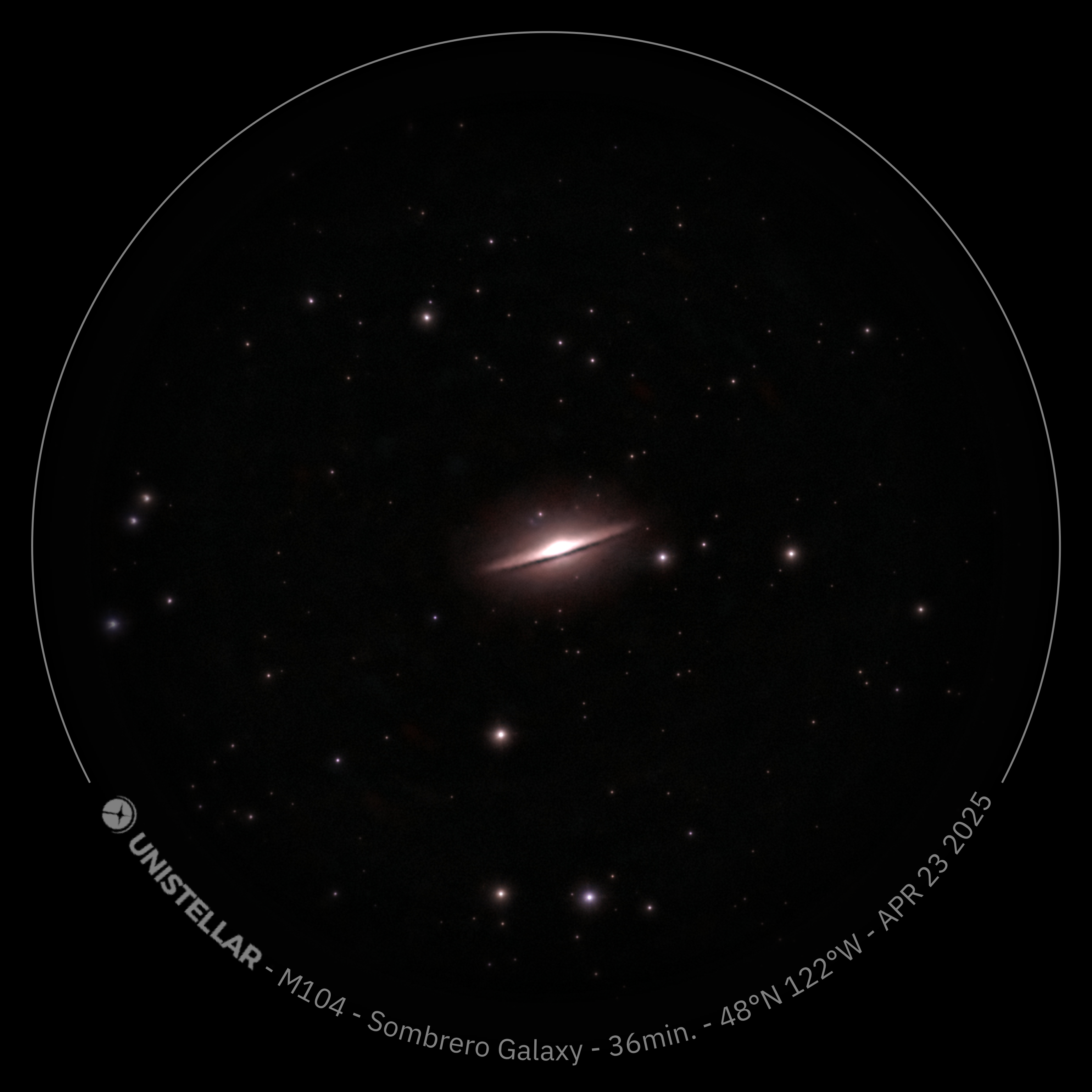
M104 – Sombrero Galaxy
36m
2025-04-23
Another great shot of the Sombrero, with colors and sharpness enhanced.
M104 – Sombrero Galaxy
70m
2025-05-04
Easily my best picture of the Sombrero Galaxy, with beautiful colors and a sharp shadow of dust. Long exposures are good!
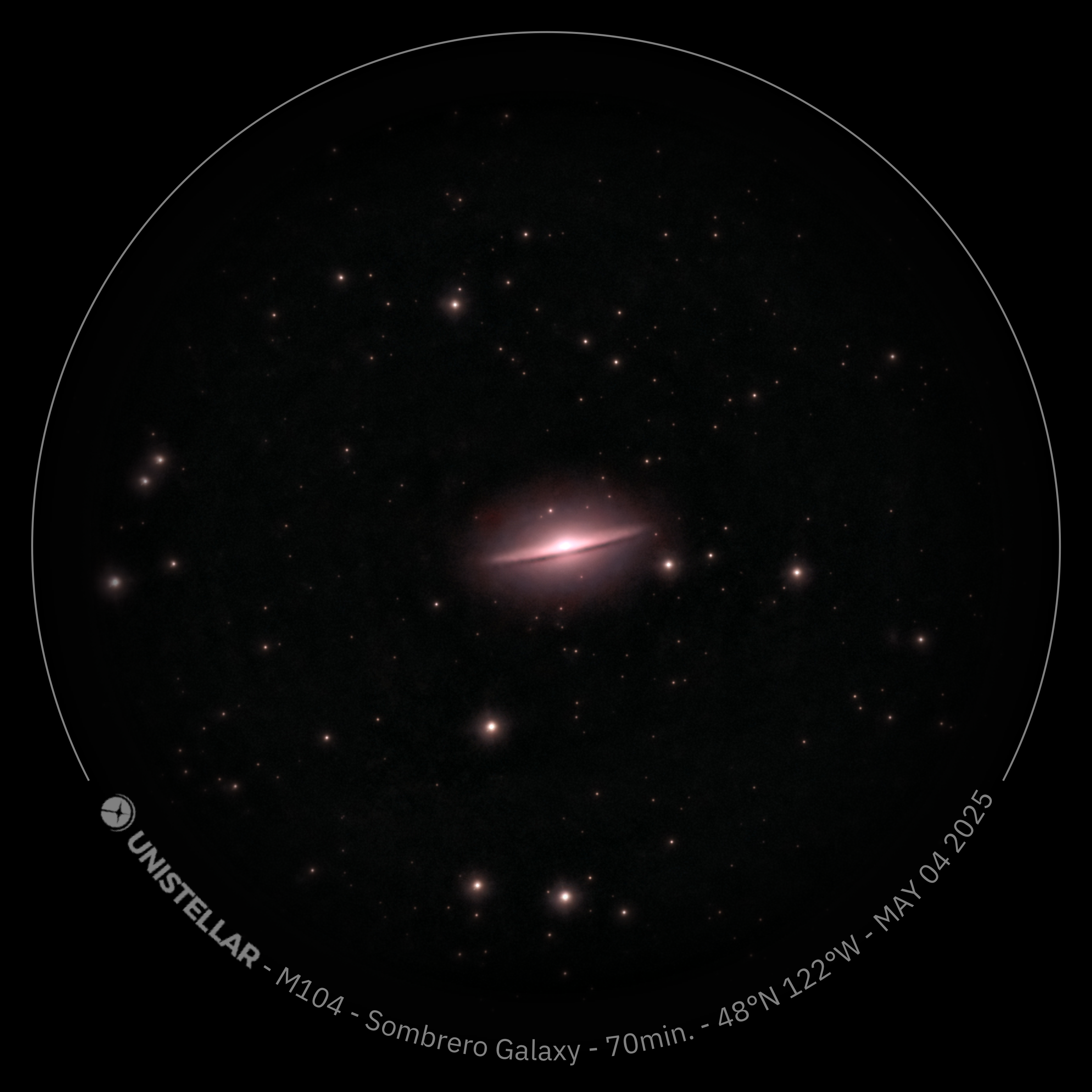
M104 – Sombrero Galaxy
17m
2025-05-24
If not for the two three(!) satellite tracks, this would’ve been one of the better shots I have of the Sombrero.
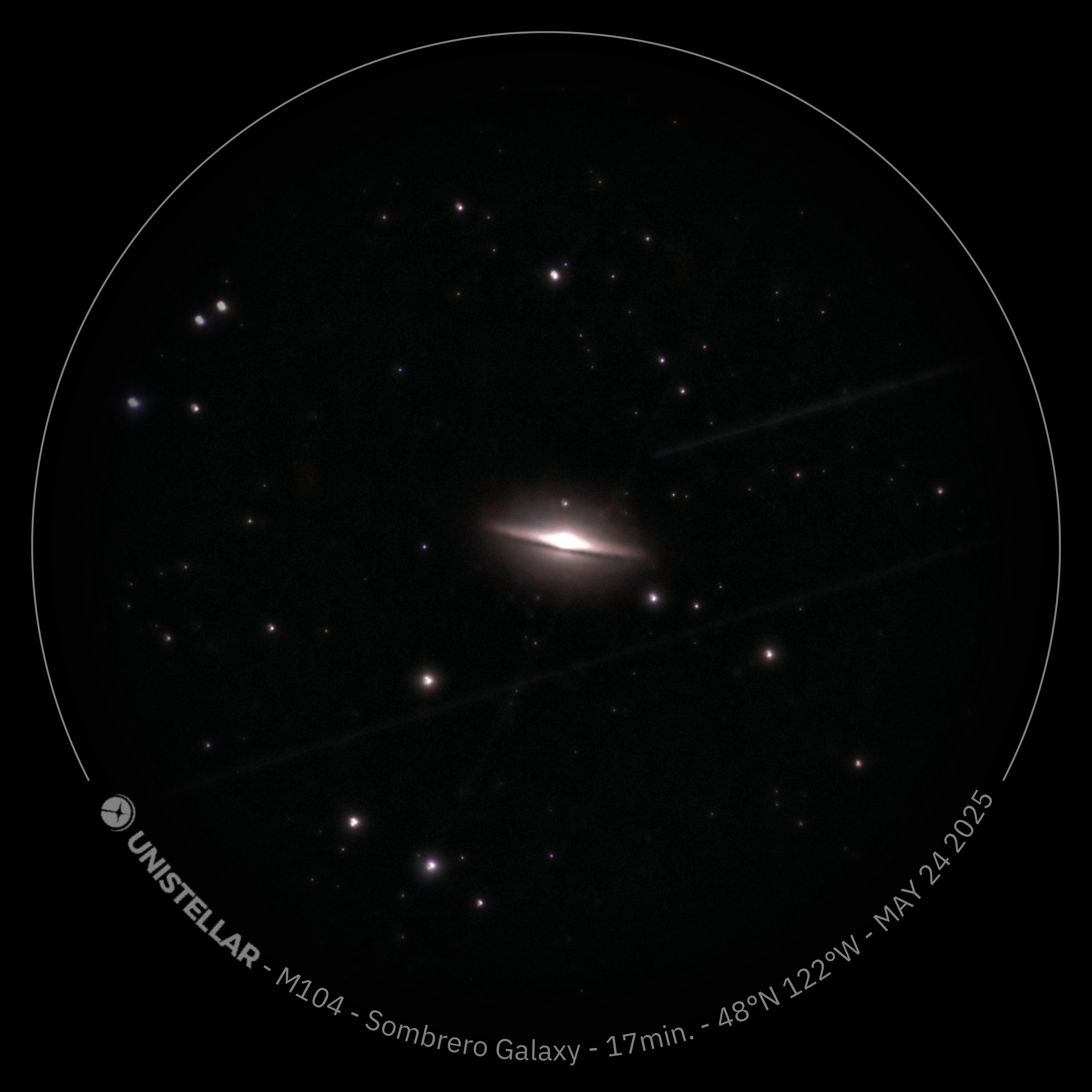
M106
7m
2025-01-26
A nice spiral galaxy; I think a longer dwell time, in the future, would be a good choice.
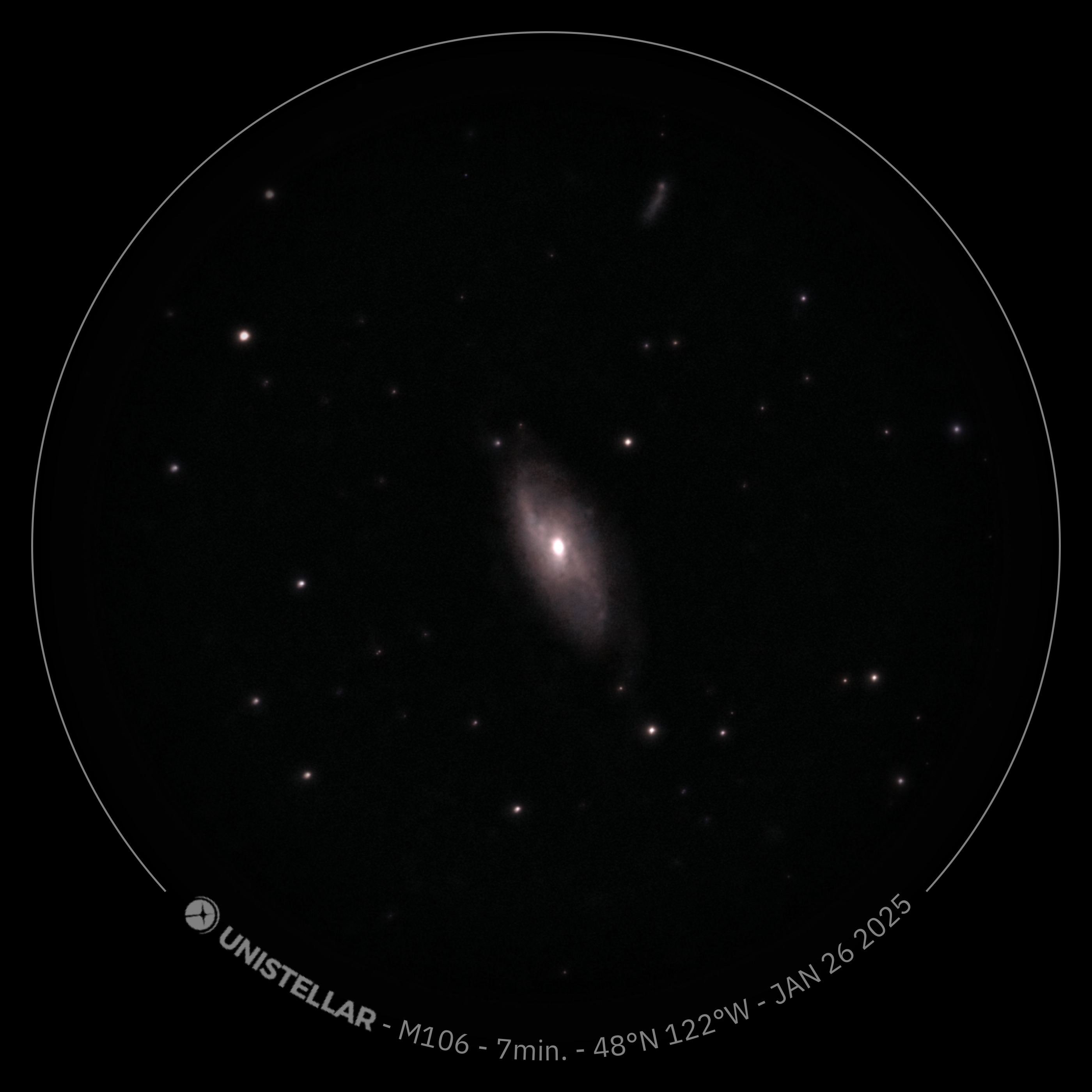
M106
30m
2025-06-03
And guess what? It is! That little blob in the lower-right is NGC 4217, an edge-on spiral galaxy that may be a companion of M106. Two galaxies for the price of one!
M110
5m
2025-10-13
Not a great photo – it cut off after only 5 minutes (I’m not sure why). M110 is a dwarf galaxy orbiting / interacting with the Andromeda Galaxy (like M32).

NGC 0247 – The Claw Galaxy
25m
2025-10-14
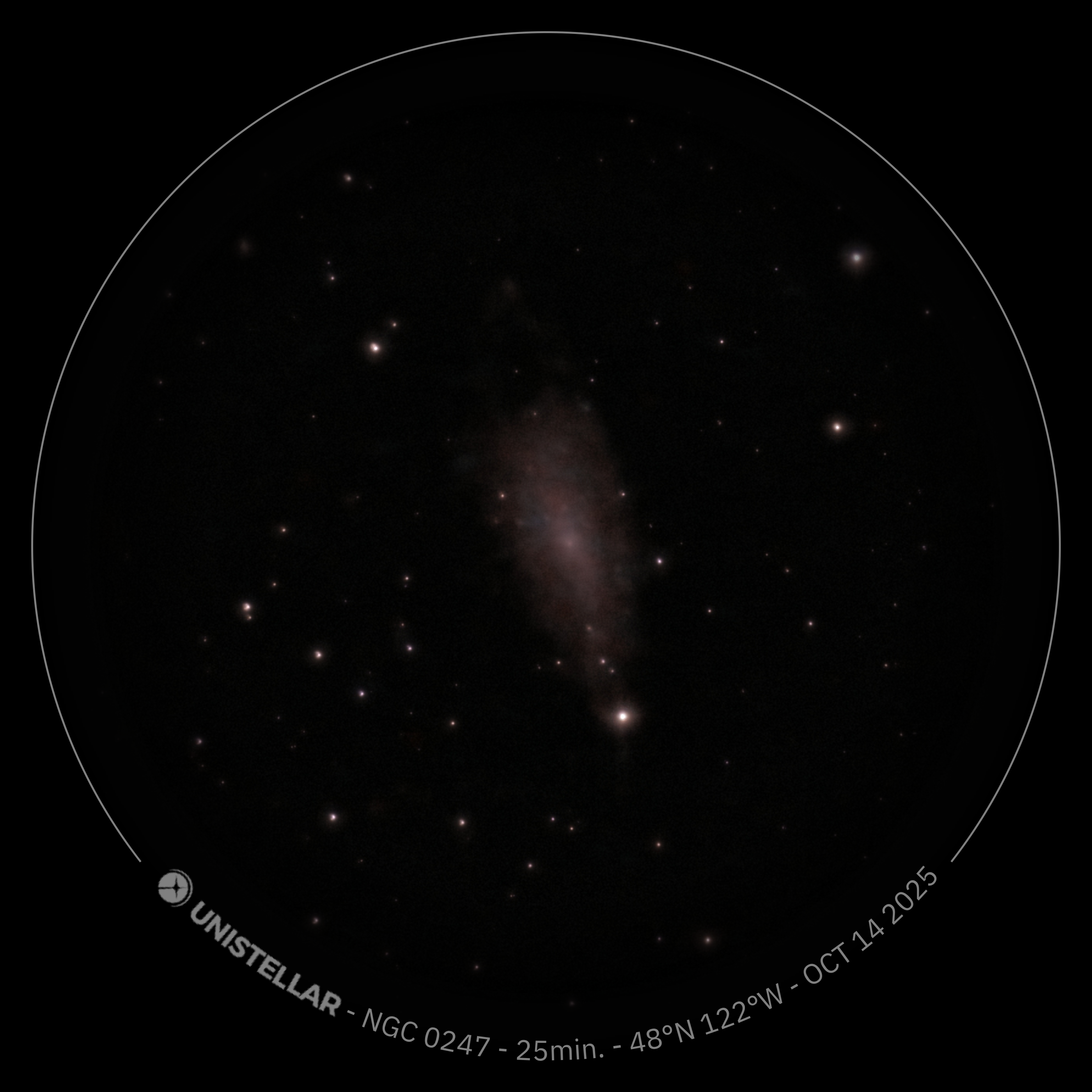
I think it’s called the claw because of the large void on one side of the spiral disk – and you can see it here. I think another attempt, with a longer dwell (this one got interrupted) might be worthwhile.
NGC 0891
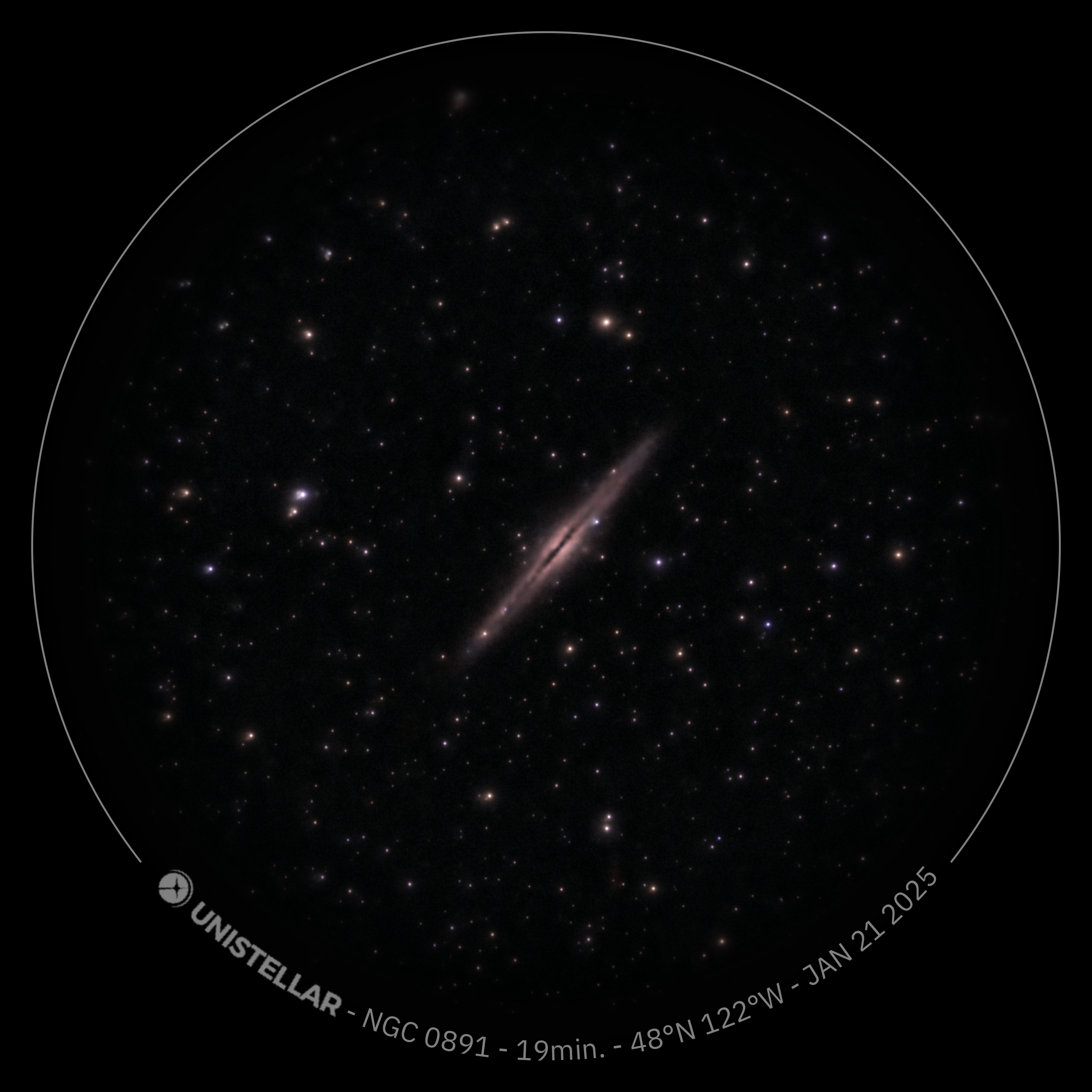
19m
2025-01-21
This is one of my favorites, definitely in the top 3 of all the pictures I’ve taken. A nearly perfect edge-on shot of a beautiful galaxy with a distinct, bright central bulge.
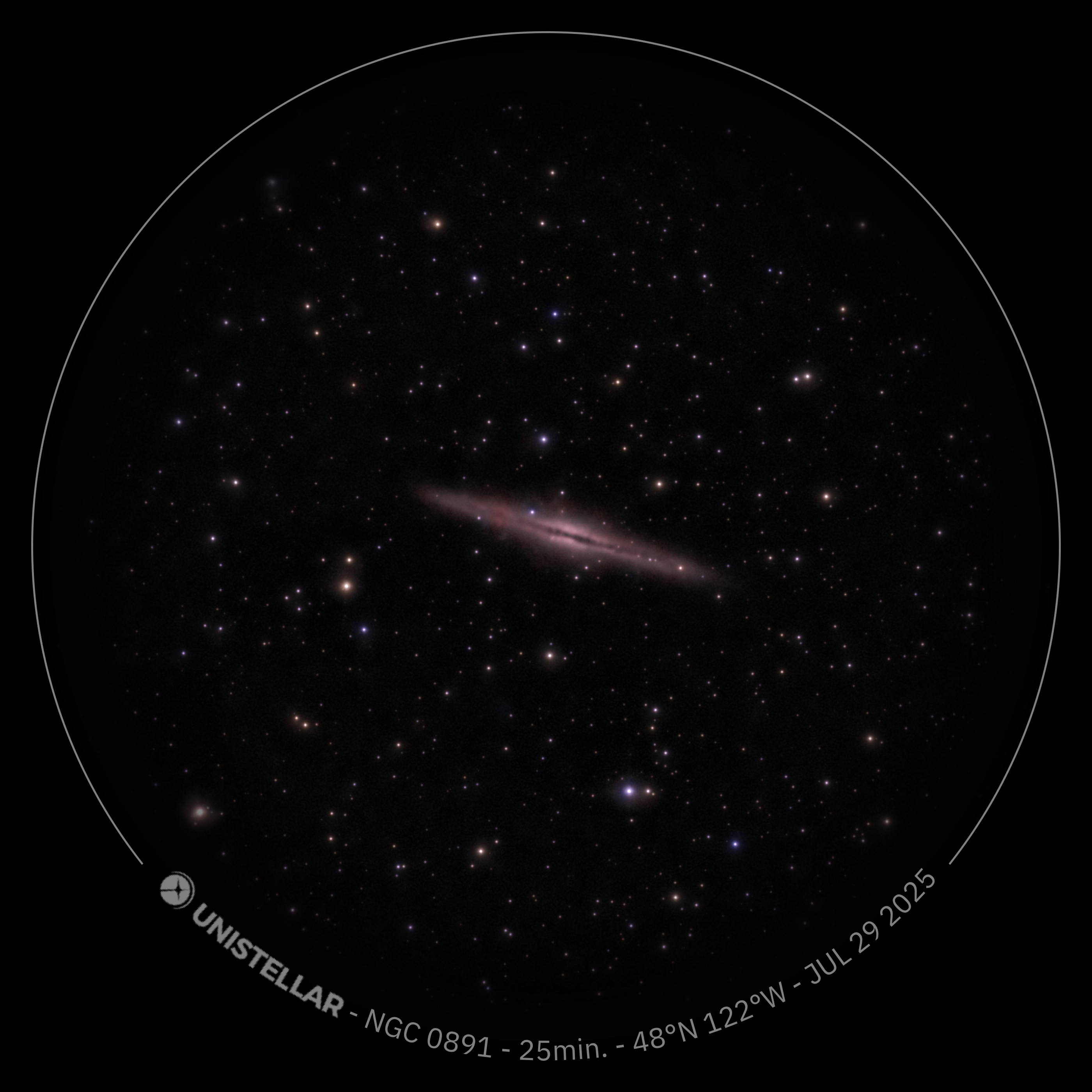
NGC 0891
2025-07-29
25m
I still love this galaxy – it’s almost perfect in terms of size, brightness, and clarity for the eVscope.
NGC 2283
3m
2025-01-24
An edge-on spiral, reminiscent of either the Black Eye galaxy or the Sombrero Galaxy. I should go back, and spend more time.

NGC 2403
4m
2025-05-24
This was my first attempt at capturing this galaxy, but it was marred by a satellite, so I stopped the exposure.

NGC 2403
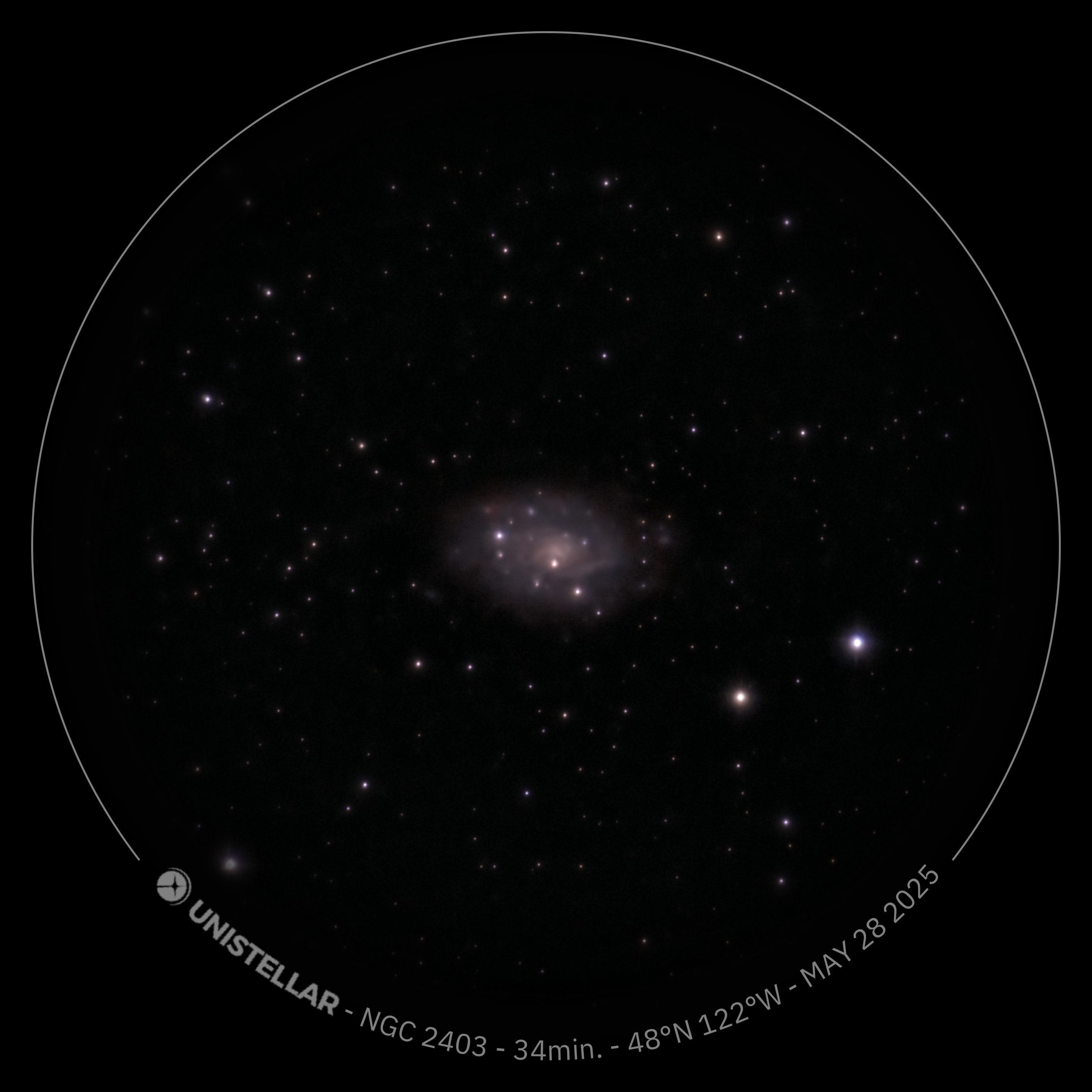
34m
2025-05-28
I really like this shot, and NGC2403 is one of the galaxies that I specifically chased after the new software came out. The bright blobs aren’t stars – they’re huge, bright star-forming clusters, giving this galaxy a very knobbly look.
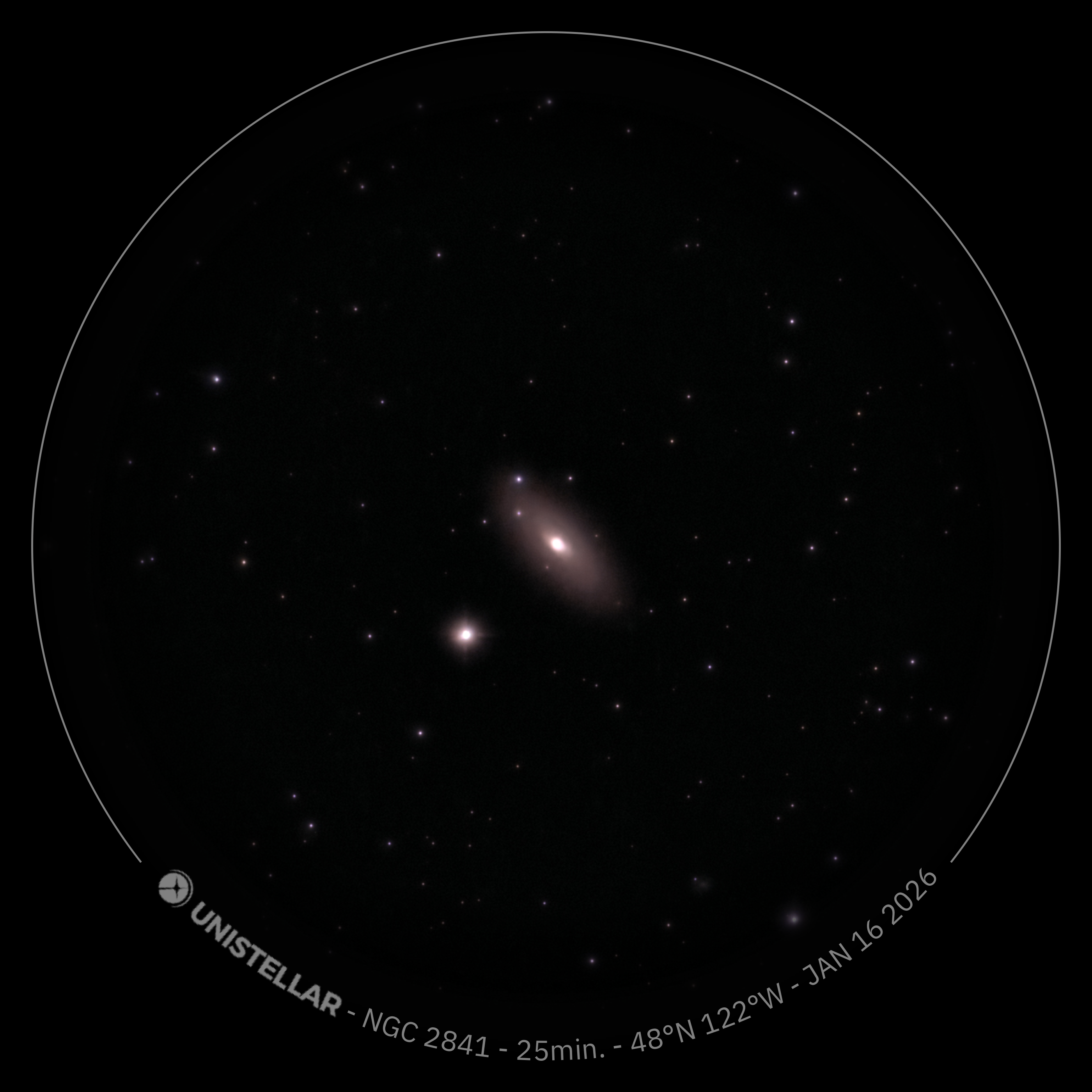
NGC 2841
25m
2026-01-16
A nice little spiral galaxy, oft referred to as a flocculent spiral galaxy, because of the poorly-defined arms and thicker dusty regions (which you can’t really make out in this image, unfortunately). It’s nice, though.
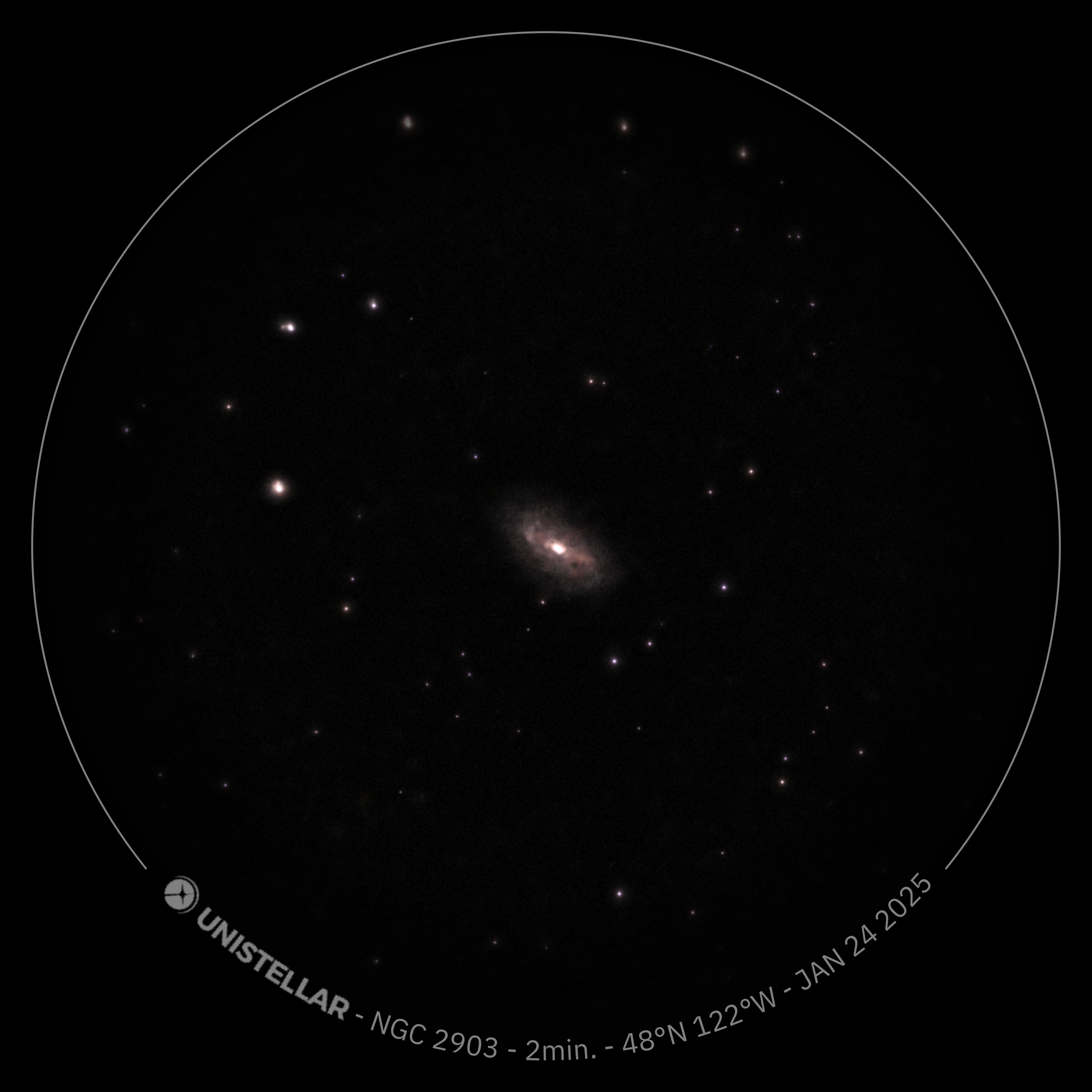
NGC 2903
2m
2025-01-24
A nice little spiral galaxy, but only 2 minutes of it. I probably should revisit it.
NGC 3079
20m
2025-01-25
A wonderfully imbalanced spiral galaxy, seen edge-on. I like the hazy halo of stars around its outer edges.

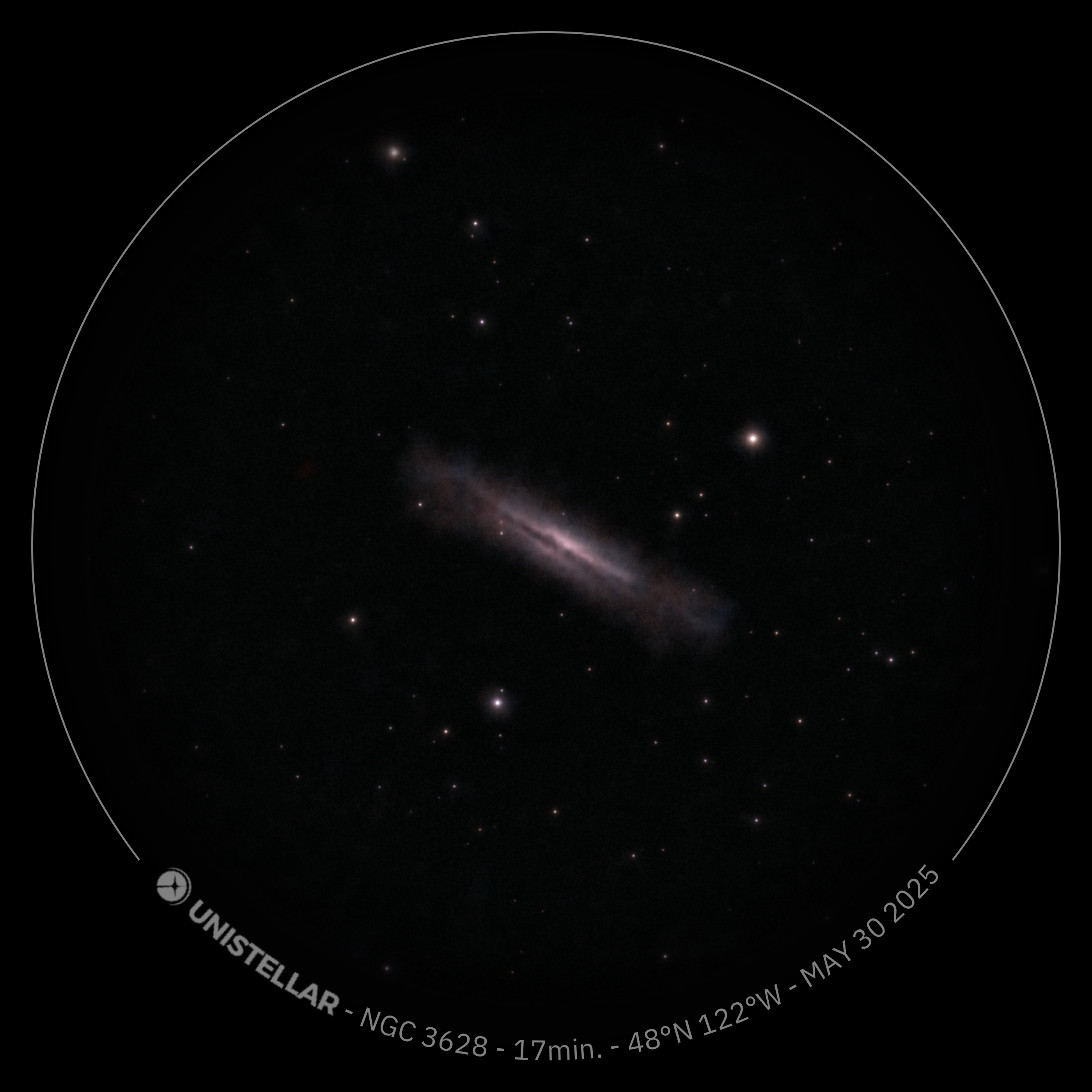
NGC 3628
17m
2025-05-30
This is one of my favorite images. Edge-on, you can see how this is a wobbly spiral galaxy – it seems to sweep down a bit on the left edge, and up on the right.
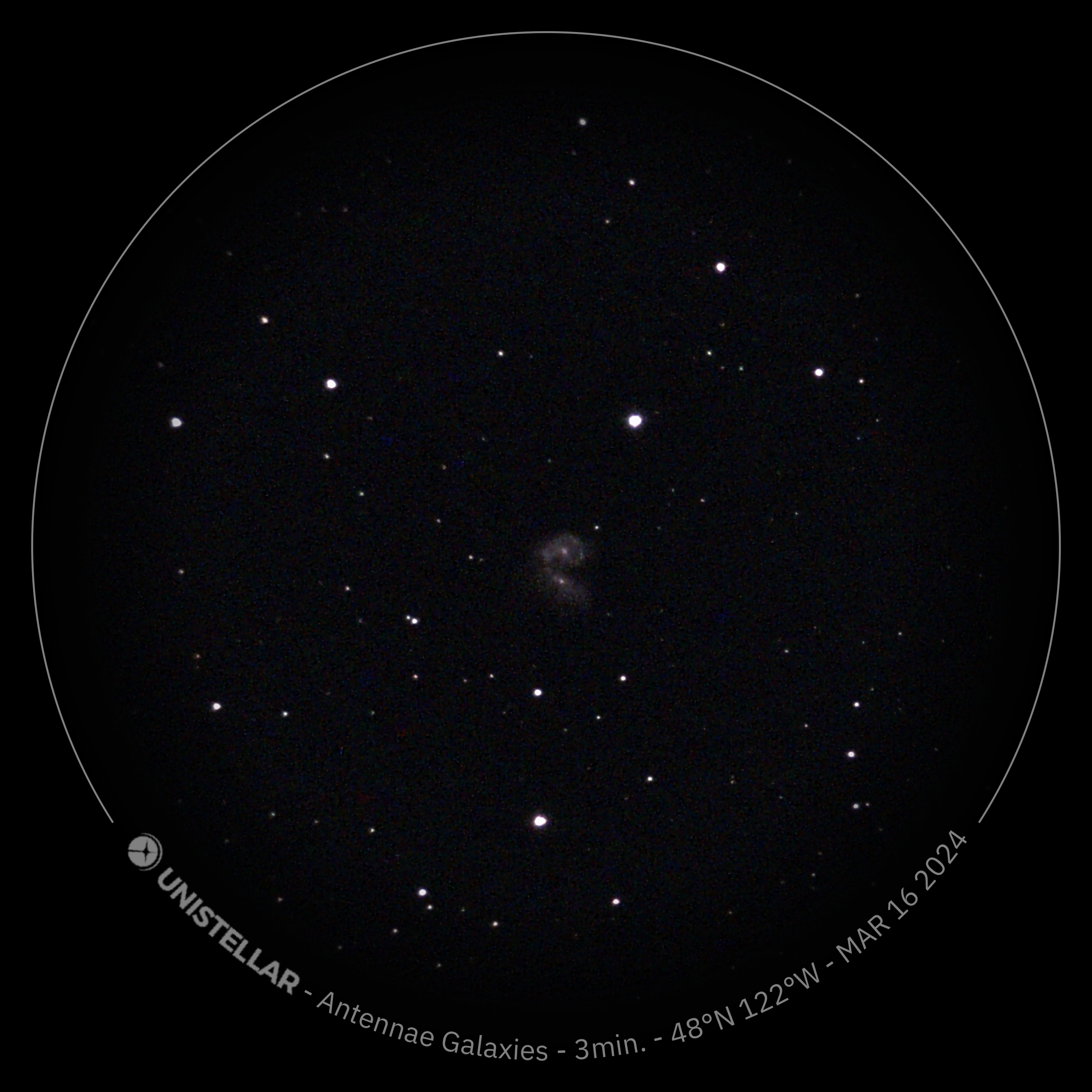
NGC 4038 and NGC 4039 – Antennae Galaxies
3m
2024-03-16
My first attempt at the Antennae Galaxies, and I think I lost tracking that night.
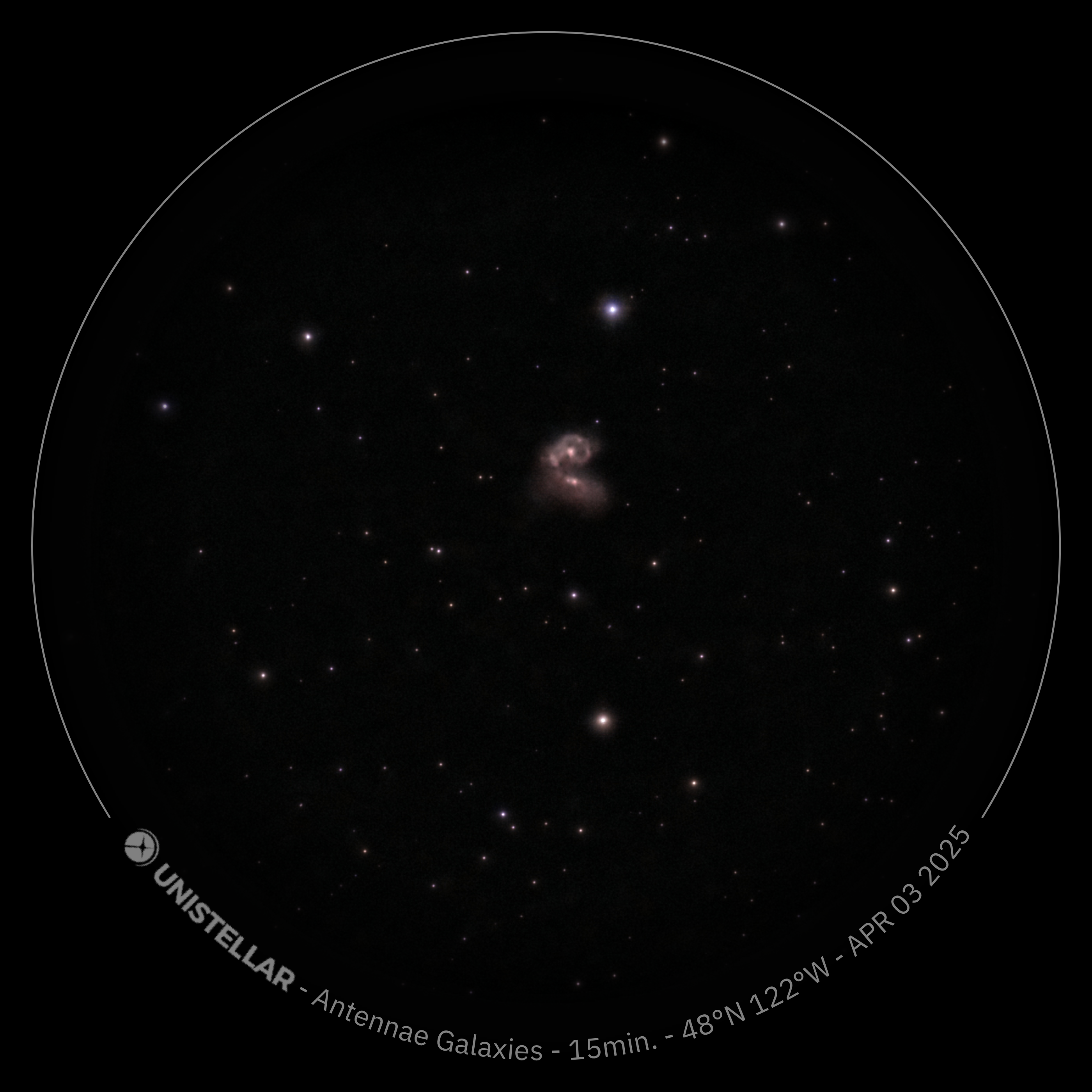
NGC 4038 and NGC 4039 – Antennae Galaxies
15m
2025-04-03
My second attempt to get the antennae, this time with a pretty good dwell time – and as you can see, two galaxies, but no antennae.
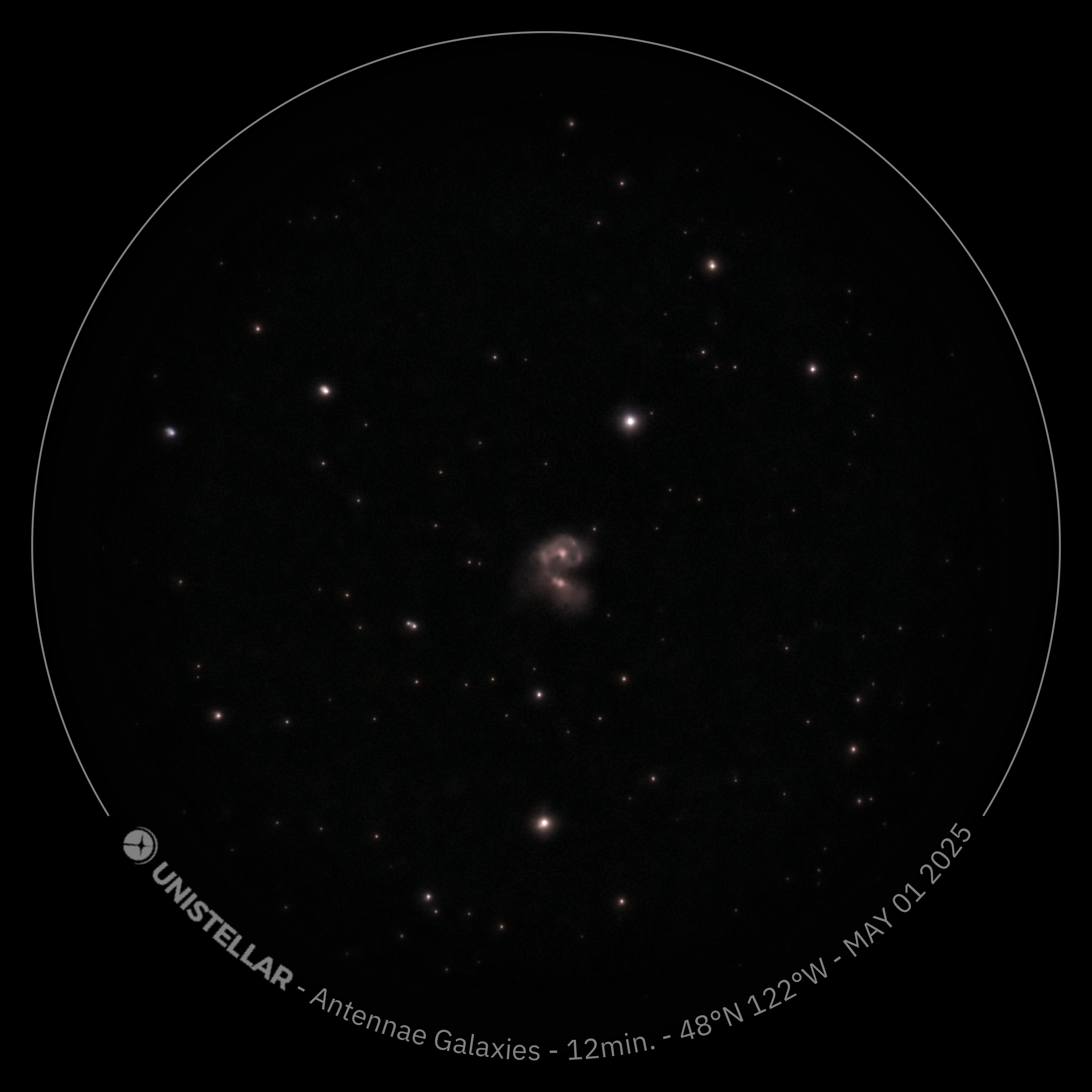
NGC 4038 and NGC 4039 – Antennae Galaxies
12m
2025-05-01
If you look online at pictures of these colliding spiral galaxies, they have these long, curving spray of stars (“antennae”) that would stretch probably half-or-more of the width of the circle. These stars were cast off when these galaxies collided around 500 million years ago. Unfortunately, they’re probably too dim for Seattle, even under the best conditions.
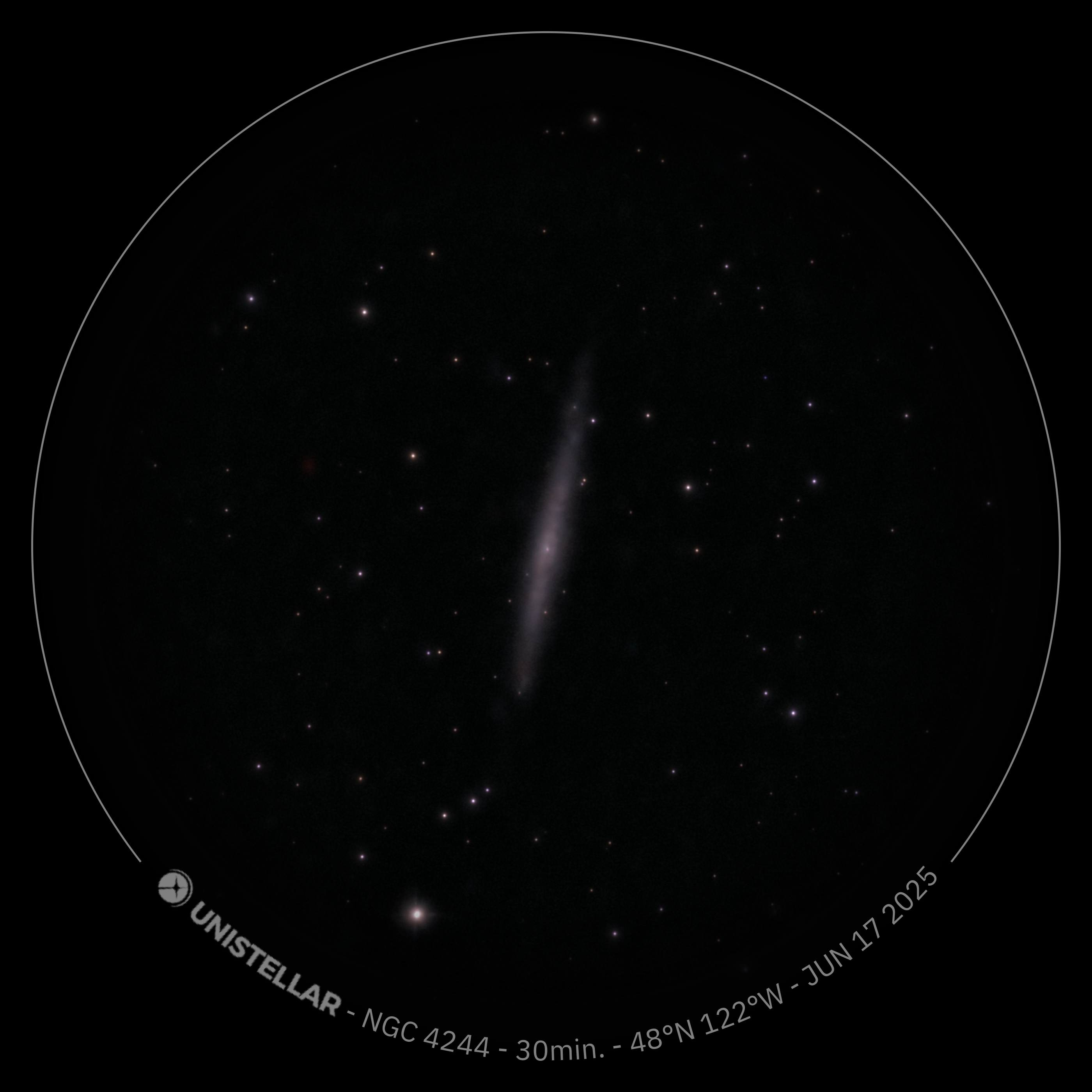
NGC 4244
30m
2025-06-17
The diffuse dust, lack of a distinctive central bulge, relatively dim stars in this one makes for a vague, cotton-like appearance.
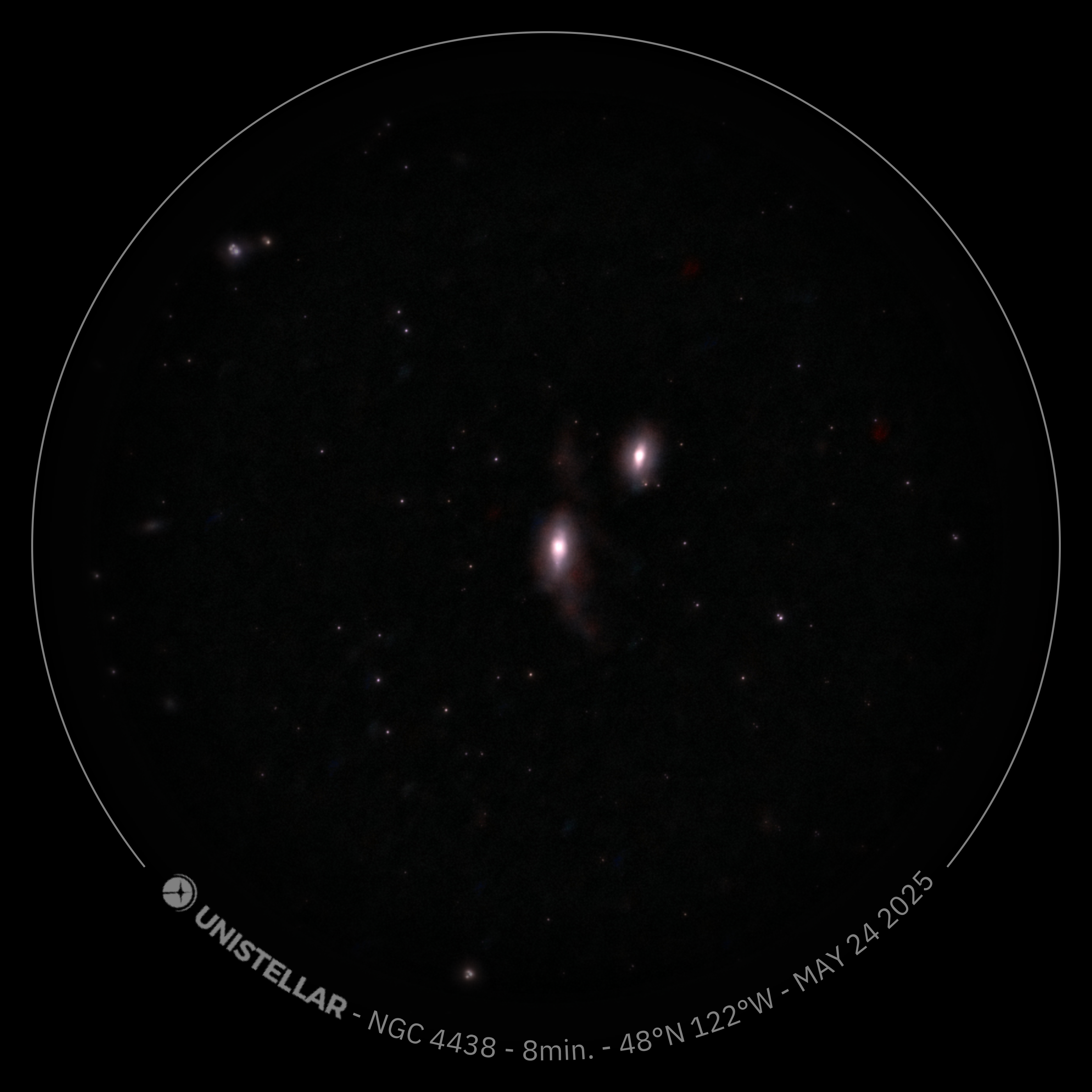
NGC 4435 and NGC 4438
8m
2025-05-24
Called “The Eyes”, these two galaxies are part of the Virgo Cluster. I wasn’t able to get a great shot of them this night; I’ll probably want to come back to them later.
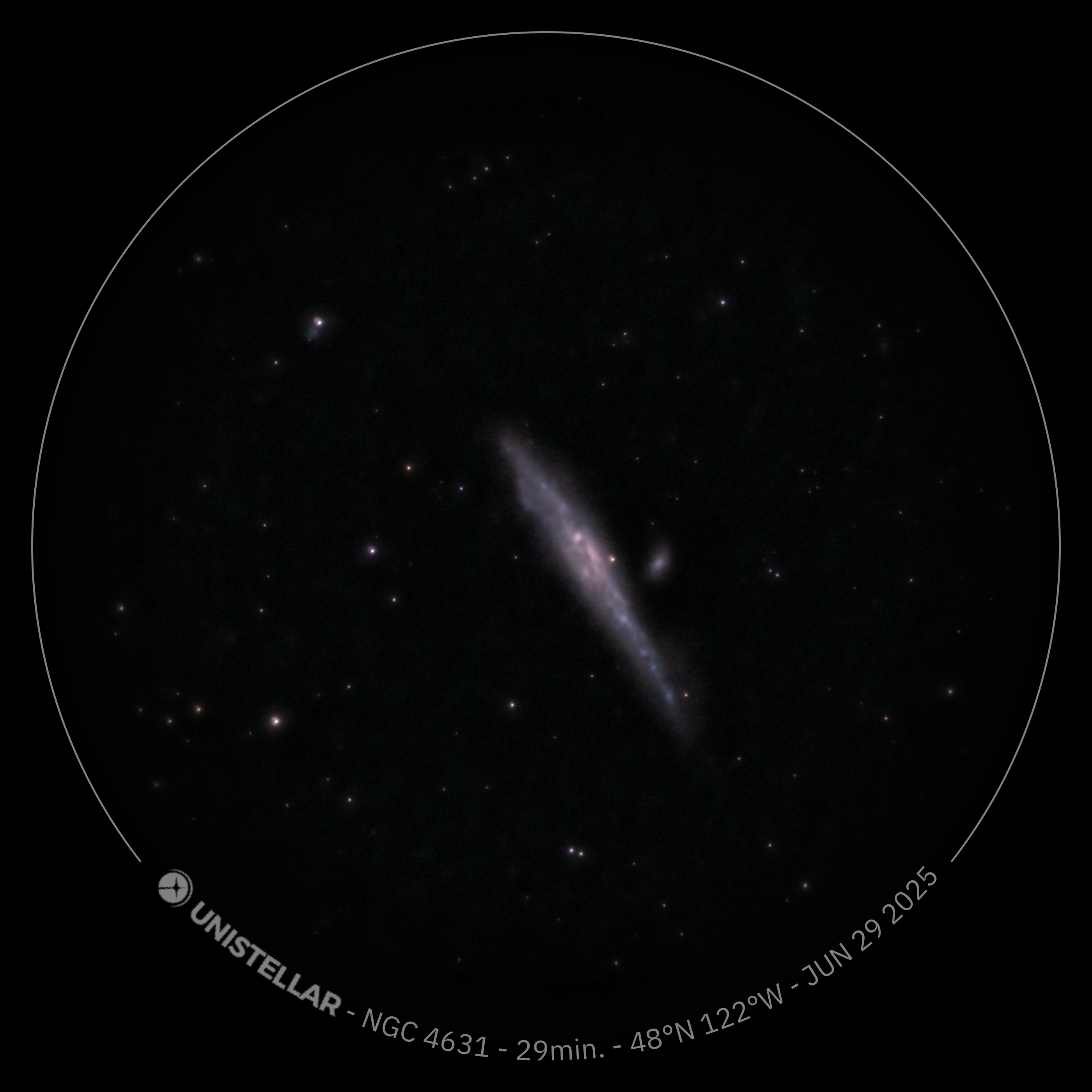
NGC 4631 and NGC 4627
29m
2025-06-29
Also called the Whale Galaxy due to its shape, this is part of the “NGC 4631 group,” which is then a part the Virgo cluster. NGC 4627 is a dwarf elliptical galaxy, and it’s the smudge just to the right of the galactic center. These two form a galaxy pair, meaning they are bound to each other and are in the process of colliding (and then combining).
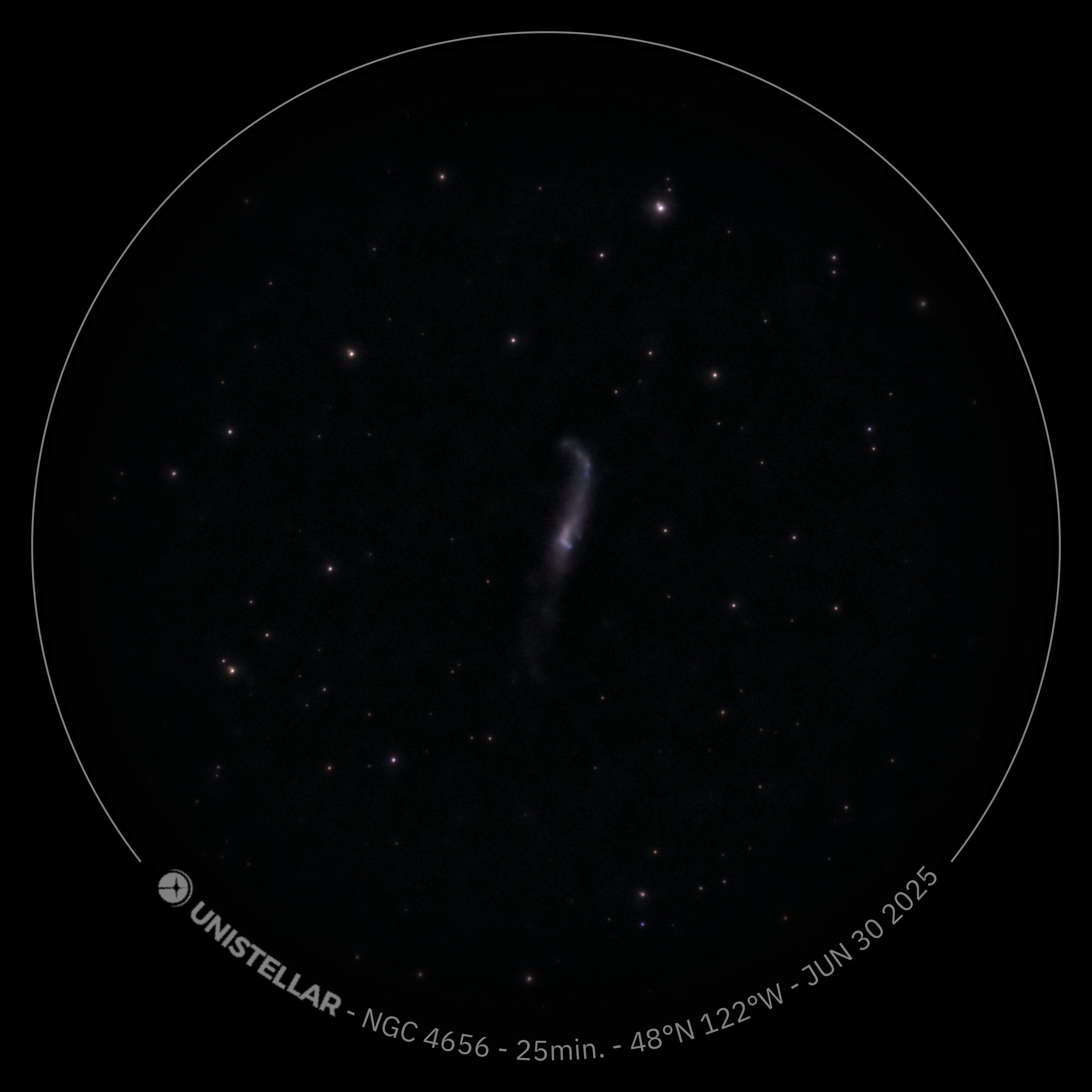
NGC 4656 and NGC 4657
25m
2025-06-30
Also called the Hockey Stick Galaxies, these strongly interacting galaxies are in the middle of a massive collision which will warp and reshape them over the next few hundred million years. These are very faint, and even a long exposure with the eVscope couldn’t get much detail.
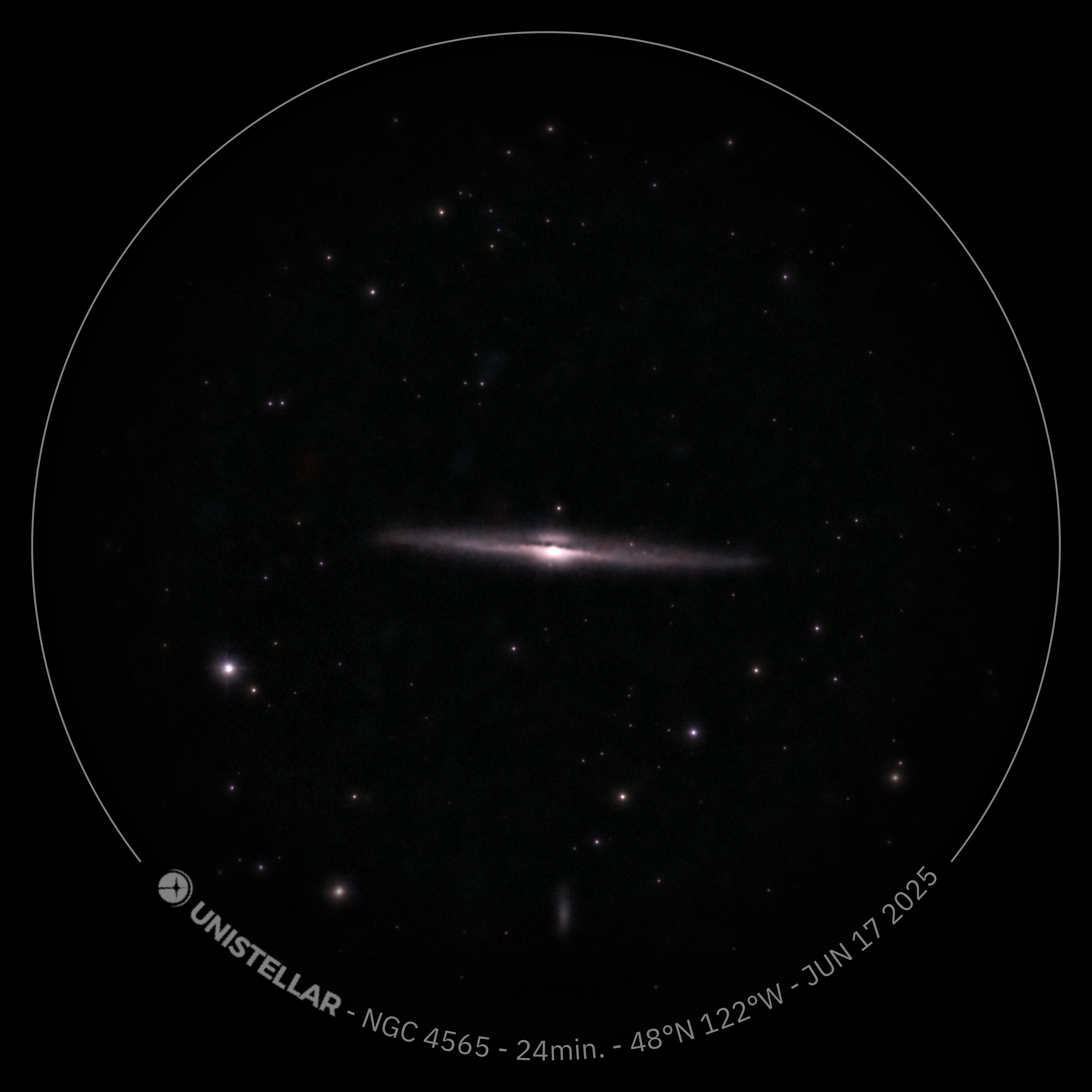
NGC 4565
24m
2025-06-17
Also referred to as the Needle Galaxy, this edge-on spiral galaxy has a strong dust band with a bright, spherical core.
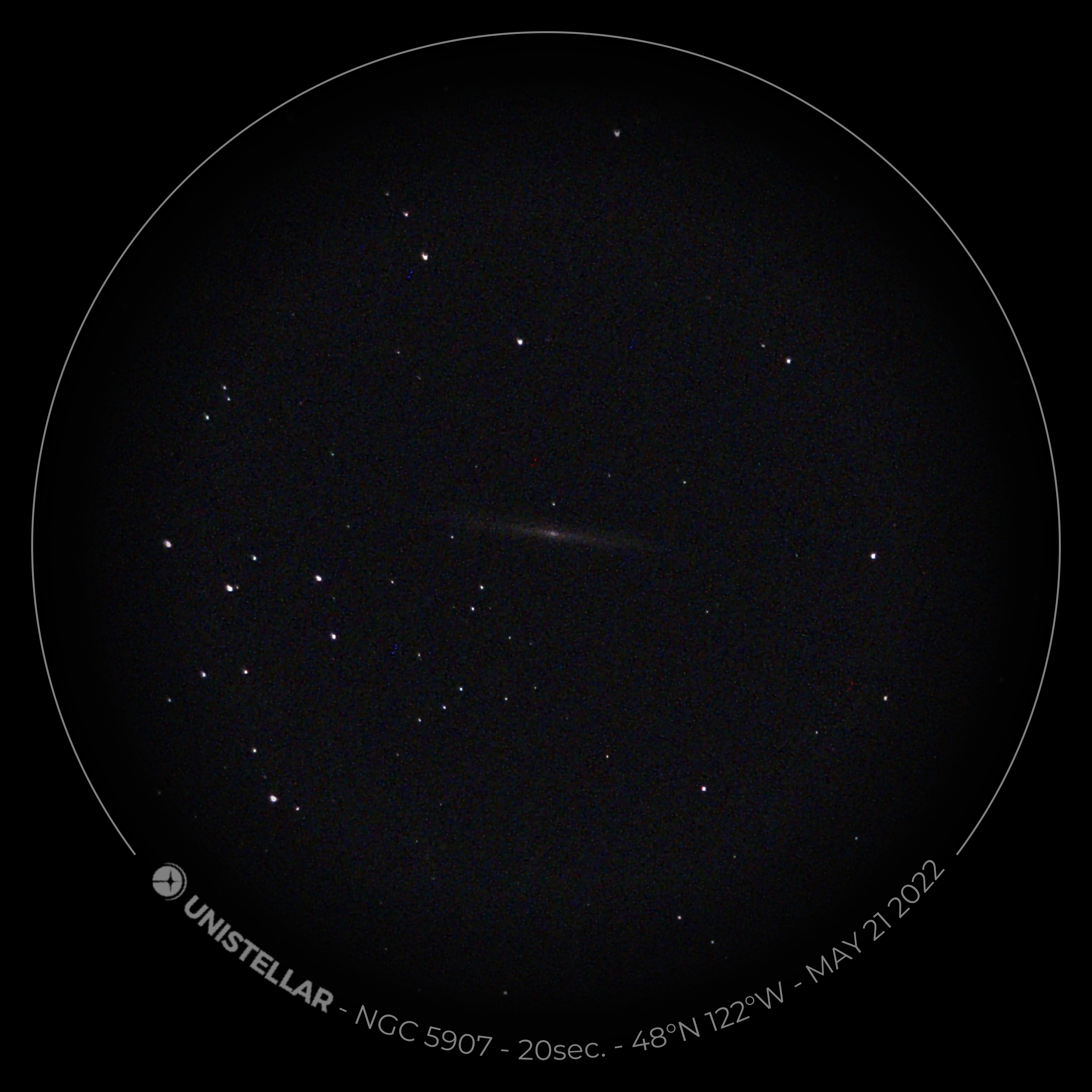
NGC 5907
20s
2022-05-21
Way too short. I think this was a failed auto-track, and I kept the image rather than tossing it. This could definitely use a re-visit.
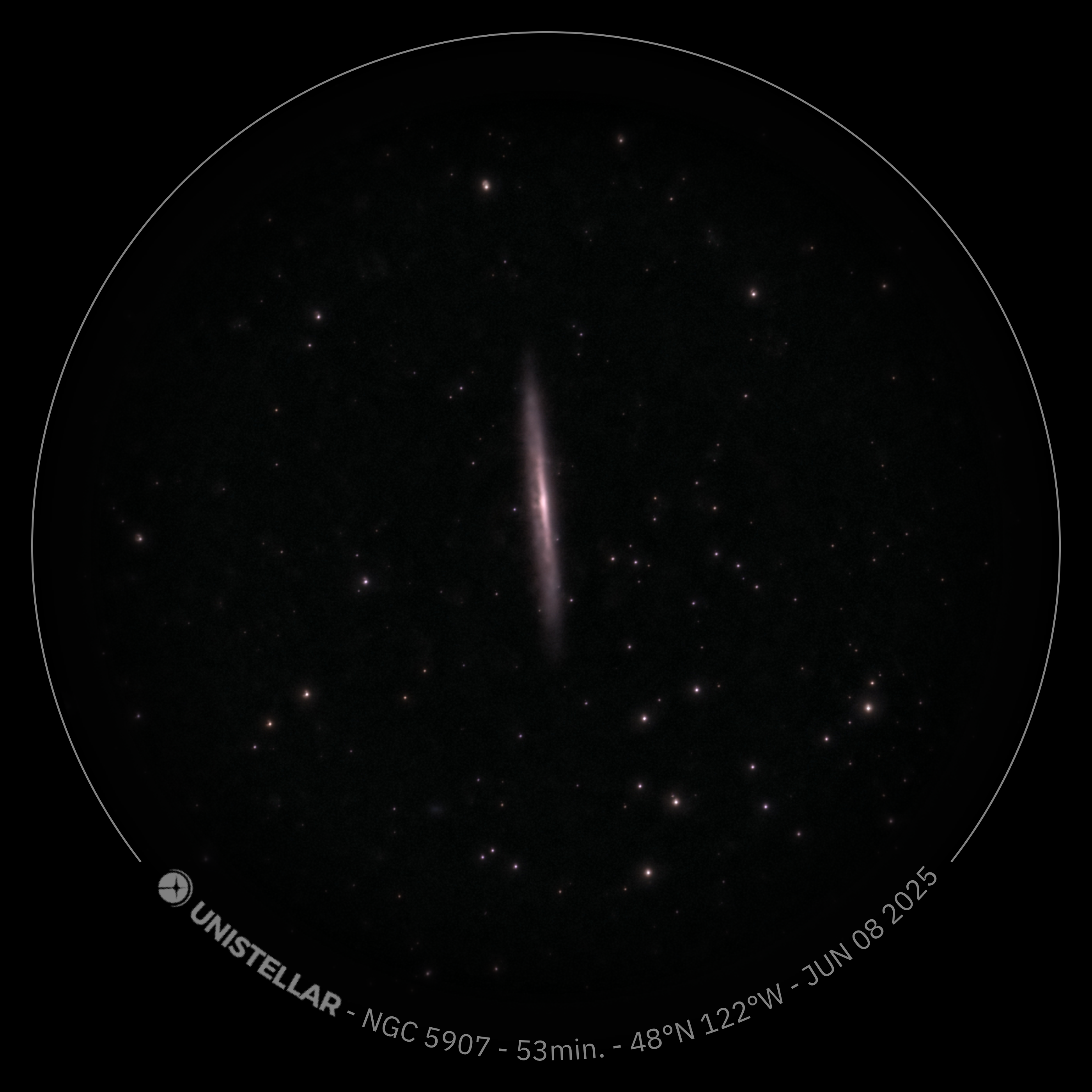
NGC 5907
53m
2025-06-08
A VERY edge-on spiral, and it seems the dust is spattered around the disk, making it somewhat mottled and dim. Nice picture though!
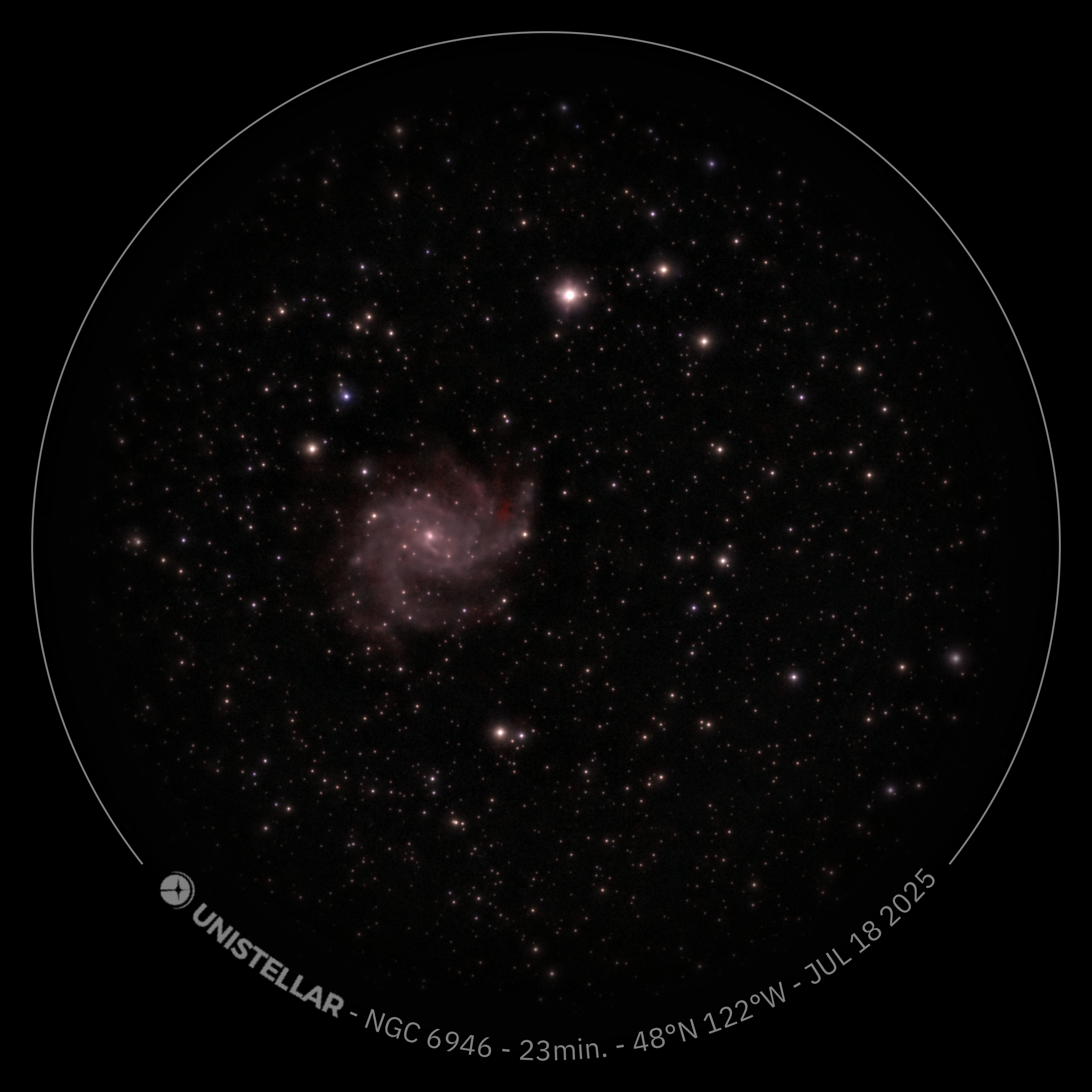
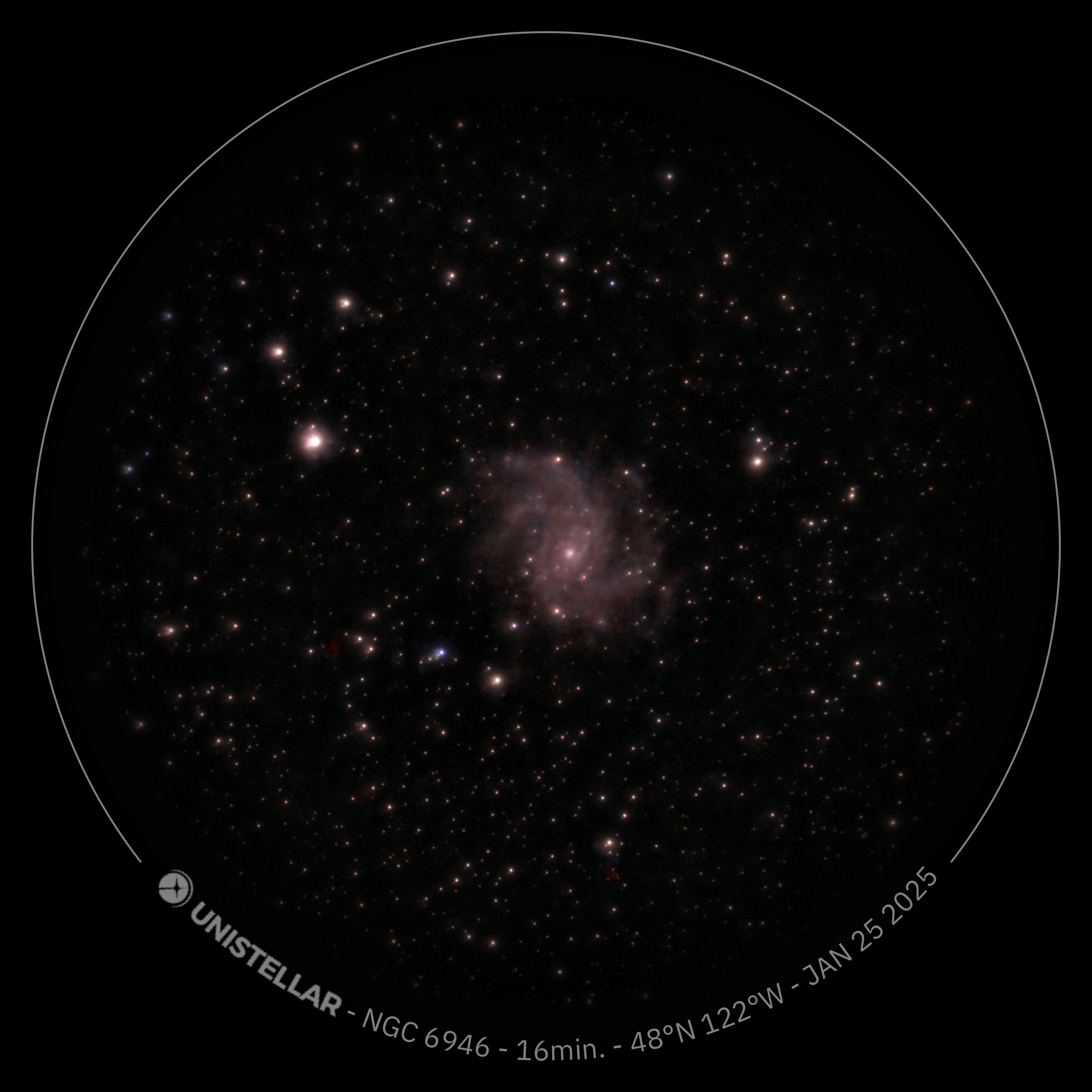
NGC 6946
16m
2025-01-25
I like this spiral – it’s a bit asymmetrical, and therefore distinct. I think the color stretching got a bit out of hand, though.
NGC 6946
23m
2025-07-18
I wanted to revisit NGC 6946, to see whether the color stretching was bad in the first one, or it really is that red of a galaxy. Turns out, it’s really that red!