I bought a Unistellar eVscope2 in 2022, and started taking lots of pictures. These are nebulae, which are one of the eVscope’s strengths. In October of 2024, Unistellar launched Vivid Vision Technology (VVT), which automatically sharpened and color-stretched the images. You can see the differences in the shots that I have below before and after the update.
It should be noted that when I talk about “size” below, it’s angular size. If you hold a ping pong ball at arm’s length, it’s going to look “bigger” than the cruise ship on the horizon, even though the ping pong ball is tiny compared to the ship. Same goes here – I’ll often compare things to “about the size of the moon,” because the moon appears just smaller than the circle in almost all of these photos. In reality, many of these nebulae are light-years across (a light-year is about 5.9 trillion miles or 9.5 trillion kilometers). That’s a smidge larger than our moon, at only two thousand miles (3.5 thousand kilometers).
B33 – Horsehead Nebula
55m
2025-01-25
This is probably my favorite shot (and if not, it’s clearly in the top 3), and I’ve rotated it 90 degrees to make the horse’s head upright. It’s one of my longest dwells, on a clear winter night, and you need to take a very long exposure to get this very dim nebula to come out. The color stretching did a lot of heavy lifting, here.

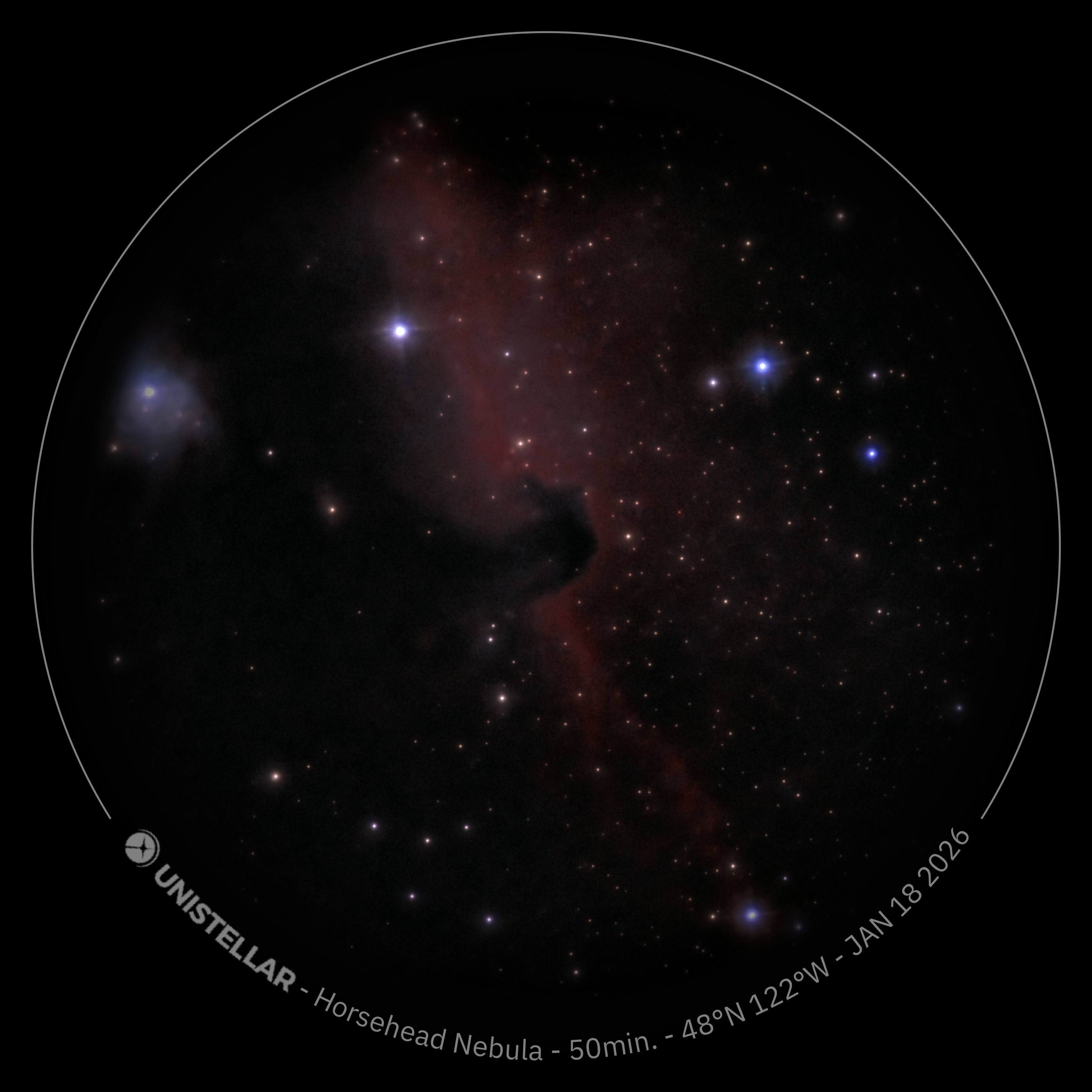
B33 – Horsehead Nebula
50m
2026-01-18
I finally got a good night to revisit one of my favorites, the Horsehead nebula, and it did not disappoint. Subtle reds and blues, and a beautiful dark cloud. Be sure to let this one run a long time!
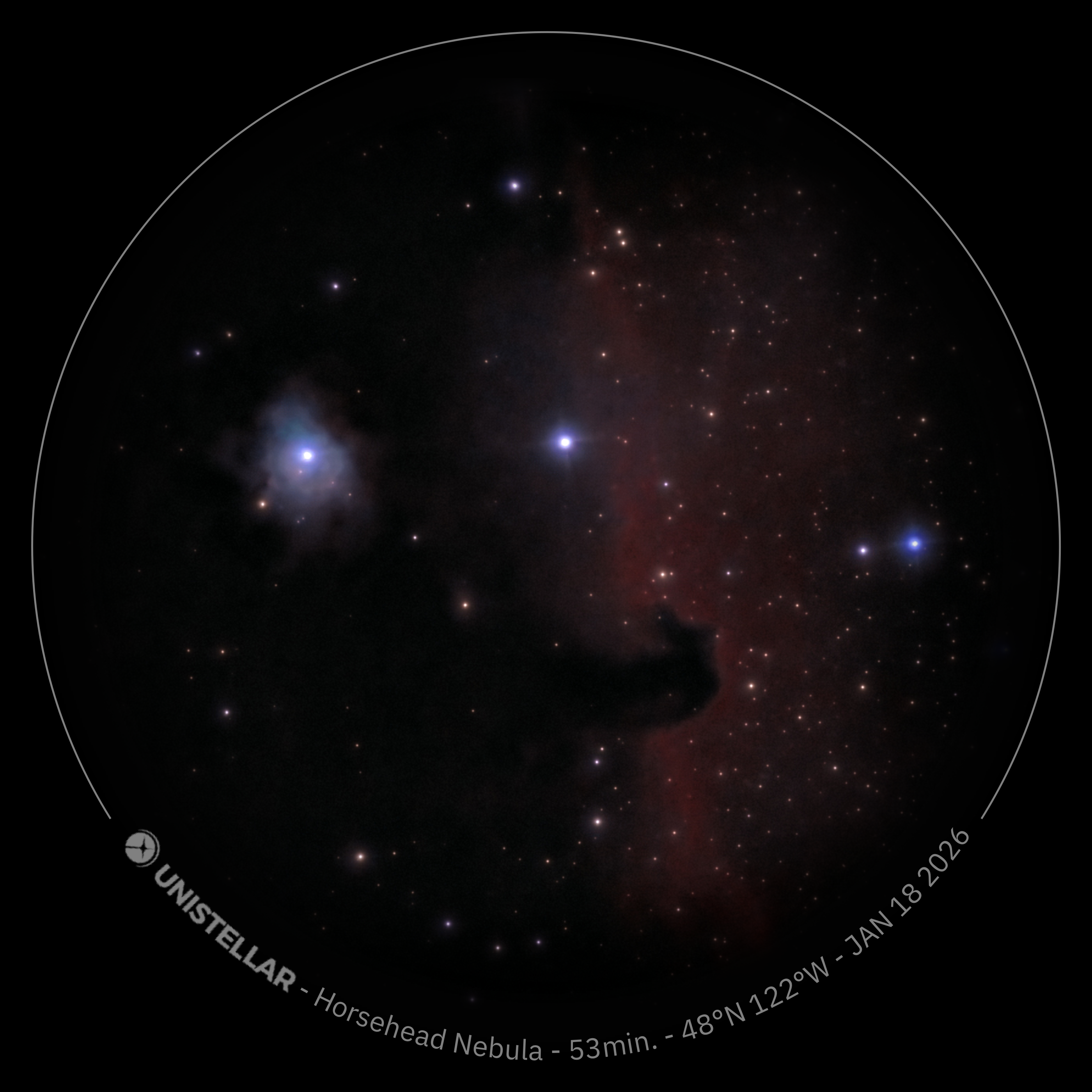
B33 – Horsehead Nebula
53m
2026-01-18
I wanted to recenter this one to capture more of that little nebula, to the left in this orientation.
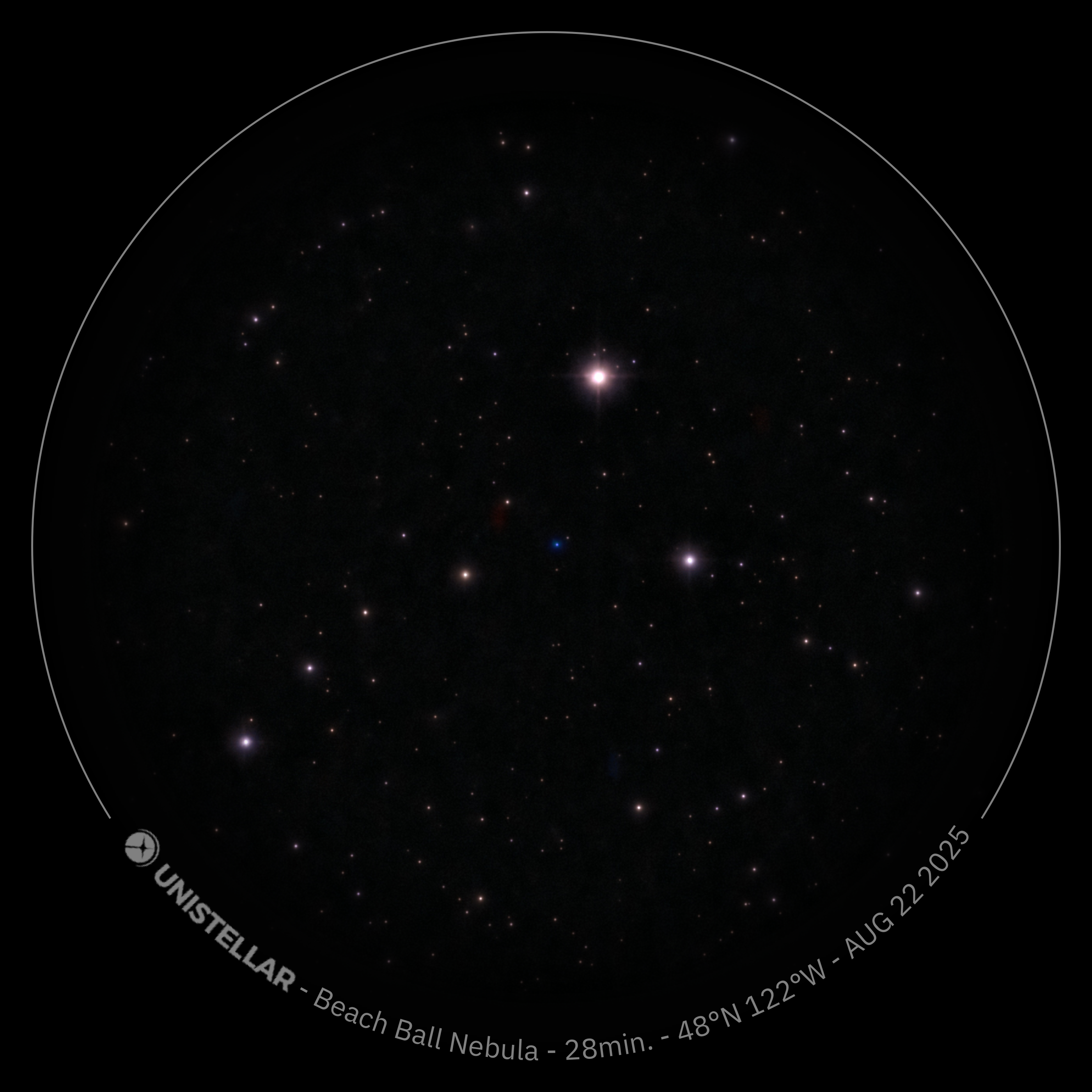
Beach Ball Nebula (NGC 6058)
28m
2025-08-22
An attempt at a new target, and it proved to be nothing much. If you zoom in on the middle, there’s a small blob of blue, maybe? Looking it up afterwards, it has an angular size of 24 arcseconds – about 1-2% of the width of the circle. Yeah, that’s as good as we’re gonna get.
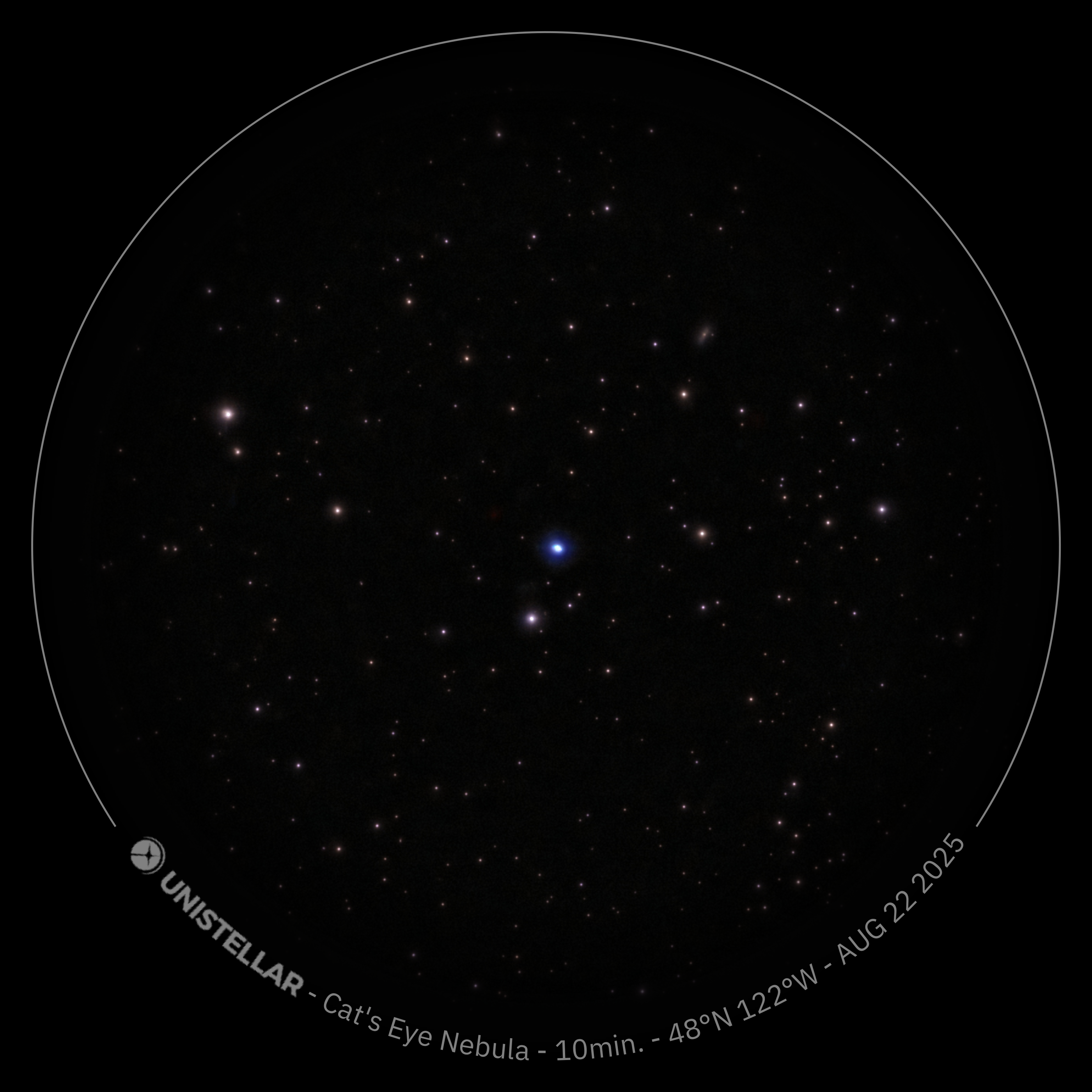
Cat’s Eye Nebula (Caldwell 6)
10m
2025-08-22
Another attempt at a new target, which proved to be not a good target for the eVscope 2. The core is the bright spot at the center, and with an angular size of only 25ish arcseconds; that’s tiny. The outer halo is 5 arc minutes, or about 1/6th the width of the circle, but it’s too dim for me to make out from inside a city, especially with such a short dwell time.
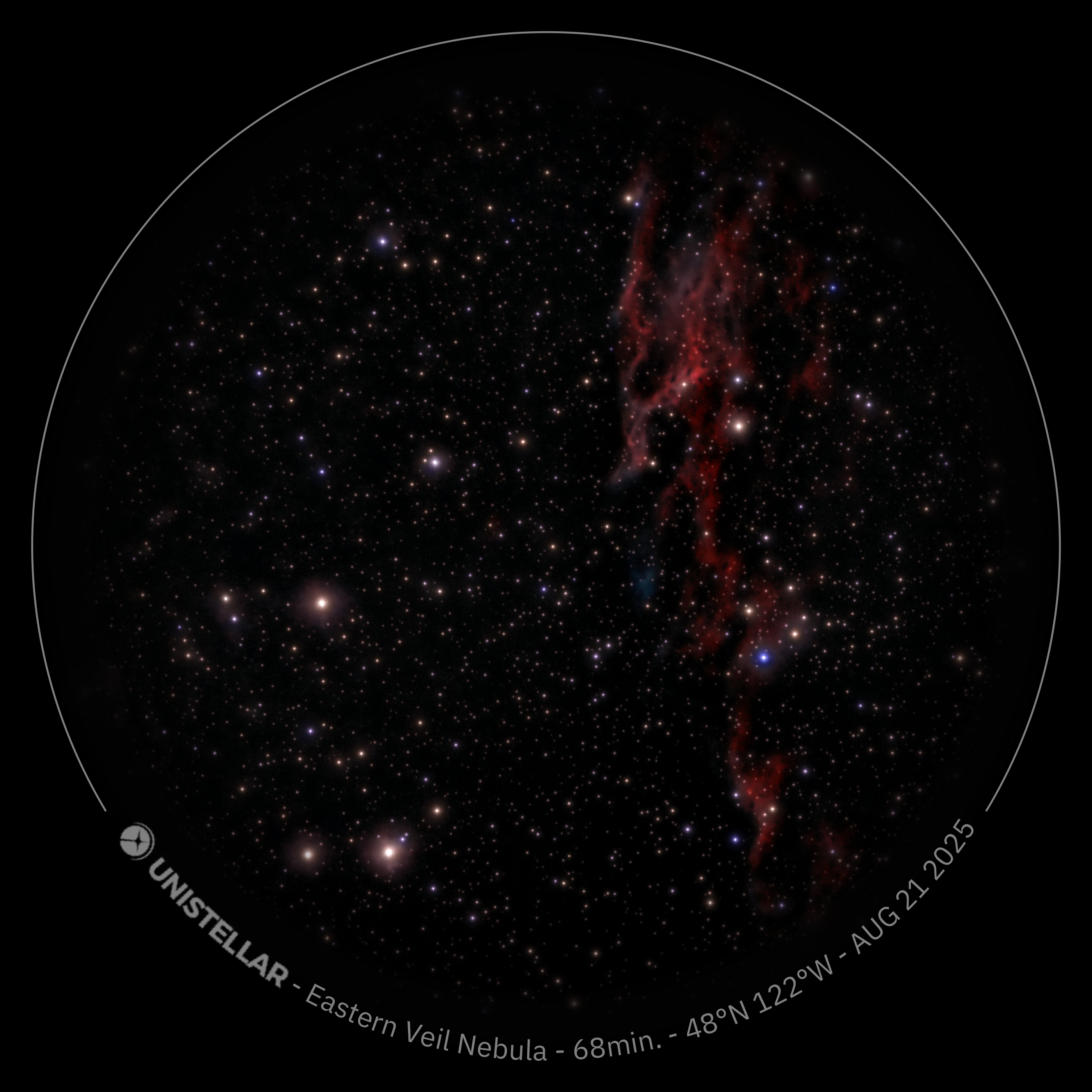
Eastern Veil Nebula (Caldwell 33)
68m
2025-08-21
The Veil Nebula is the visible part of a huge complex called the Cygnus Loop, which is the remnants of a supernova from 10-20 thousand years ago. The Eastern Veil is one of the larger and brighter bits, and it only shows up faintly despite the long dwell time.
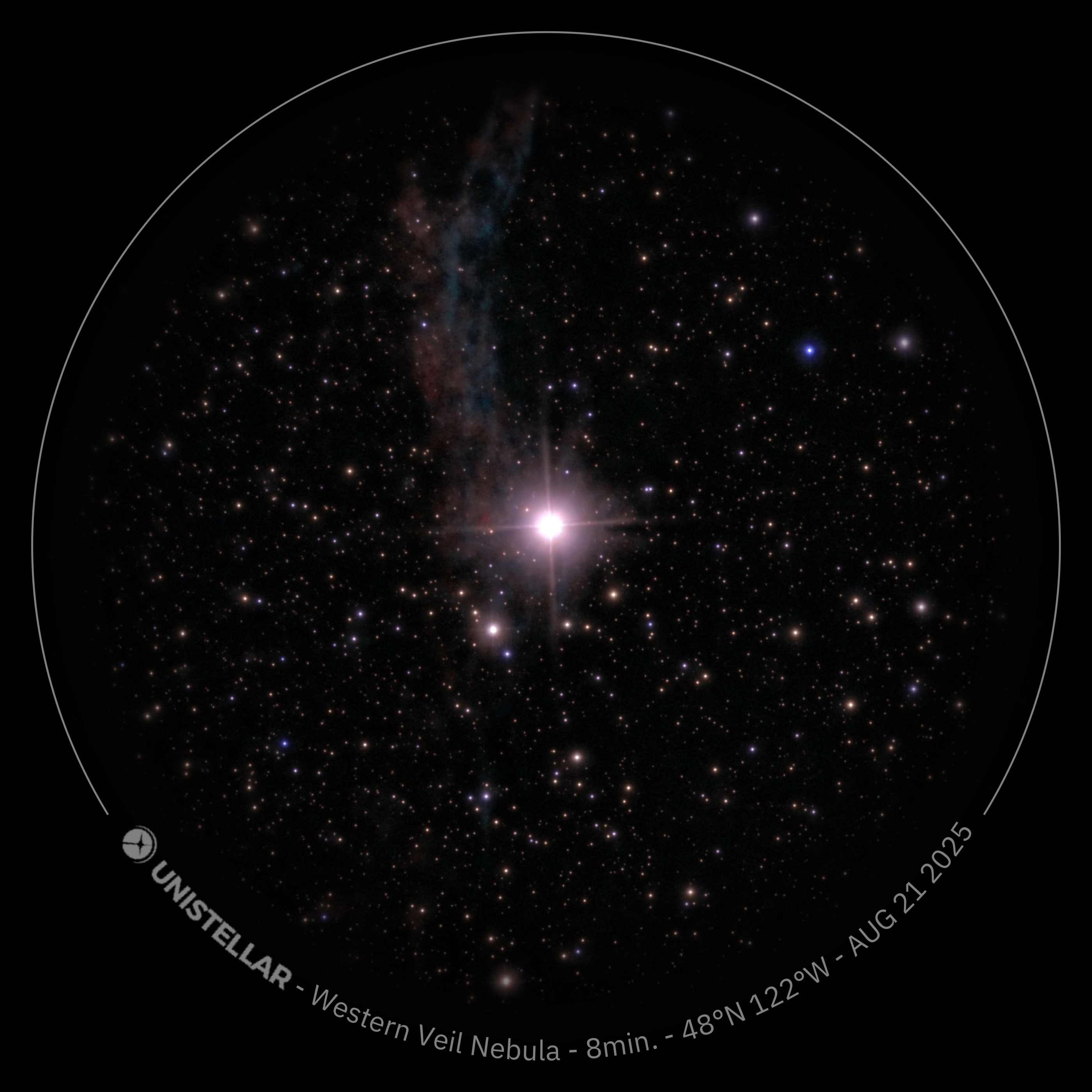
Western Veil Nebula (Caldwell 34)
8m
2025-08-21
The Western Veil is another bright part of the Cygnus Loop. This shot got interrupted, but even though it’s only 8 minutes, I really like the fact you can clearly make out both blue and red elements of the cloud.
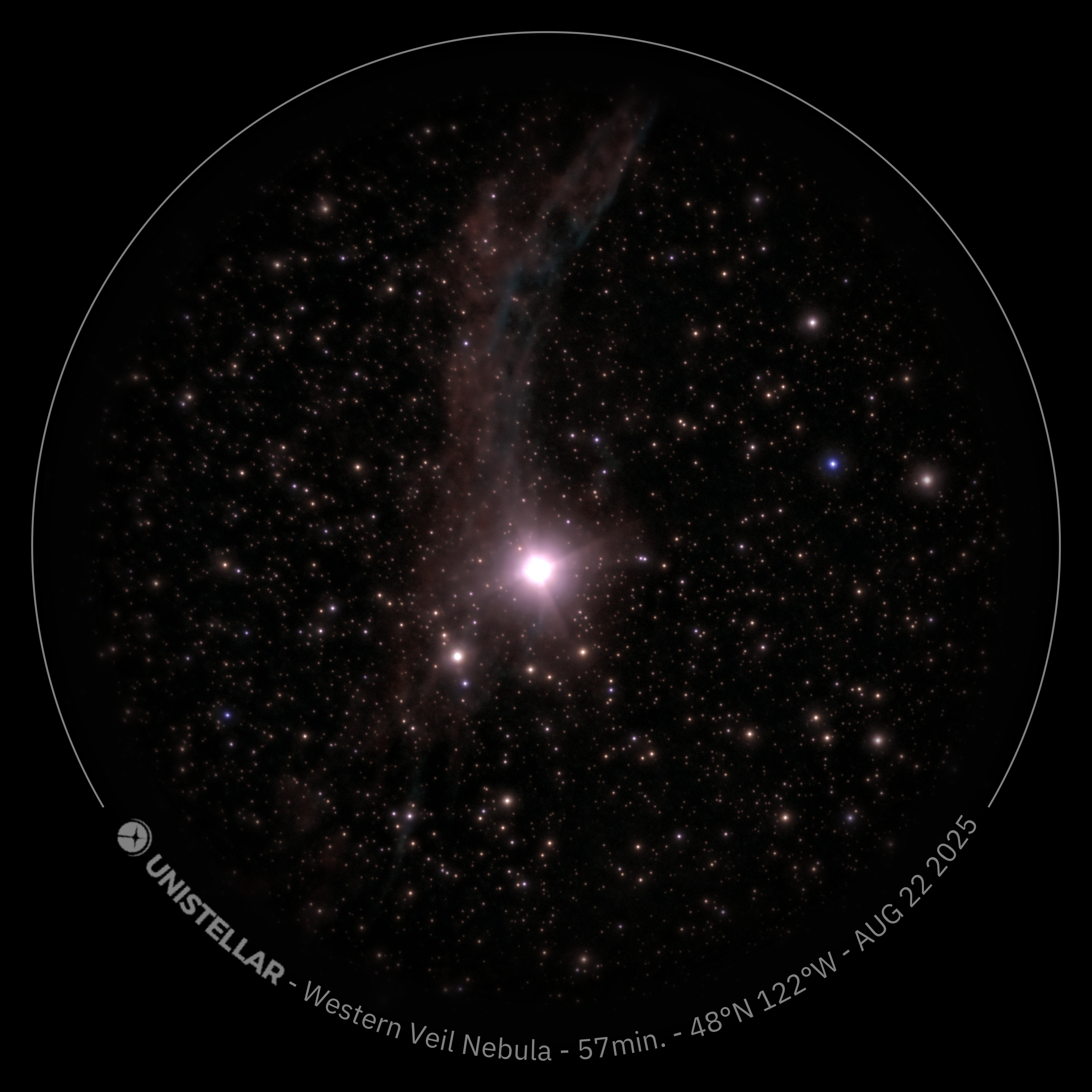
Western Veil Nebula (Caldwell 34)
57m
2025-08-21
A longer shot of the western veil, and even though this was almost an hour, you can only make out faint elements. The bright star is 52 Cygni, which is what’s called a “foreground star.” The veil nebula is about 1,470 light years away, whereas 52 Cygni is only around 201 light years away.
Elephant’s Trunk Nebula IC 1396A
63m
2025-08-22
If there’s a nebula here, I don’t see it. I even gave it over an hour of dwell time – it can produce great results on nebulae like the Horse’s Head or the Veil. Here? Nothing.
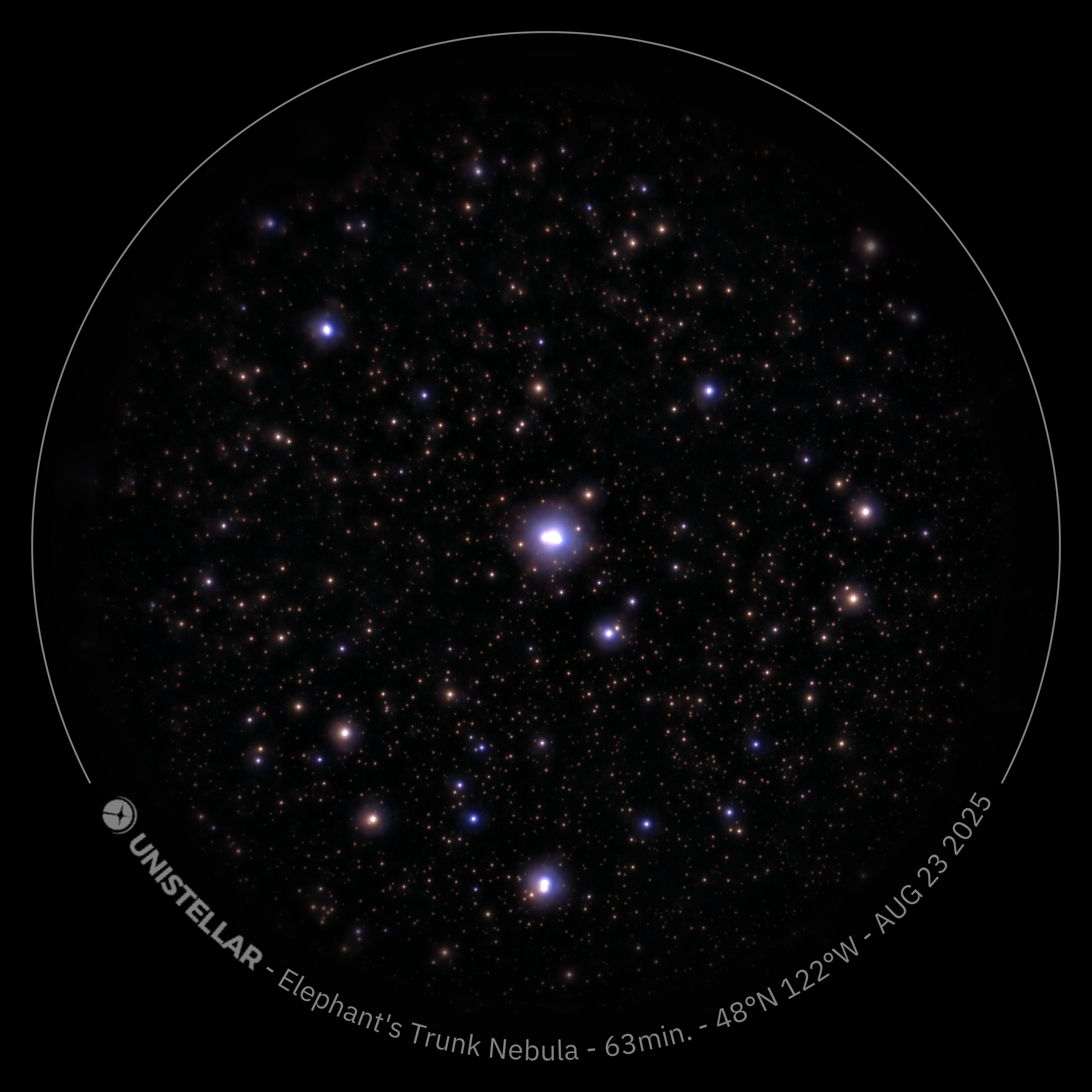
Note: The Unistellar catalog appears to be incorrect if you search for the Elephant’s Trunk (at least as of August 2025). The Elephant’s Trunk is part of a much larger nebula called IC 1396A, which is a nebula that’s six times wider than the field of view. The center of that nebula is HD 206267A, which is the super bright triple star in the center of the above image. IC 1396A is very boring in the middle (pictured above), but much more interesting around its edges. The problem here is that the Unistellar catalog is mis-targeting one of the small, interesting parts (called the Elephant’s Trunk) and aiming the camera at the center of the larger nebula complex.
Second attempt, this time with RA/declination coordinates specified:
IC1396 – Elephant’s Trunk Nebula
53m
2025-10-13
It’s the right spot, and it’s a long dwell time, and you can baaaaarely make out the hints of a nebula.

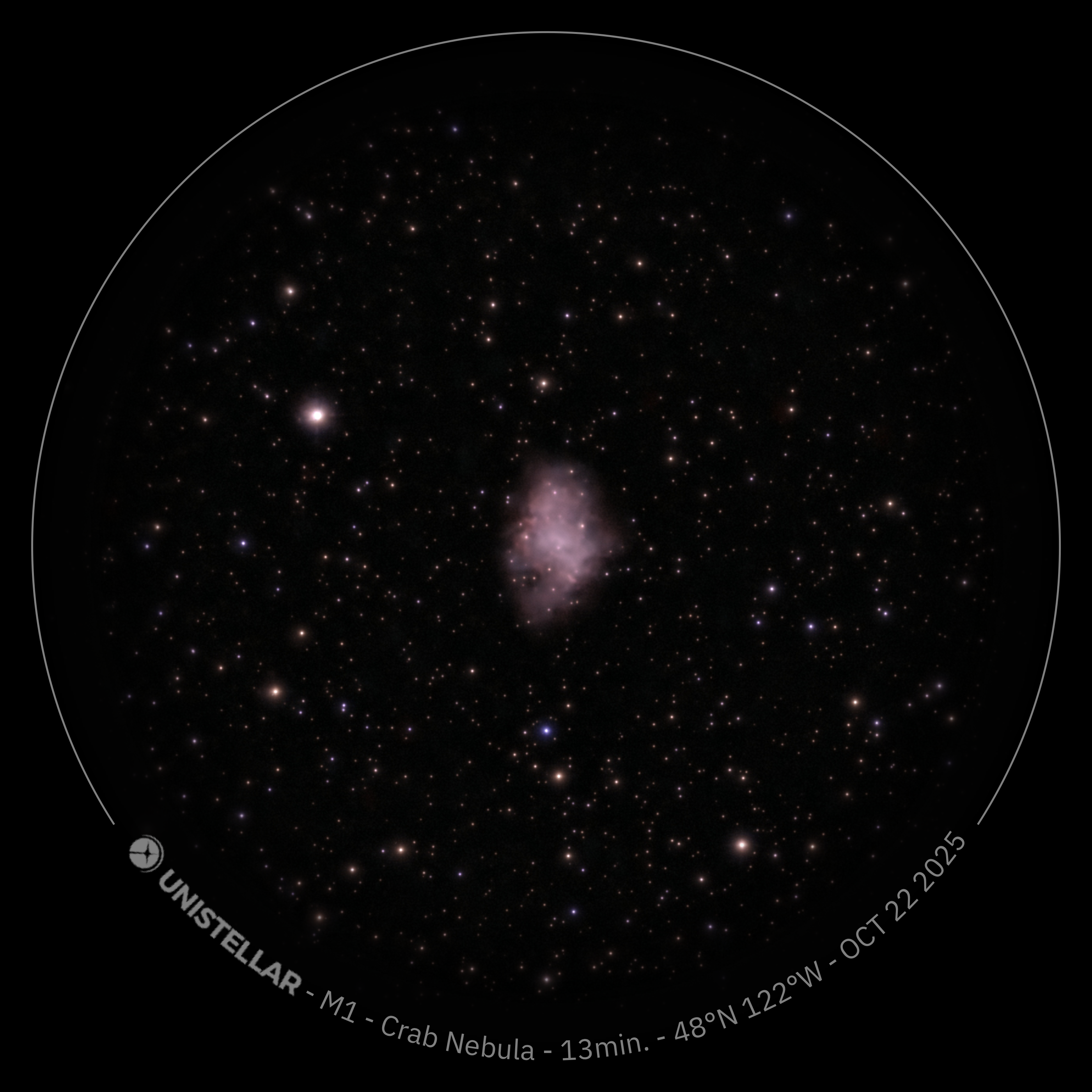
M1 – Crab Nebula
13m
2025-10-22
This nebula was the result of a supernova in 1054 C.E. which was observed and documented by cultures from Central America to Asia. It’s a nice little supernova remnant, and it’s actually bright enough that you can see it pretty easily with binoculars.
M8 – Lagoon Nebula
2m
2024-08-12
This was shortly before the launch of the new software, with color stretching and image sharpening, and you can compare it to the next one…

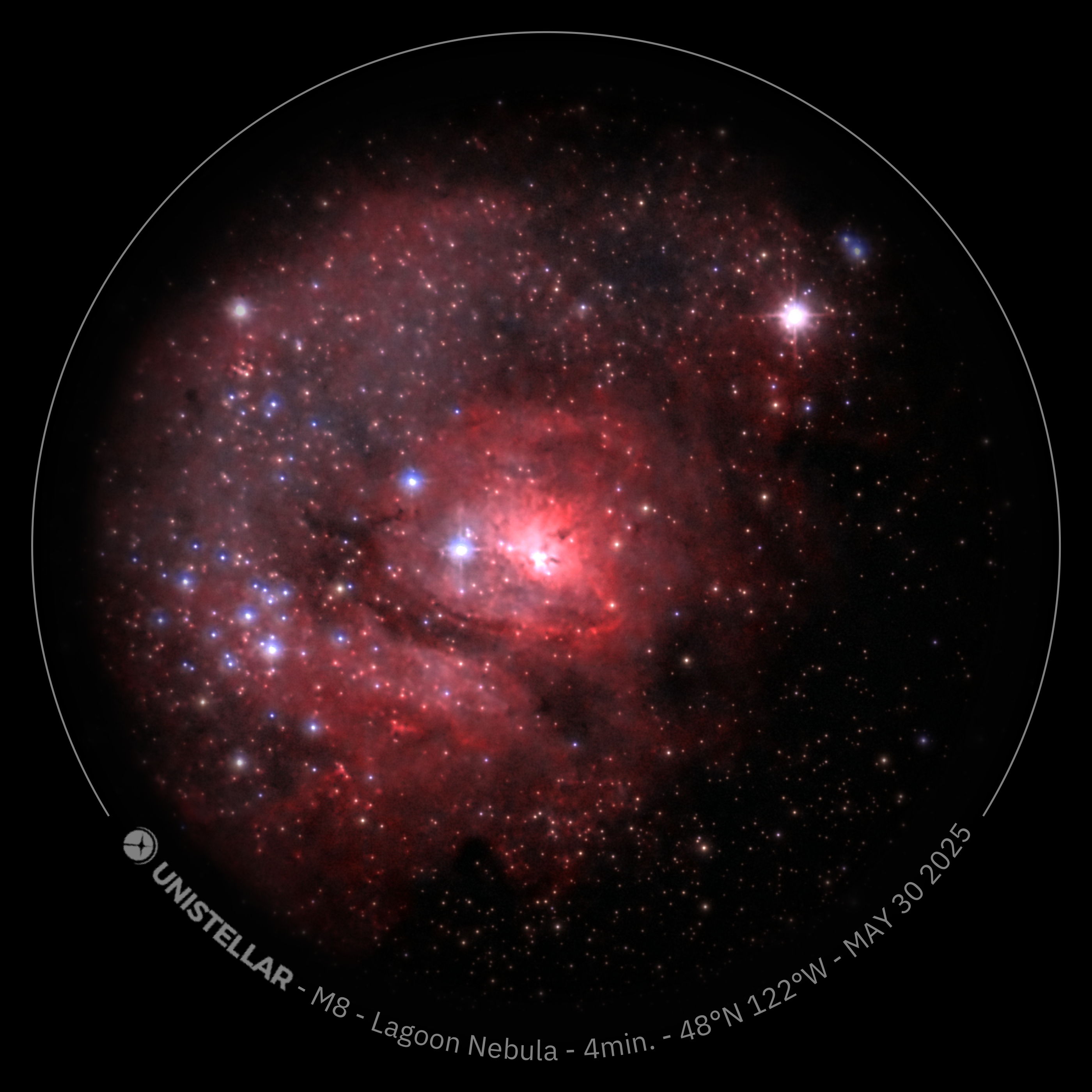
M8 – Lagoon Nebula
4m
2025-05-30
I took this one and the next one the same night, and despite this one being the shorter exposure, I feel like it might be better. The color stretching software is pretty cool.
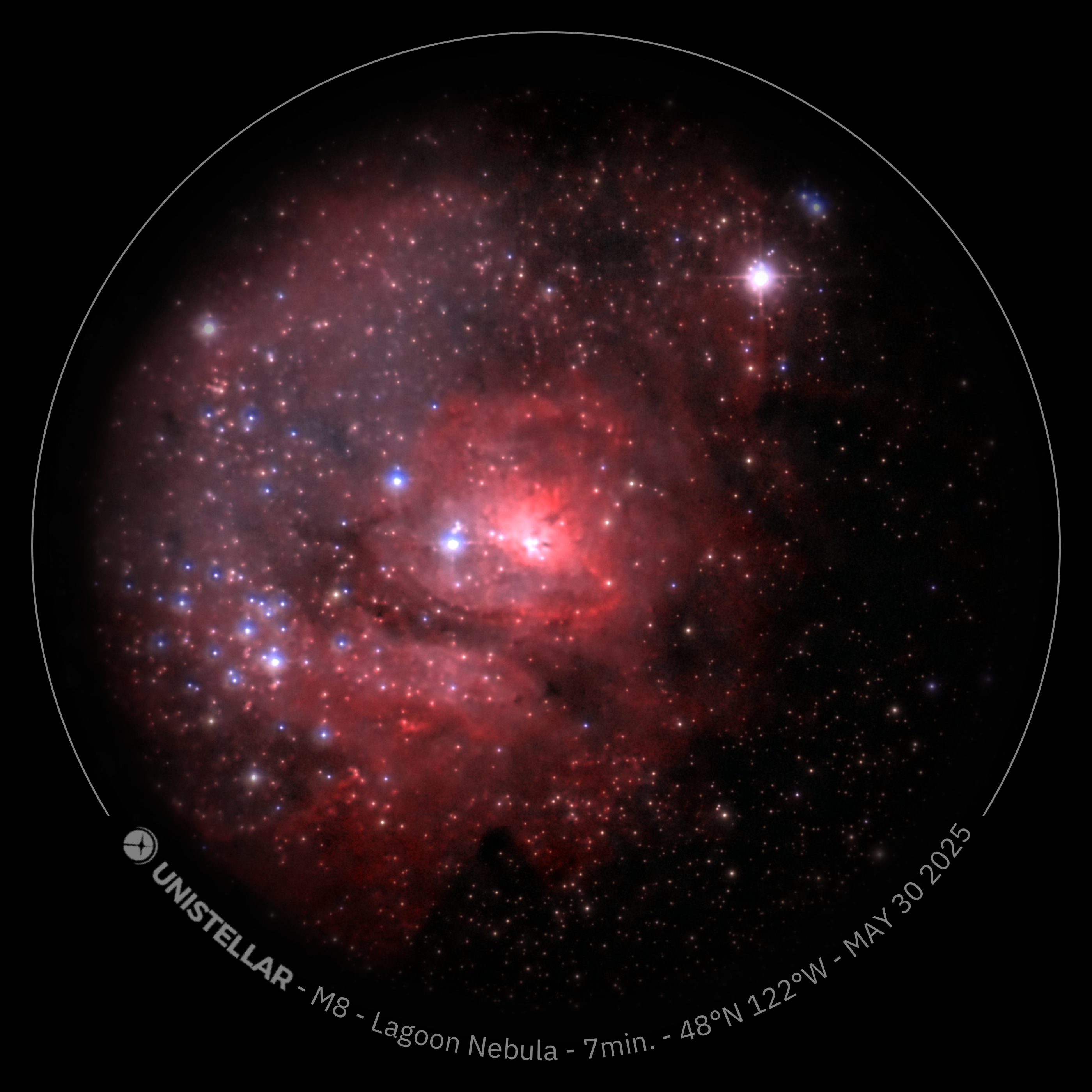
M8 – Lagoon Nebula
7m
2025-05-30
I took this one and the last one on the same night, and the colors are more vibrant here, but it’s also a fuzzier image. Maybe a thin cloud passed overhead? Hard to tell.
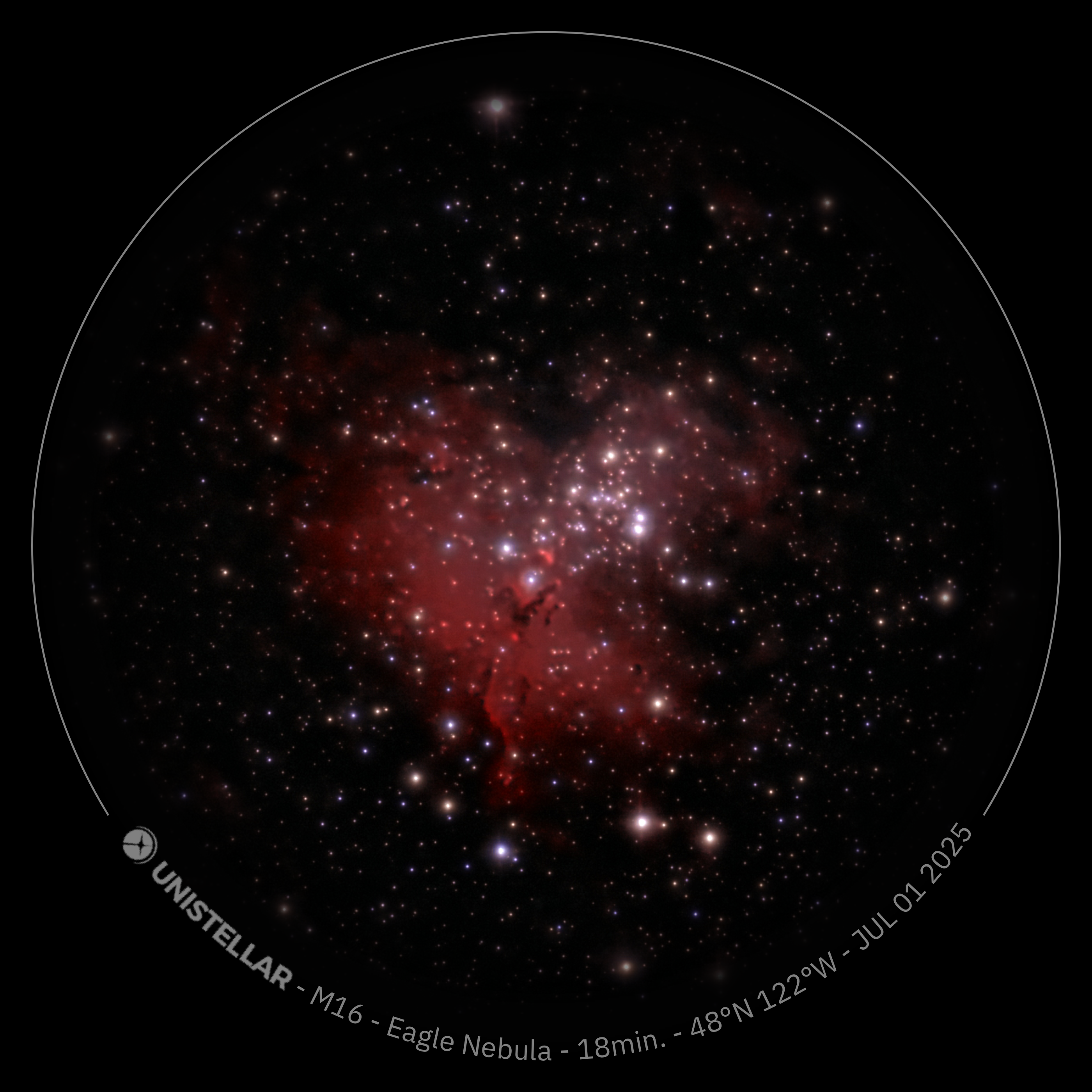
M16 – Eagle Nebula
18m
2025-07-01
After the first minute or two, this was only a dull red blotch. Even so, I decided to leave it running, and when I came back 15 minutes later, was blown away. Zoom in on the center of this image, and note the detail in the clouds. Those pillars are light-years tall. And I can take a picture of them from my back porch. Maybe my new favorite picture with the eVscope 2.
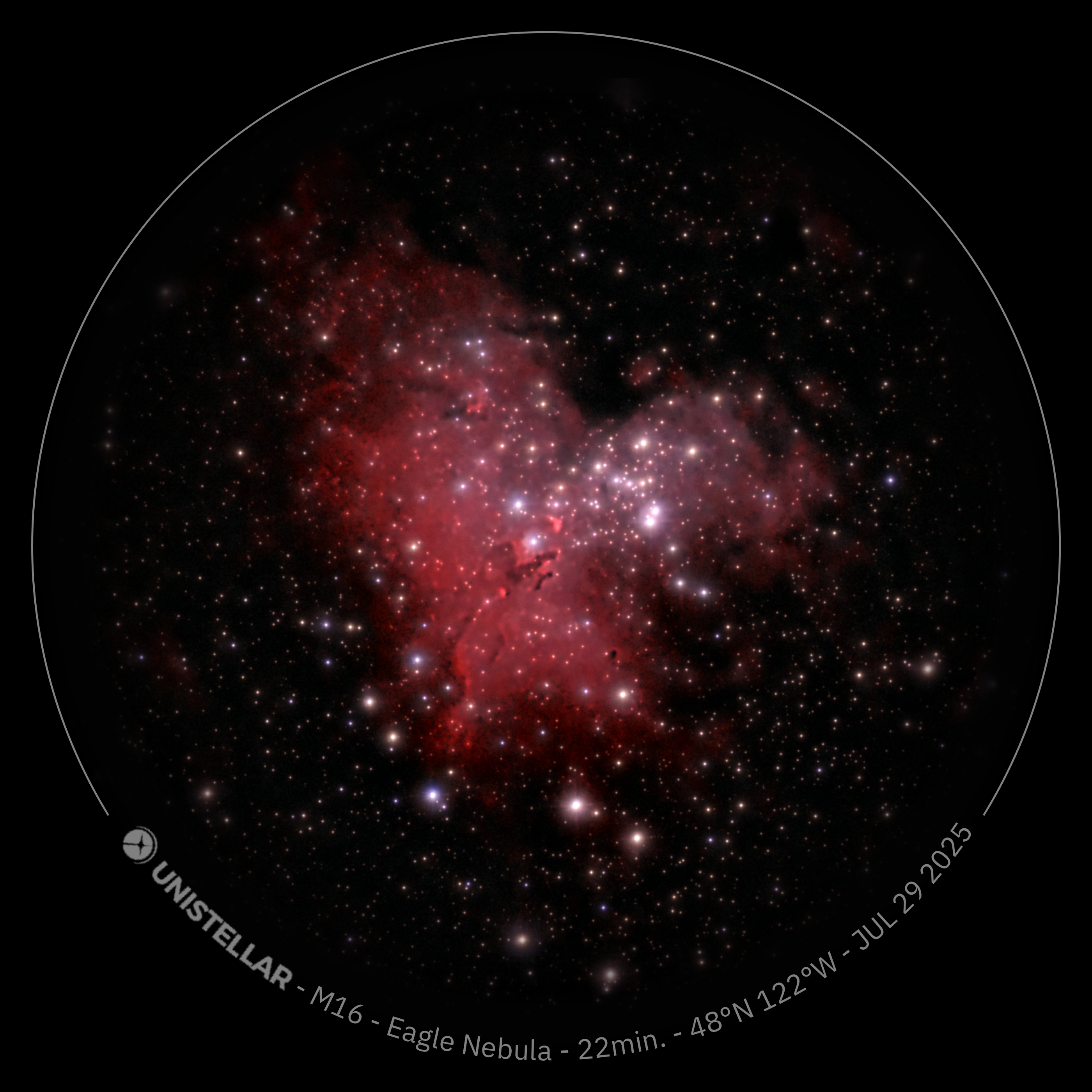
M16 – Eagle Nebula
2025-07-29
22m
Another fantastic shot, including the Pillars of Creation. This is one of the best nebulae that you can capture with the eVscope.
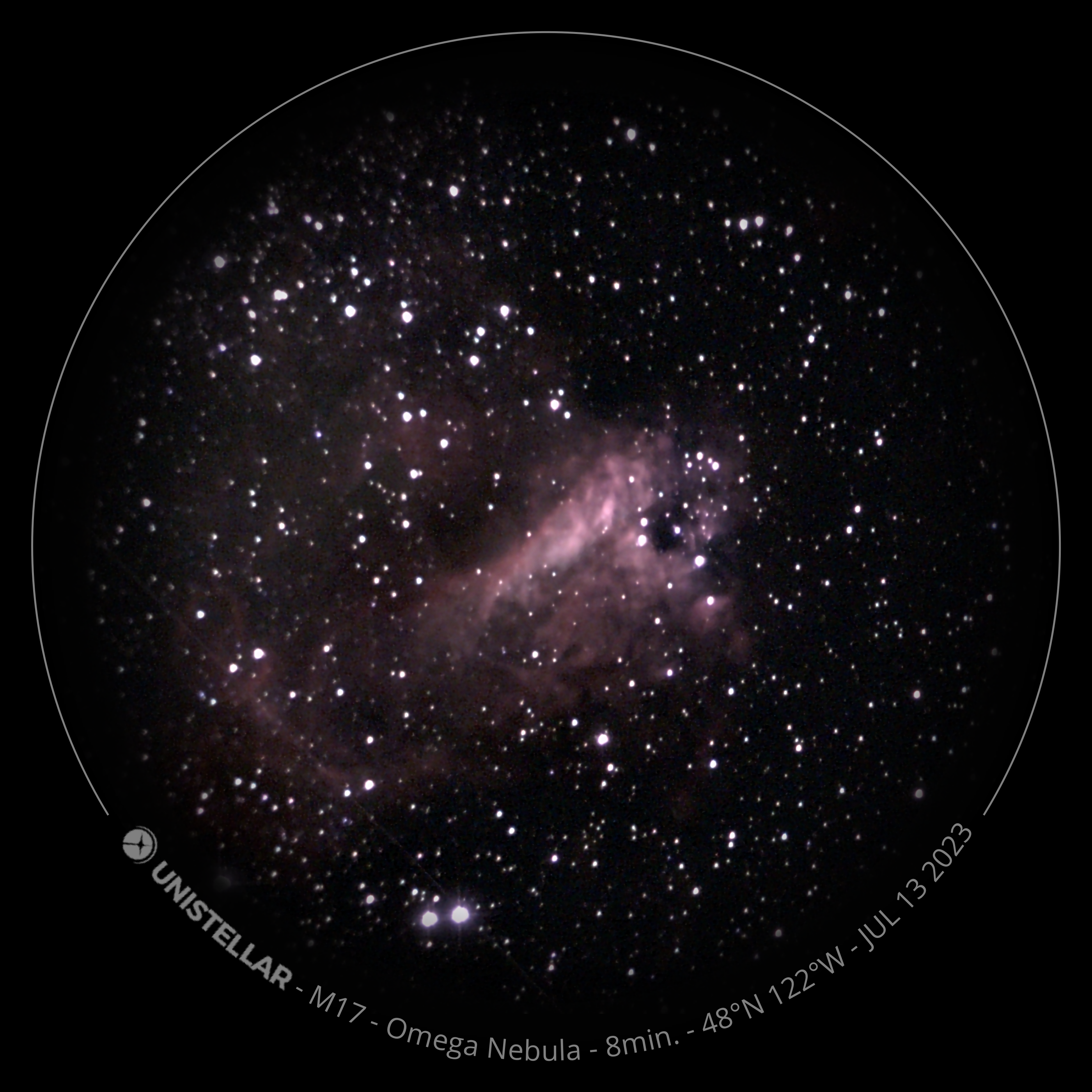
M17 – Omega Nebula
8m
2023-07-13
This was one of my early attempts at the Omega Nebula, which is both large (almost the size of the moon) and relatively bright.
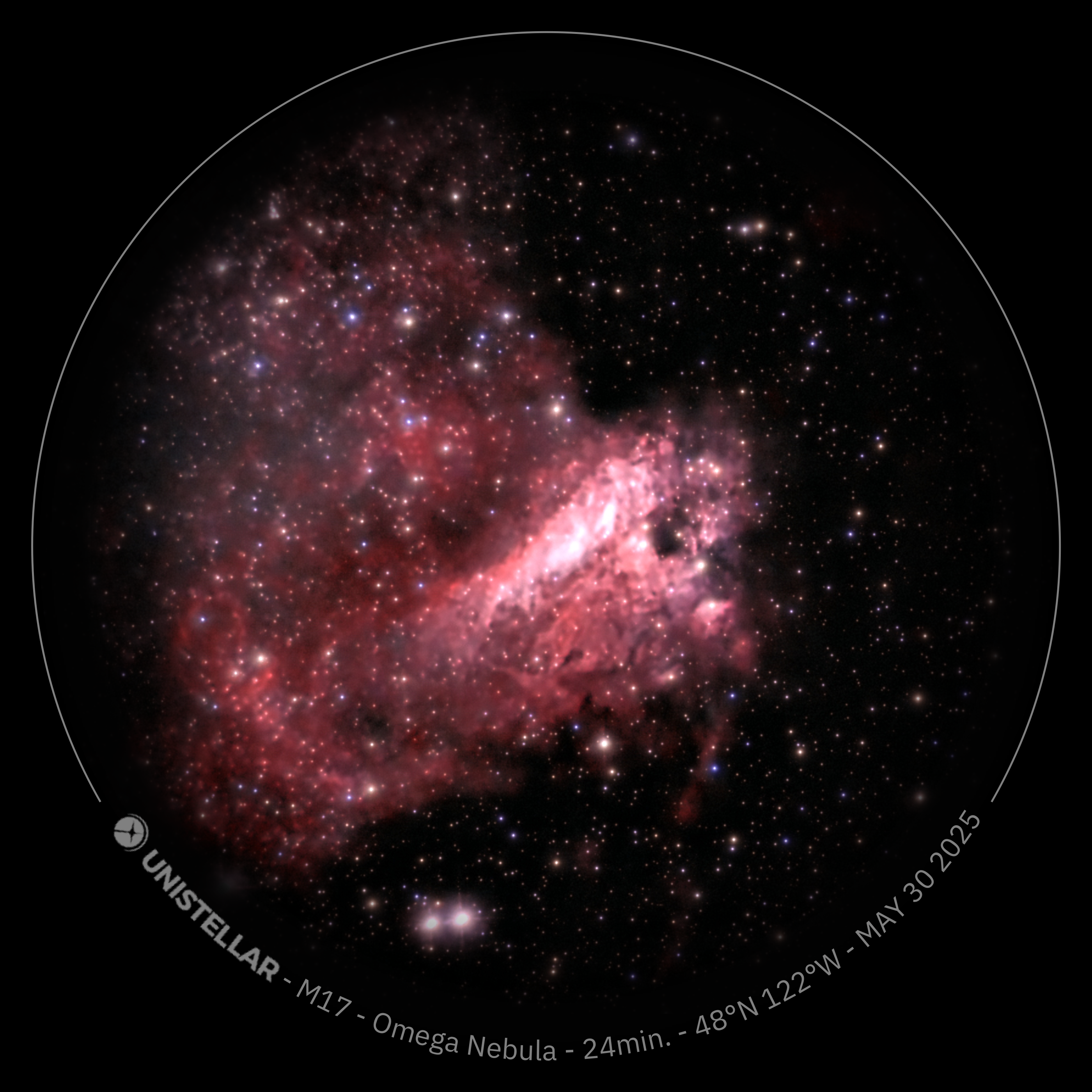
M17 – Omega Nebula
24m
2025-05-30
Now you can really see the improvements from sharpening and color-stretching the images. This is a much more vibrant image, with crisper contrasts.
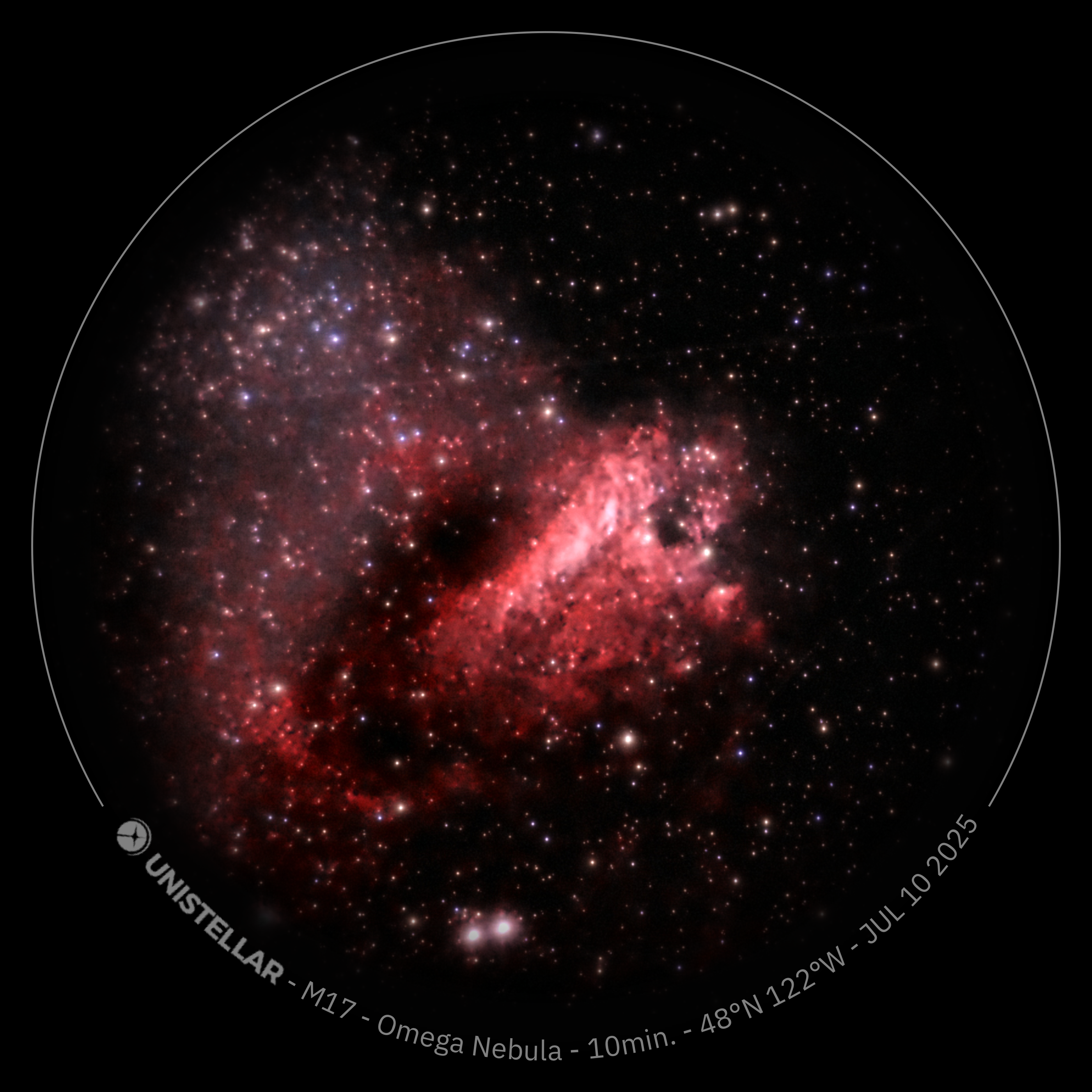
M17 – Omega Nebula
10m
2025-07-10
A nice shot of the Omega Nebula, but it was cut short at only 10 minutes of dwell time due to high clouds.
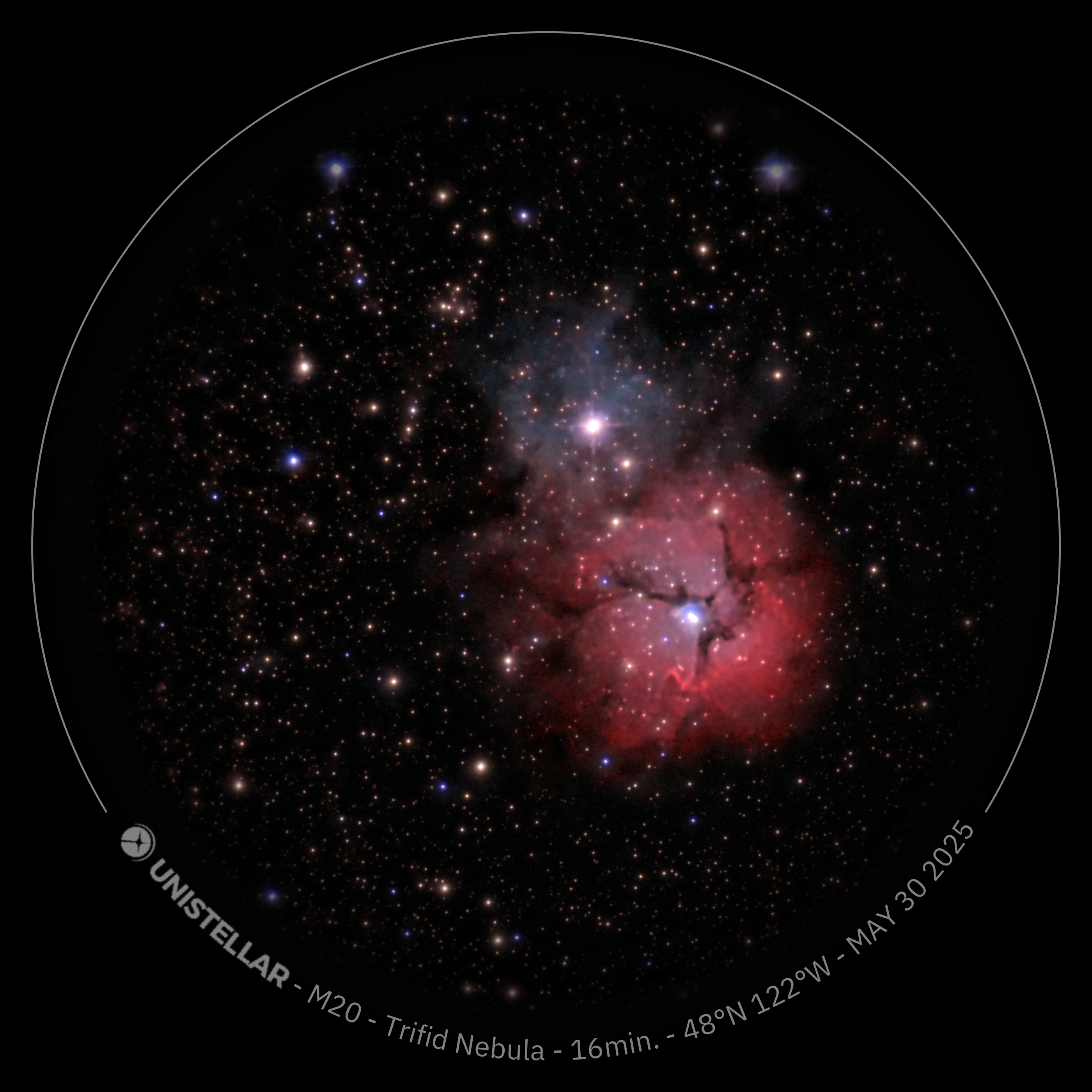
M20 – Trifid Nebula
16m
2025-05-30
The Trifid Nebula is actually three nebulae: a dense, red, emission nebula, a wispier blue reflection nebula, and a spiky, shadowy dark nebula in front. The VVT software update really makes this an excellent nebula for the eVscope to image.
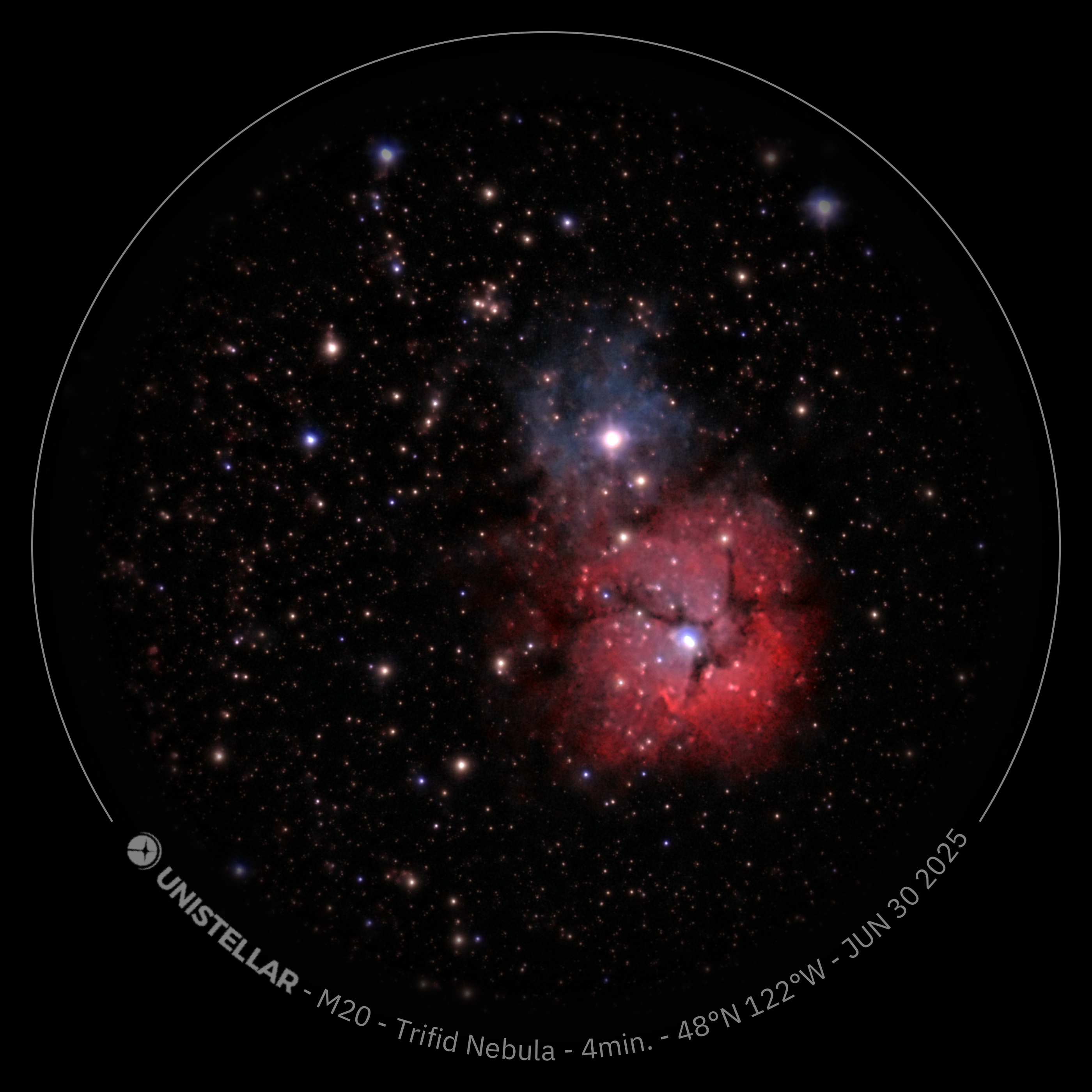
M20 – Trifid Nebula
4m
2025-06-30
It surprises me that I can get such bright colors with only a 4 minute exposure. High clouds interrupted this shot, unfortunately.
M27 – Dumbbell Nebula
4m
2023-07-01
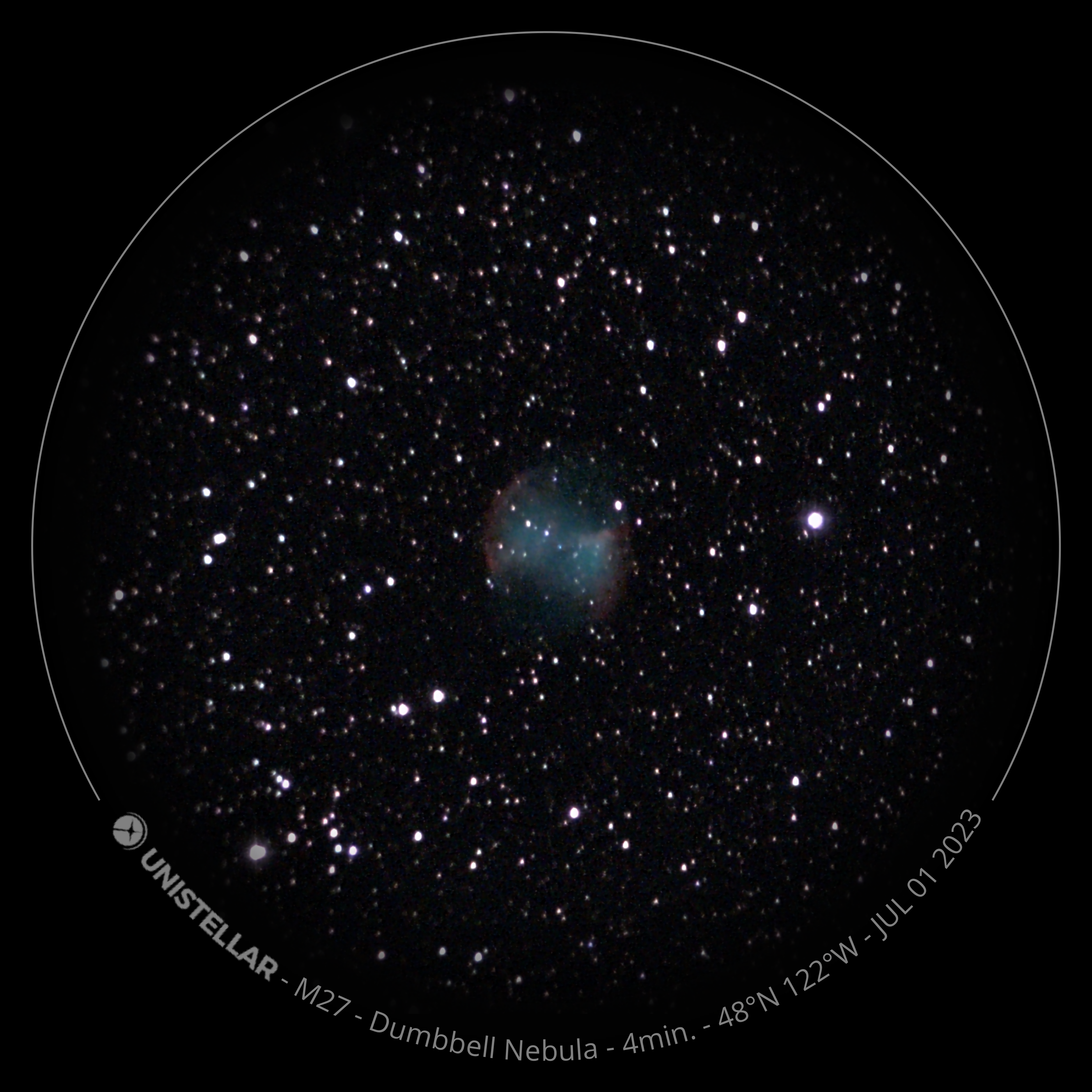
Not a long enough exposure at 4 minutes, you lose most of the detail and can only barely make out the nebula.
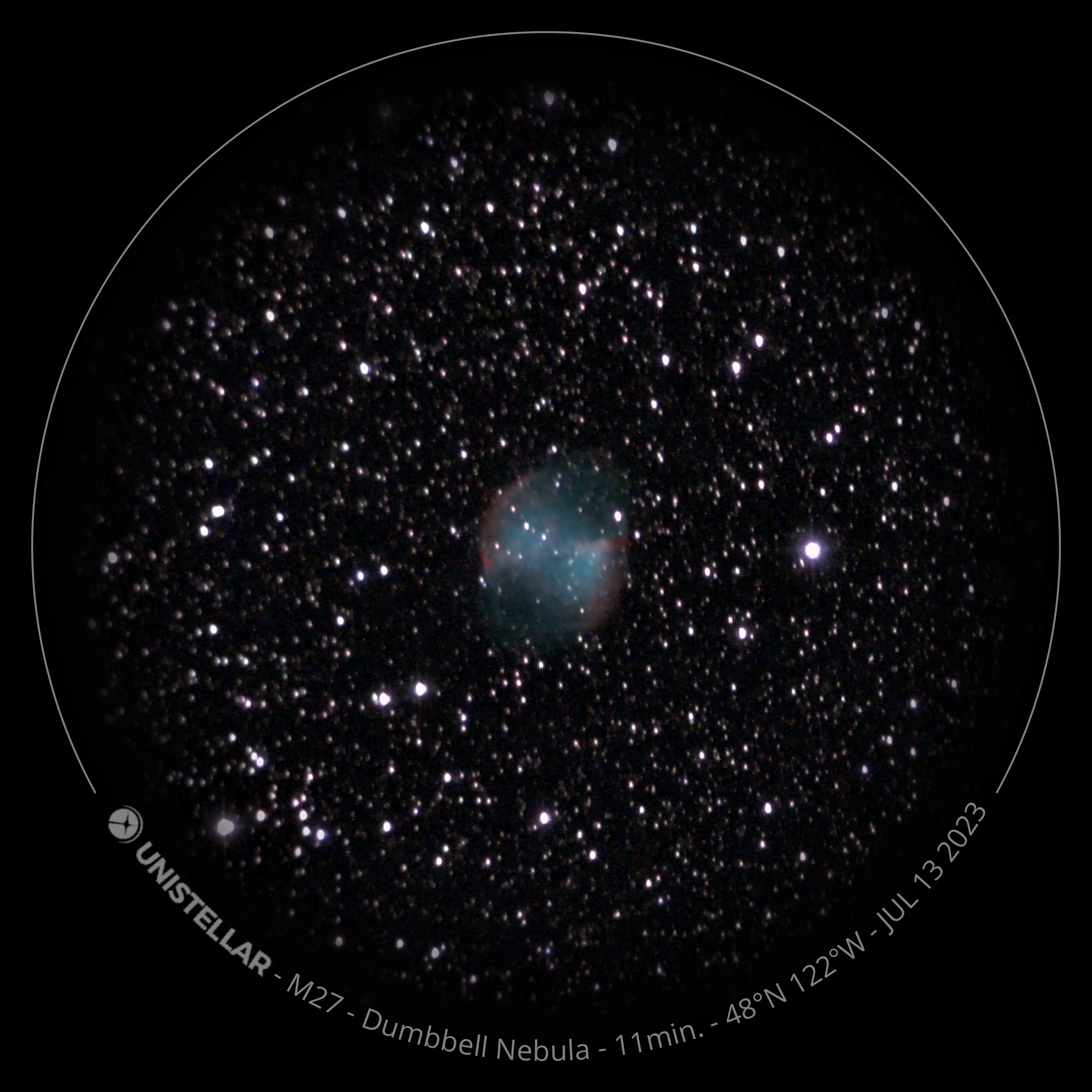
M27 – Dumbbell Nebula
11m
2023-07-13
Early on, this was one of my favorite pictures. The colors are very distinct.
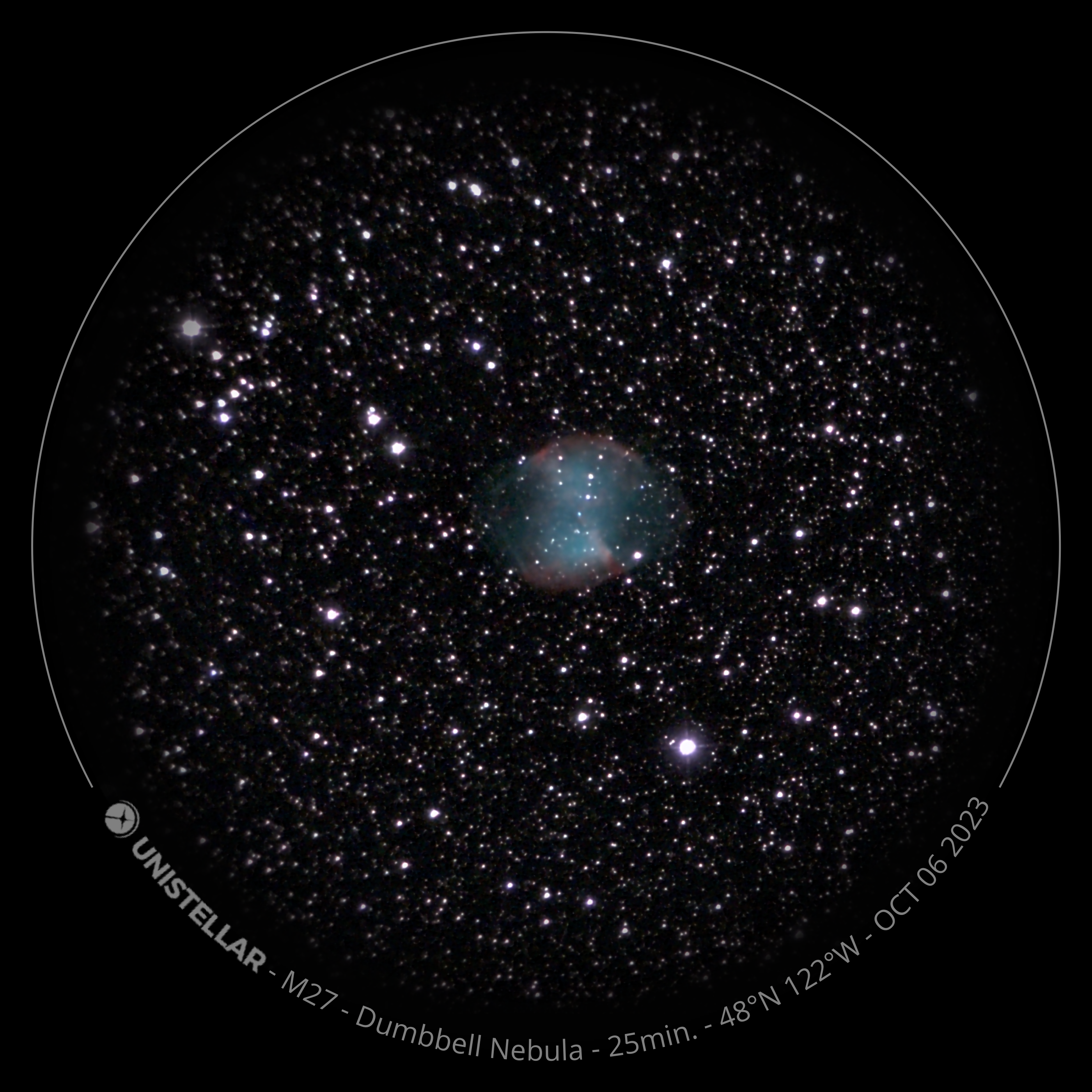
M27 – Dumbbell Nebula
25m
2023-11-06
There are two colors in the Dumbbell Nebula: the red is hydrogen, spewed out from the outer layers of the star as it is going through its death throes before going supernova; and the blue is oxygen, formed in the star’s last few moments, just before it collapses and then explodes.
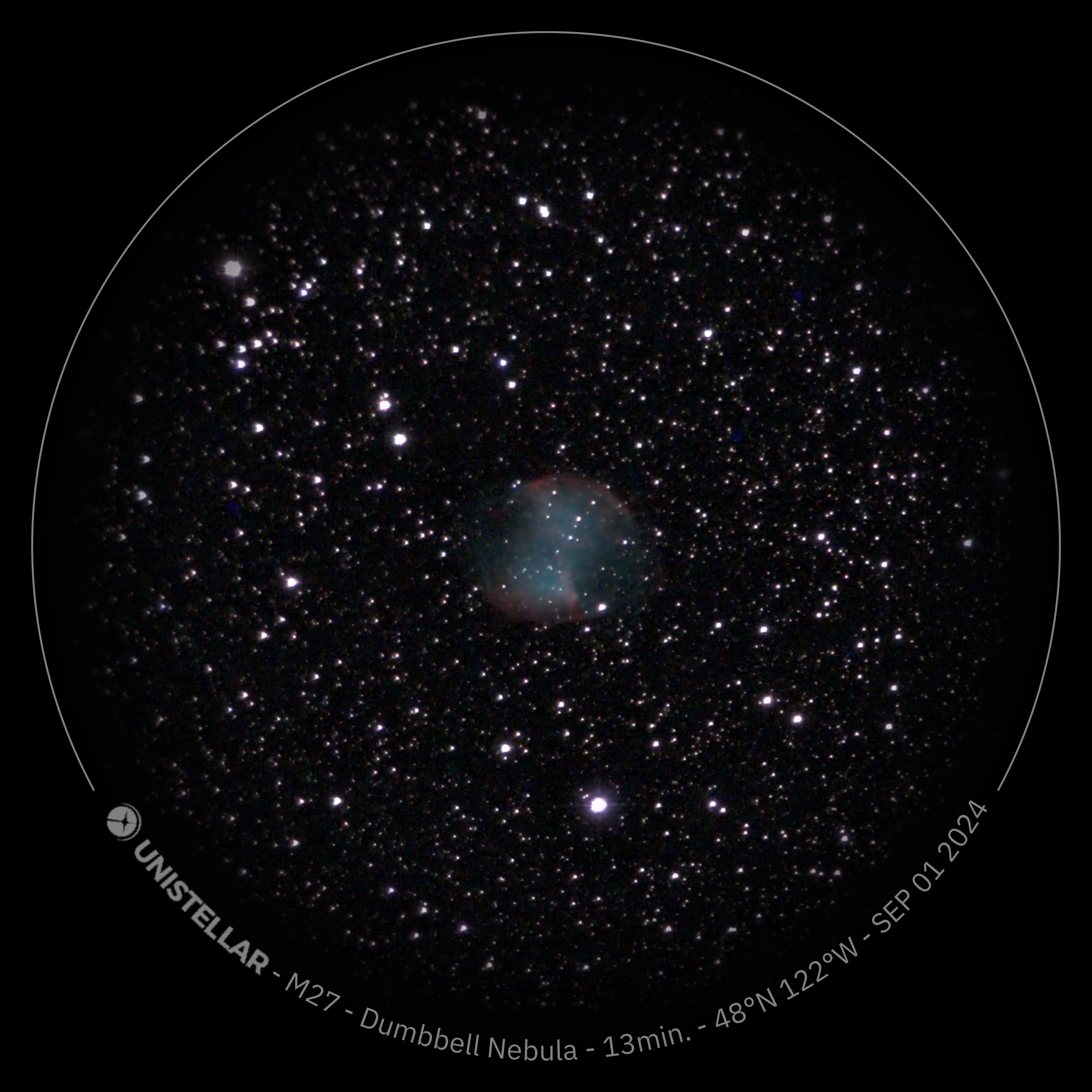
M27 – Dumbbell Nebula
13m
2024-09-01
This was just before the new software launched, and you can compare it to the next one…
M27 – Dumbbell Nebula
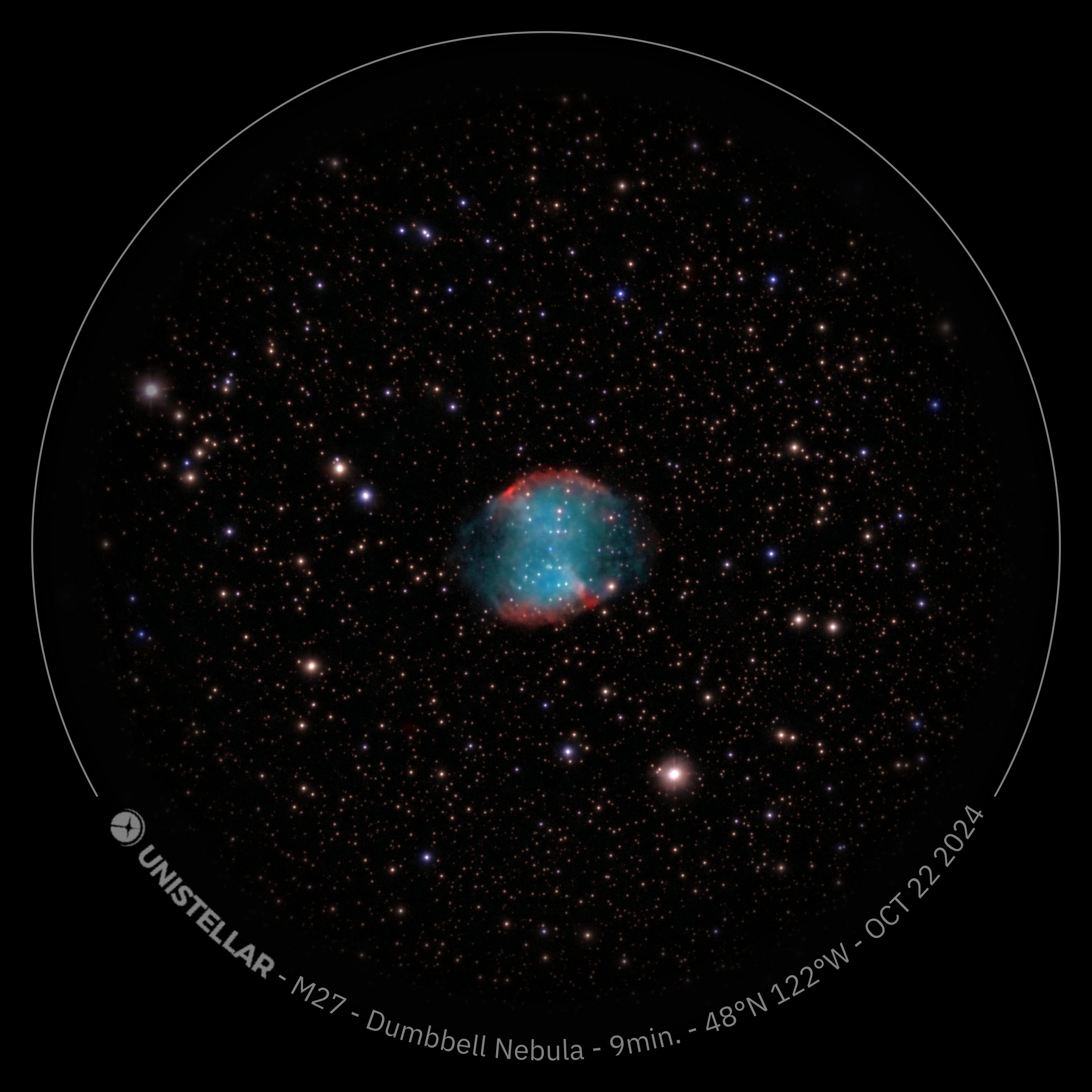
9m
2024-10-22
You can really see the difference with the updated software. The reds are redder, the blues more vibrant, and the edges are much more crisp. This was one of the first shots I took after the new software launched (this and the Orion Nebula).
M27 – Dumbbell Nebula
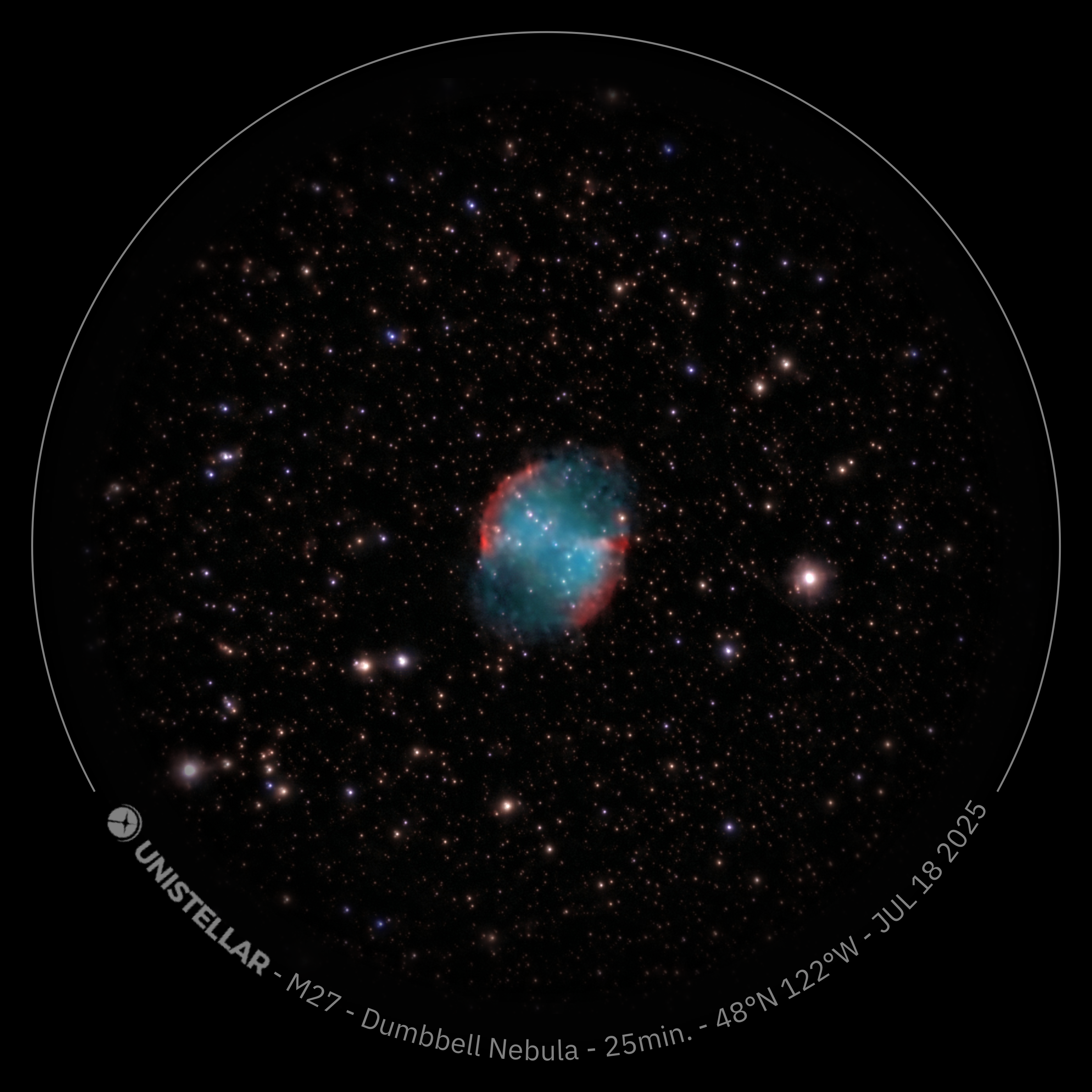
25m
2025-07-18
I caught this the same night I was (unsuccessfully) attempting to capture Titan casting a shadow on Saturn. This was the best photo I took that night, unfortunately.
M42 – Orion Nebula
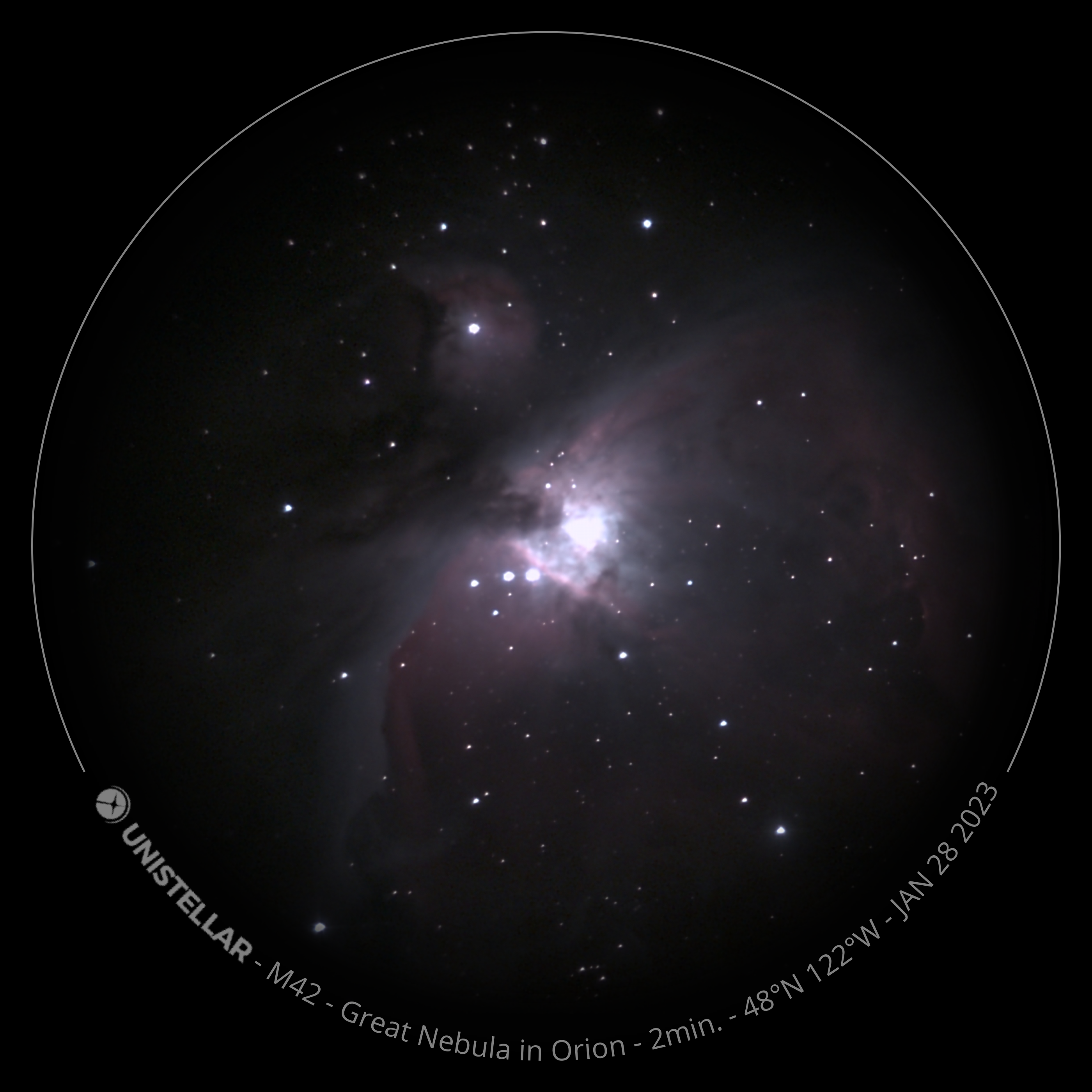
2m
2023-01-28
Before the color stretching, you could get a great shot of the Orion Nebula, but it seemed washed out. It’s still quite impressive, and you can see the different tendrils of dust cloud obscuring the brightly-lit nebula behind it. Two minutes isn’t long enough, though.
M42 – Orion Nebula
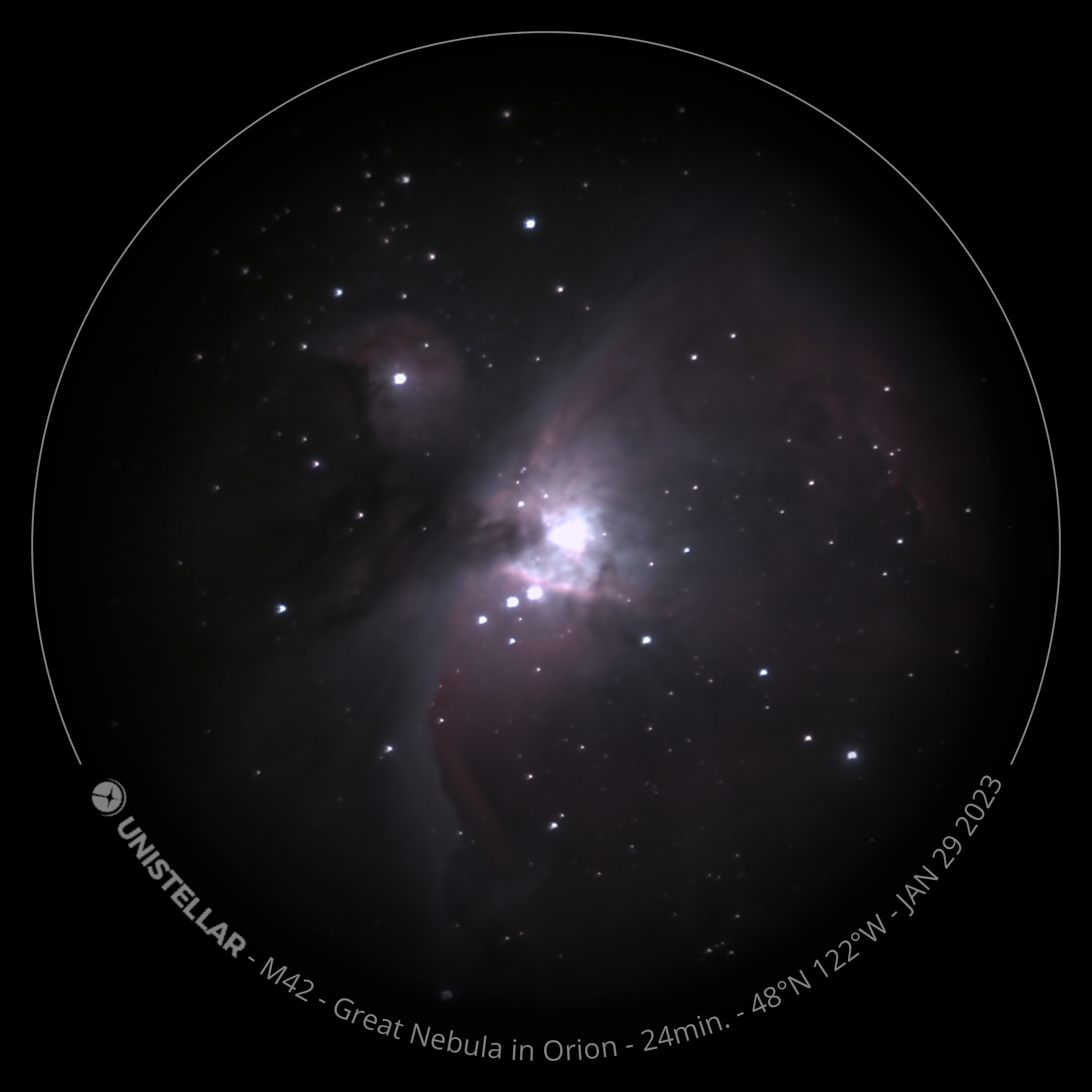
24m
2023-01-29
Another early shot of the Orion Nebula. 24 minutes is much better.
M42 – Orion Nebula
18m
2024-10-23
After they launched the new software, this was one of the first shots I took with the enhanced imaging. I was pretty happy with the result.
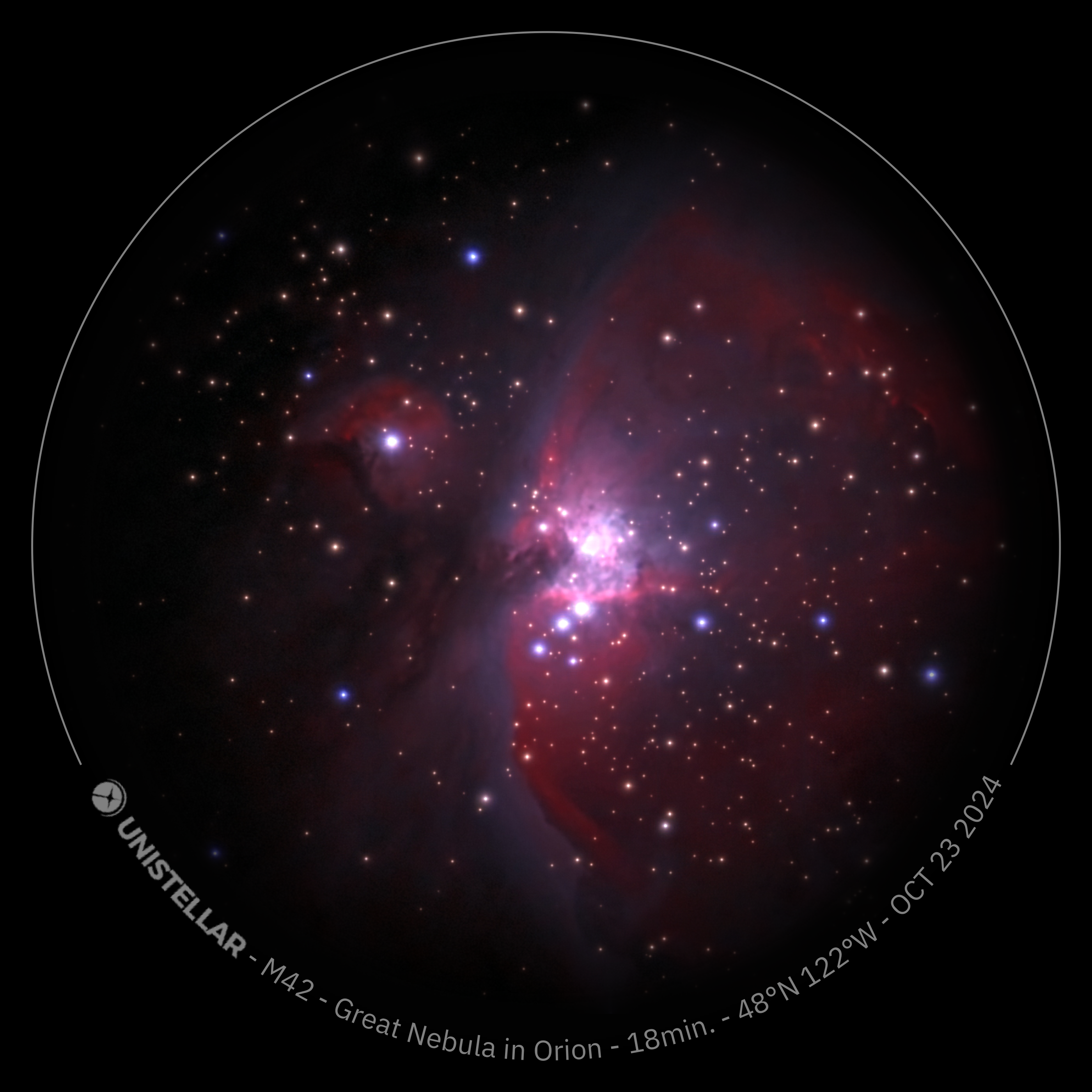
M42 – Orion Nebula
8m
2024-12-09
This is a pretty good shot, and the color stretching is doing a lot of great work. But I think it was a hazy night this night – the edges are fuzzier than others I have of the Orion Nebula.
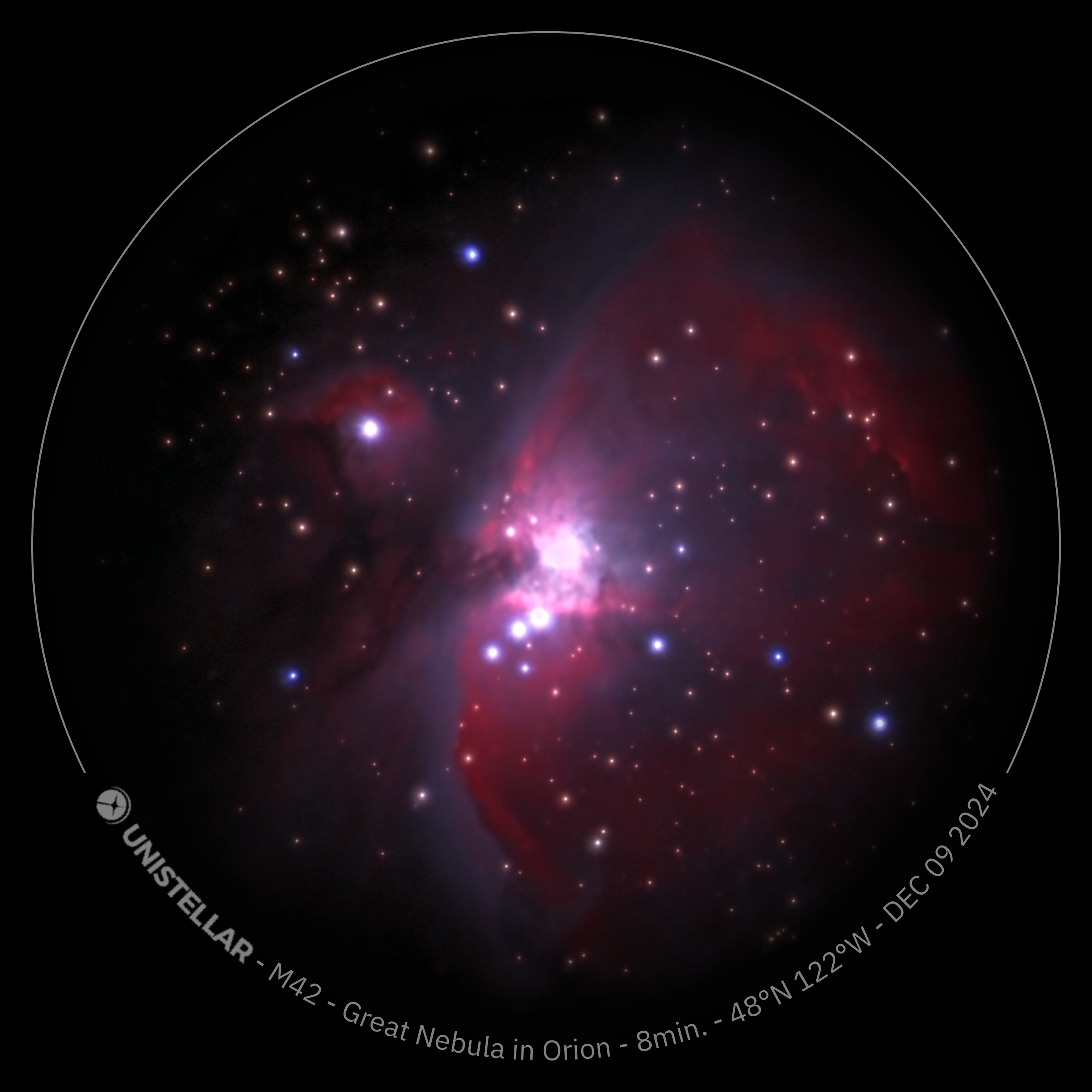
M42 – Orion Nebula
6m
2025-01-19
With the new software, the colors on the Orion Nebula pop. I really like the sharp lines between the purples and reds.
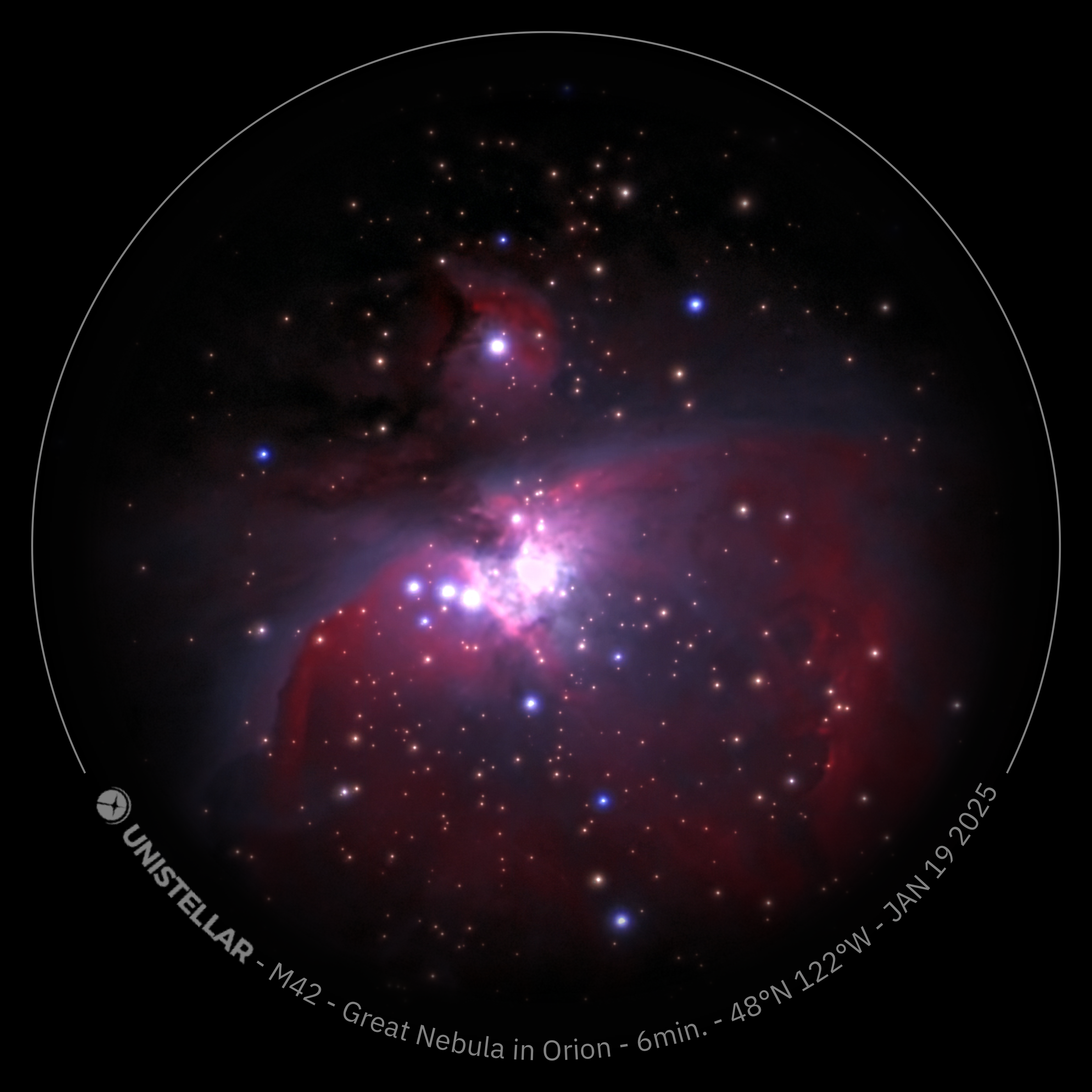
M42 – Orion Nebula
104s
2025-01-19
Same night, shorter exposure, and without the color stretching applied, you can see that the image is much more washed-out and dim.
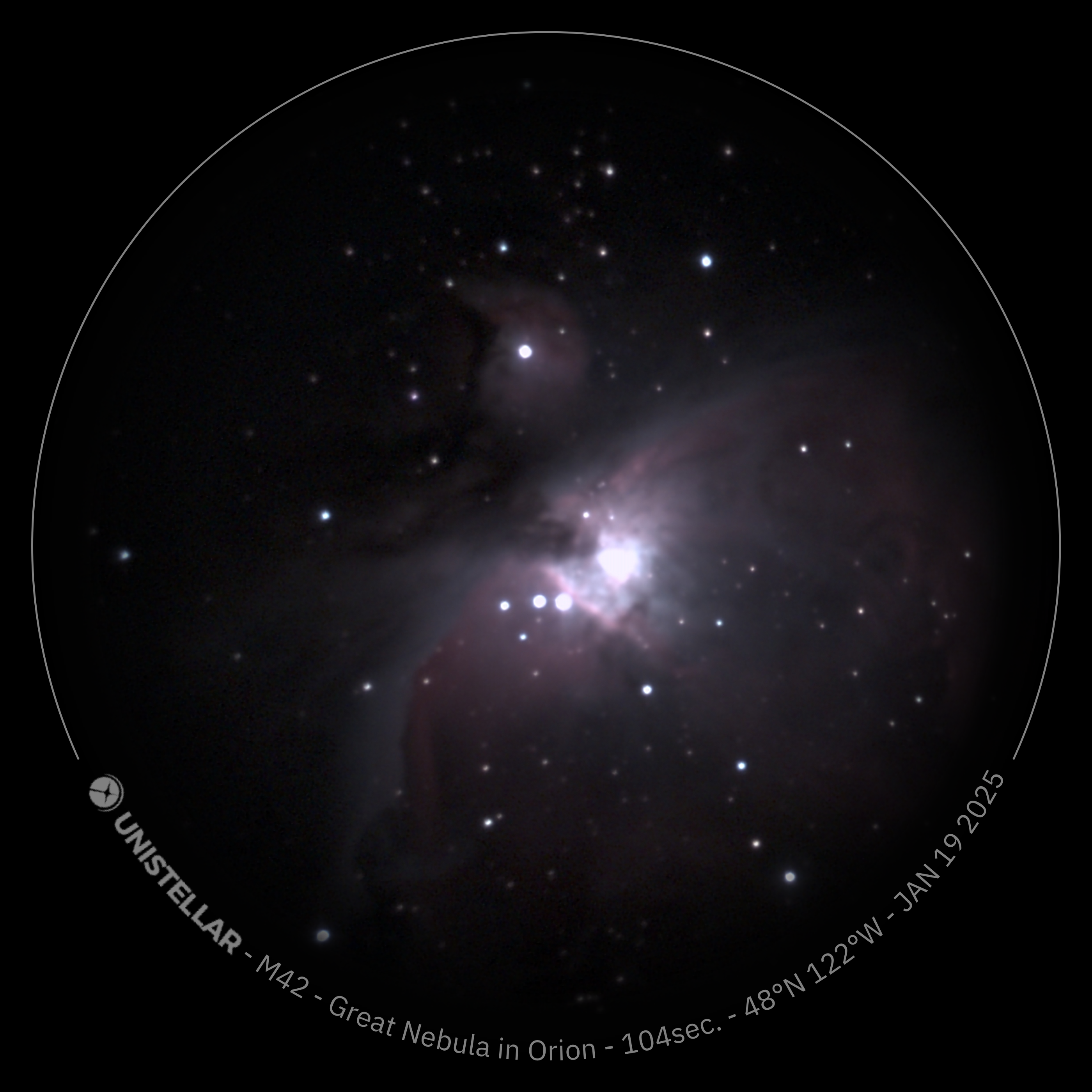
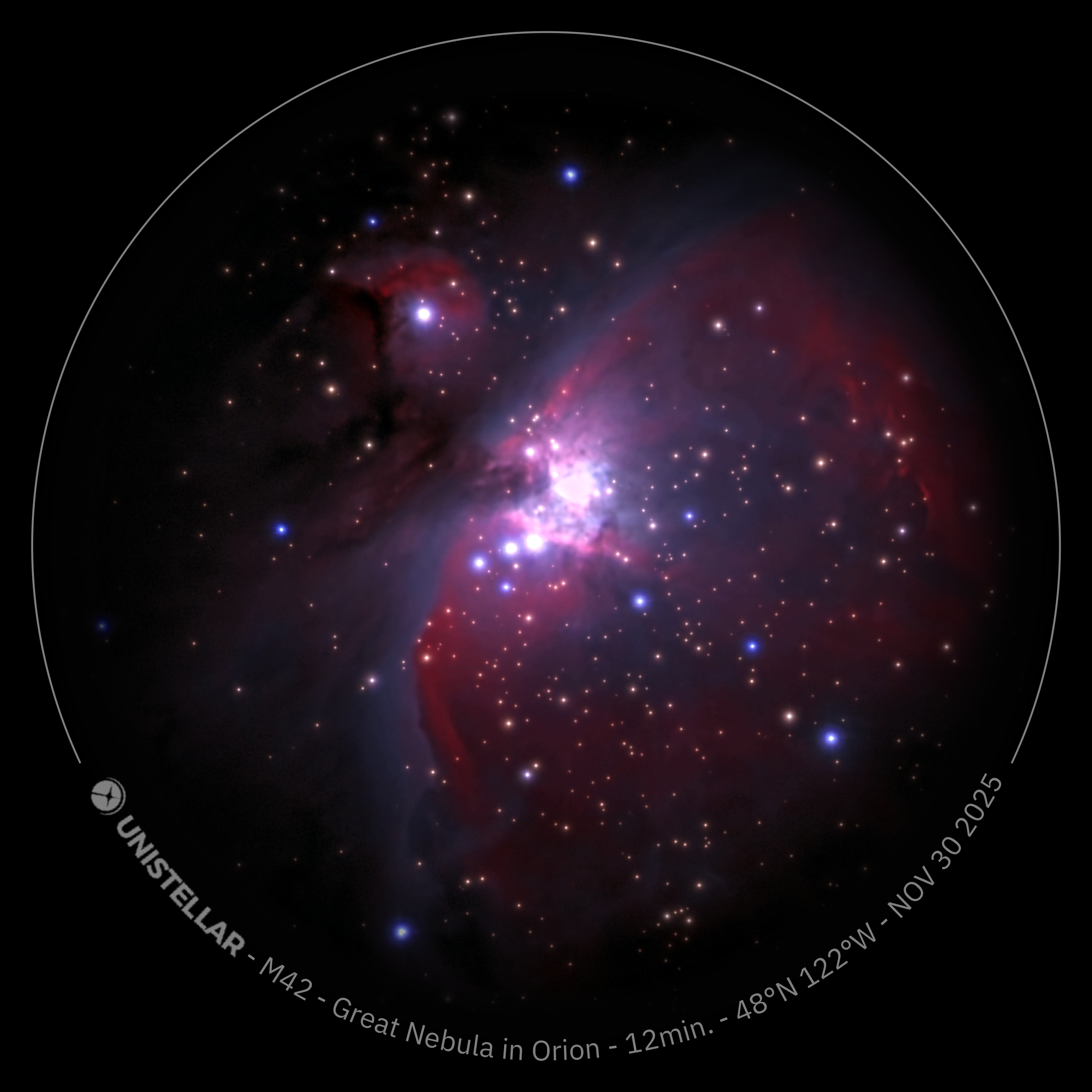
M42 – Orion Nebula
12m
2025-11-30
I mean, when the Orion Nebula is up, you gotta get a picture of it. It’s one of the best things that you can capture with the eVscope.
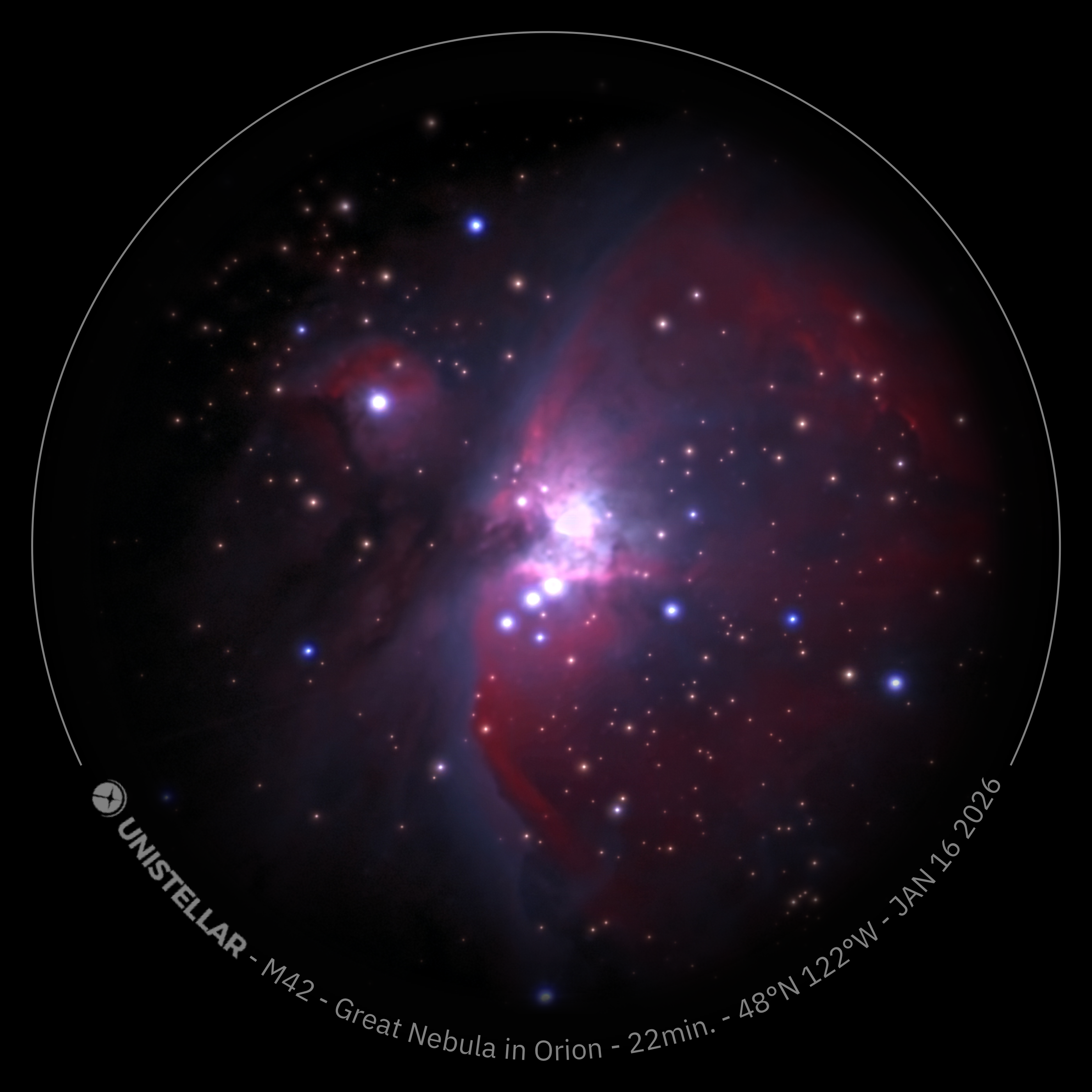
M42 – Orion Nebula
22m
2026-01-16
Always good to come back to the Orion Nebula, which is great on the eVscope.
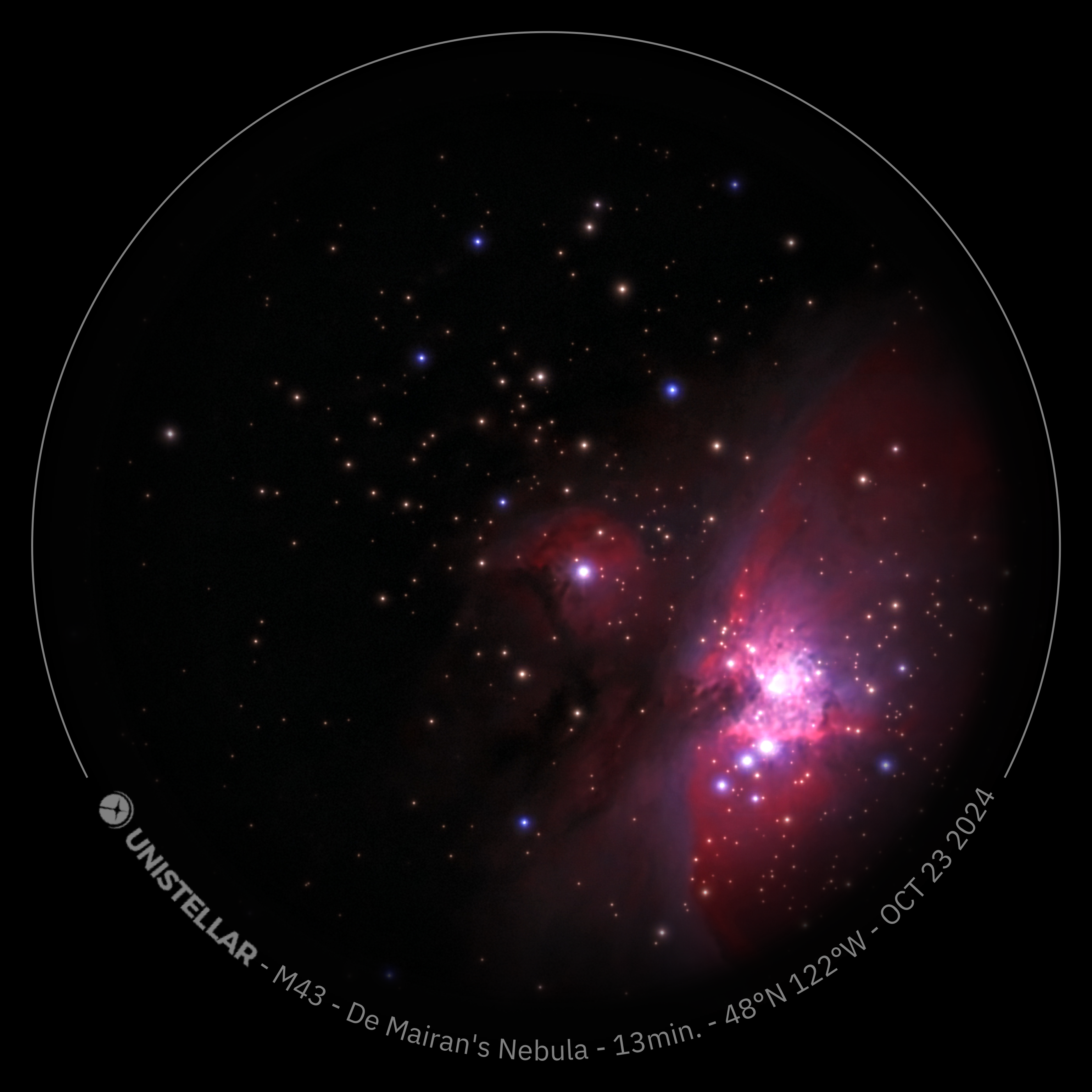
M43 – De Marian’s Nebula
13m
2024-10-23
Wait, isn’t that just the Orion Nebula? Yeah, that’s it in the lower right; De Marian’s is the small red nebula in the center of this image, which is part of the larger Orion Nebula group.
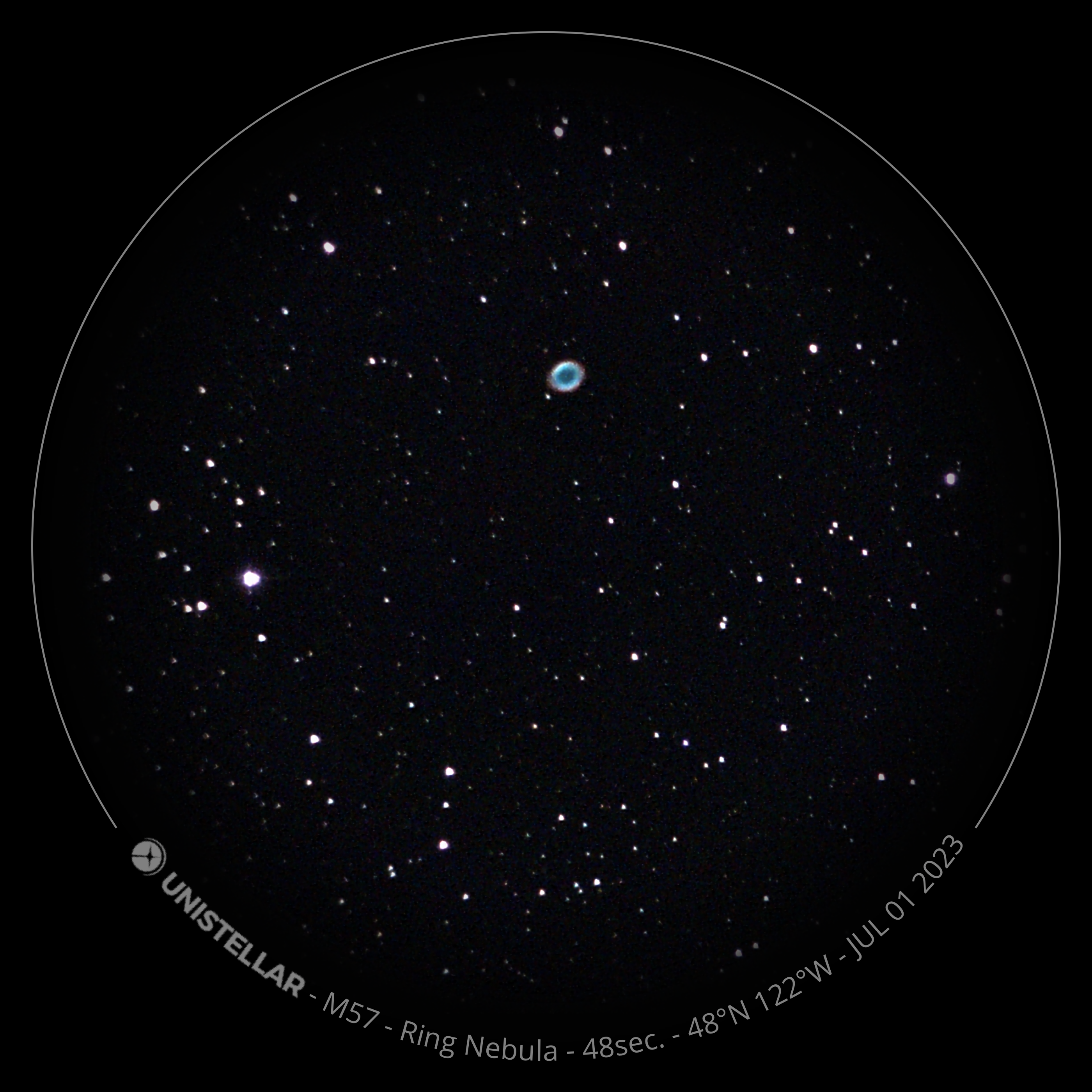
M57 – Ring Nebula
48s
2023-07-01
I was not great, early on, at getting and keeping alignment. I was probably also impatient. Still, at under a minute of exposure, this isn’t a bad picture.
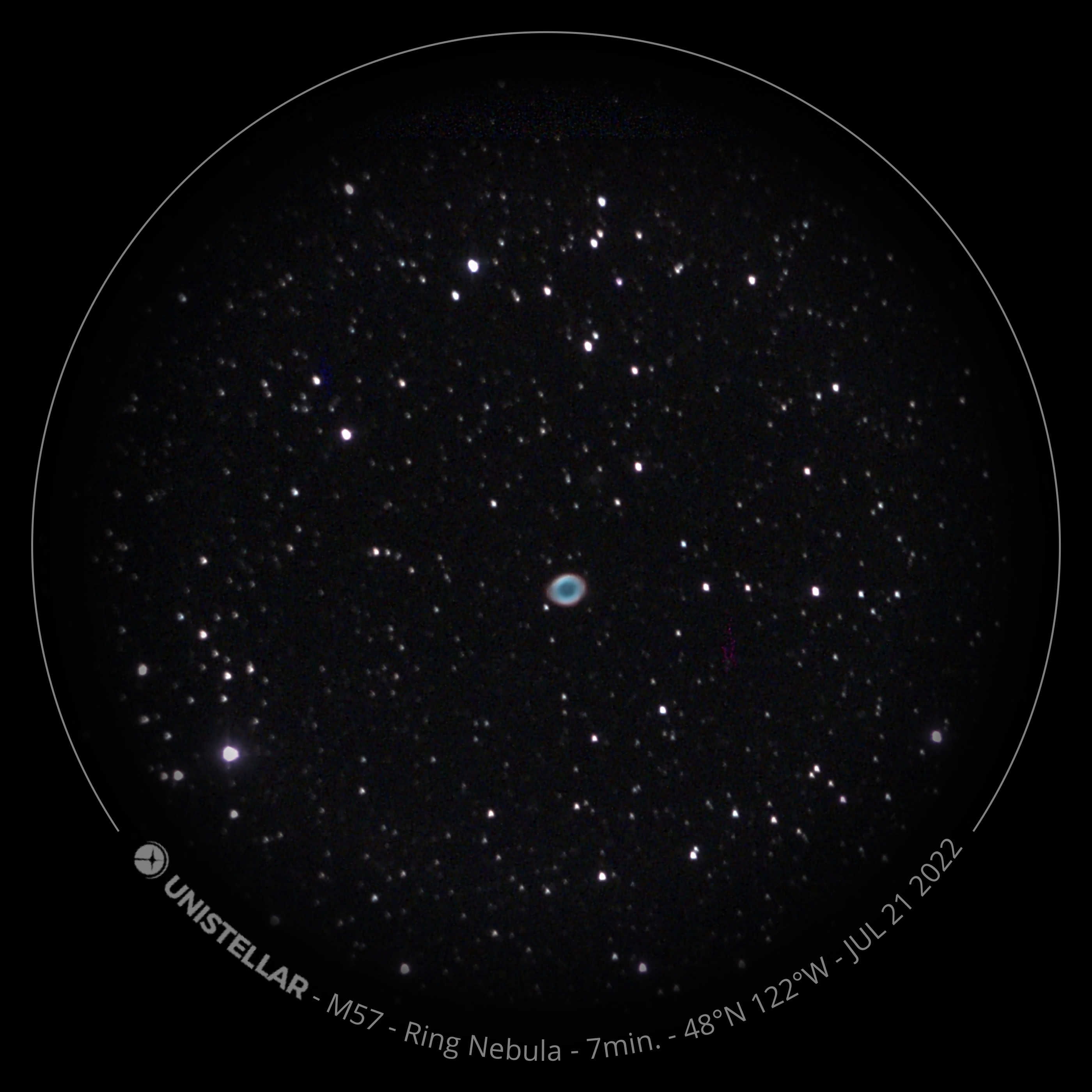
M57 – Ring Nebula
7m
2022-07-21
One of my early attempts, and not bad.
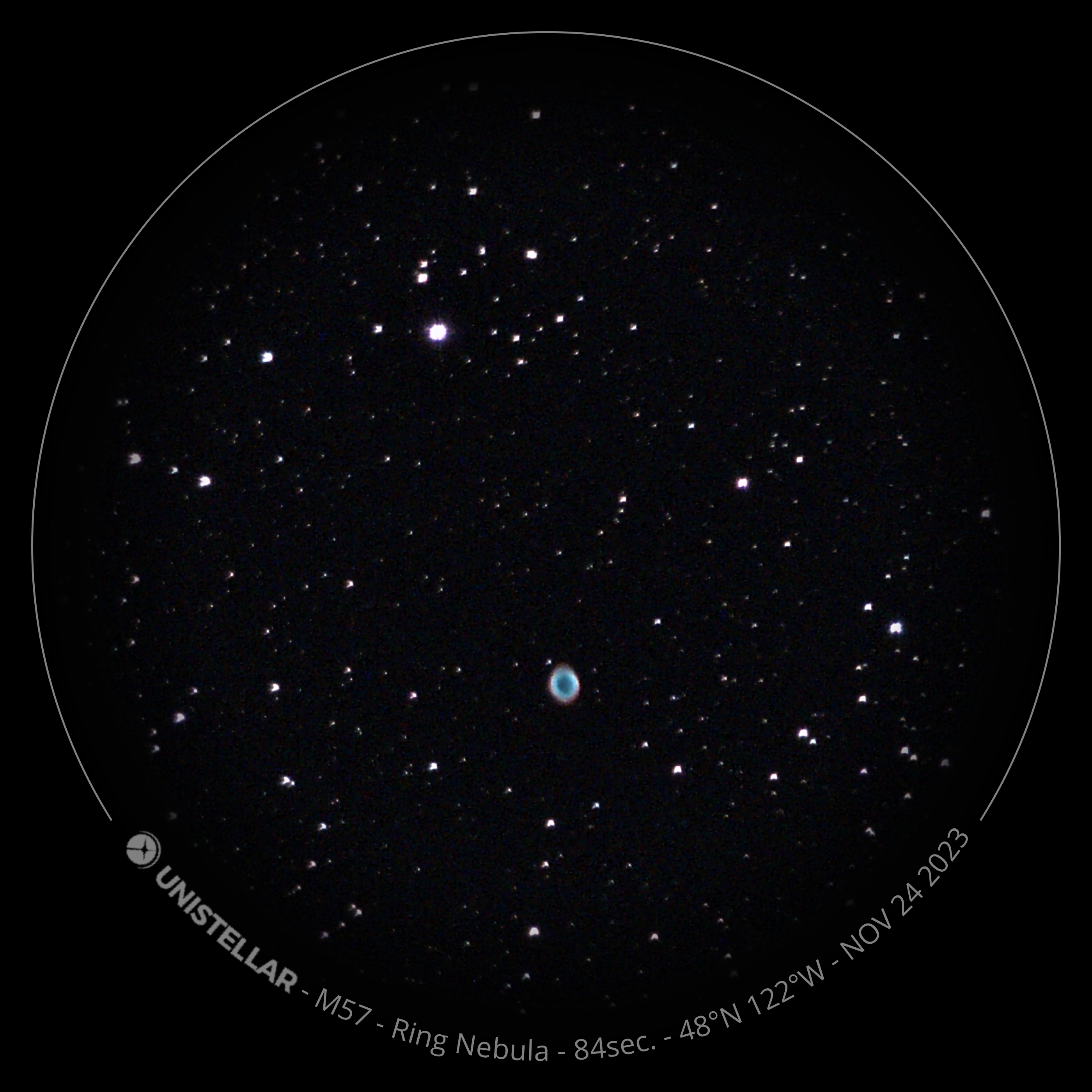
M57 – Ring Nebula
84s
2023-11-24
One of my early attempts at the ring nebula, and not a great picture.
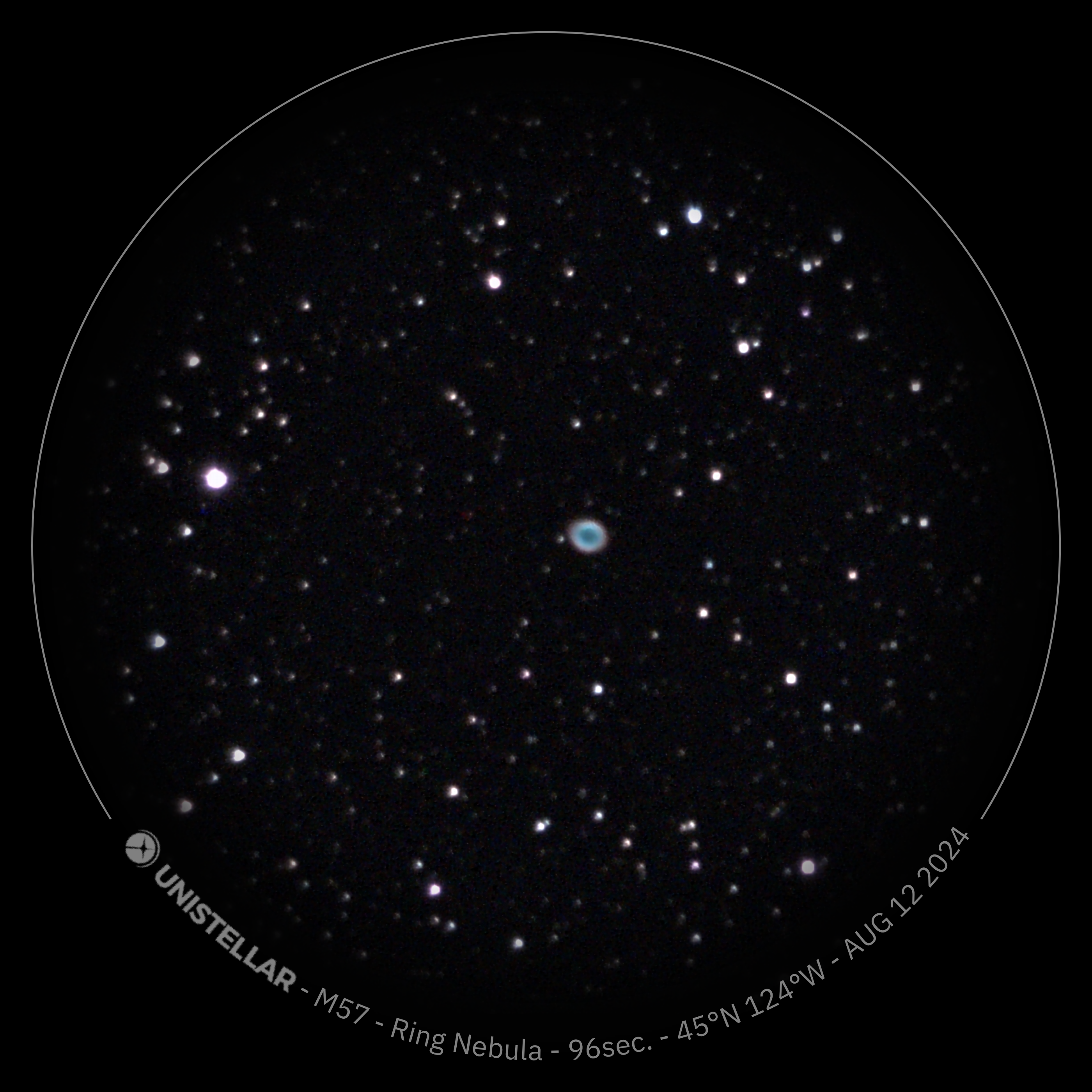
M57 – Ring Nebula
96s
2024-08-12
This is shortly before the new software dropped.
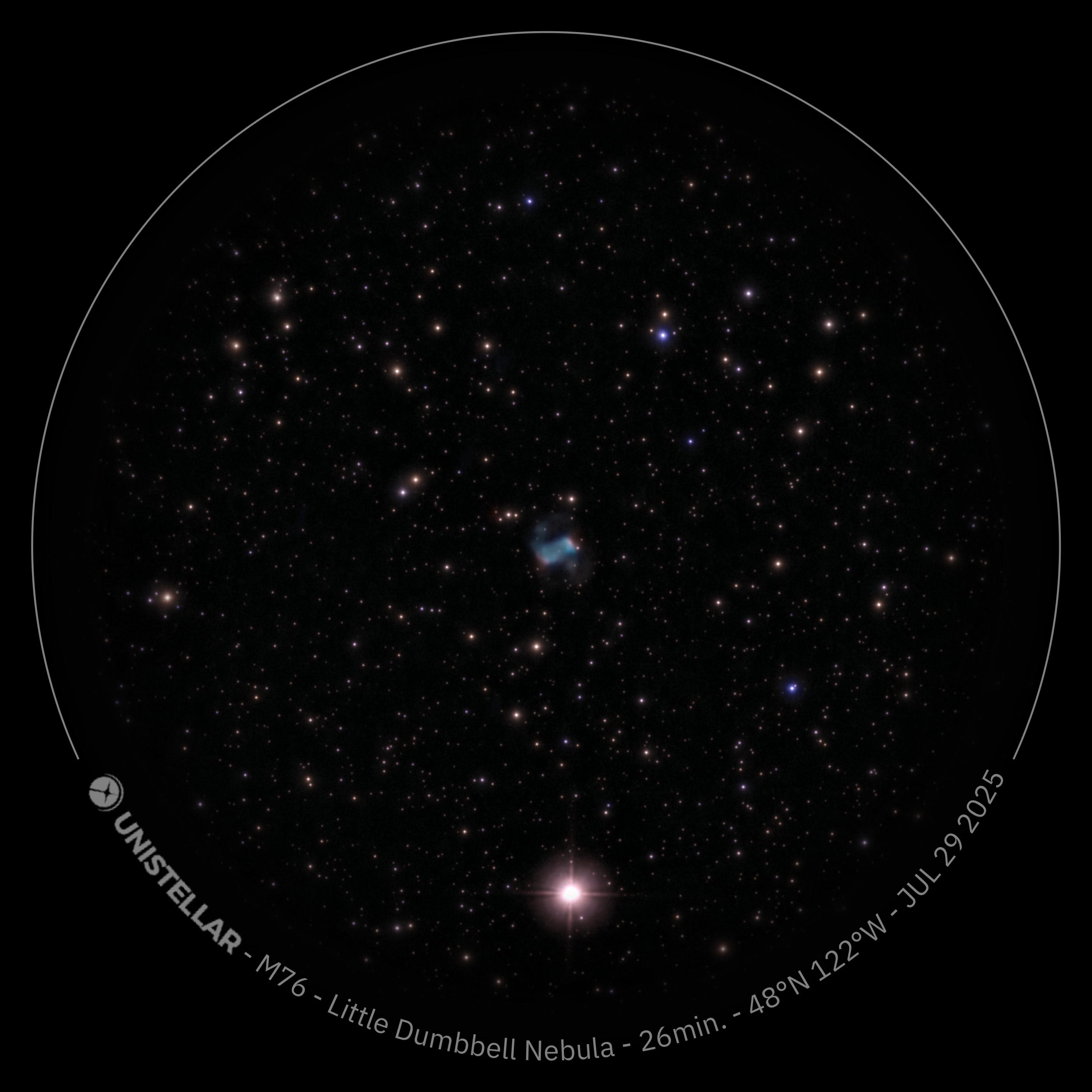
M76 – The Little Dumbbell Nebula
2025-07-29
26m
Not a great shot, when compared to what’s available online, but still, a nice color photo of a small and distant nebula. I suspect this might be better with a darker sky, from a higher elevation, but from within a city? Pretty dang good.
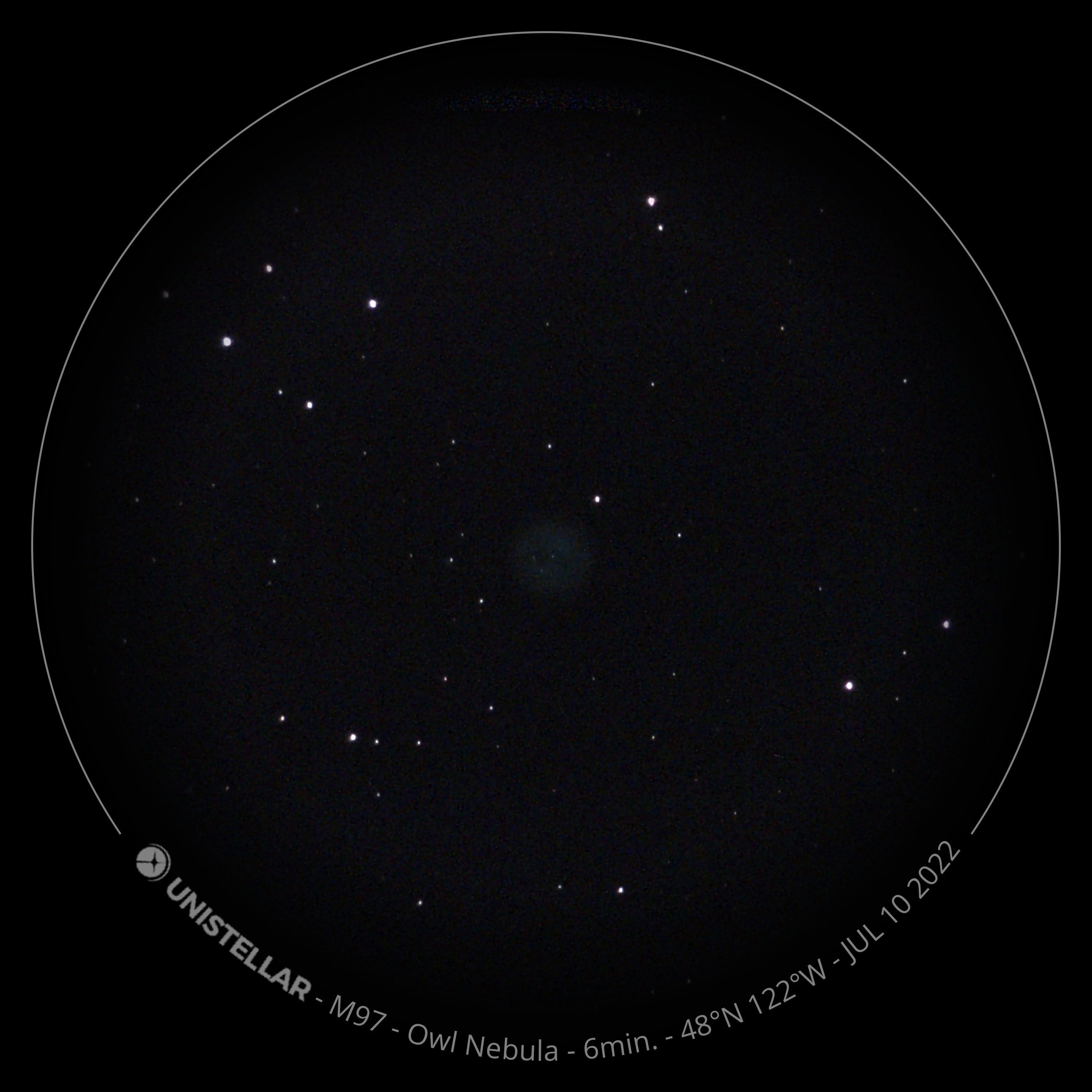
M97 – Owl Nebula
6m
2022-07-10
An early attempt at the Owl Nebula, which is both small and faint. It gets better once the color-stretching software update kicks in.
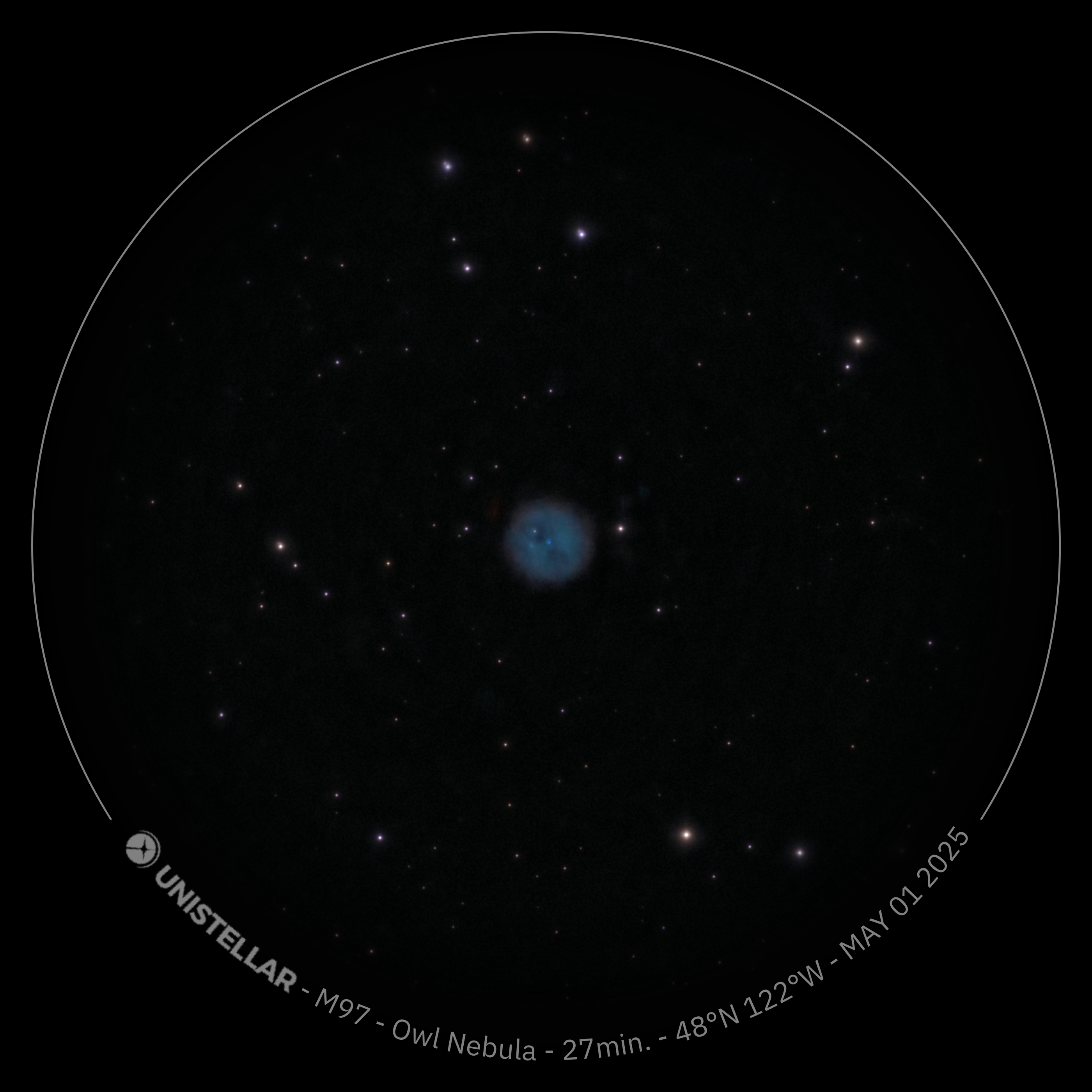
M97 – Owl Nebula
27m
2025-05-01
Now you can see two improvements: a longer dwell time (27 vs 6 minutes), plus the color-stretching really brings out both the blues and reds of the faint Owl Nebula.
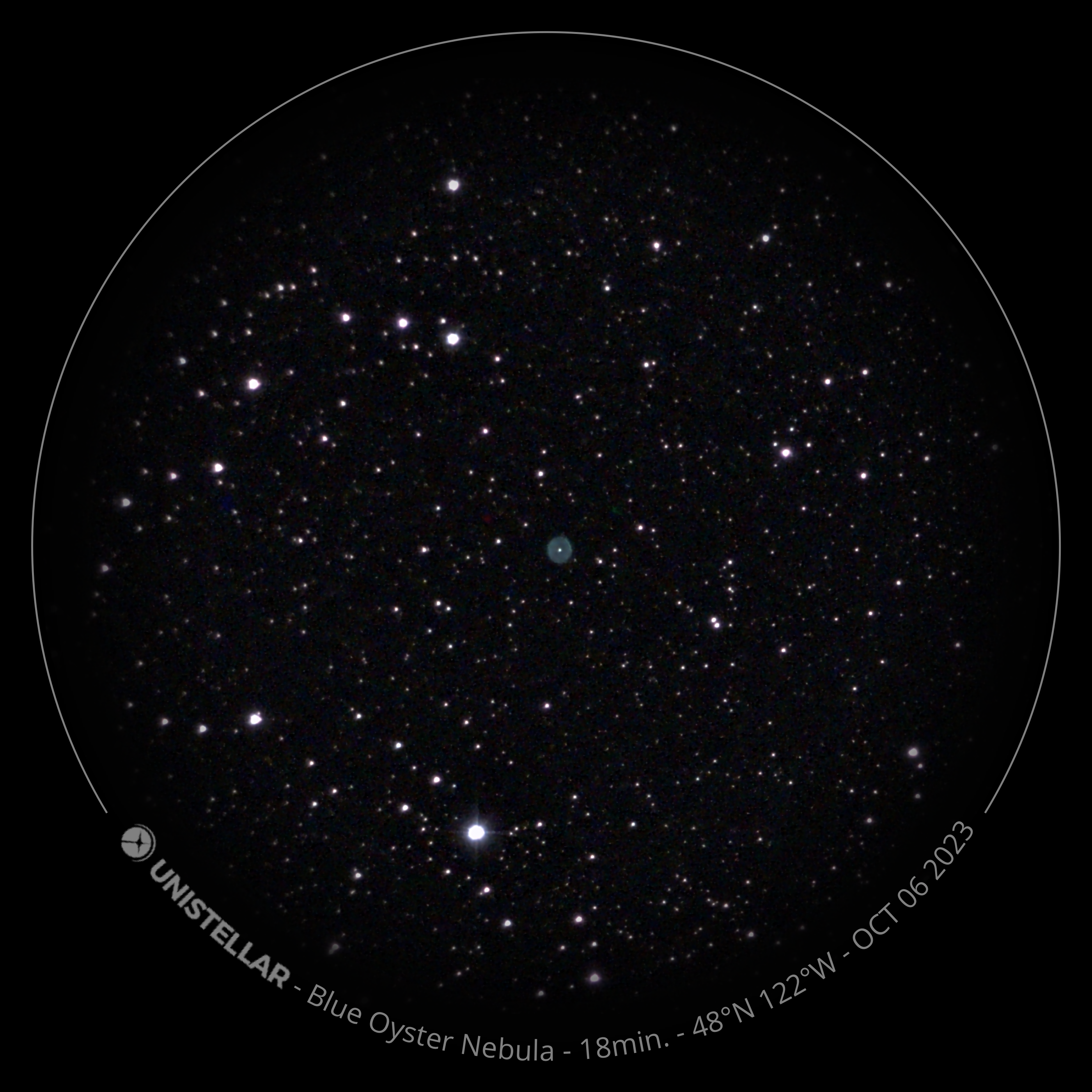
NGC 1501 – Blue Oyster Nebula
18m
2023-11-06
The Blue Oyster nebula is both small and dim, putting it at the limit of what the eVscope can capture with any significant detail. Even so, it’s quite pretty.
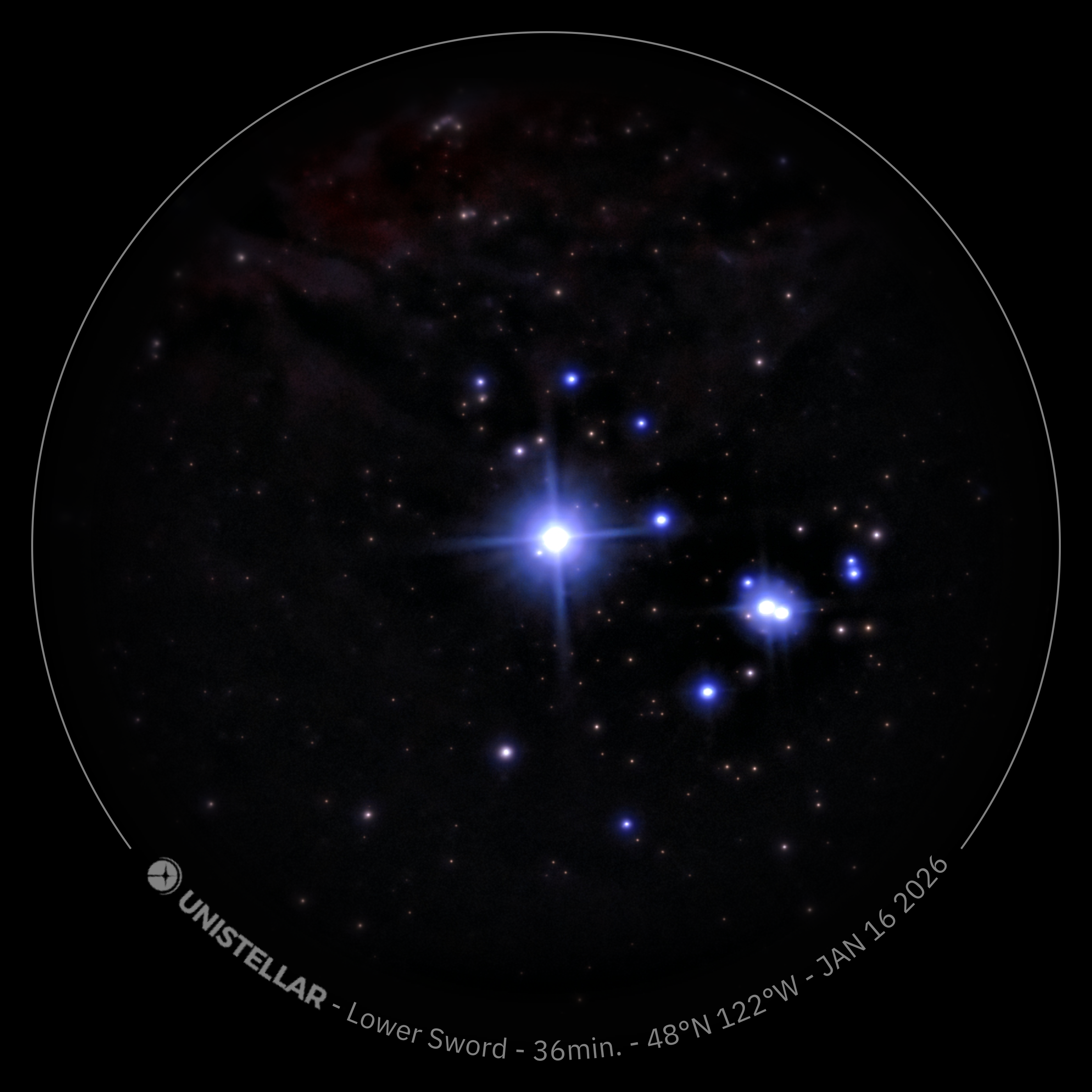
NGC 1980 – Lower Sword
36m
2026-01-16
More of the Orion Nebula complex, the Lower Sword is a star cluster plus wisps of the nebula, which you can just make out in the top left of this image.
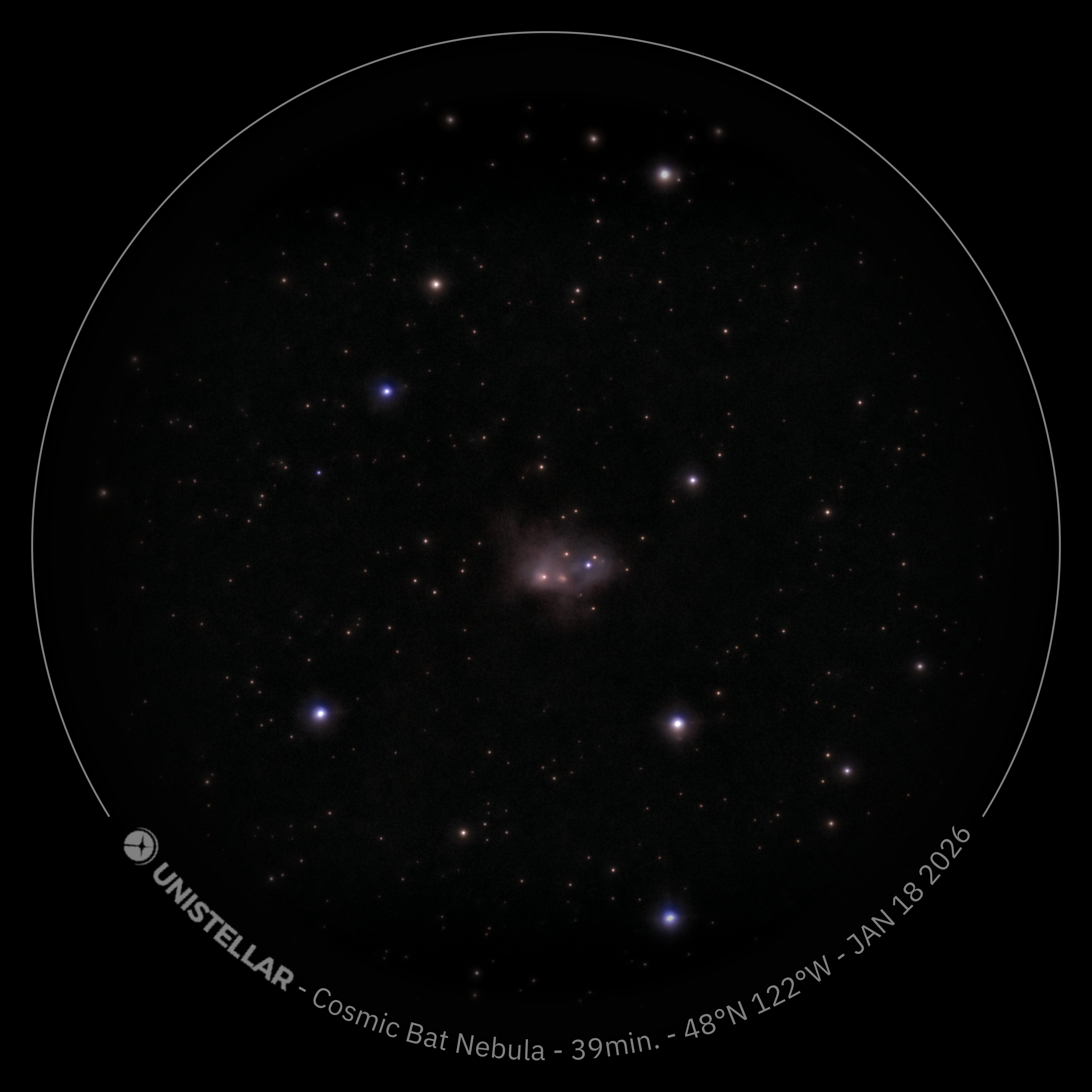
NGC 1788 / LDN 43 – Cosmic Bat Nebula
39m
2026-01-18
A challenging nebula to catch on the eVscope2, particularly in a city. A lot of the finer details are lost, the sensor probably lacks the resolution to do it justice, and the light pollution really limits the color depth available. I’ll keep it here for reference, but this might be an example of a deep sky object that’s not well suited for my setup.
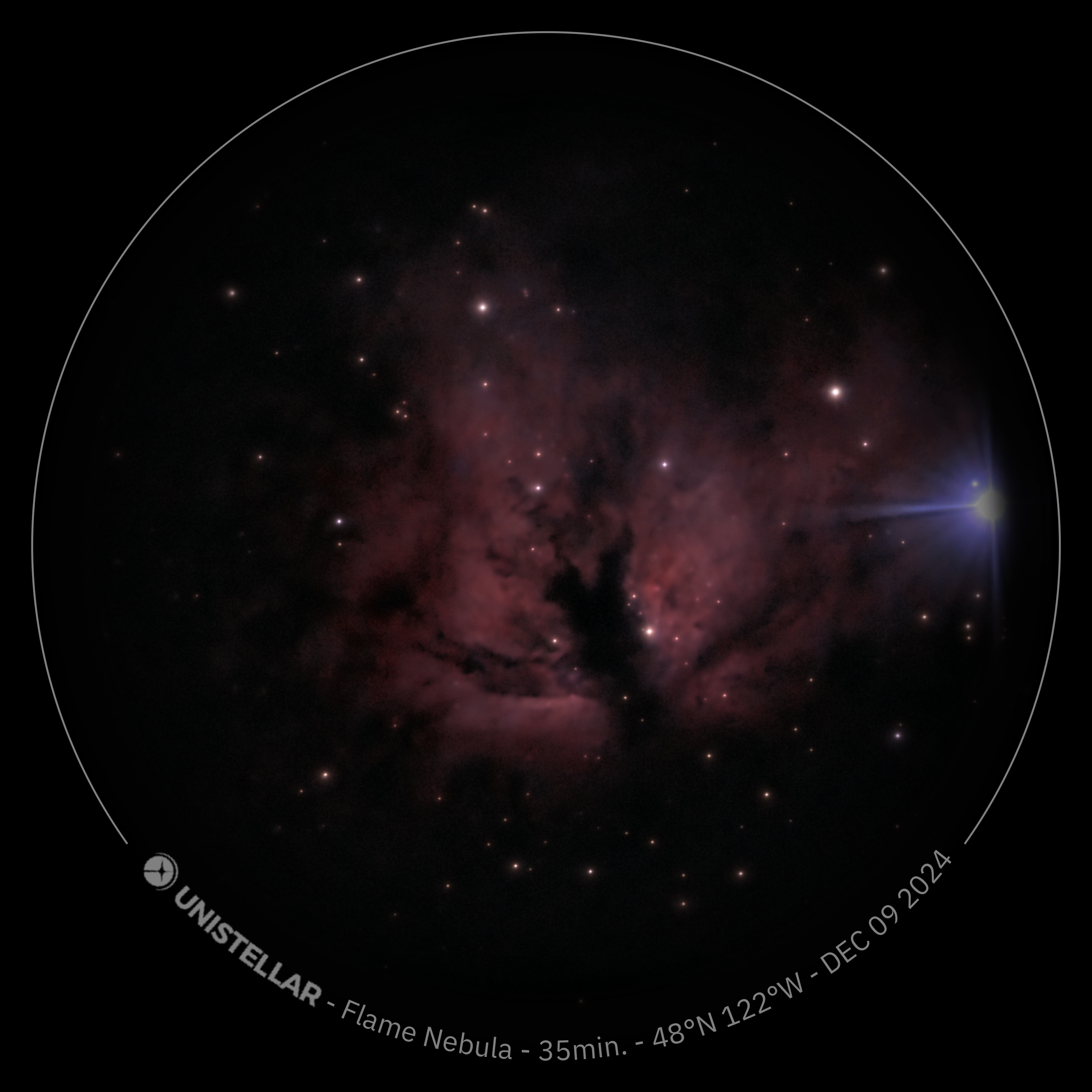
NGC 2024 – Flame Nebula
35m
2024-12-09
With a longer dwell time, the colors and edges are much sharper than the next image.
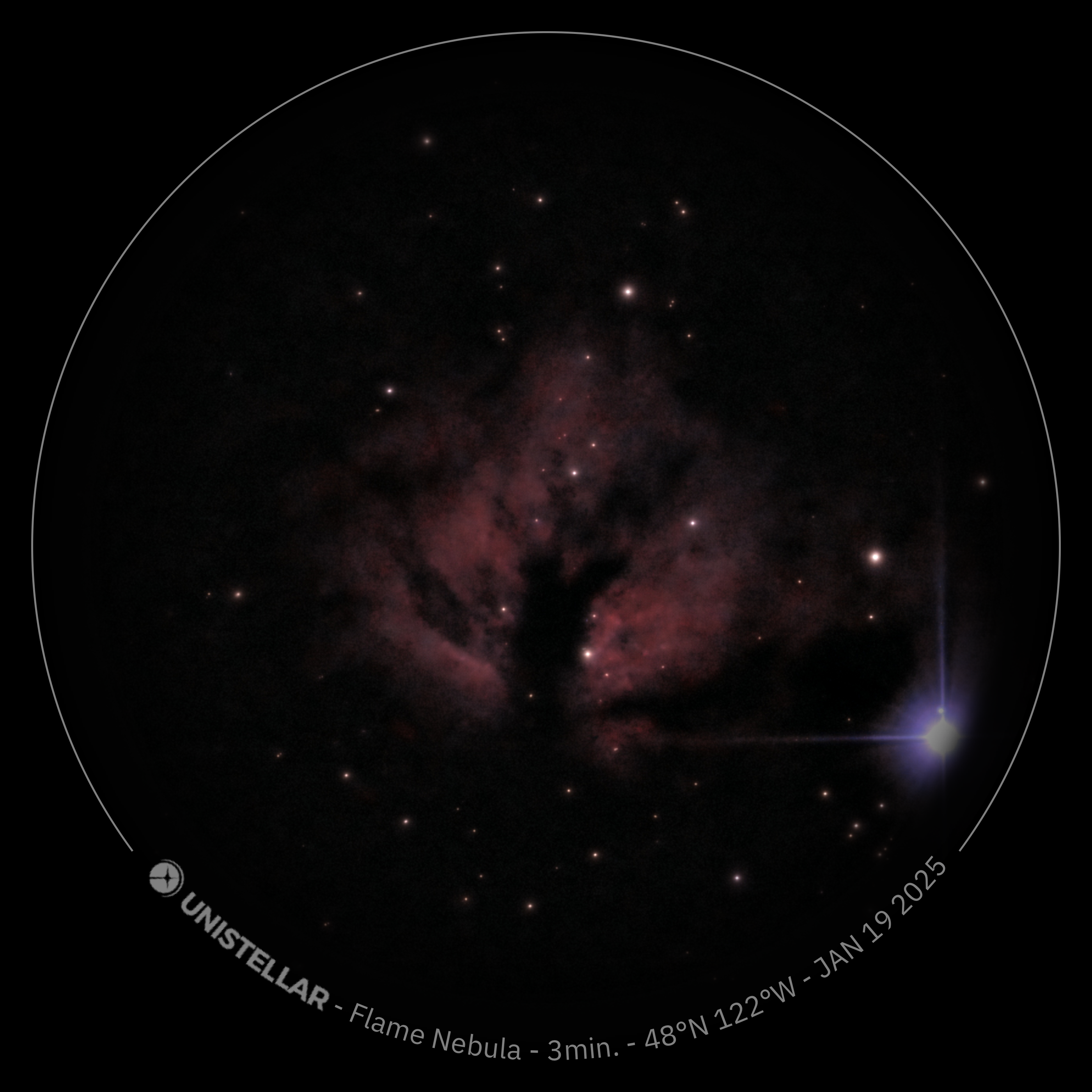
NGC 2024 – Flame Nebula
3m
2025-01-19
A shorter dwell time, on the other hand, doesn’t produce as great an image. Probably not a surprise.
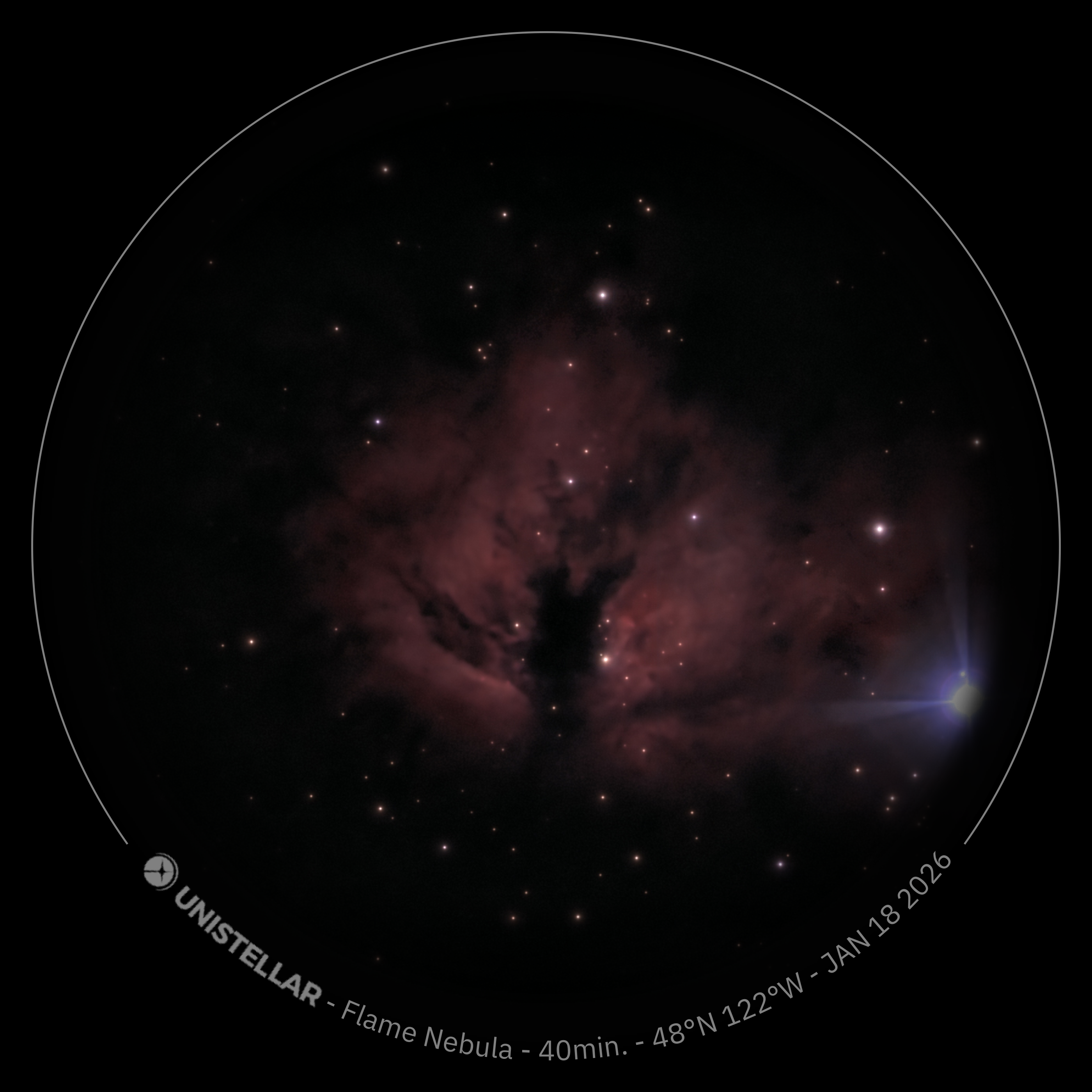
NGC 2024 – Flame Nebula
40m
2026-01-18
If you look online for pictures of either the Flame Nebula or Horsehead Nebula, you’ll realize how close they are – about one moon-width apart. The eVscope can’t zoom, so you’ll never get both at the same time, but they’re both part of the much larger Orion Nebula complex, and the bright star at the edge of this frame is Alnitak, the left-most star in Orion’s belt.
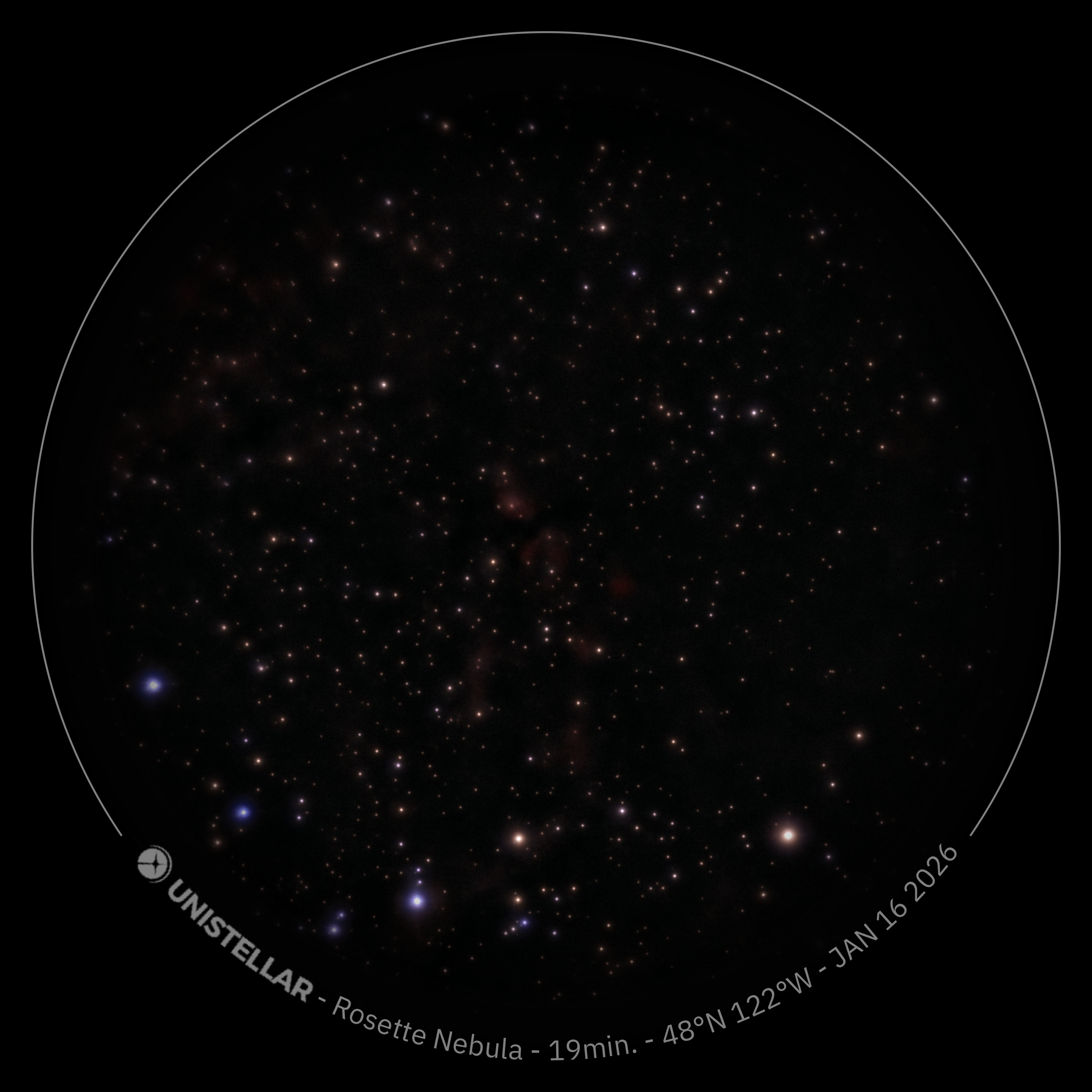
NGC 2237 – Rosette Nebula
19m
2026-01-16
Another very faint nebula that doesn’t seem to do well in the eVscope. You can see hints of pinks and reds, but not a full nebula like you might hope.
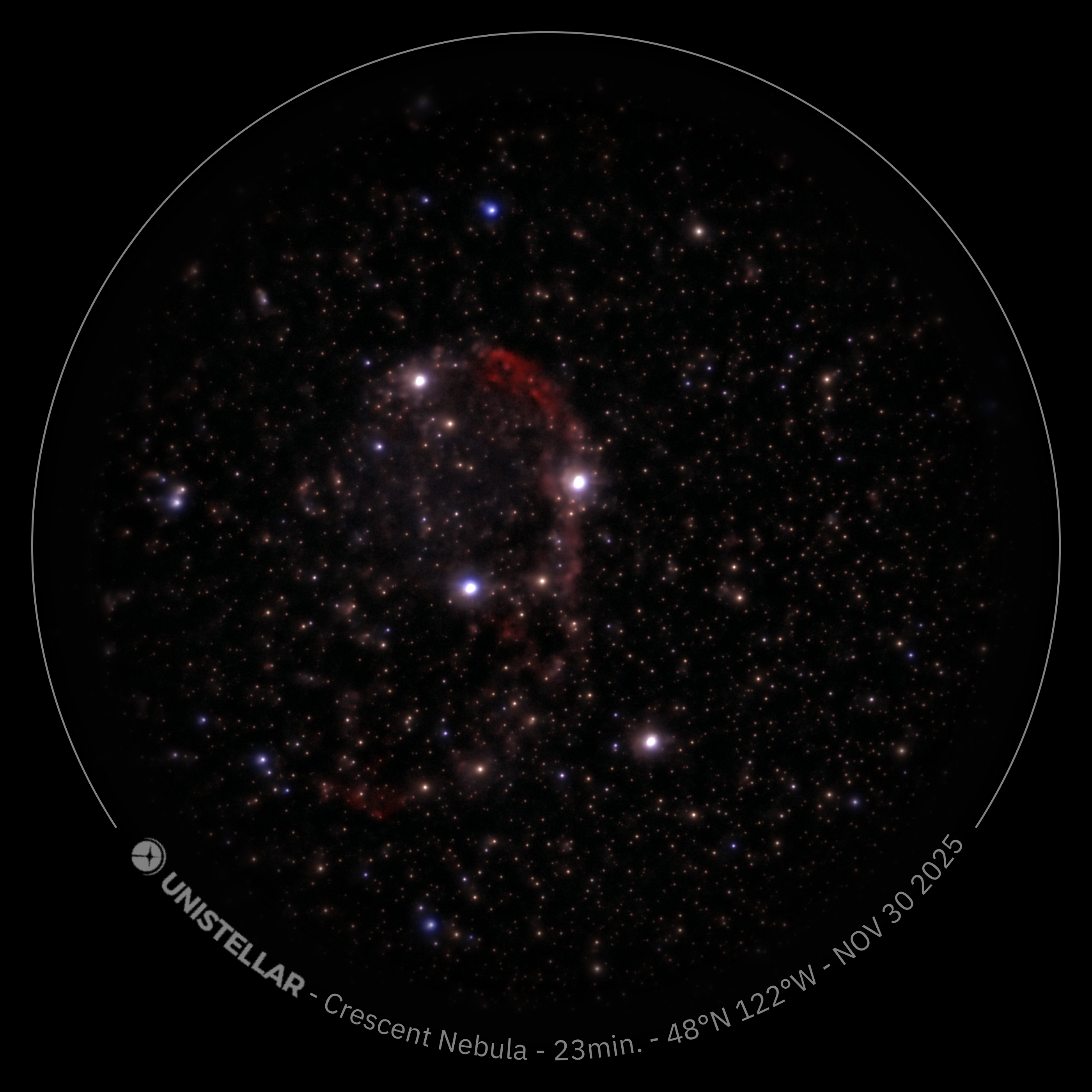
NGC 6888 – Crescent Nebula
23m
2025-11-30
I think the fact that I’m in a city means I lose a lot of the more diaphanous areas of this nebula, but it’s about the right size for the eVscope. I think if I can get to a dark rural area, I might come back to this one, and let it bake for a long time.
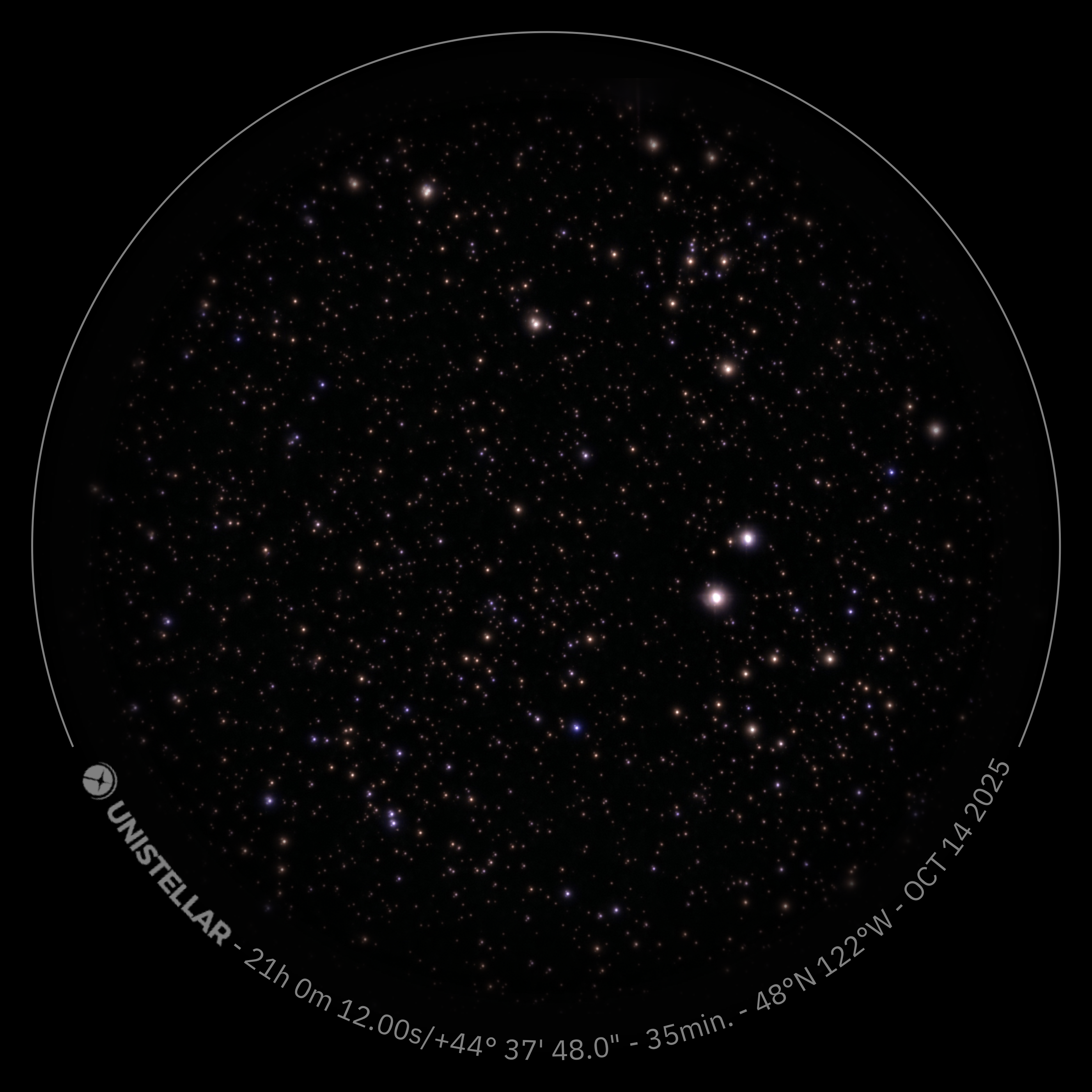
NGC 7000 – The North America Nebula
35m
2025-10-14
This might be the new elephant – the North America Nebula is about 3 to 4 moon-widths across, and I just picked a spot inside it and took a picture. Turns out, I picked one of the most boring spots. Note to self: next time try 20h58m25s / +43:24:26 or 21h00m21s / +43:53:23.
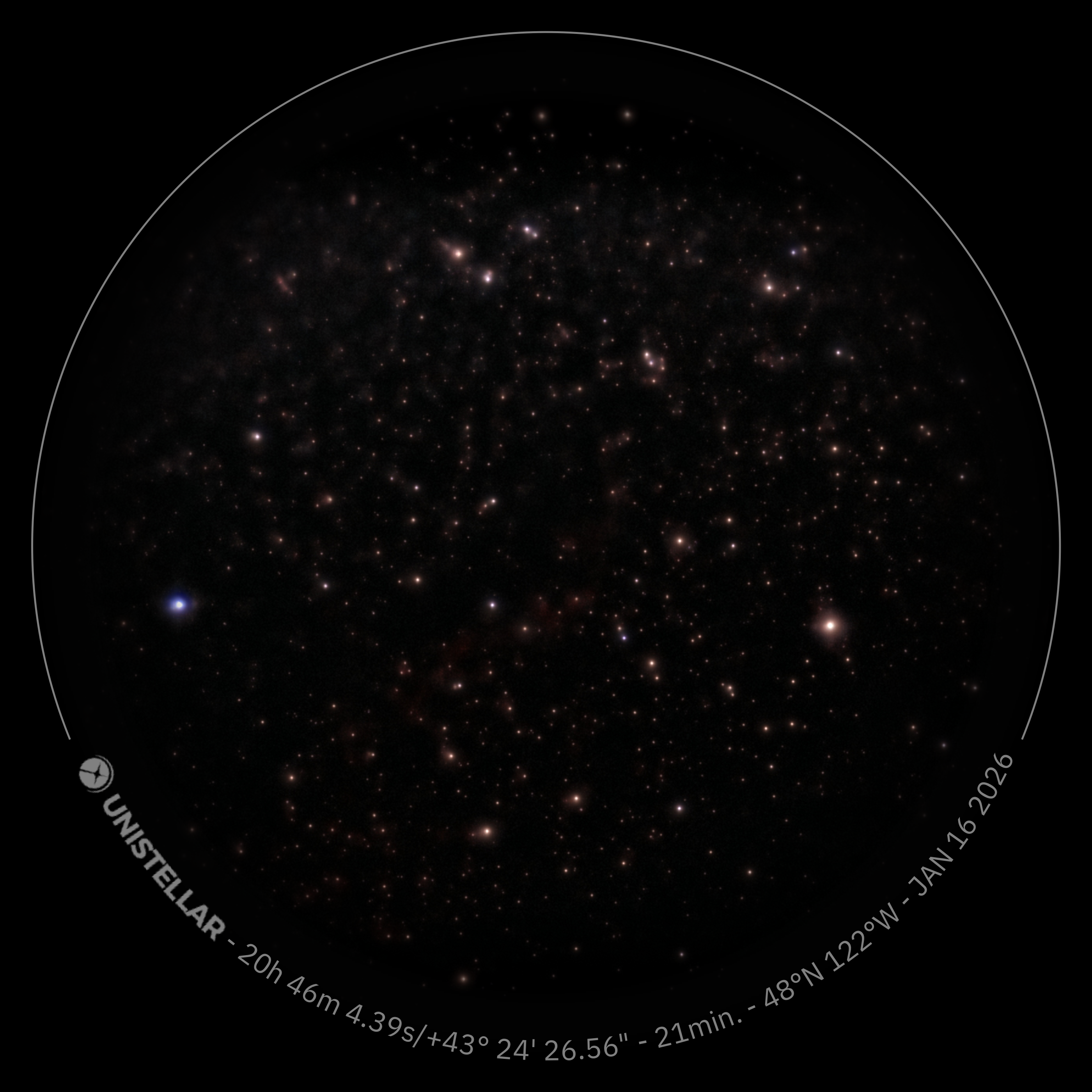
NGC 7000 – The North America Nebula
21m
2026-01-16
This is my attempt at 20h 46m 4s / +43:24:27, and again, it didn’t turn out great. It’s too thin and too dim to really work, given the lighting conditions.
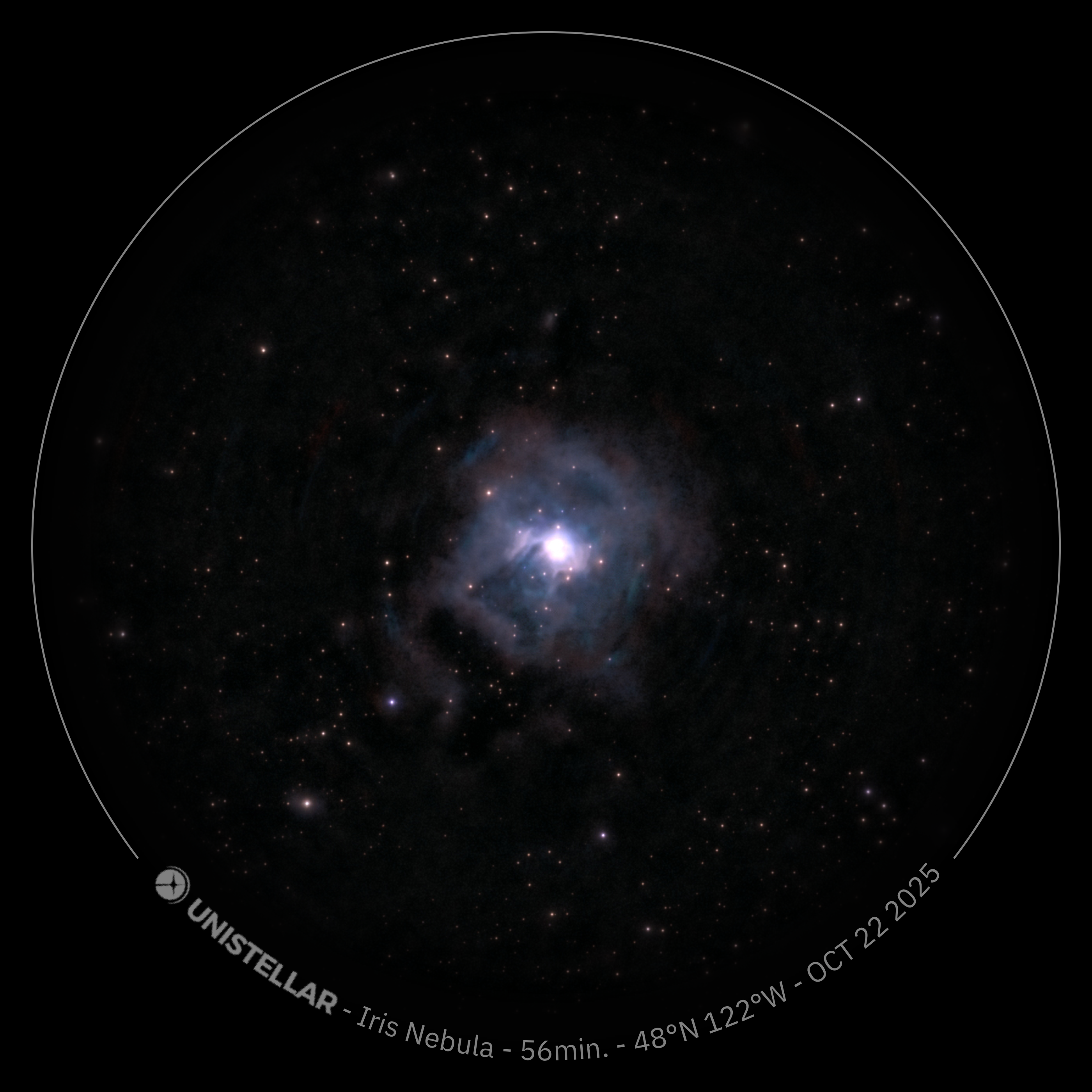
NGC 7023 – Iris Nebula
56m
2025-10-22
This is another one that the Unistellar catalogue doesn’t have good data for, and you have to force it to go find it. I’m glad I did, because this is a very beautiful nebula.
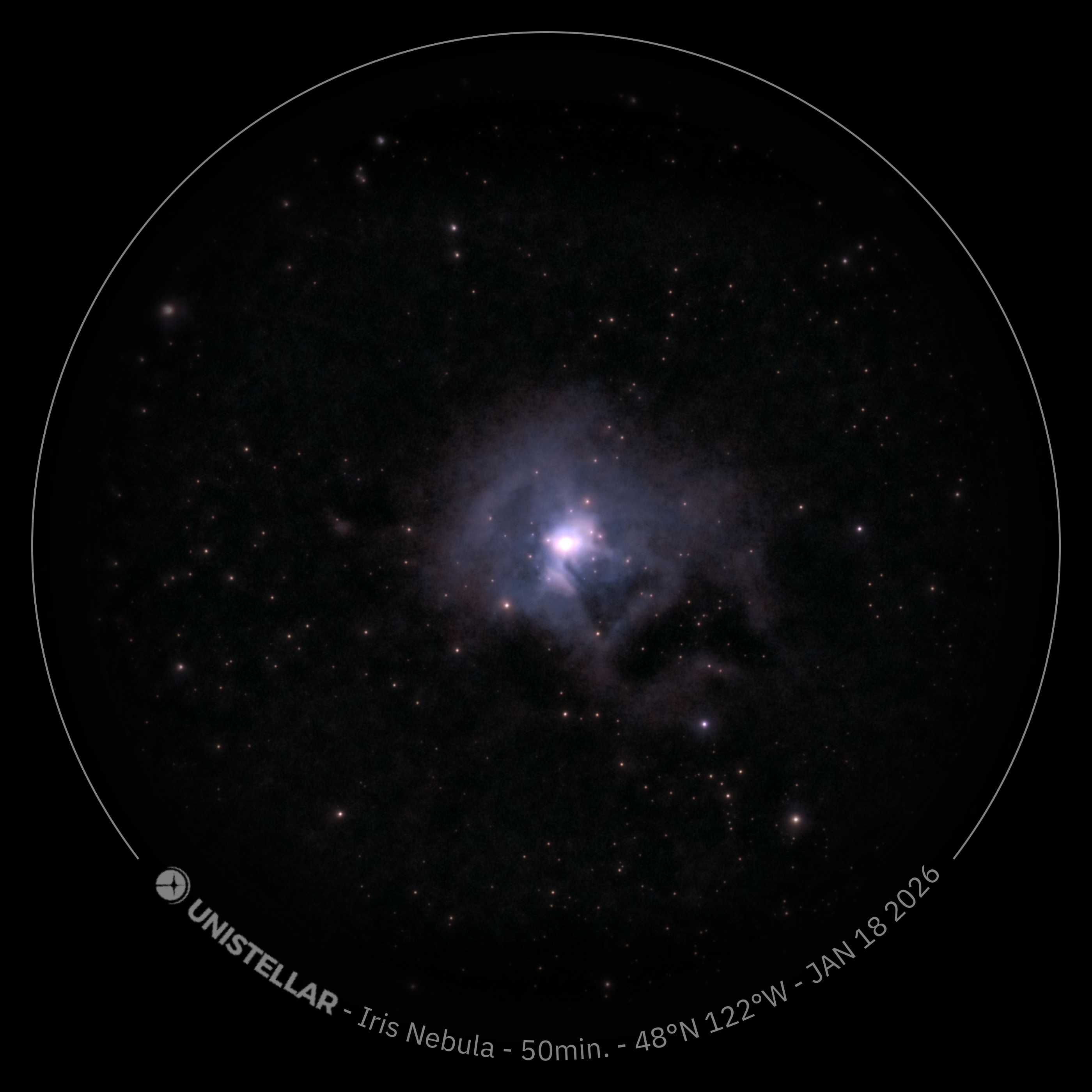
NGC 7023 – Iris Nebula
50m
2026-01-18
I thought my earlier shot of this had weird artifacts (that looked like concentric circles), and I was right. This is a better image of a lovely nebula.
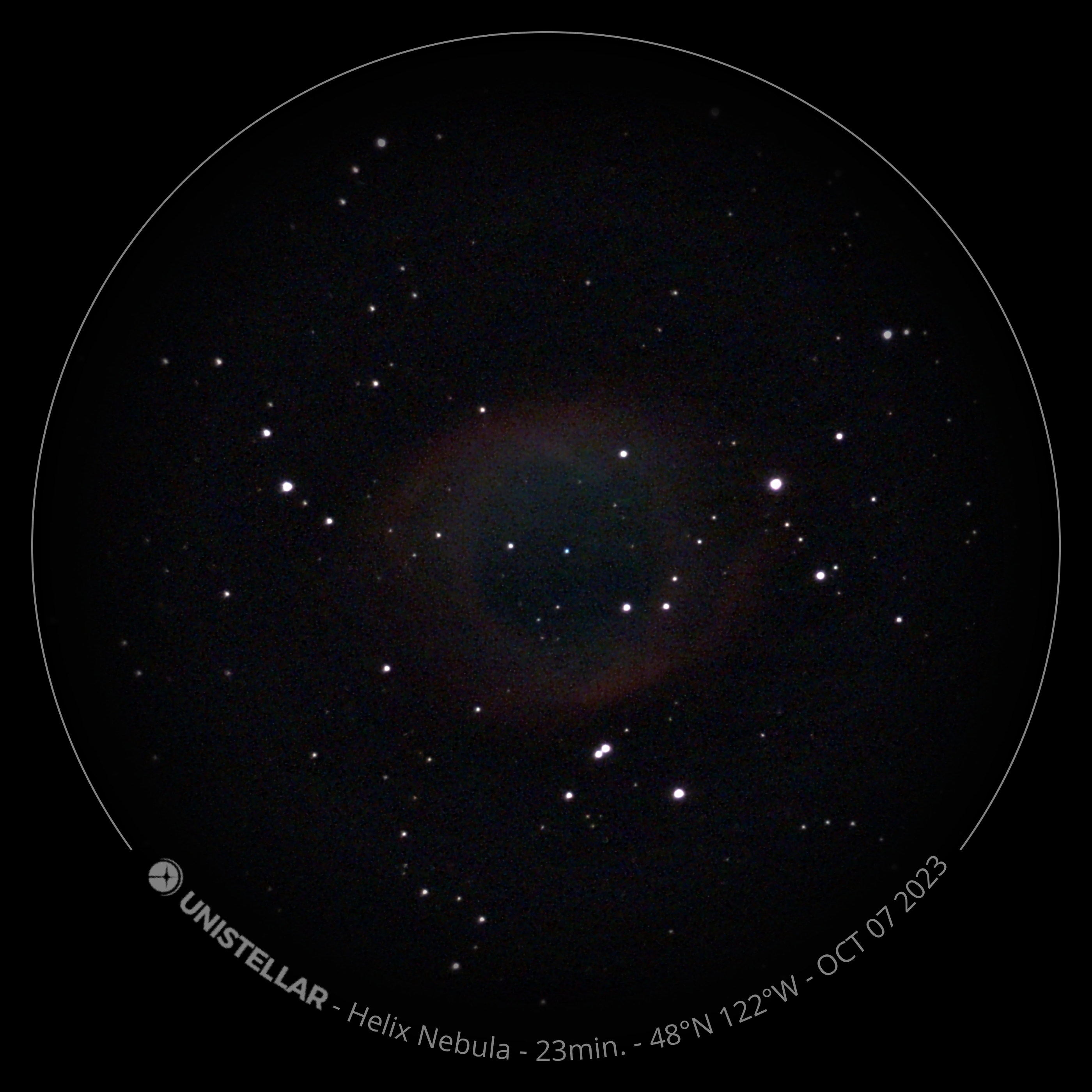
NGC 7293 – Helix Nebula
23m
2023-11-07
The Helix Nebula is incredibly dim. Even at 23 minutes, it’s almost impossible to make out.
NGC 7293 – Helix Nebula
32m
2024-10-06
After the new software launched, you can see that it helps with a very faint nebula like this one. It’s still very faint, but not as bad as before.

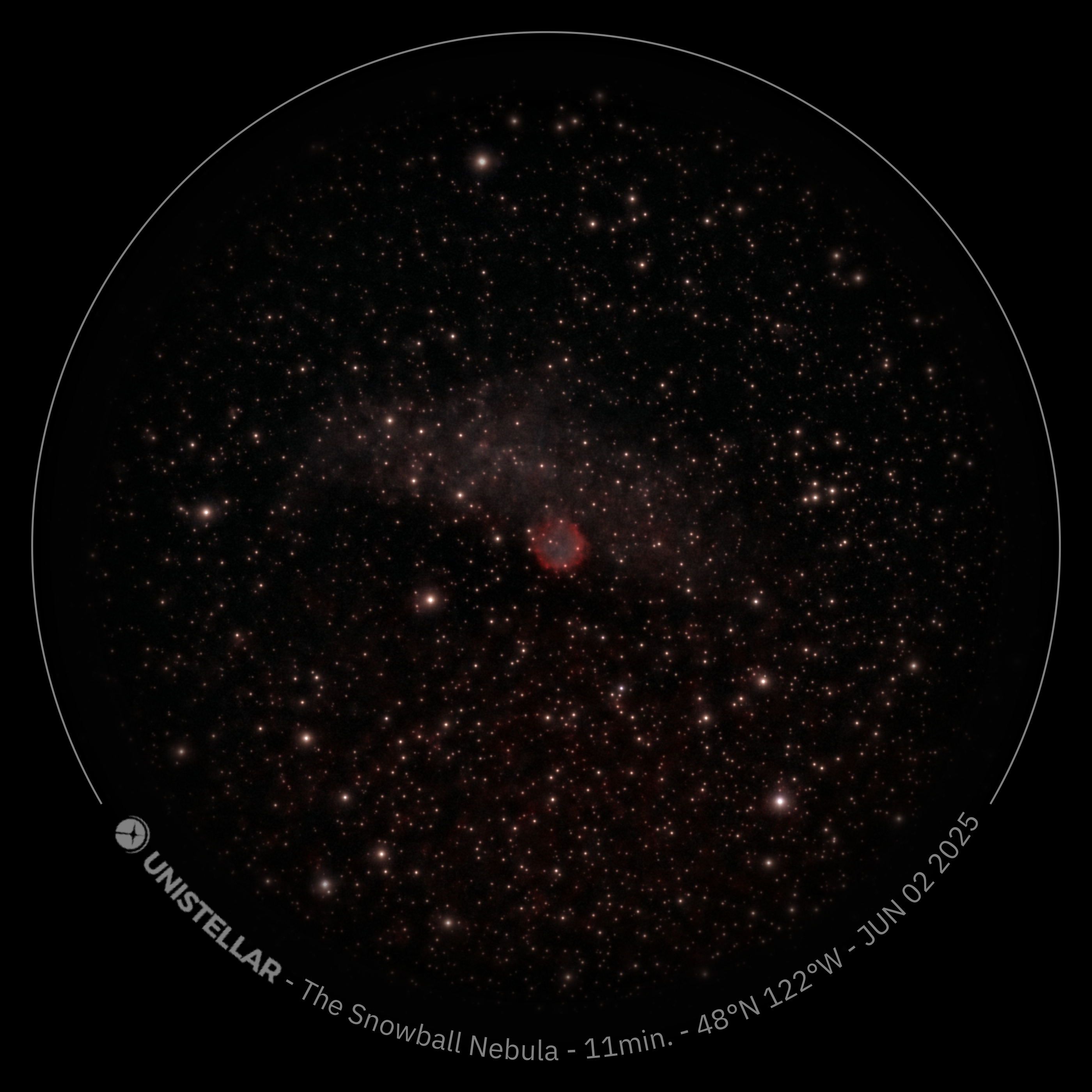
NGC 7662 – Snowball Nebula
11m
2025-07-02
This one is both faint and small; I’m not sure how much of this is atmospheric haze vs. actual nebula. Also, the color stretching here seems a bit extreme – I don’t think EVERY star is red, right? I’ll try this one again on another night.
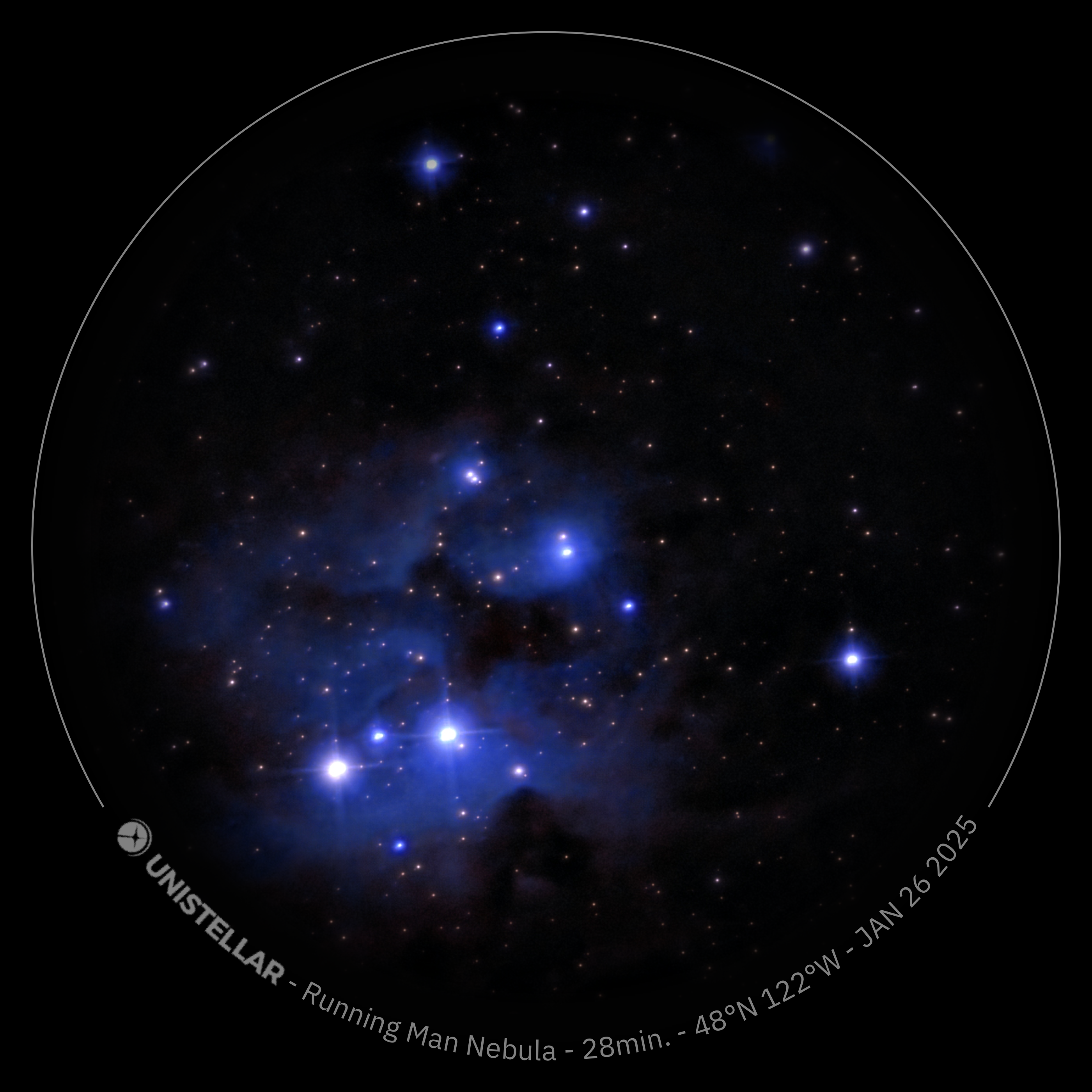
S279 – Running Man Nebula
28m
2025-01-26
This is a great shot of the Running Man Nebula, which is part of the Orion Nebula cluster. The color stretching software did some great work here. I got some great blues, but other images have a lot more pinks. I’d like to revisit this one next winter, when Orion’s up.