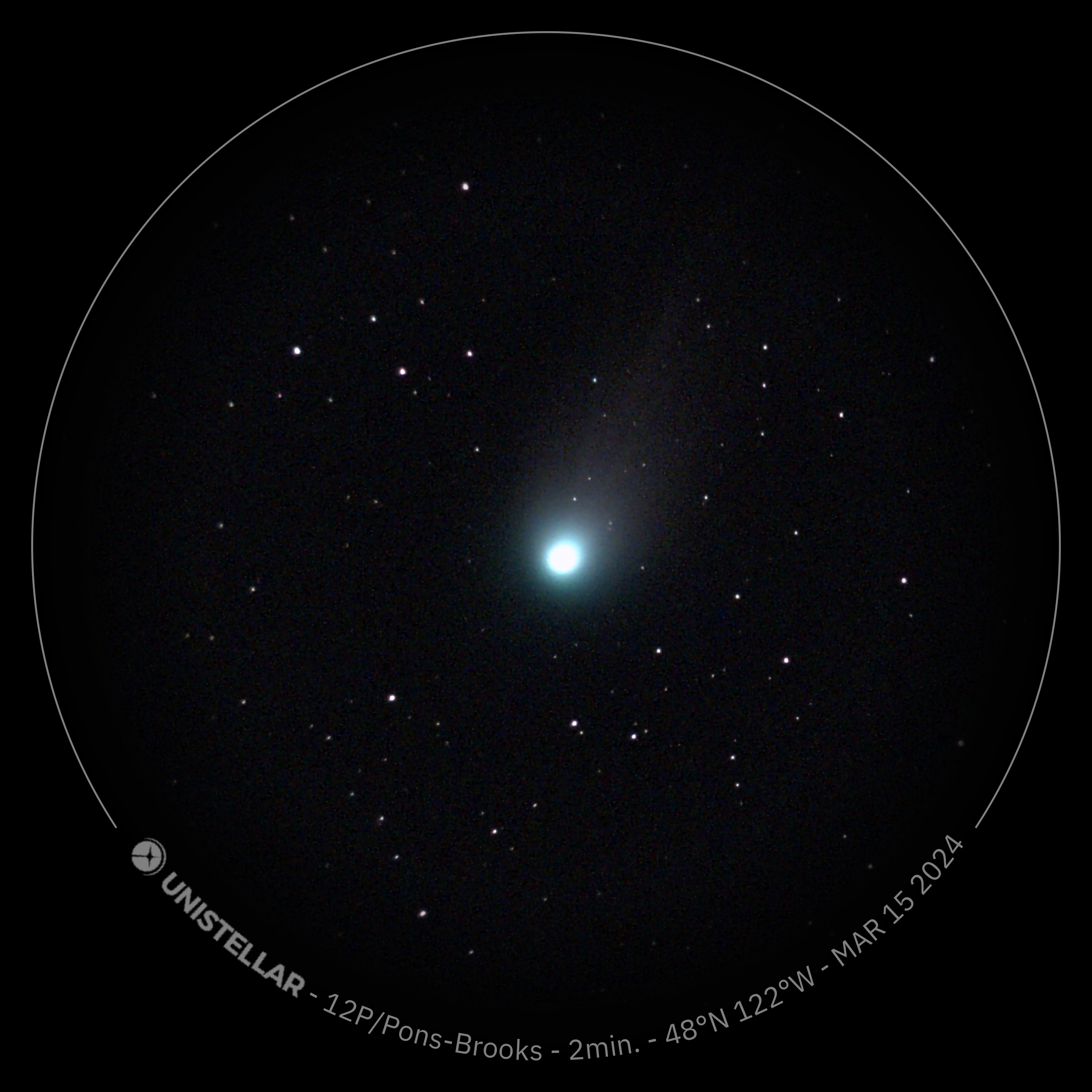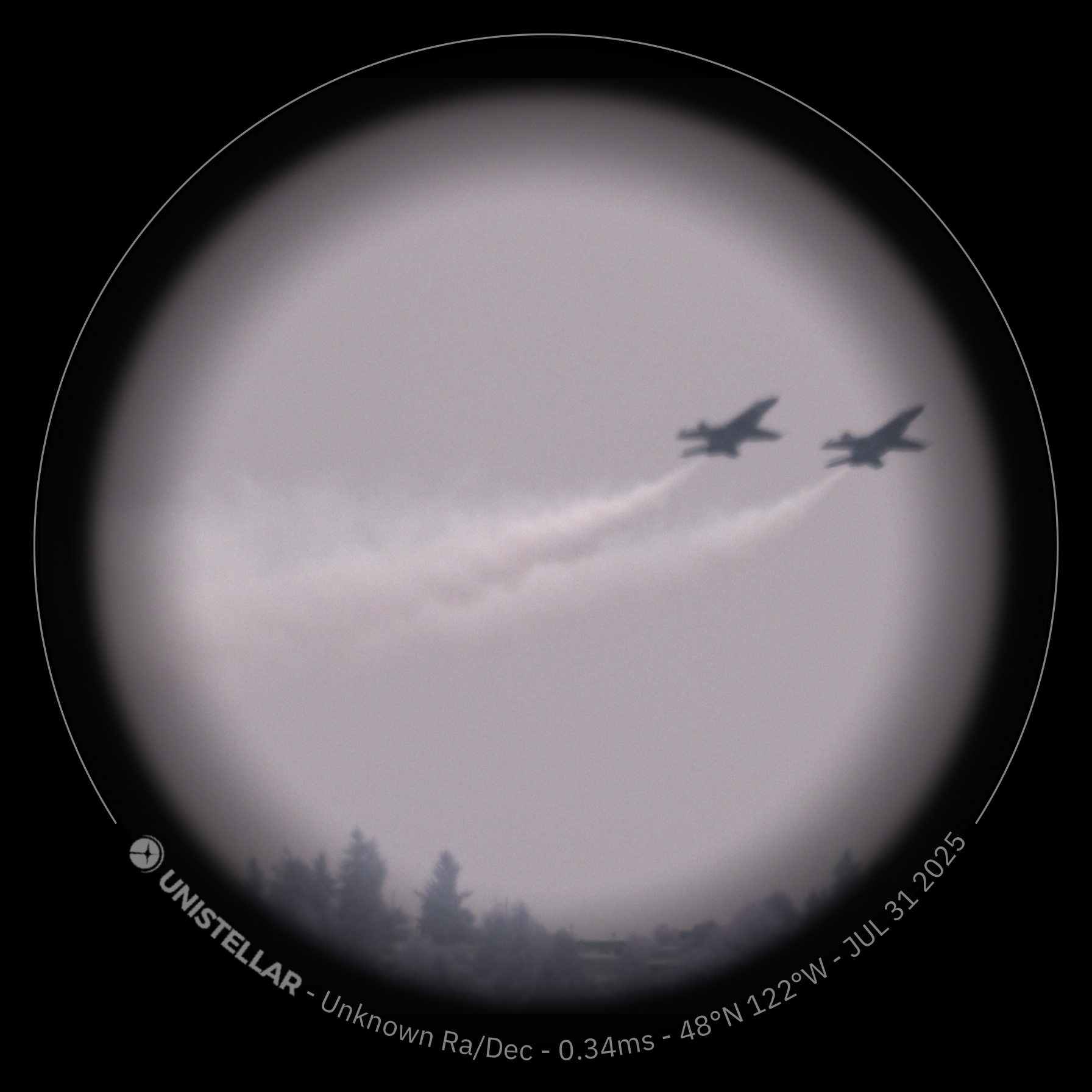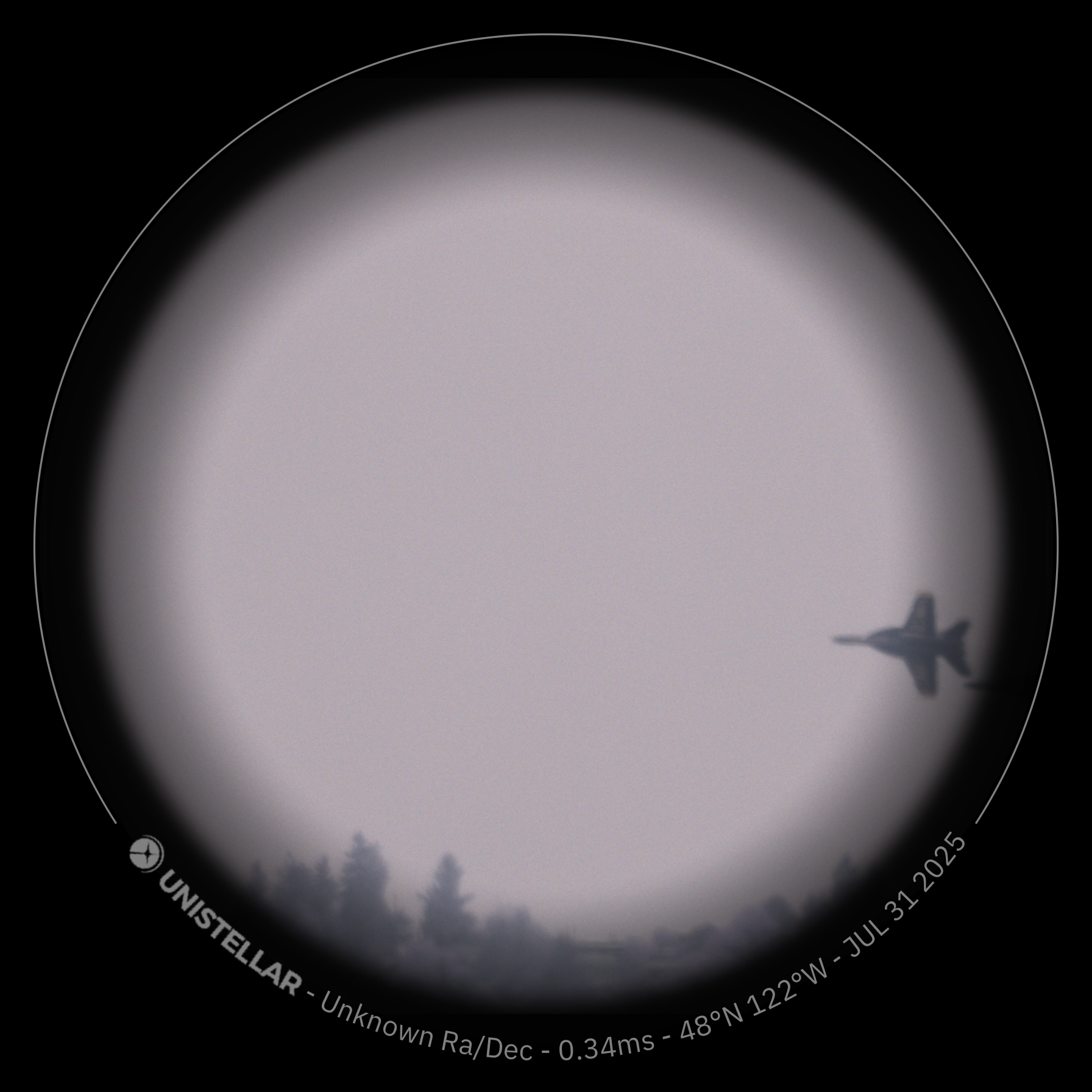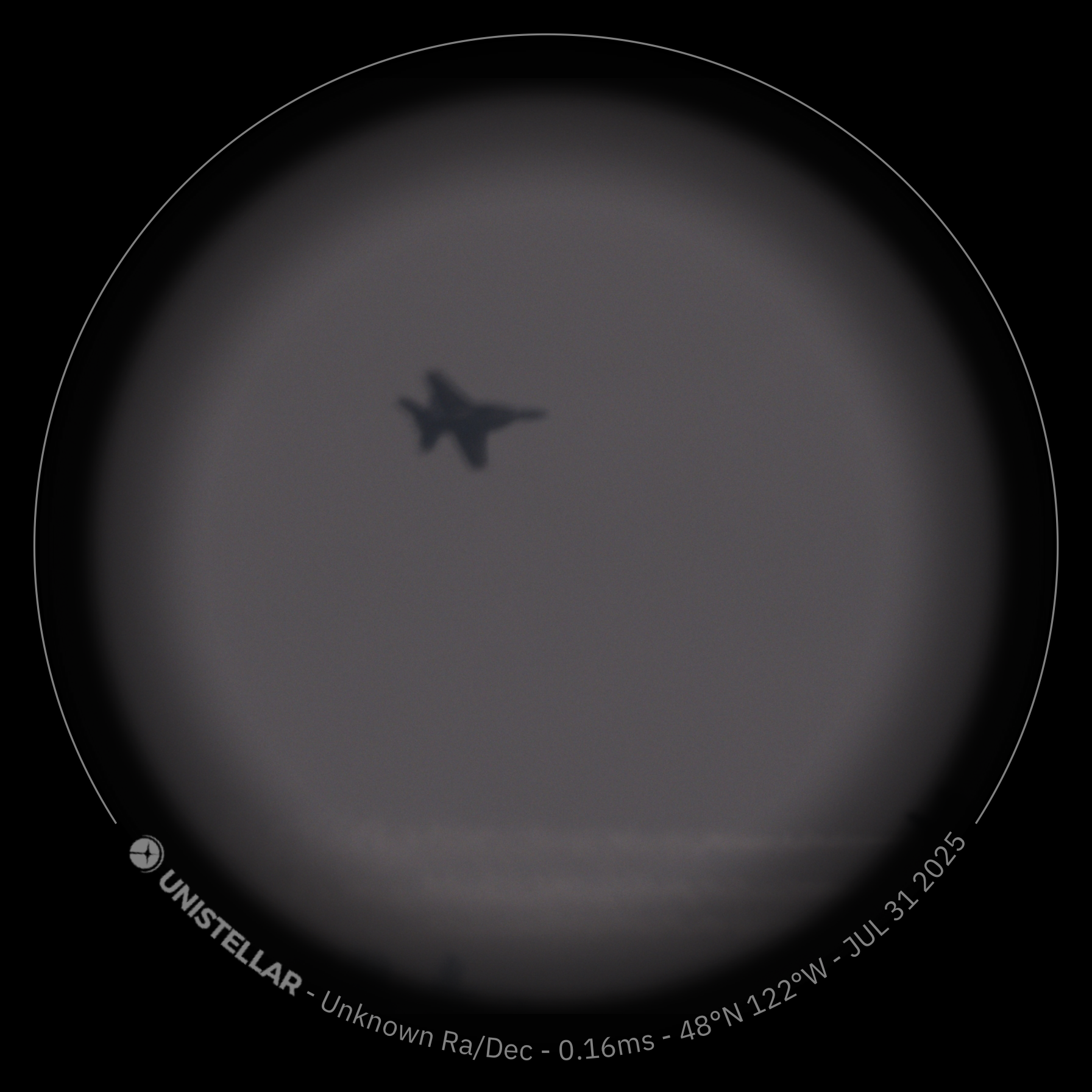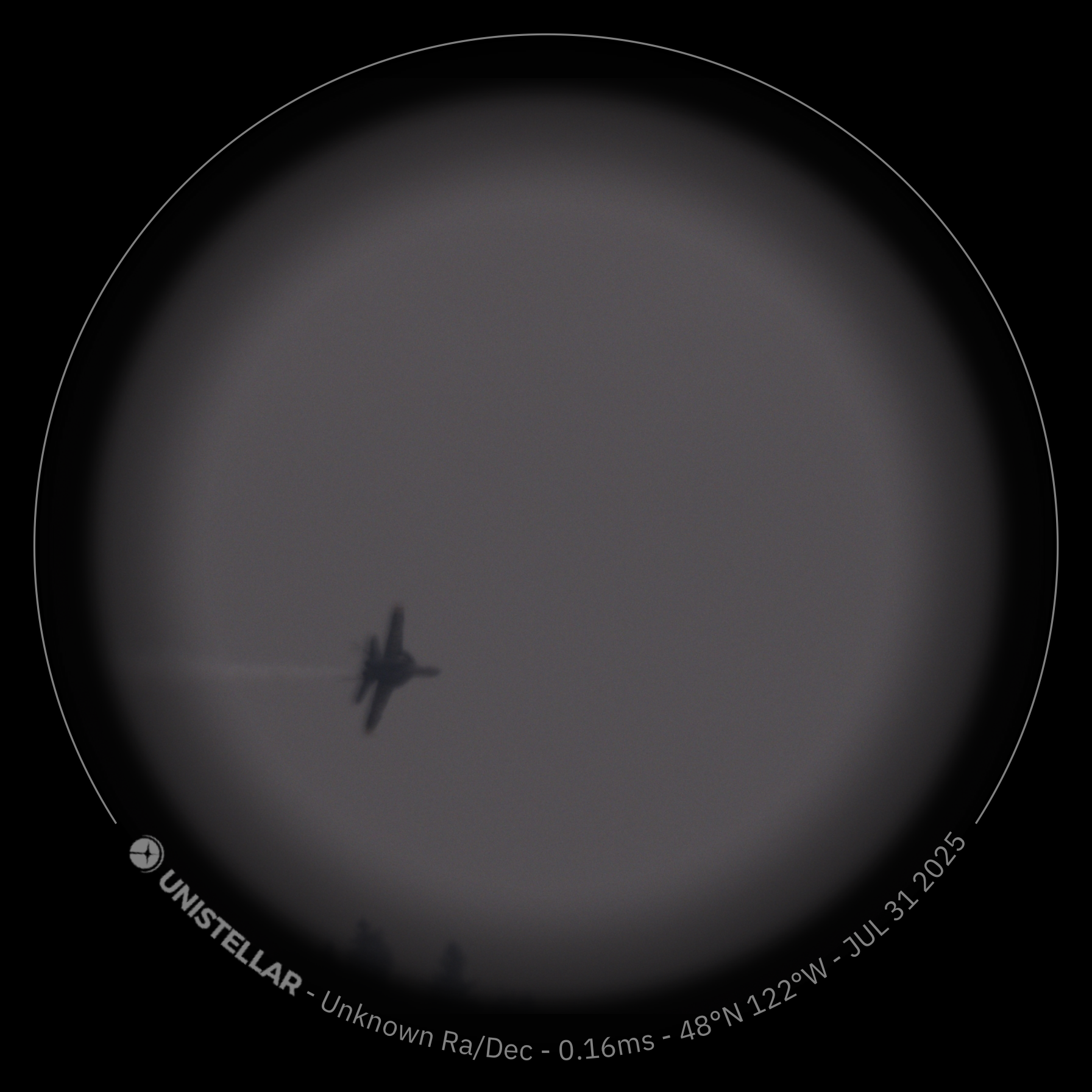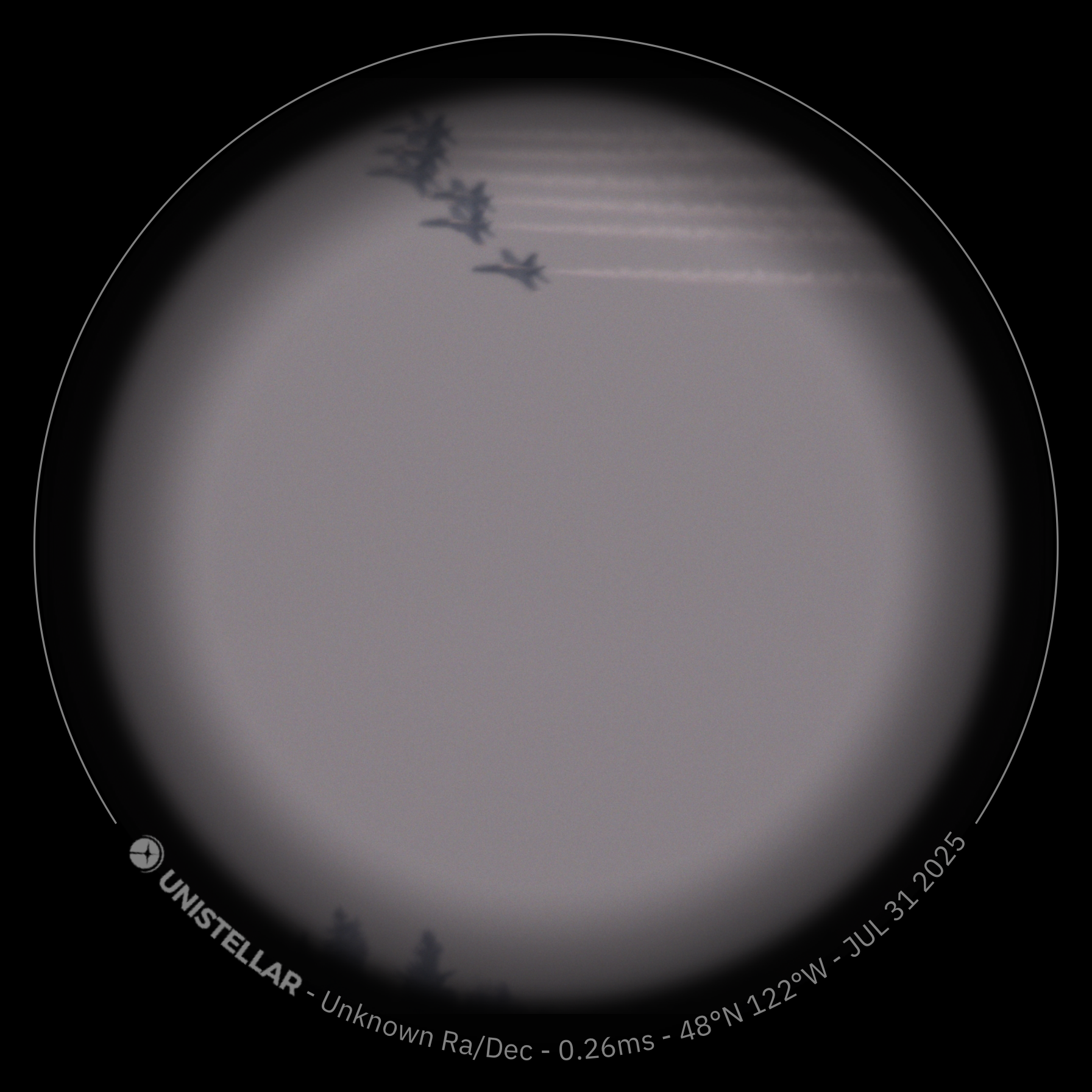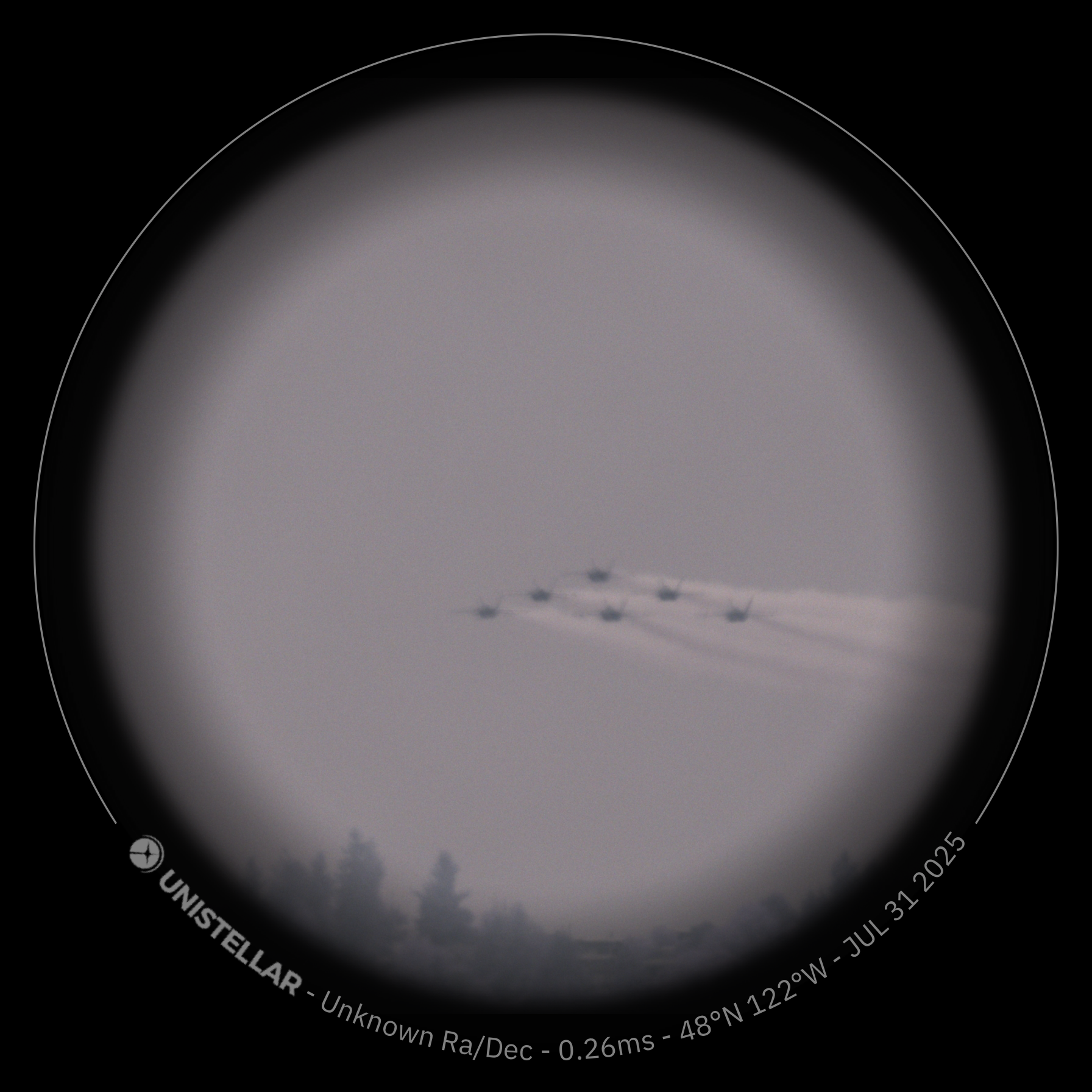
Every summer, the Blue Angels perform in Seattle at SeaFair. For those that don’t know, the Blue Angels are the US Navy’s acrobatic flight team, and they perform all over the world. When in Seattle, they fly over Lake Washington, which I can see from my back porch. I set up the eVscope this afternoon to try to catch them during practice, and as I suspected, it was really hard. The eVscope has a fixed and limited field of view, it’s slow to move, and the screen refresh rate is probably 5-10 frames per second. They’re in and out of your field of view in 3-4 frames, so you have to watch, click, and pray. I took 22 pictures this afternoon, got planes in 12 of them, and the only ones where they’re any good are below. Still, it was fun to capture them with the telescope!
Also, to get these, I had to manually adjust the gain and brightness, and the telescope had the annoying habit of occasionally (and apparently randomly) switching back to automatic mode – which entirely blacked out the screen, as it reset both to effectively 0. That forced another half-dozen clicks as I had to go to the adjustment screen, switch back to manual mode, and adjust the sliders to be able to see anything.
To capture the photos below, I picked a spot near the horizon where I knew they often flew past, found it in the telescope, and then watched for when they approached. As they did, I started watching my phone screen, and as soon as I saw them, I clicked to take a photo. Sometimes I was early, but usually I was late.
I had a clear night a couple nights ago, without high clouds, and decided to give it a go. I was happy with what I captured!
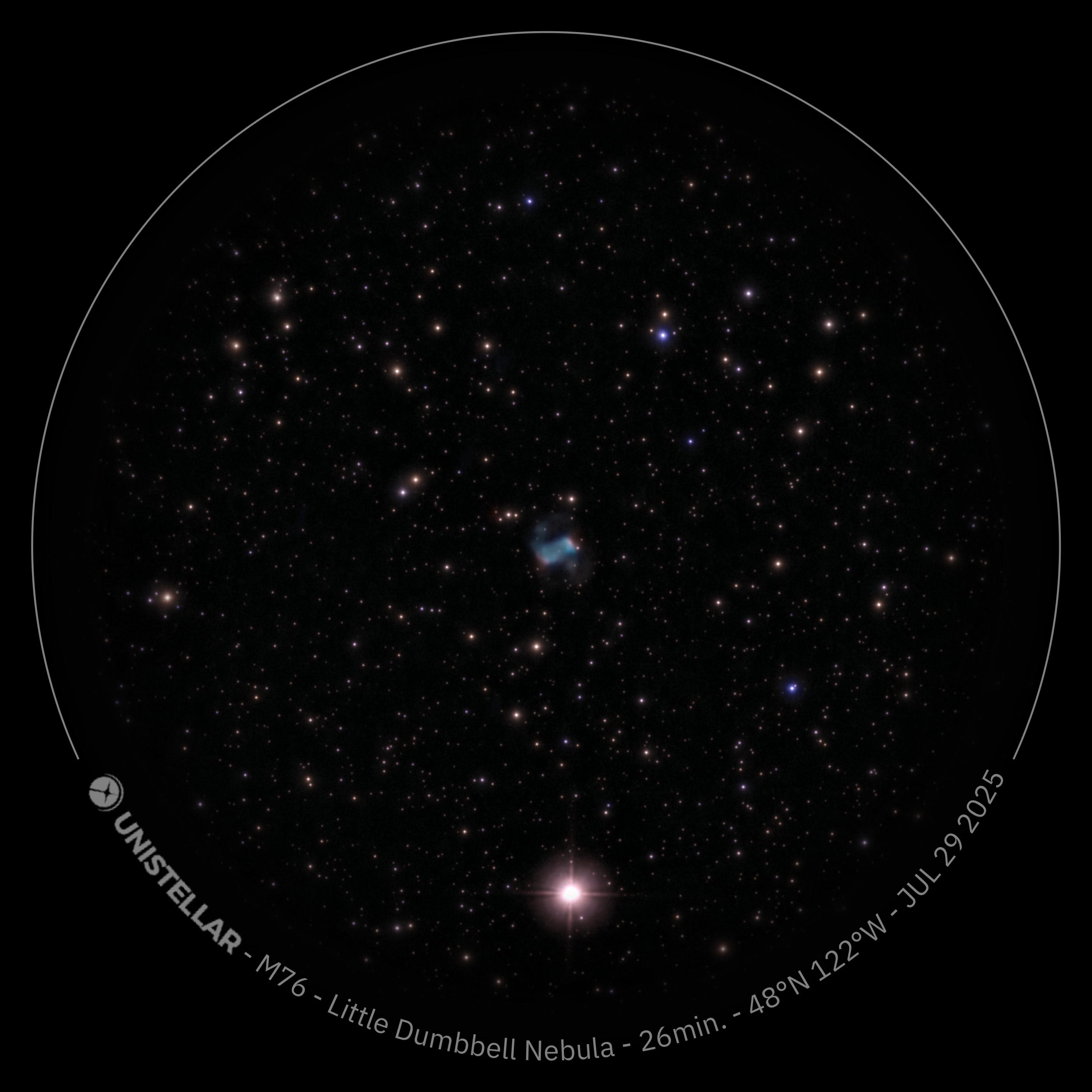
The first image is a new object (for me) – the Little Dumbbell Nebula. The Dumbbell (M27) is a favorite for the eVscope in the northern hemisphere, given its size, brightness, and clarity. The Little Dumbbell (M76) is much smaller in terms of visual angle, and dimmer, but still has distinct red and yellow elements.
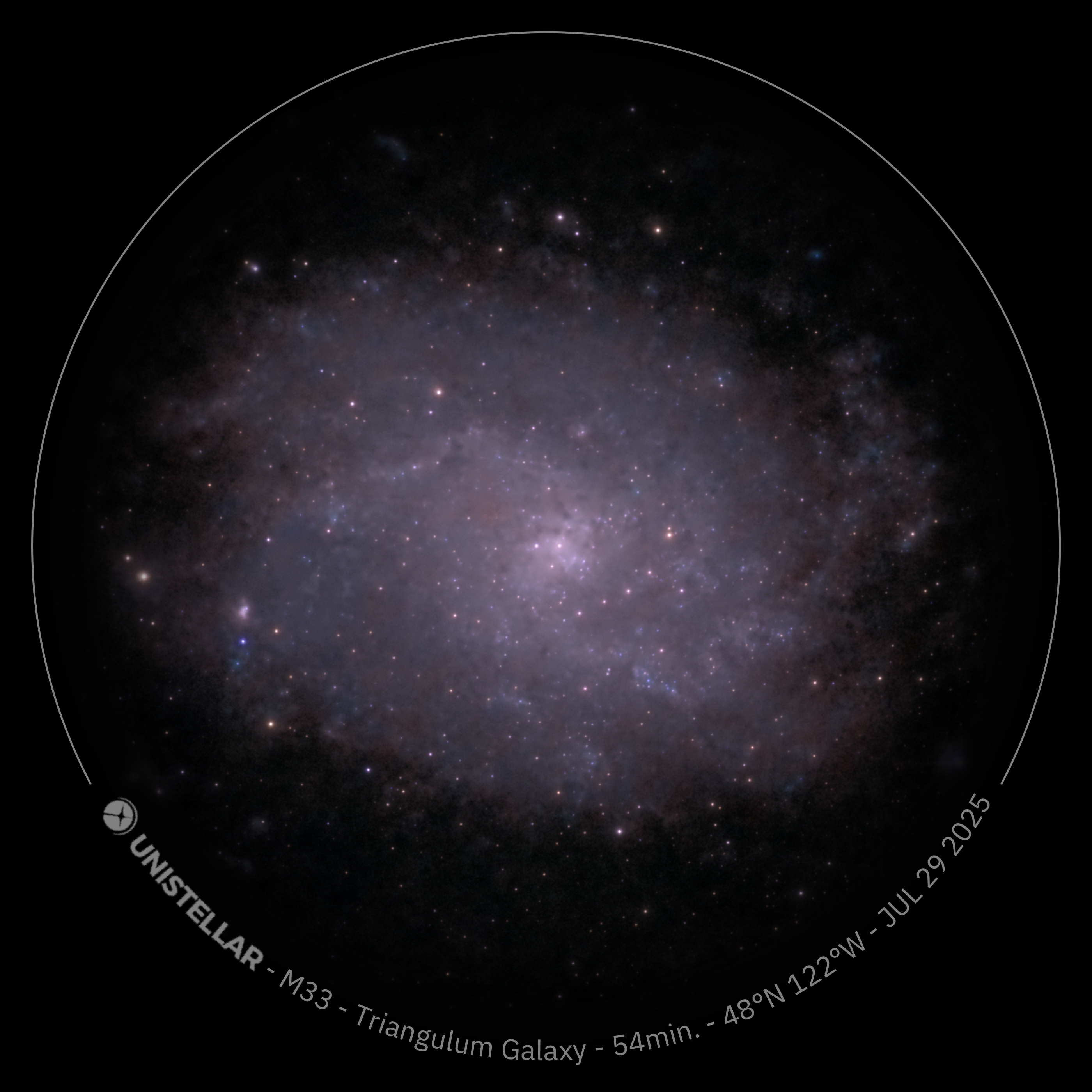
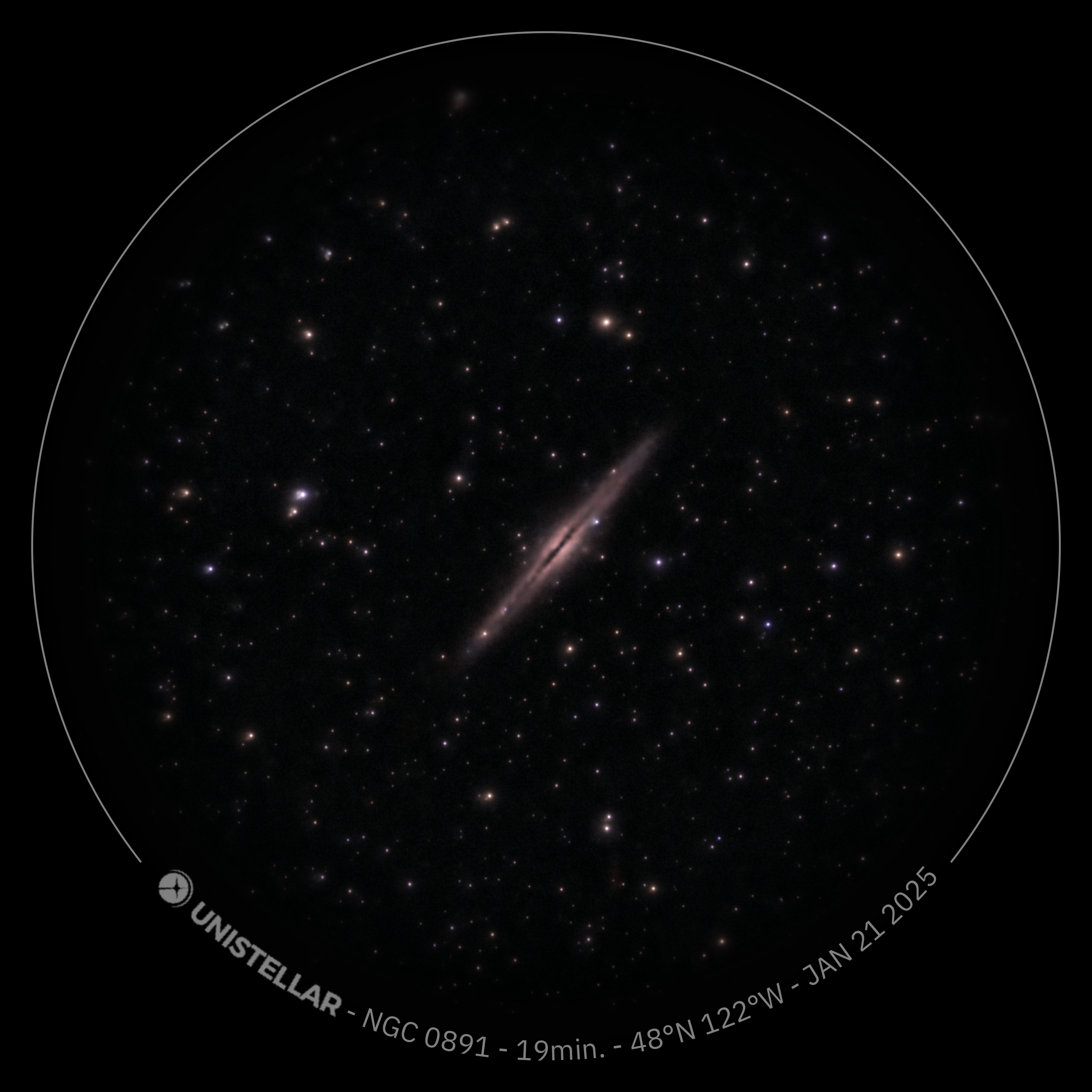
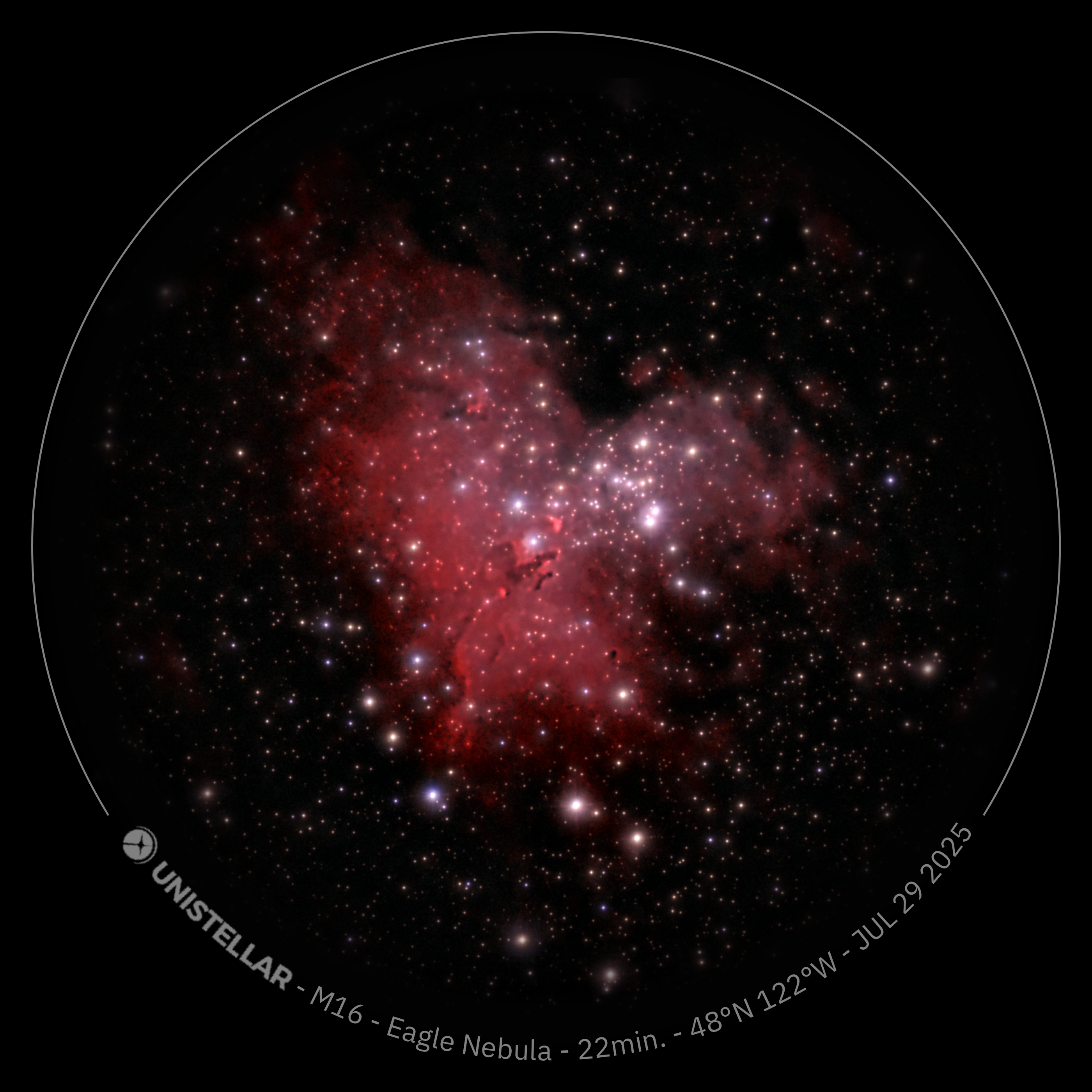
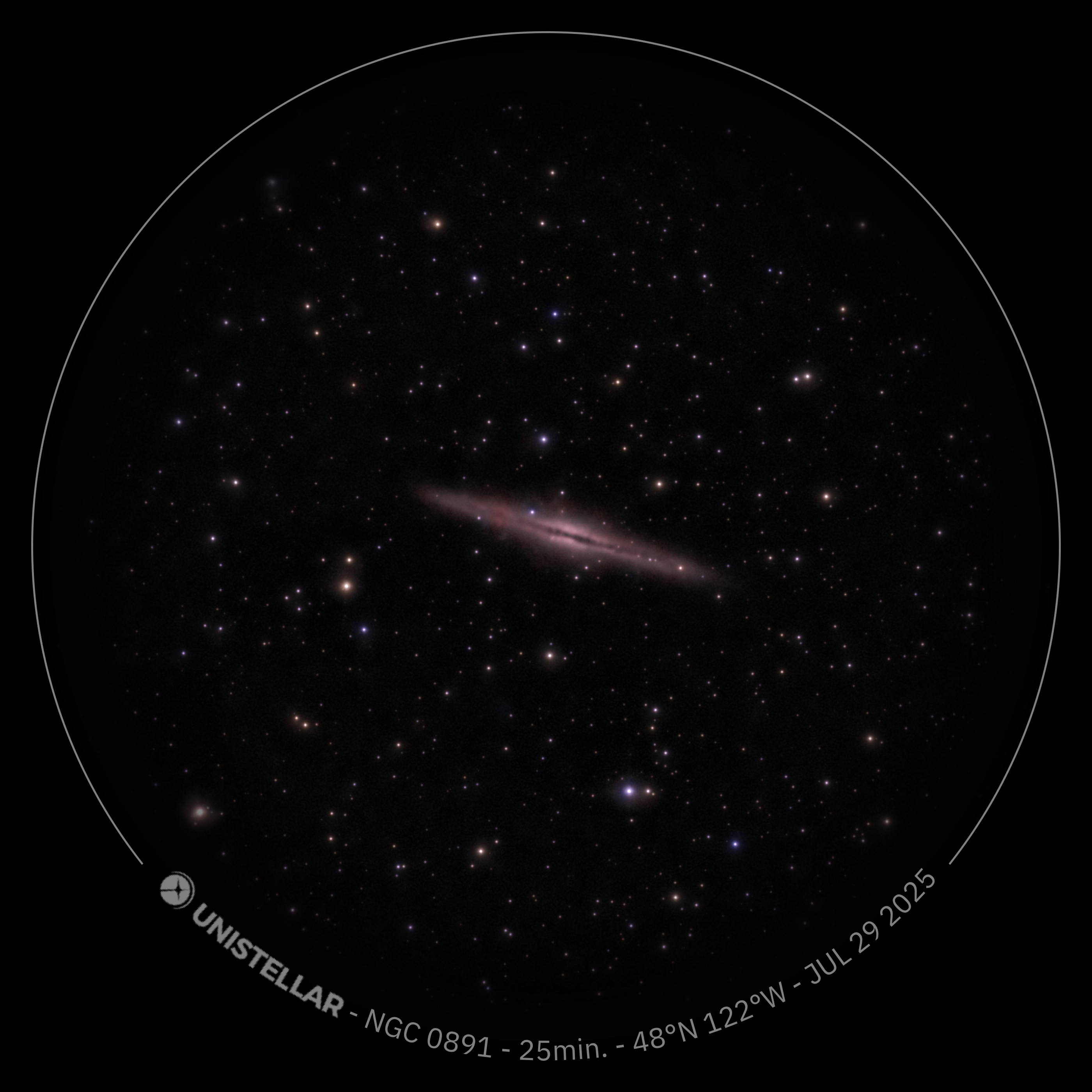
The other three were revisits to previous favorites – the Eagle Nebula, with its spectacular Pillars of Creation clearly visible; NGC 0891, a wonderful edge-on galaxy with distinct dust clouds and a bright central bulge; and the Triangulum galaxy, a face-on diffuse spiral galaxy with beautiful red-, yellow-, and blue-colored stars. It’s the largest galaxy we can see that fits in the eVscope field of view. The Andromeda galaxy is larger, but would need approximately a dozen images stitched together in a mosaic. It’s weird to think that the Triangulum is almost as big as a full moon, but we can’t see it, since it’s so dim. It’s also weird to think that there are nocturnal animals, with vision much better than ours, that CAN see it, just hanging there, in the night sky.
These will be added to the nebulae and galaxies pages.
M76 – The Little Dumbbell Nebula
2025-07-29
26m
Not a great shot, when compared to what’s available online, but still, a nice color photo of a small and distant nebula. I suspect this might be better with a darker sky, from a higher elevation, but from within a city? Pretty dang good.
M16 – Eagle Nebula
2025-07-29
22m
Another fantastic shot, including the Pillars of Creation. This is one of the best nebulae that you can capture with the eVscope.
NGC 0891
2025-07-29
25m
I still love this galaxy – it’s almost perfect in terms of size, brightness, and clarity for the eVscope.
M33 – Triangulum Galaxy
2025-07-29
54m
I wanted to get a really long dwell time on the Triangulum, to get the dim glow of the diffuse arms, and to really highlight the bright giant stars in its arms. I love the different colors you can clearly make out.
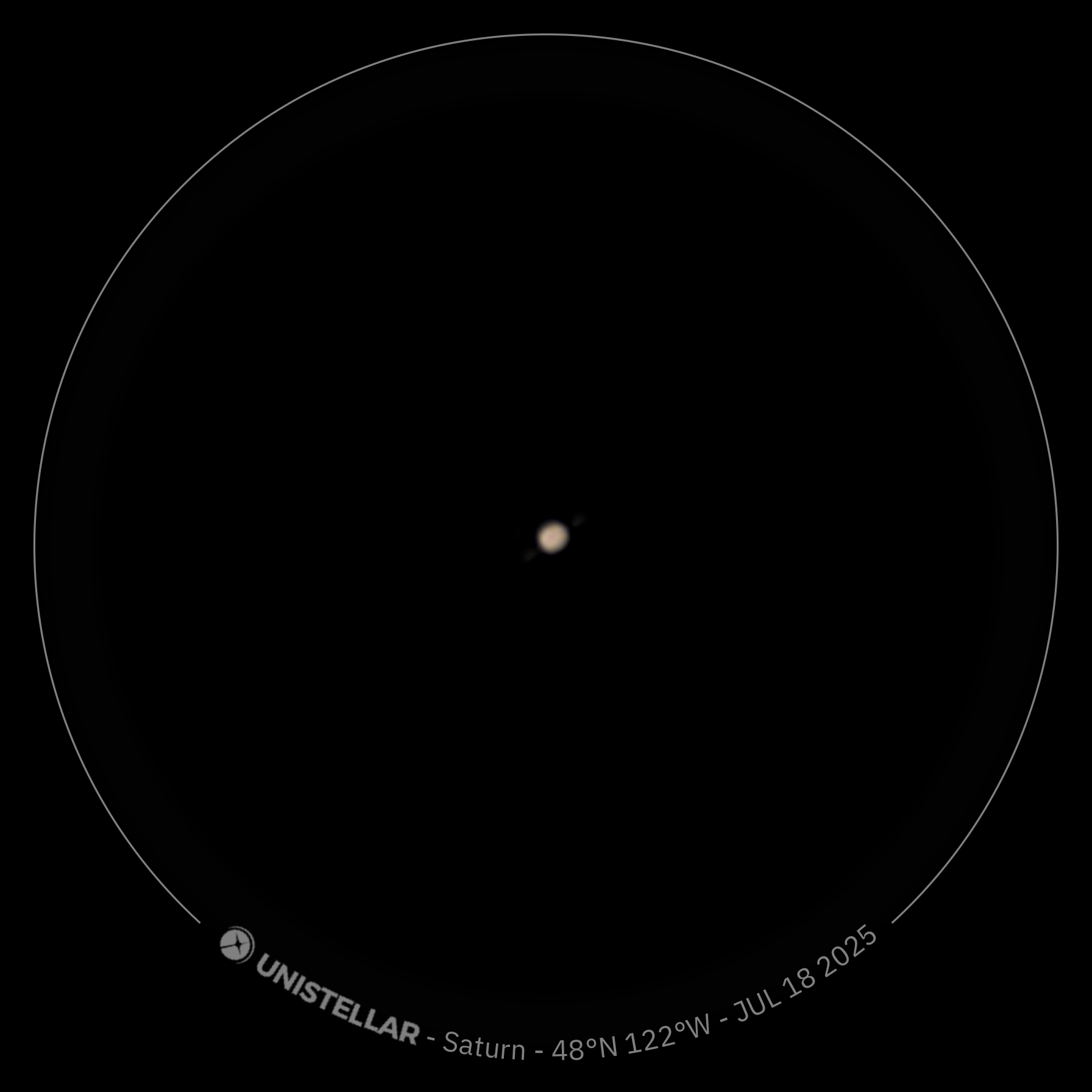
On July 18th, Titan passed between Saturn and the Sun, casting a shadow over the Saturnian cloud tops. Unistellar pitched this on their website as a viewing opportunity, and I figured, what the heck? Let’s give it a go. The Jupiter eclipse by Io was… okay? I knew that Saturn was both smaller and further away, but since Titan was relatively large, I thought maybe I could see it.
I set up to start taking pictures around 08:30 GMT (1:30am PDT), and took pictures at 08:28, 08:33, 09:10, 09:12, 09:13, 09:31, 09:32, and 09:54. Unfortunately, they were all pretty much the same, and came out like the one below.
Saturn
snapshot
2025-07-18
An attempt to capture Titan casting a shadow on Saturn. Unfortunately, the resolution isn’t high enough to make out the details.
I tried dwell times of 10s, 20s, 30s, 4m, and even one that was about 20m. In truth, the best ones came at around 20 seconds – much shorter, and there were no details; much longer, and everything washed out into a blobby orange haze. None came out any better than the one above, which was the best of the bunch. You can’t make out any shadow from Titan, and you can barely make out the rings. I started to make a movie of the images, but once I imported them and started aligning them, I just gave up, because there just wasn’t anything to see.
I confirmed, again, what I’ve mentioned before – the Unistellar eVscope2 is a phenomenal telescope for capturing moon-sized dim objects like nebulae and galaxies, even within an urban environment. It’s a good telescope for capturing star clusters. But it’s not good at the solar system objects, given both the limitation on field size and an inability to zoom. And unless you’re really into post-processing and stitching your images (which I’ve not yet attempted), it’s not good for large objects like the Milky Way or the Andromeda Galaxy.
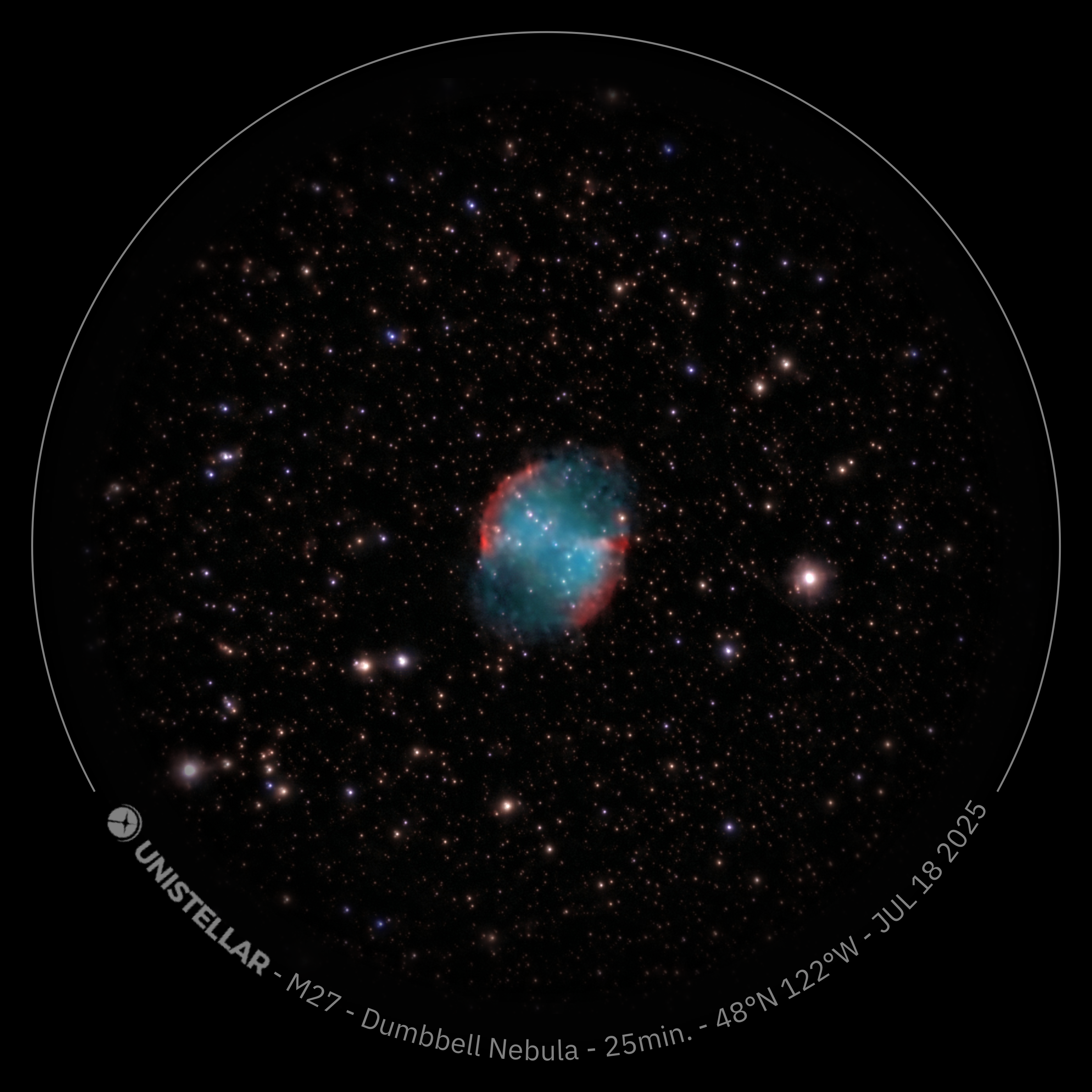
Since I didn’t want the evening to be a total loss, I did get a shot of the Dumbbell Nebula, which I thought came out quite well:
M27 – Dumbbell Nebula
25m
2025-07-18
I caught this the same night I was (unsuccessfully) attempting to capture Titan casting a shadow on Saturn. This was the best photo I took that night, unfortunately.
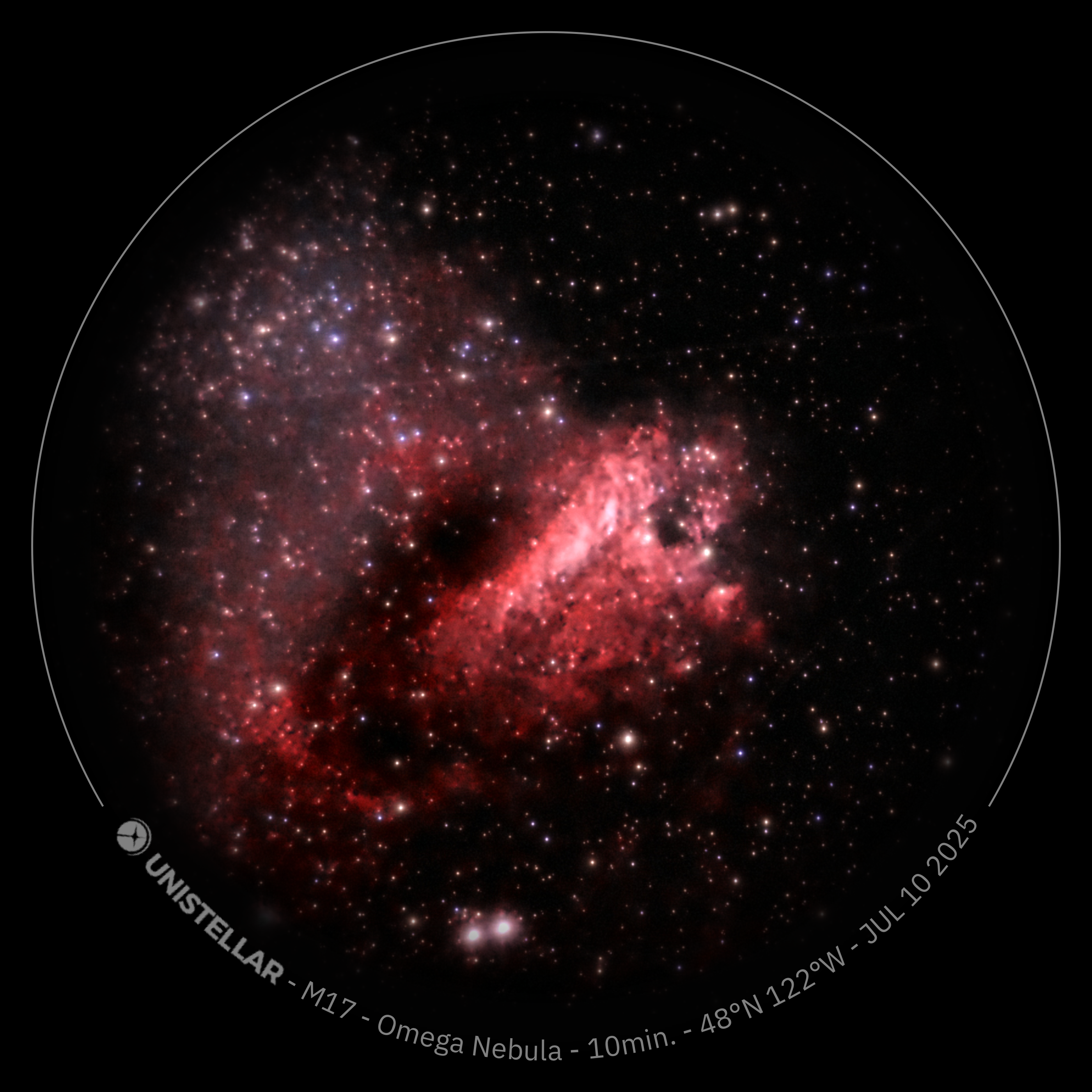
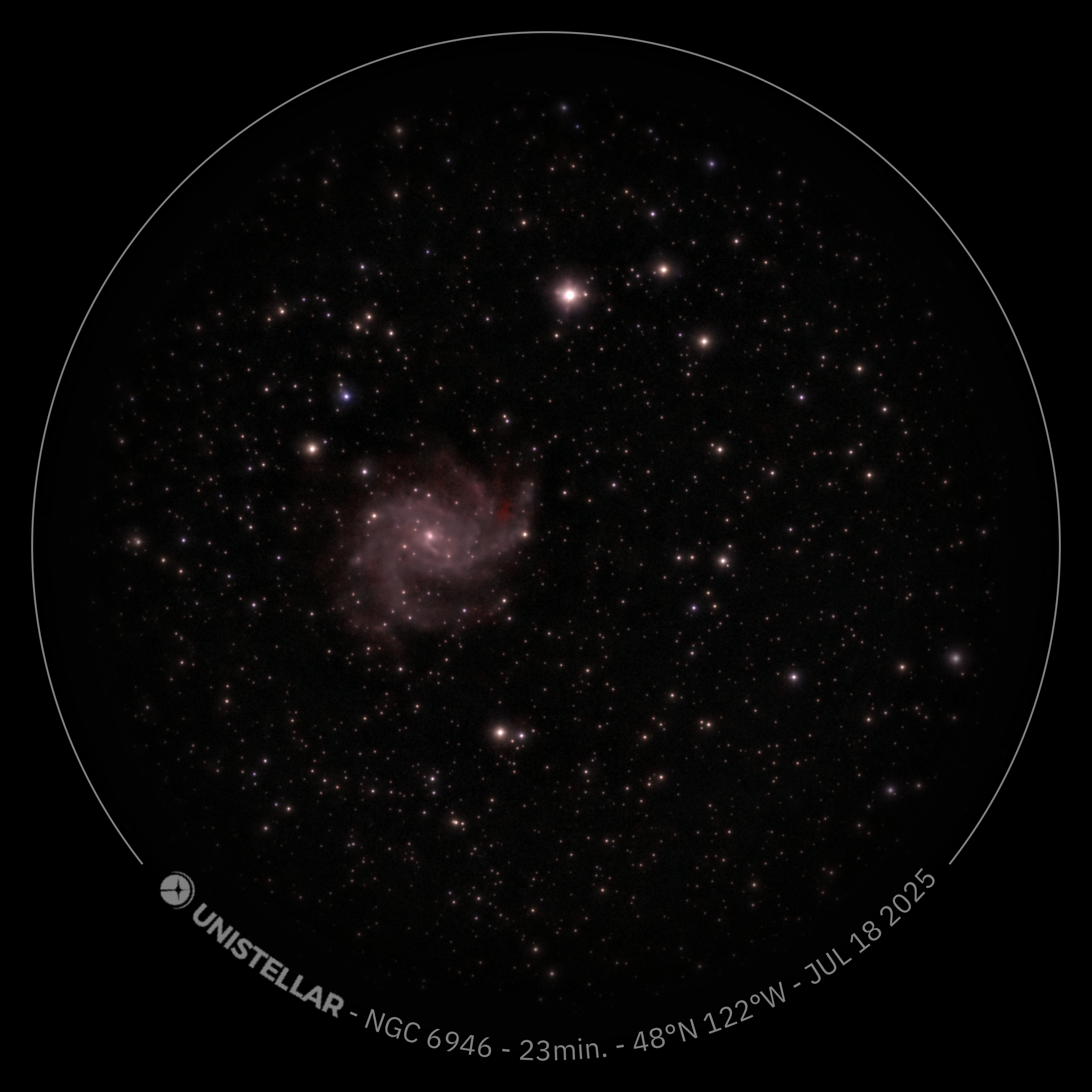
I did get the telescope out a few other times in the past couple weeks. We had a lot of nighttime high haze and thin clouds, as is common in Seattle in the summer, and so my telescope kept failing shots after only a few minutes. I did get two photos that I thought were worthy of posting:
M17 – Omega Nebula
10m
2025-07-10
A nice shot of the Omega Nebula, but it was cut short at only 10 minutes of dwell time due to high clouds.
NGC 6946
23m
2025-07-18
I wanted to revisit NGC 6946, to see whether the color stretching was bad in the first one, or it really is that red of a galaxy. Turns out, it’s really that red!
The last one was actually the night after the Saturn attempt – but Saturn was around 2:00 in the morning, whereas the photo of NGC 6946 was taken around 11pm the next evening.
All the above will be added to the Galaxies, Nebulae, and Solar System Objects pages as appropriate.
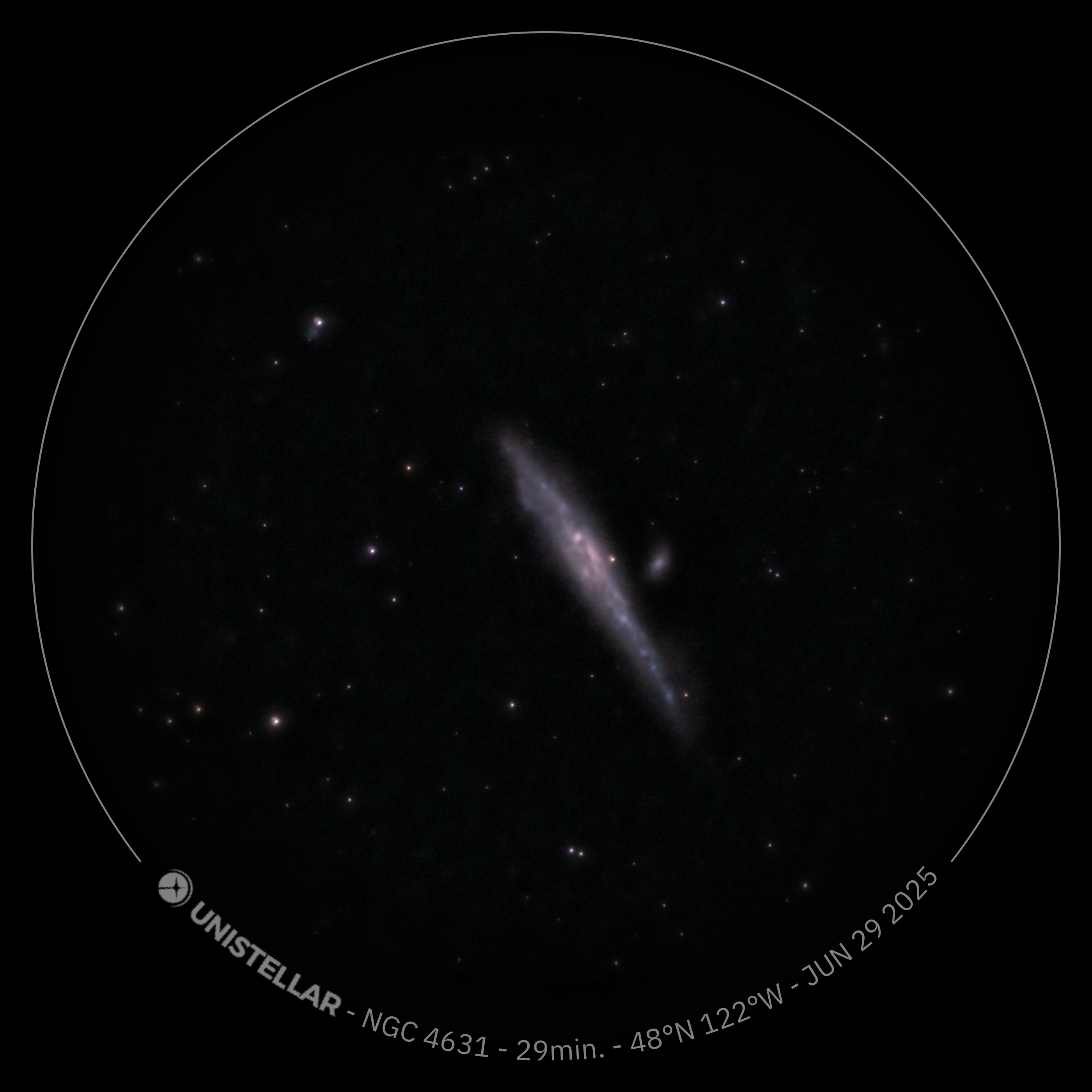
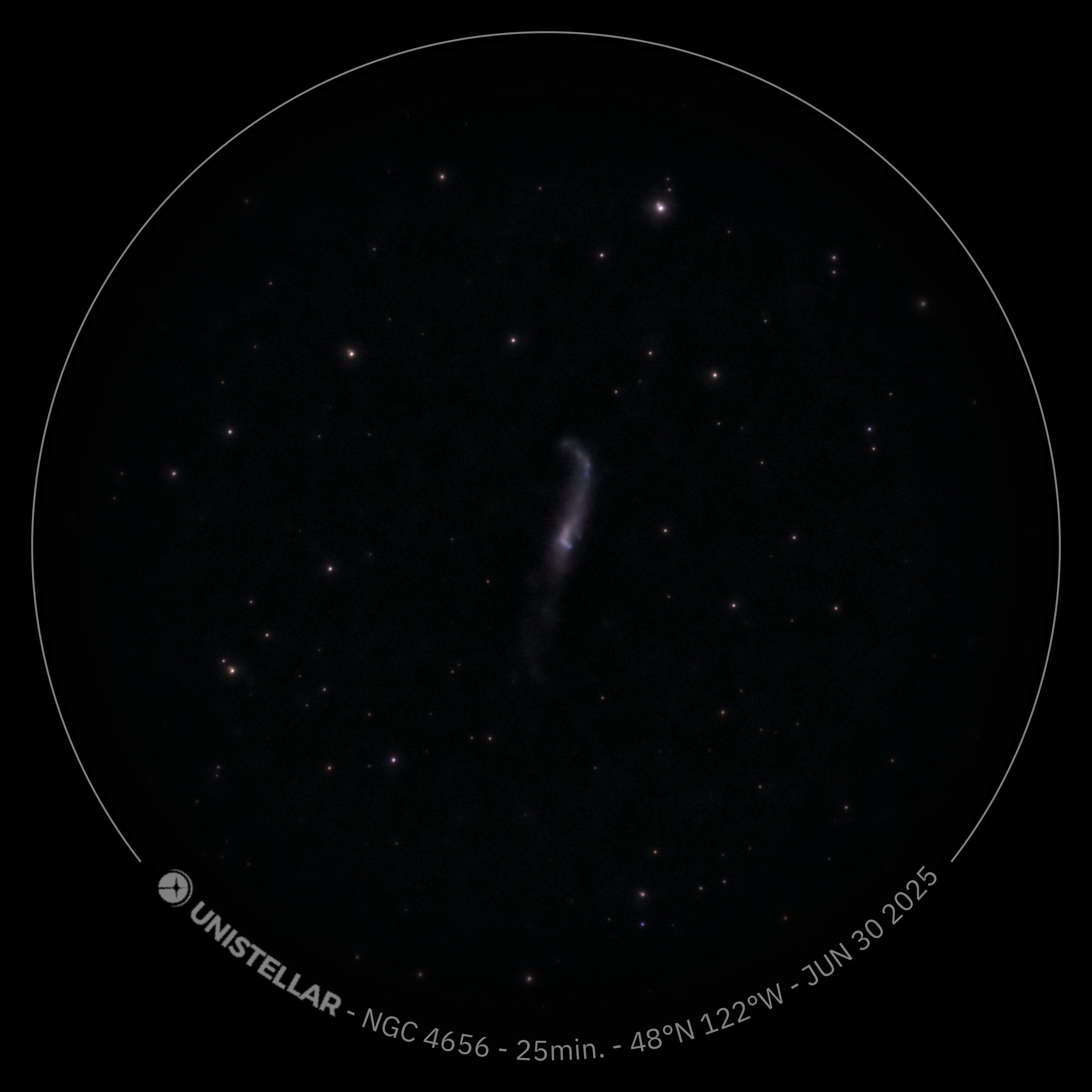
It’s been clear the last few nights, and I got some new photos. The first night I focused on galaxies that I’d not yet captured, and I got two new ones that are part of a cluster of galaxies referred to as the NGC 4631 group. All are part of the larger Virgo Cluster, but these four are part of a group that may be as few as five galaxies or as many as twenty-seven, all interacting with and orbiting each other. The ones that I’ve captured are close together – just beyond the viewable angle of my telescope, so about two or three moon-widths apart.
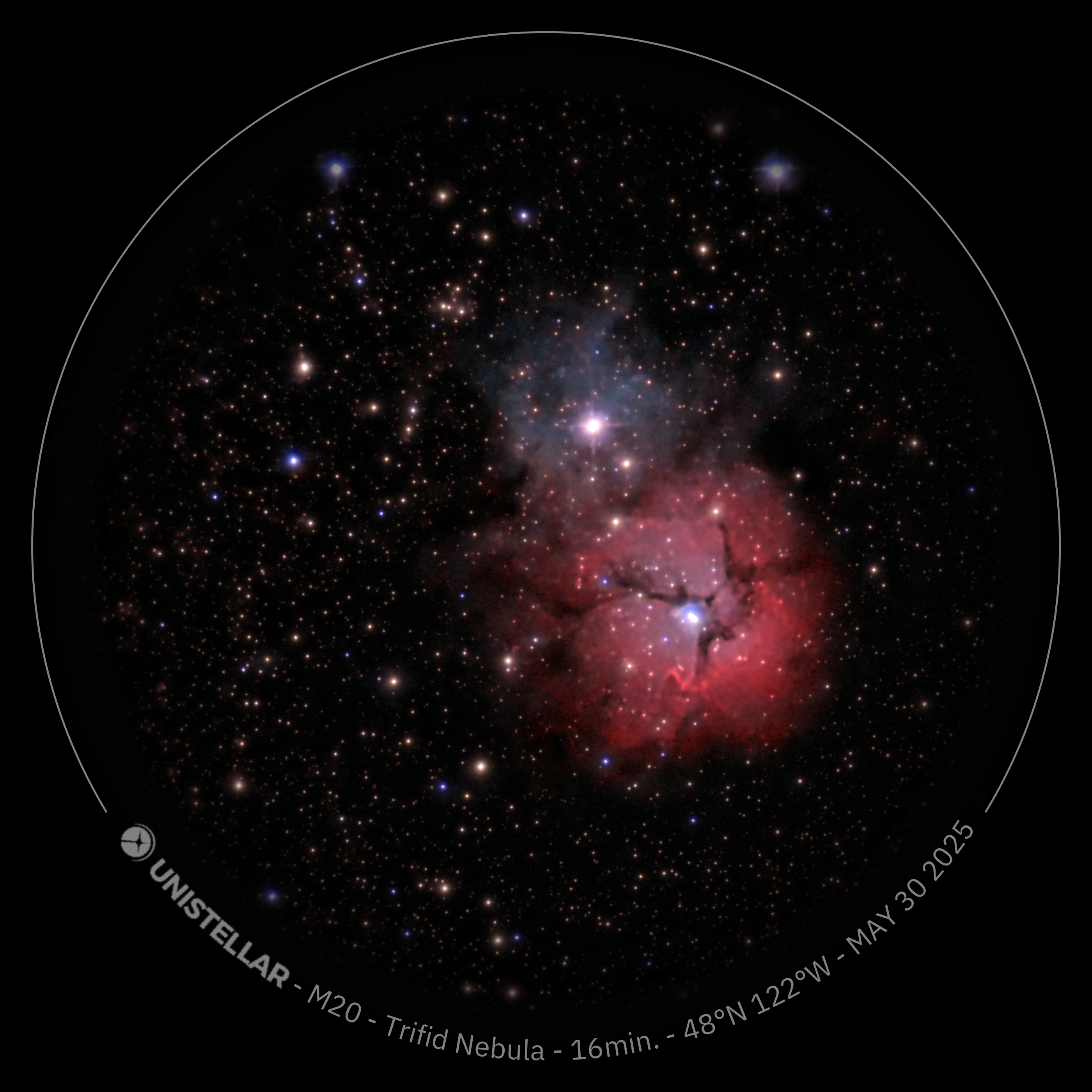
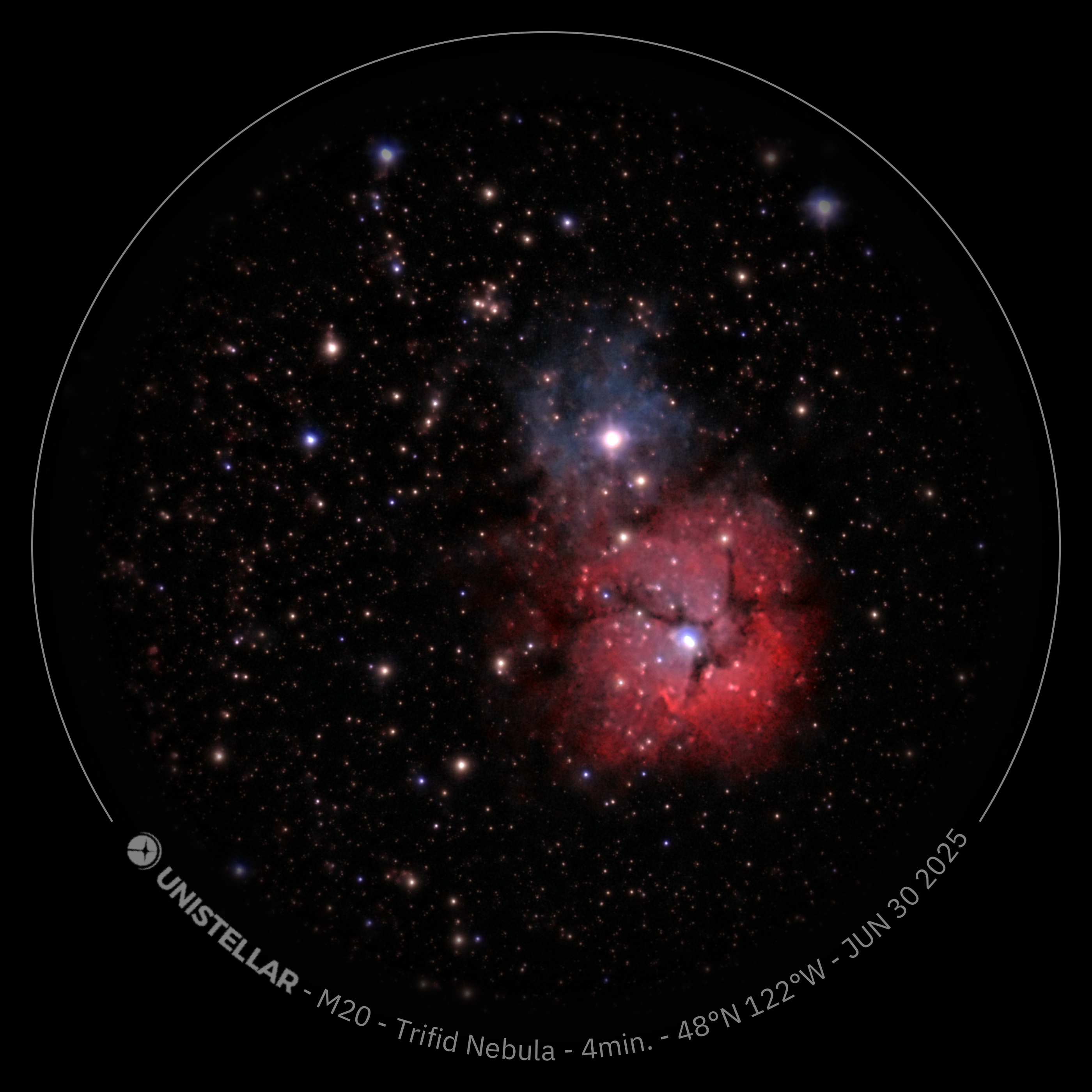
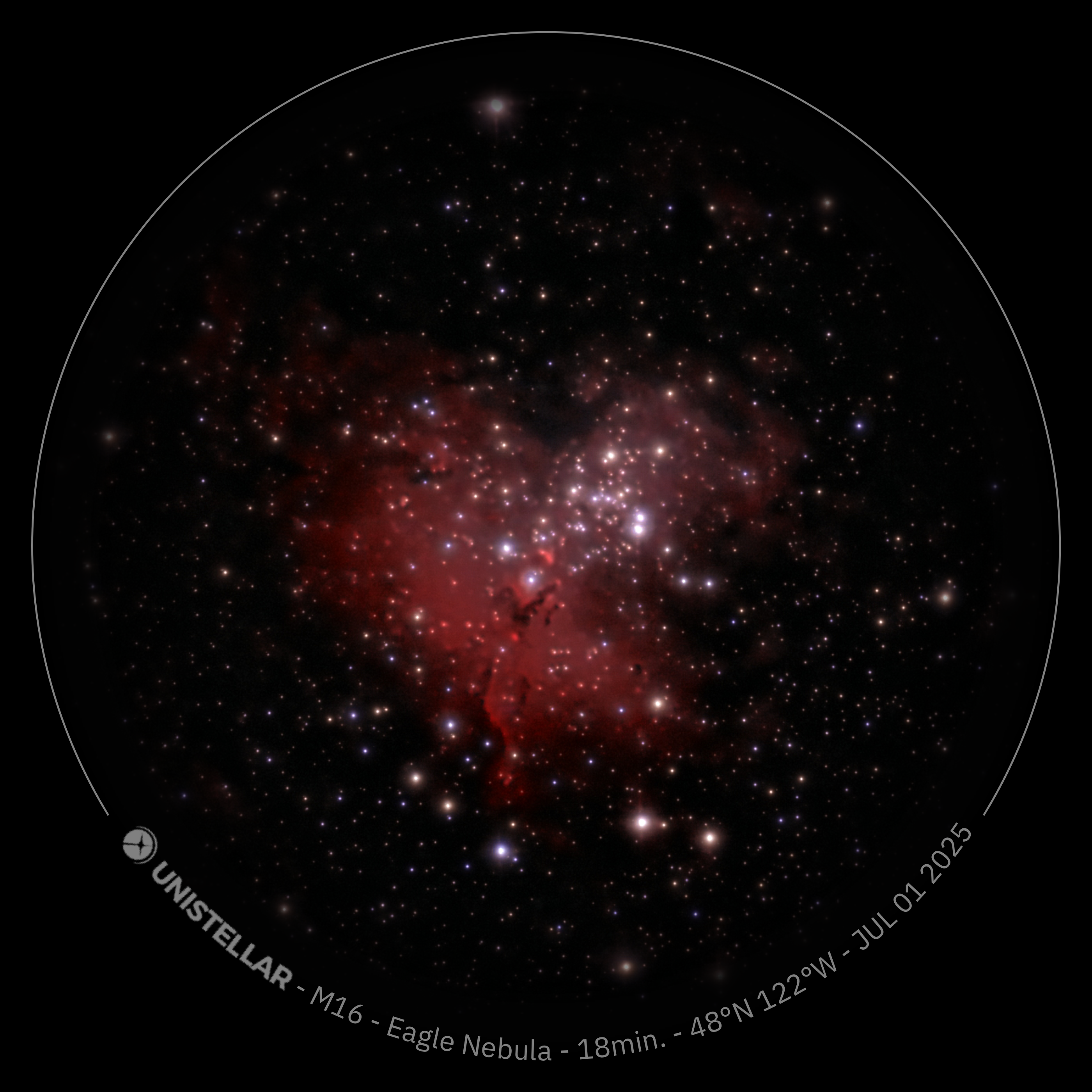
The second night, I first revisited an old friend – the Trifid Nebula. My shot got interrupted by high clouds, unfortunately, but it was good enough to post. After that, I decided to try a new one (for me): the Eagle Nebula, and boy, that one’s a winner with the eVscope. It’s definitely a new member of the top 3 best shots I’ve taken, and might be my new favorite. The detail in the nebula is amazing. The eagle-eyed among you may recognize the “Pillars of Creation,” made famous by the Hubble telescope. It’s amazing to me that I can, with a small-ish telescope on the back porch of my home, capture an image that includes these same pillars, in the detail and vibrancy that I have.
These images have been added to the Galaxies and Nebulae pages.
NGC 4631 (and NGC 4627)
29m
2025-06-29
Also called the Whale Galaxy due to its shape, this is part of the “NGC 4631 group,” which is then a part the Virgo cluster. NGC 4627 is a dwarf elliptical galaxy, and it’s the smudge just to the right of the galactic center. These two form a galaxy pair, meaning they are bound to each other and are in the process of colliding (and then combining).
NGC 4656 and 4657
25m
2025-06-30
Also called the Hockey Stick Galaxies, these strongly interacting galaxies are in the middle of a massive collision which will warp and reshape them over the next few hundred million years. These are very faint, and even a long exposure with the eVscope couldn’t get much detail.
M20 – Trifid Nebula
4m
2025-06-30
It surprises me that I can get such bright colors with only a 4 minute exposure. High clouds interrupted this shot, unfortunately.
M16 – Eagle Nebula
18m
2025-07-01
After the first minute or two, this was only a dull red blotch. Even so, I decided to leave it running, and when I came back 15 minutes later, was blown away. Zoom in on the center of this image, and note the detail in the clouds. Those pillars are light-years tall. And I can take a picture of them from my back porch. Maybe my new favorite picture with the eVscope 2.
Despite the high clouds, I made another attempt a couple nights ago. Unfortunately, most of my long exposures got interrupted, and so I got two good images and one mediocre image. On the plus side, the mediocre one has 2 galaxies in it, so maybe it’s twice as mediocre! All of these have been added to the Galaxies page.
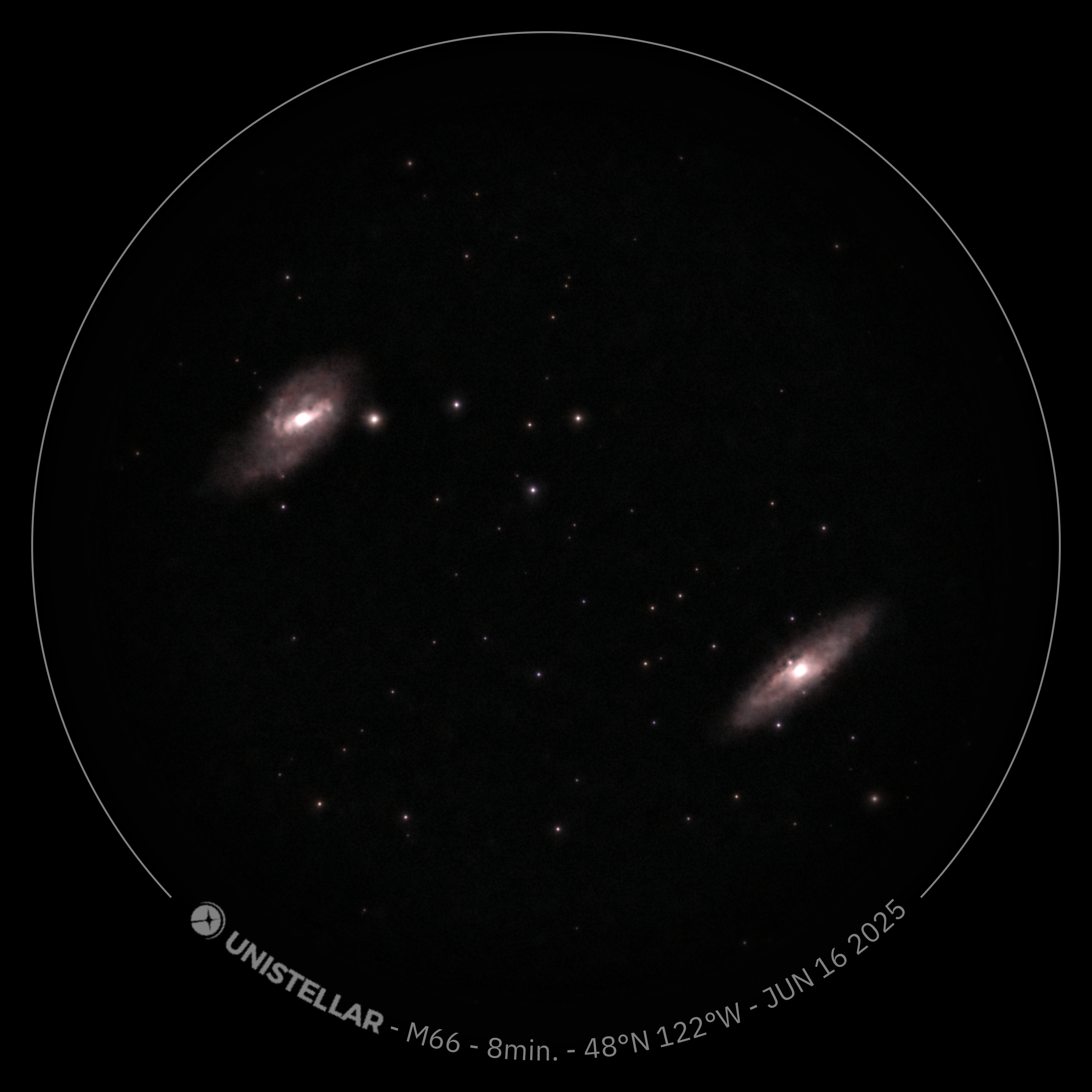
M65 and M66
8m
2025-06-16
These are two of the three in the Leo Triplet, which also includes NGC 3628. Not a great night; I took 6 shots and all but one got interrupted due to high clouds. This was one that got interrupted. NGC 3628 remains the best of these three.
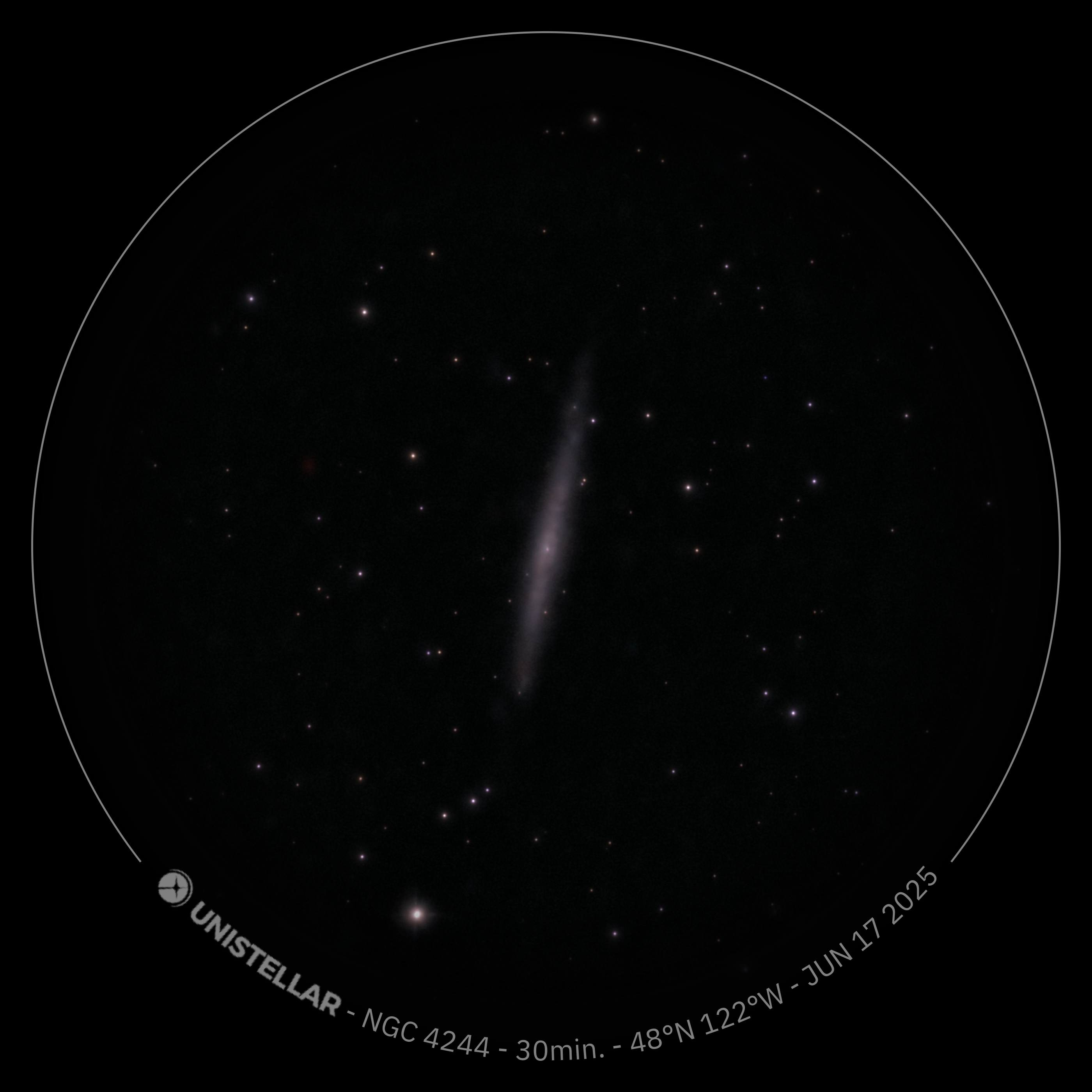
NGC 4244
30m
2025-06-17
The diffuse dust, lack of a distinctive central bulge, relatively dim stars in this one makes for a vague, cotton-like appearance.
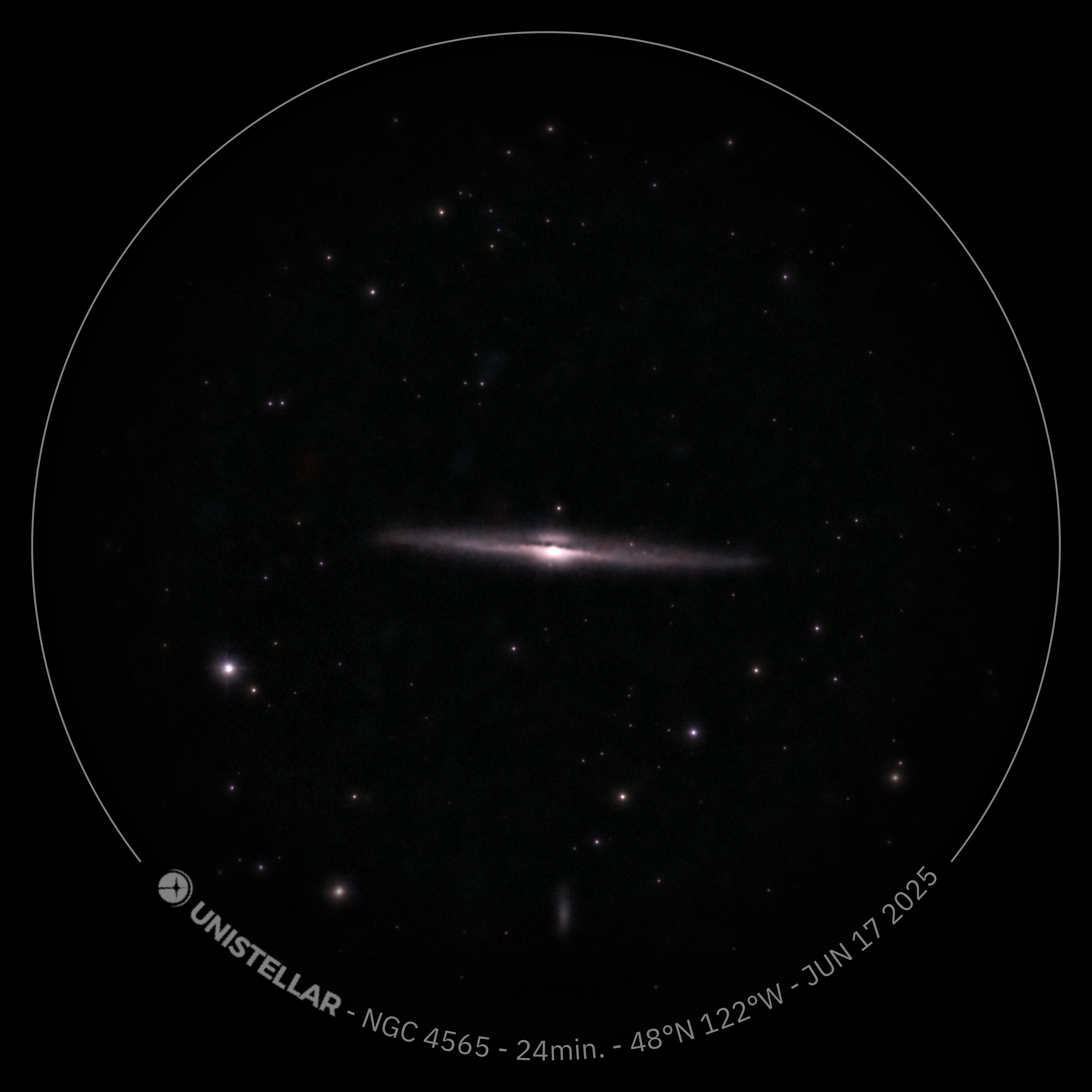
NGC 4565
24m
2025-06-17
Also referred to as the Needle Galaxy, this edge-on spiral galaxy has a strong dust band with a bright, spherical core.
I wanted to capture some new things last night. Unfortunately, the high clouds kept ruining the tracking, so there’s about 4-5 photos that were 60 seconds or less, which I’m not even going to bother uploading. All my shots ended up with the “enhanced vision disrupted” message; the longest I got was 27 minutes. The ones I kept, below, have been added to the star cluster and galaxy pages.
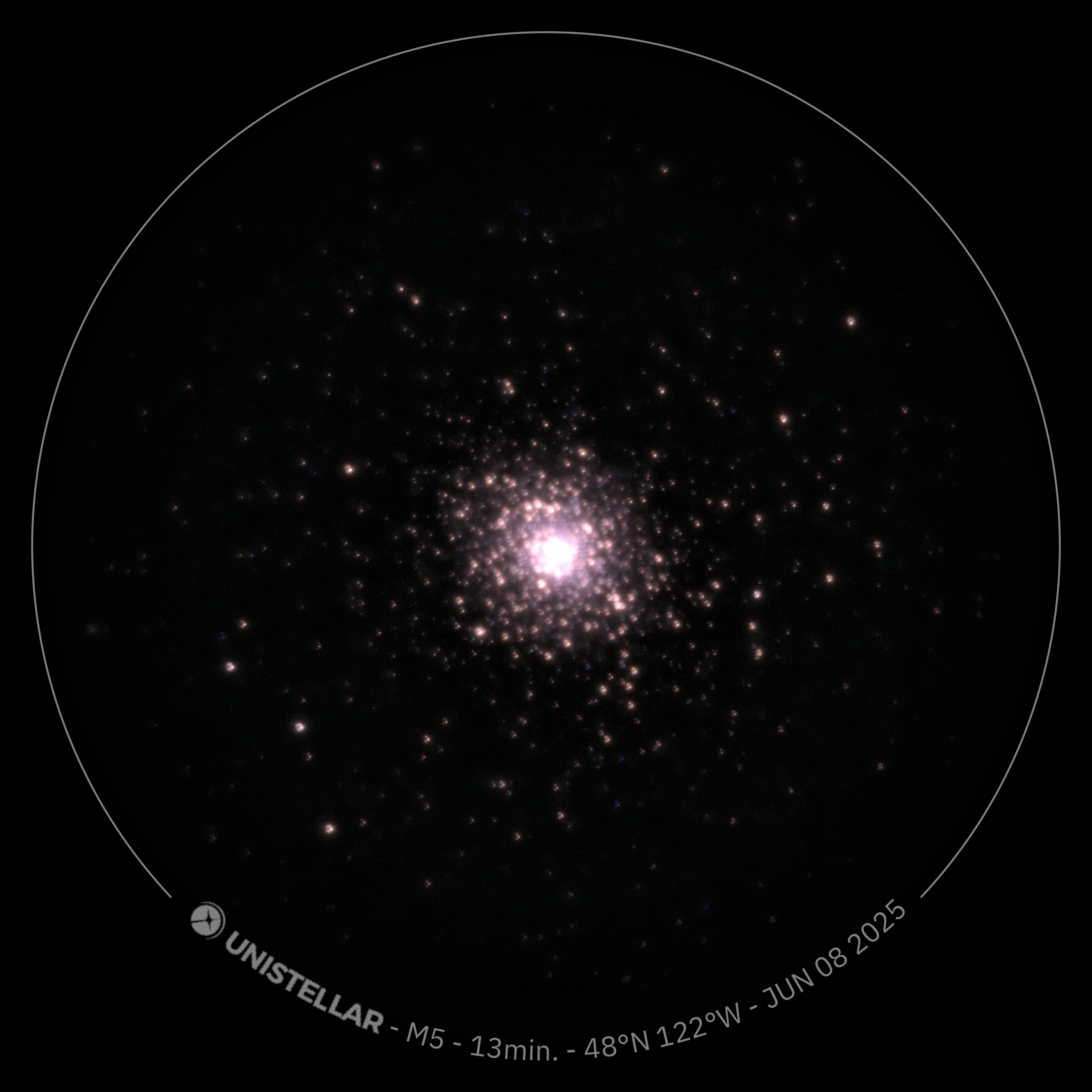
M5
13m
2025-06-09
This cluster’s core is so bright that it can sometimes be mistaken for a faint star by the naked eye.
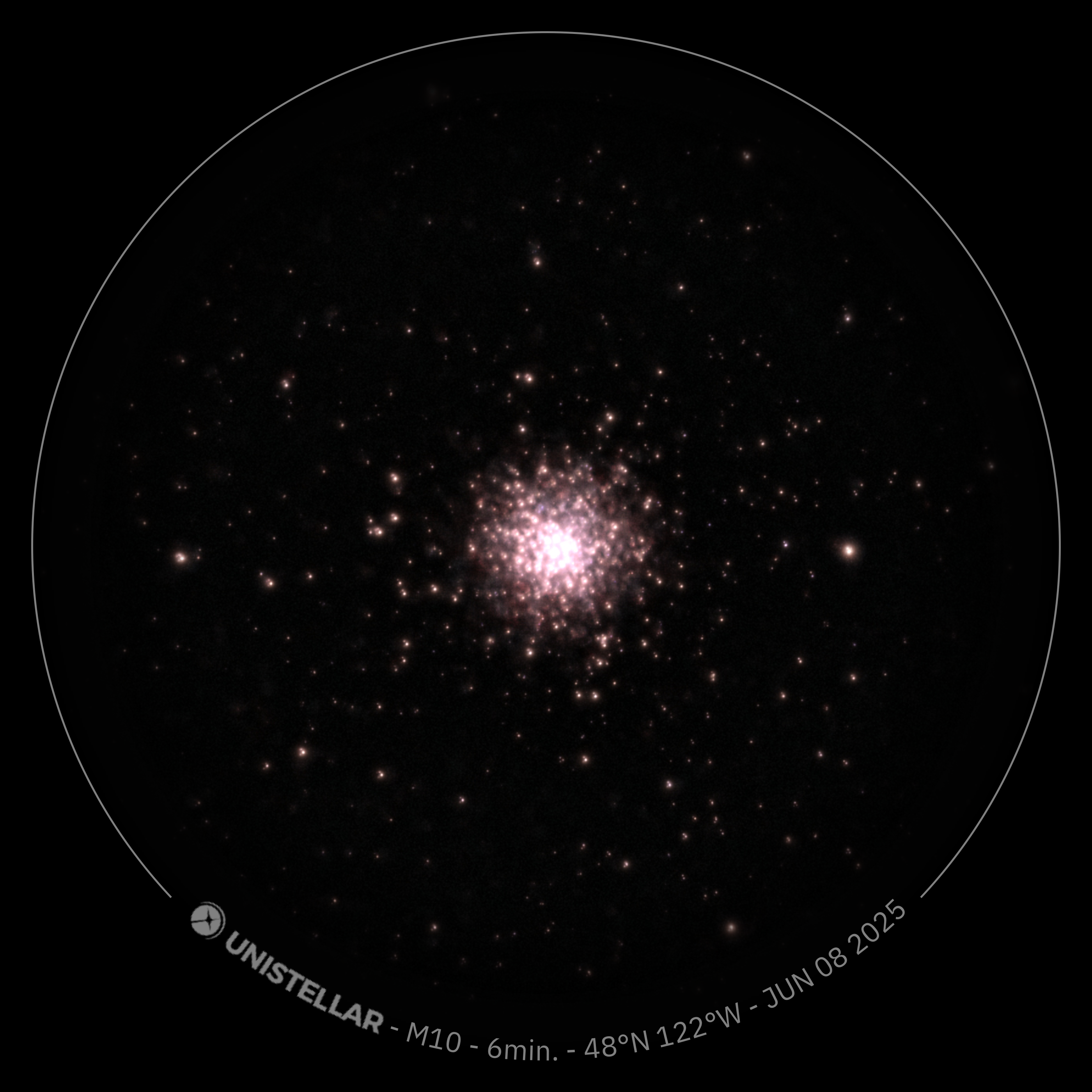
M10
6m
2025-06-09
A nice little cluster, the bright core of stars is only 35 light-years across.
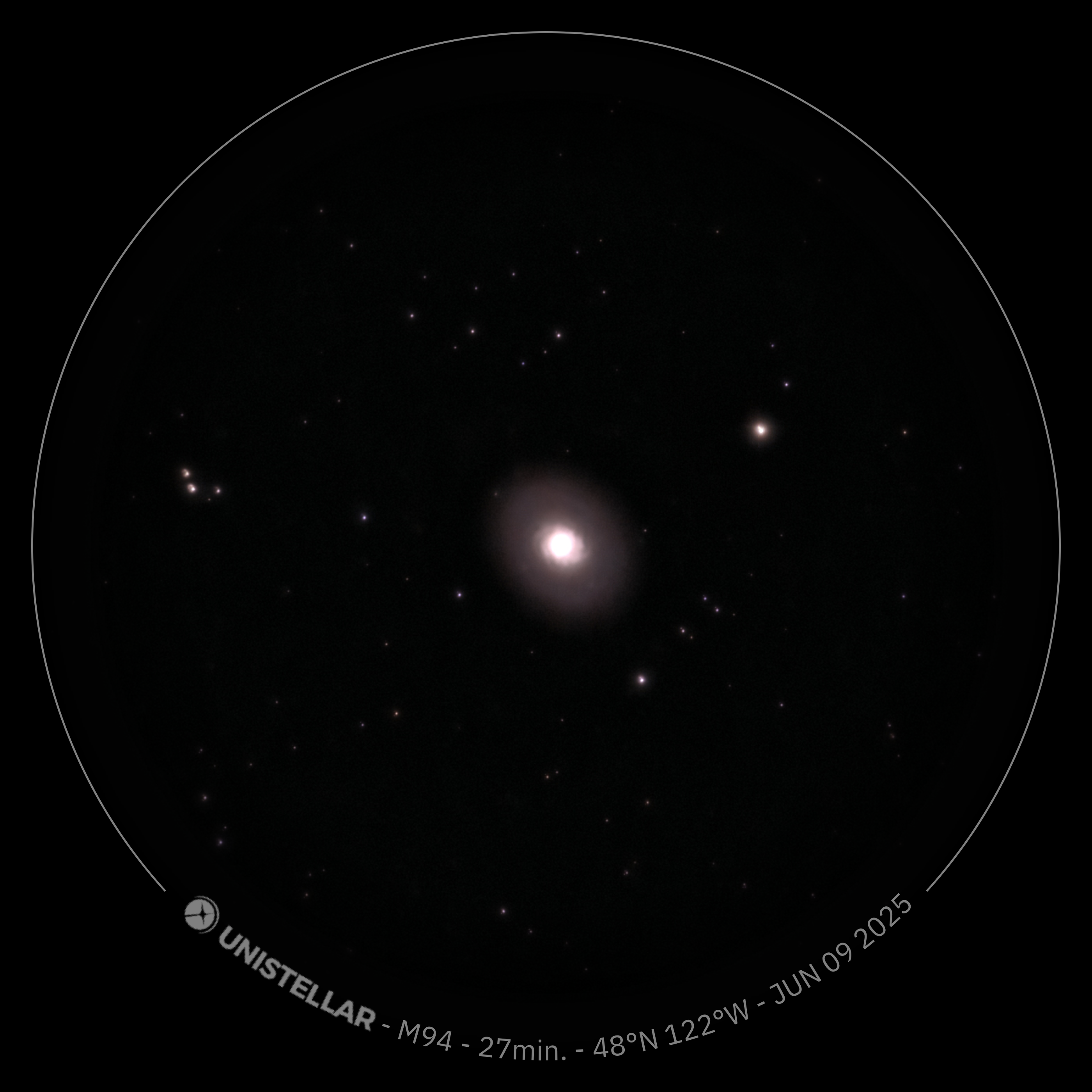
M94 – Cat’s Eye Galaxy
27m
2025-06-09
M94 is sometimes known as the Cat’s Eye Galaxy or the Croc’s Eye Galaxy, but it’s just M94 in the Unistellar catalog. I think this is one that could really benefit from a very dark night, from a high elevation, with no humidity. I was 0 for 3 last night, but still got a relatively nice image.
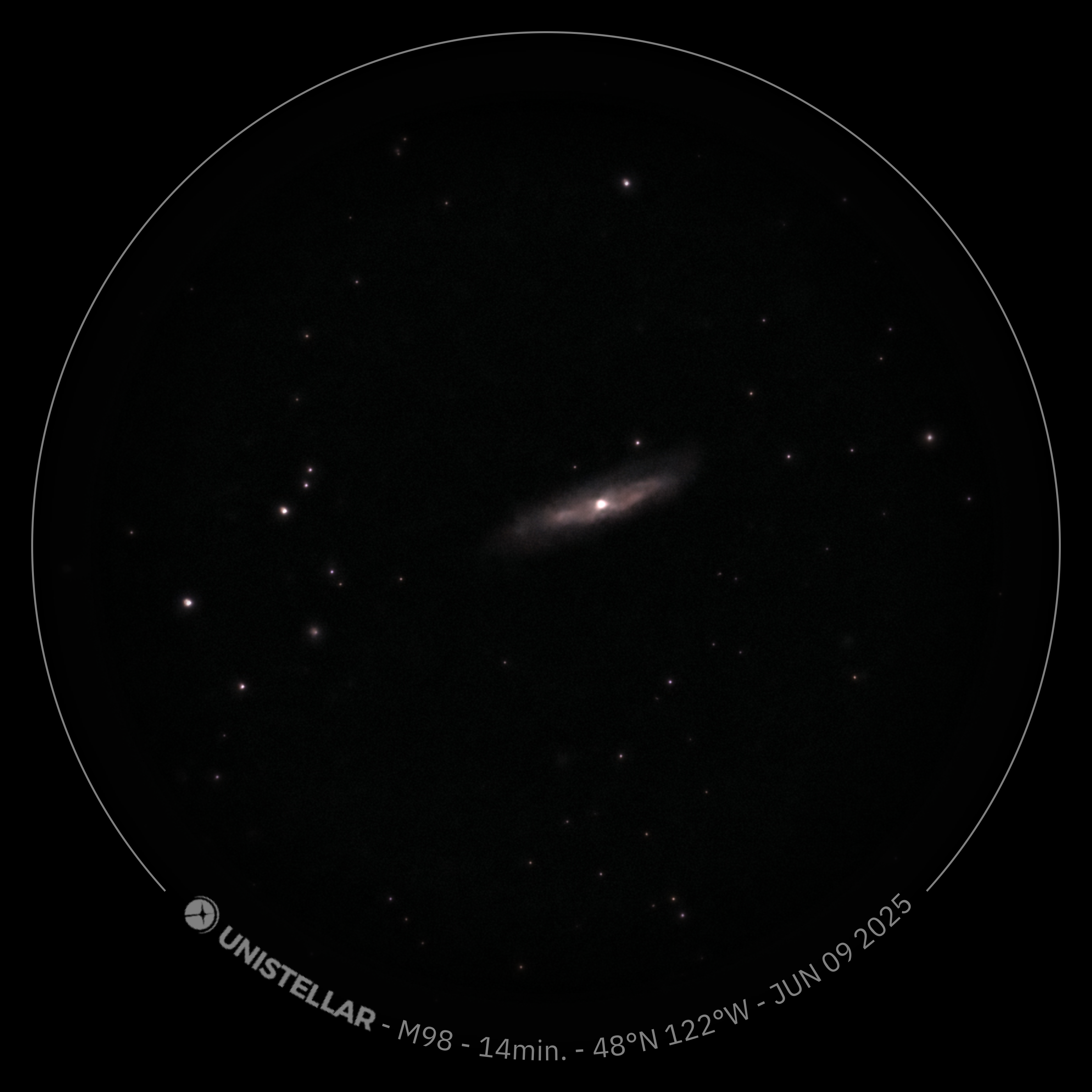
M98
14m
2025-06-09
Not a bad little spiral galaxy. The relatively short dwell time, high clouds, and three-quarters moon created a pretty poorly resolved image. Probably worth a re-visit.
One of the reasons I started this website was because I wanted a place to remember the objects I’ve already photographed, what I hadn’t, and what I wanted to re-visit. It worked! I got two re-visits last night: M64 – the Black Eye Galaxy, and NGC5907. I’ll be adding both of them to the Galaxies page.
Any others you’d like a re-visit, or any suggestions on what I should try to capture? Leave a comment!
NGC 5907
53m
2025-06-08
A VERY edge-on spiral, and it seems the dust is spattered around the disk, making it somewhat mottled and dim. Nice picture though!
M64 – Black Eye Galaxy
17m
2025-06-08
This was my 2nd attempt of the night; the first one lost tracking at under 2 minutes (I’m not going to bother uploading it), and this one failed at 17 minutes, so I called it a night & packed up. Not as long as I really want, but a longer dwell time still produced a very nice image.
The Galaxies page is now up, and that’s all the photos I’ve got that are worth putting on the website … so far. It’s cloudy tonight, so nothing new to add.
My long-term plan is to update this website within a few days, every time that I get some new pictures. Given that this is Seattle, and the weather is unpredictable, that might be a day or two, or it might be a month. I’ll add the new photos to each post, and then also add them to the individual pages.
Feedback is welcome! Anything you think I should take a picture of? Anything that you think is worth a re-visit? Got any questions about one of the pictures? Let me know, and I’ll try to respond.
Star clusters page is up! Not as many of them, but they’re still pretty cool. Note that individual stars (of which I’ve only taken 2) are also on that page.