More Clusters and a Hidden Galaxy

I had a night with wispy high clouds, so I decided to take images of star clusters. They seem like they’re easier for the telescope to retain a lock, and you usually don’t need to have as long of a dwell (although, I’ve learned, the longer dwells do pay off with a lot more detail and color).

The next night I managed to catch two new galaxies, including one that really likes to hide.

All of these will appear in their respective pages (star clusters and galaxies), linked in the header.

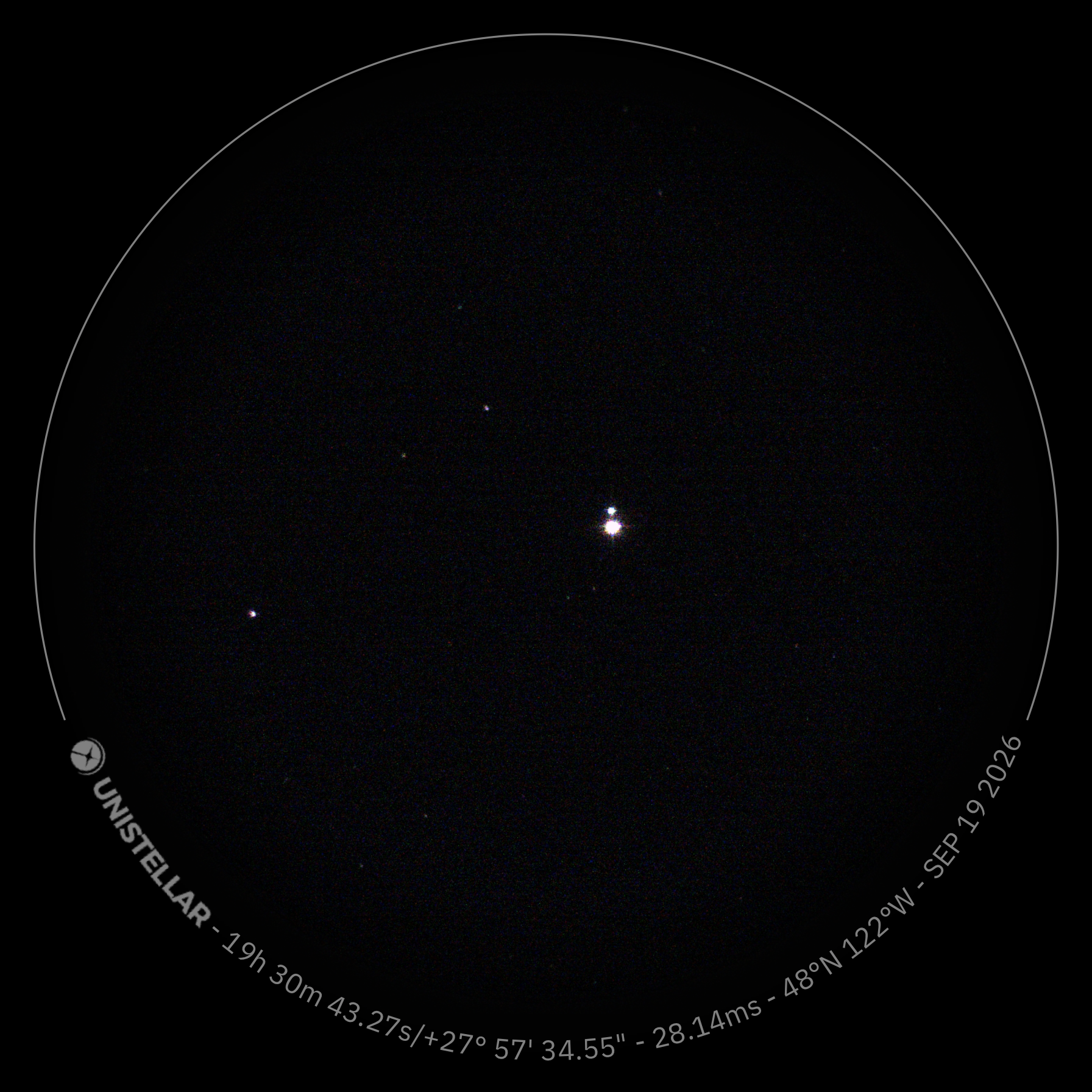
Albiero

28ms

2026-09-19

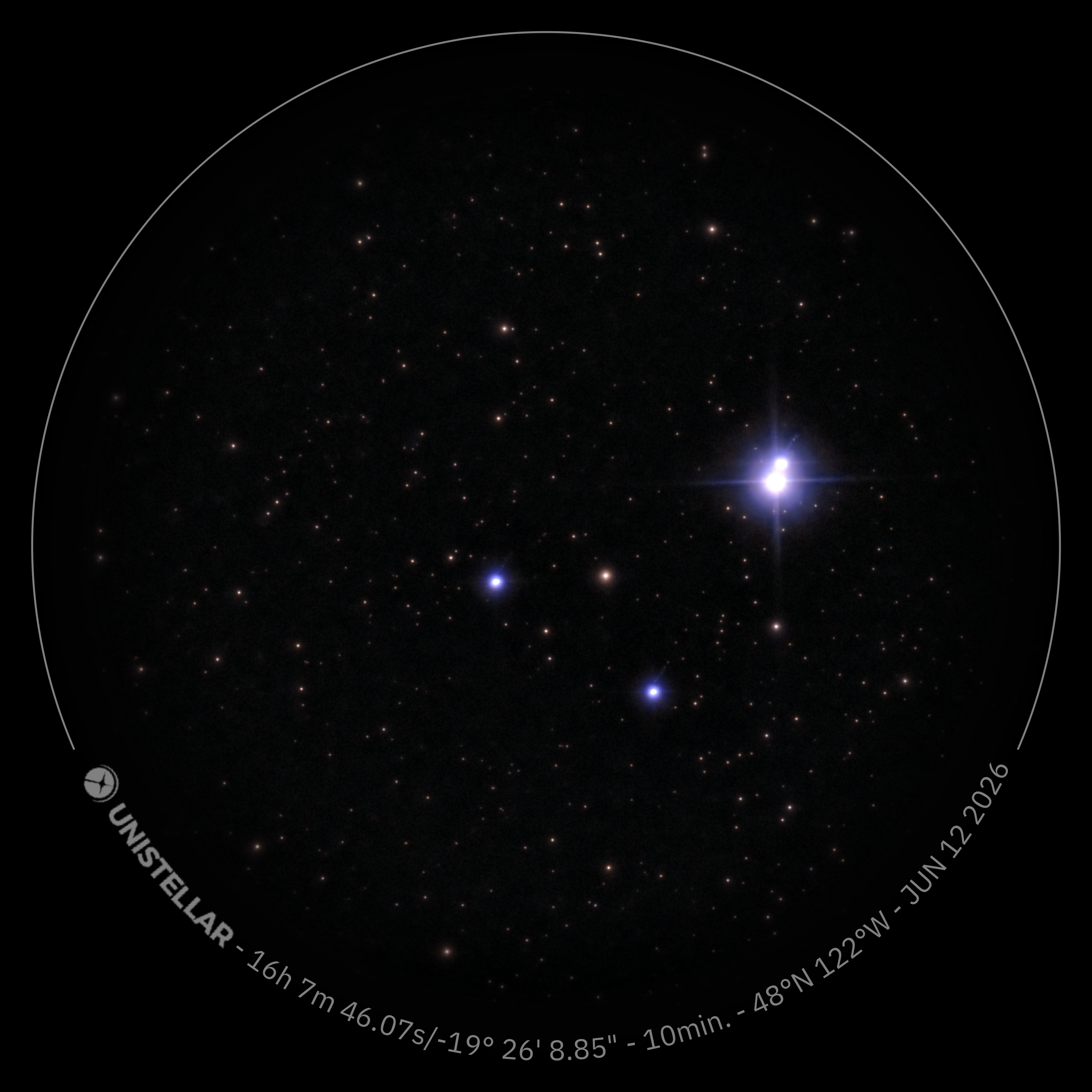
Two things: one, this isn’t a cluster, per se, it’s a binary star; and two, I said earlier that I wanted to try to re-capture this one, but with the settings tweaked to actually see the binary system. This is with both the gain and the brightness manually dialed way down, and you can clearly see the two stars. Compare this to my other Albiero image to see the difference.
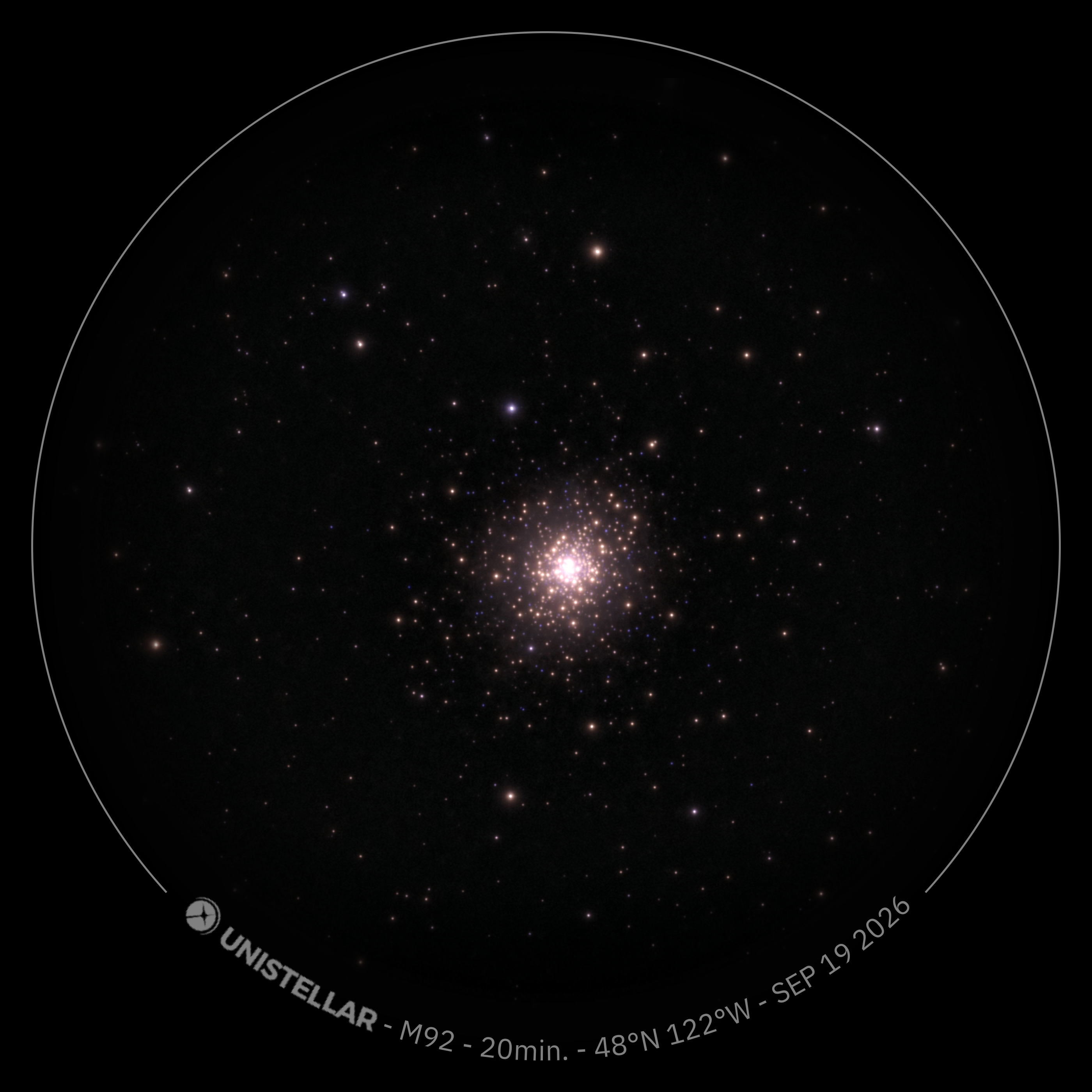
M92

20m

2026-09-19

My other shot of this one was super short, so I wanted a better one. There’s a lot of density in the center, but the longer dwell time shows all the little dust-grain stars that the shorter dwell missed.
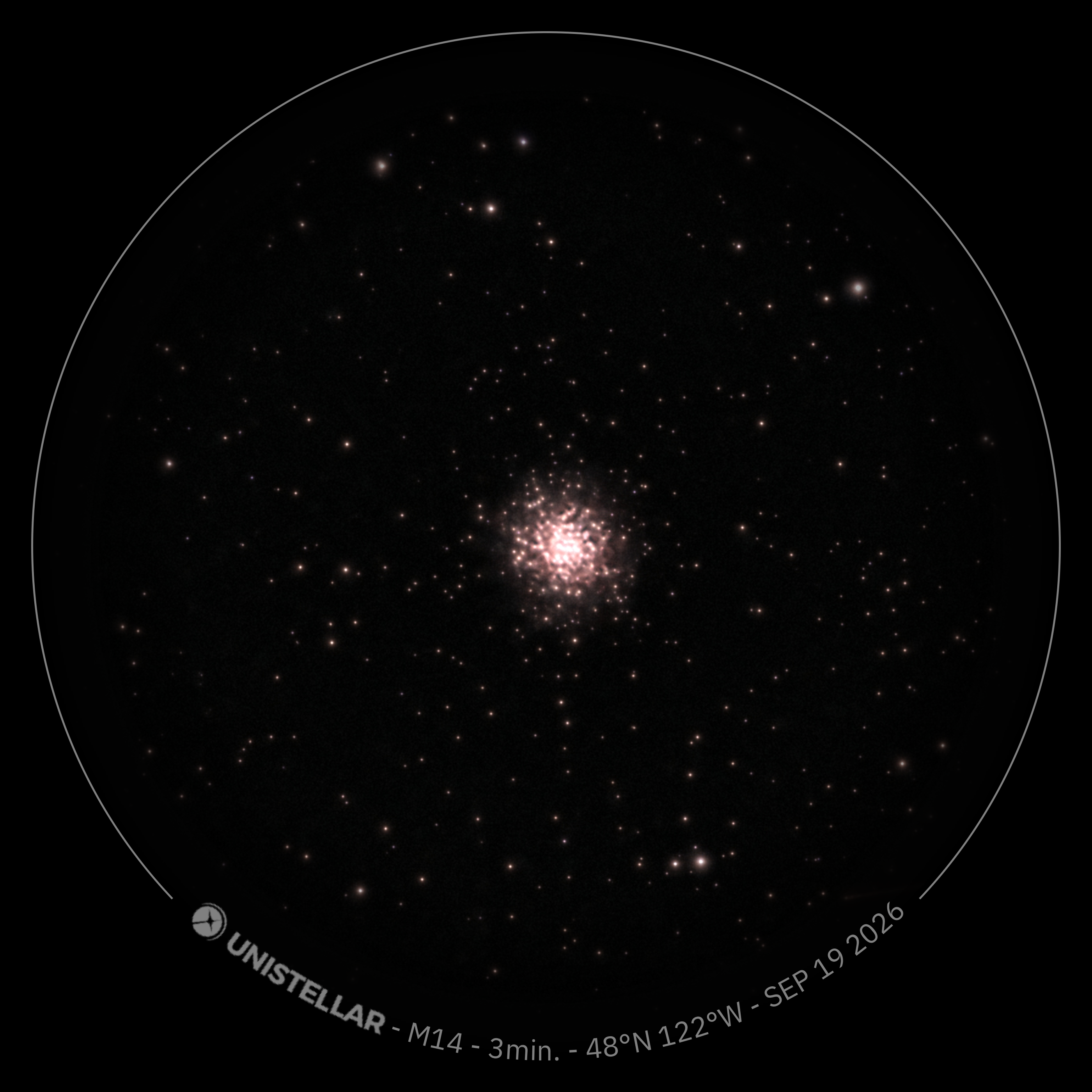
M14

3m

2026-09-19

I actually hadn’t captured M14 before, so here it is! Another tight cluster; I think the dwell got interrupted by the high clouds, and hence so short.
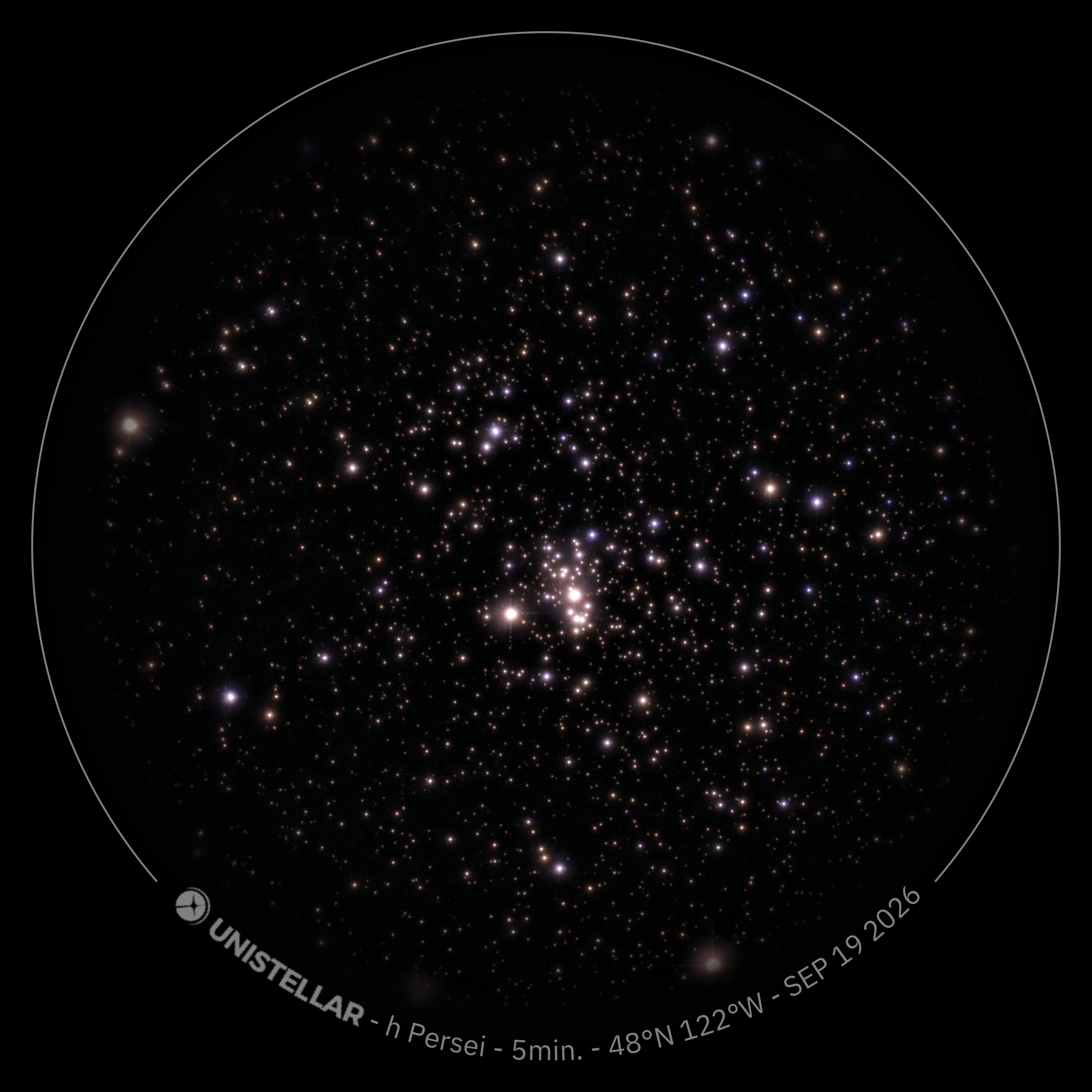
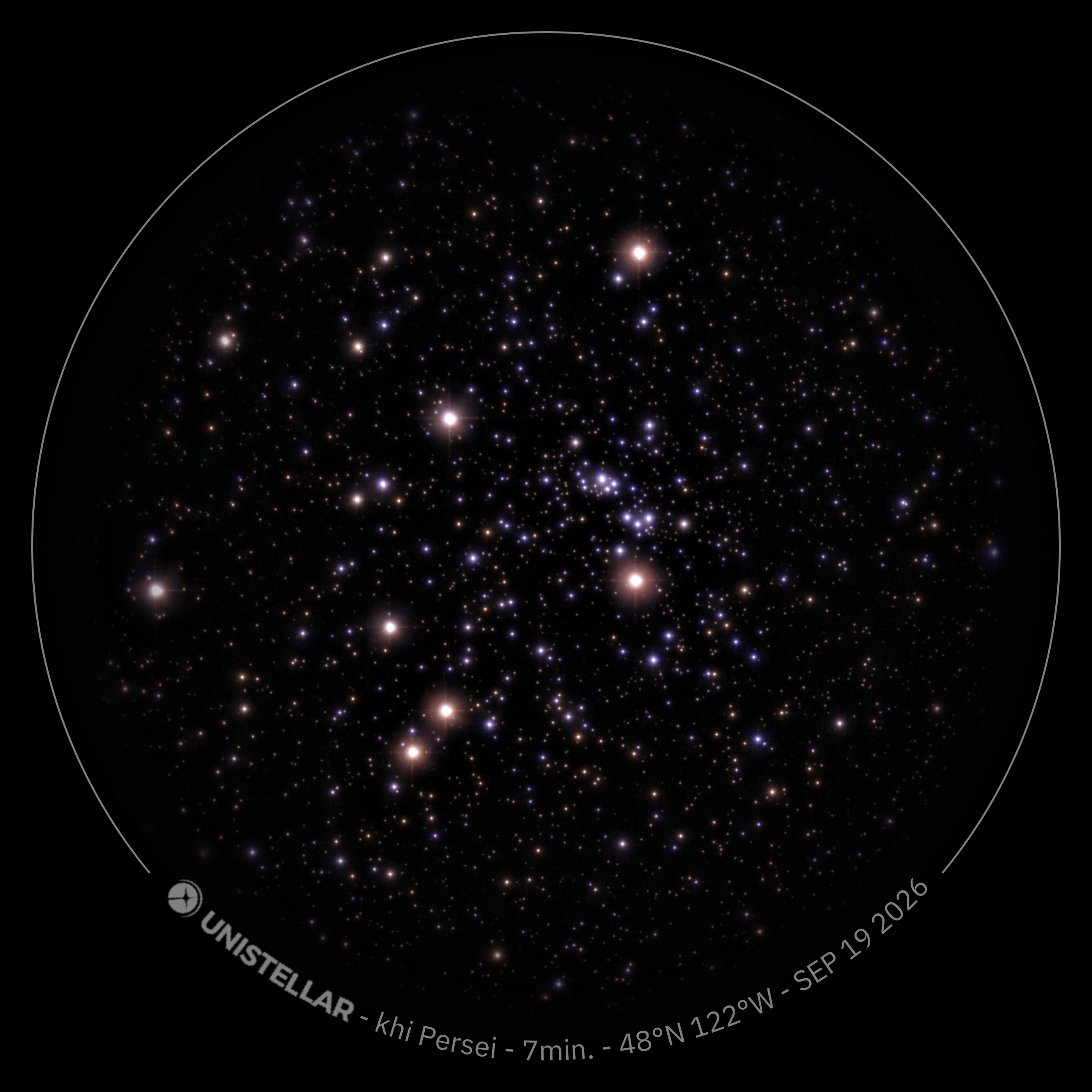
The h Persei and χ Persei clusters are each about 30-50 light years across, and only about 300-500 light years apart in actual space, in the direction of the constellation Perseus. In the eVscope, it’s referred to as khi Persei (rather than the greek χ) probably due to text encoding issues more than anything (although the geek in me wonders why they didn’t just do everything in UTF8, but whatever, we’re drifting off-topic). They’re both relatively sparse (open) clusters, with a mix of large-bright stars and small-dim stars of varying colors. With a smaller telescope that has a wider field of view, this double-cluster is an oft-photographed favorite, due to their proximity and distinctive appearances.

NGC 869 – h Persei

5m

2026-09-19

Part of the double cluster (with χ Persei), this is the slightly larger and brighter of the two.
NGC 884 – khi (χ) Persei

7m

2026-09-19

Part of the double cluster (with h Persei), this one is slightly less massive, dimmer, and more diffuse than its counterpart.
The next night I decided to target a few more dim objects – this time galaxies – to add to the catalog, and I got two nice ones.

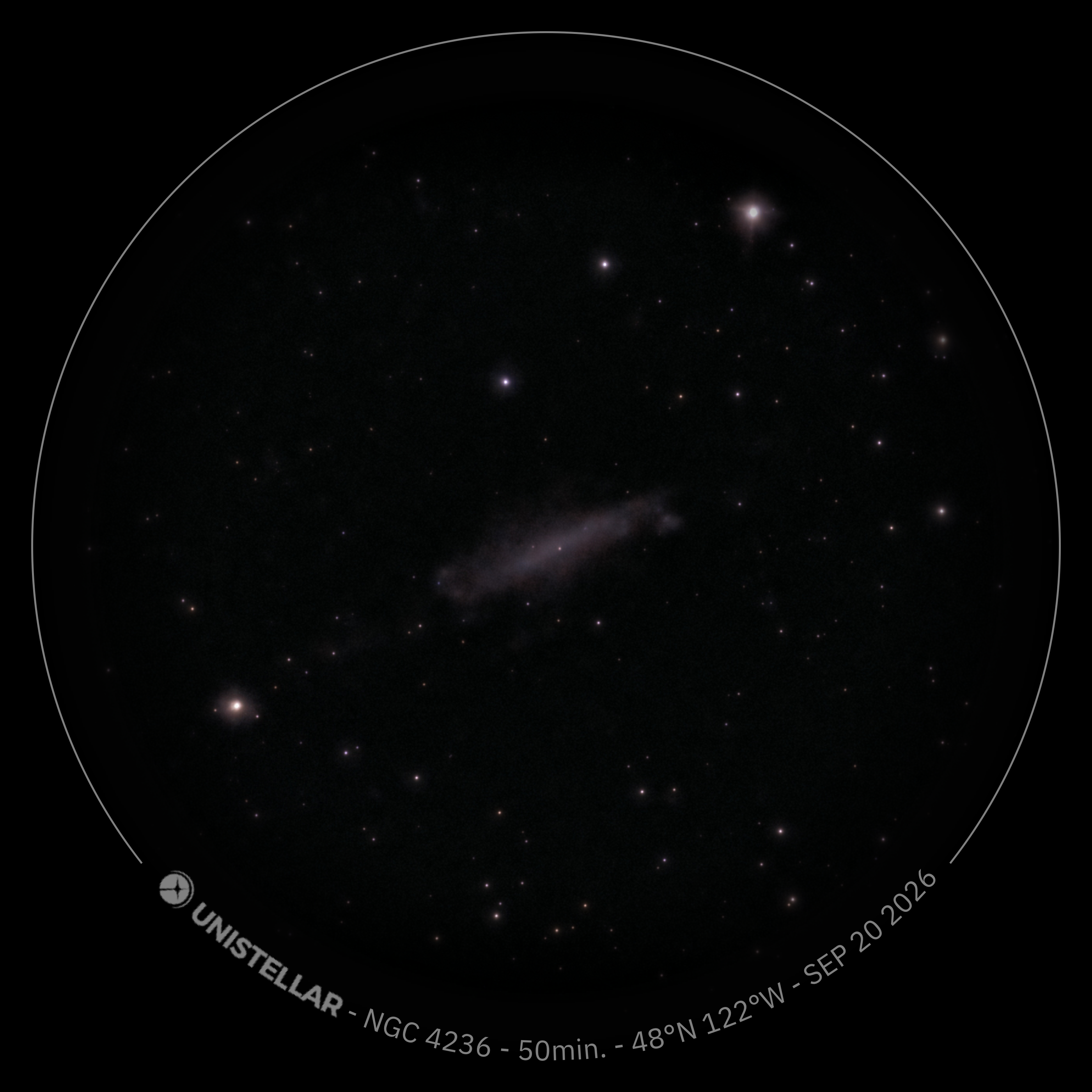
NGC 4236 / Caldwell 3

50m

2026-09-20

It lacks a well-defined center and bright core, but appears to be a relatively diffuse spiral. It’s part of the M81 group (M81 is Bode’s Galaxy), a cluster of galaxies all bound to one another gravitationally.
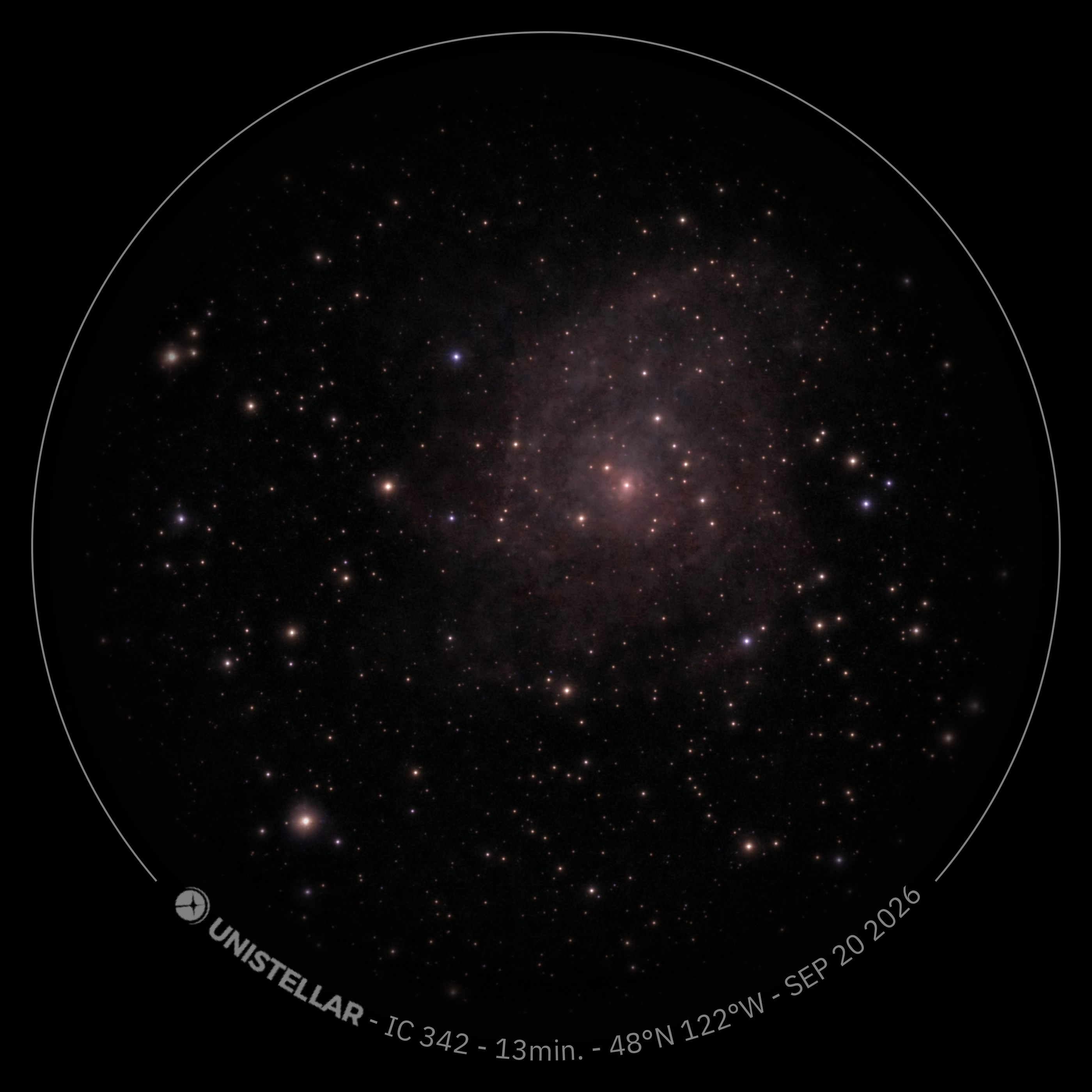
IC 342 / Caldwell 5 – The Hidden Galaxy

13m

2026-09-20

I only got this at 13 minutes because I wanted to save it and it was cool; when I tried for a 50+ minute shot, it failed due to high clouds. It’s called the Hidden Galaxy because it appears in the direction of galactic plane of the Milky Way – just far beyond it. So we’re seeing the parts of it that make it through the gas and dust and stars of our own galaxy.
Posted in Space on the back porch | Tagged , , , , , , , , , , , , , , , , , , | Leave a comment

Learning About Brightness (and How Faint I Can Go)

So I’ve been looking for more targets that were (a) appropriately sized, and (b) of sufficient brightness, given my location.

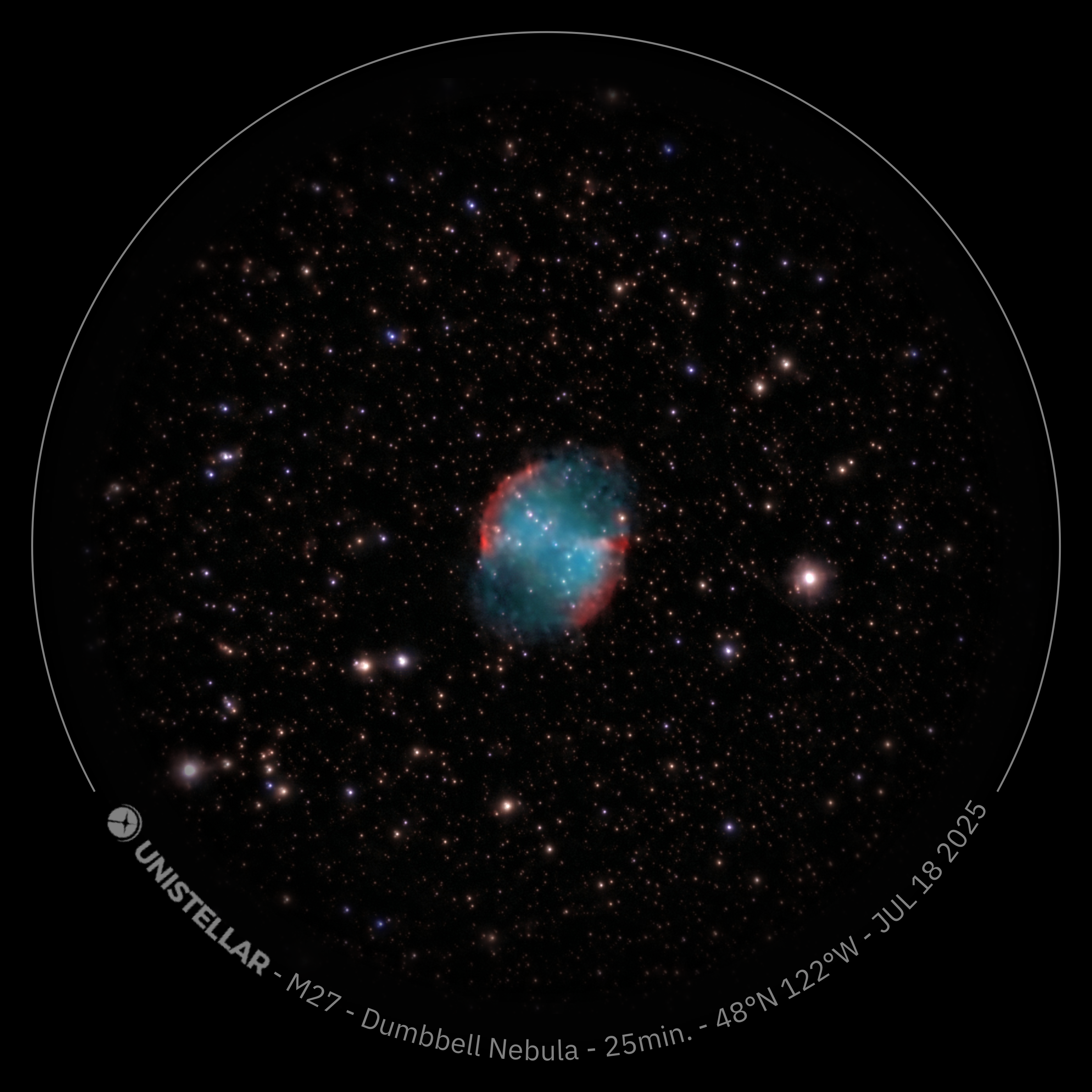
For the eVscope and in terms of size, the best targets are around 10-30 arc-minutes, since they fit in the field of view nicely. Smaller targets are doable, but you really don’t want to go below 2 or 3, and anything bigger than ~35 is larger than your visible area. For scale, the Dumbbell Nebula comes in around 8 arc-minutes on its long axis, while the Ring Nebula is about 1.5 arc-minutes across. At the large end, the full moon is just over 30 arc-minutes, or about the width of the field of view.

The Dumbbell Nebula
8 x 5.7 arc-min
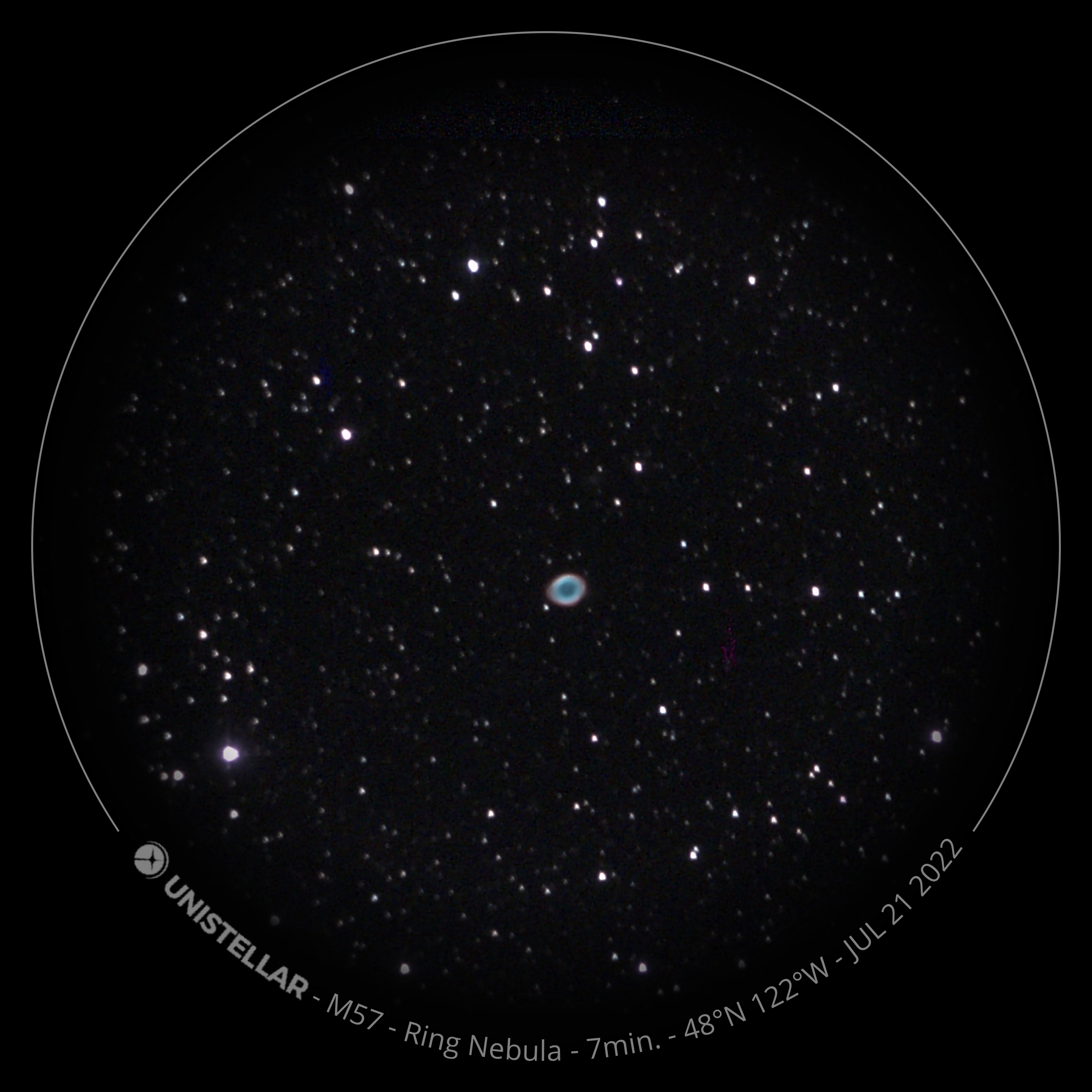
The Ring Nebula
1.4 x 1.0 arc-min
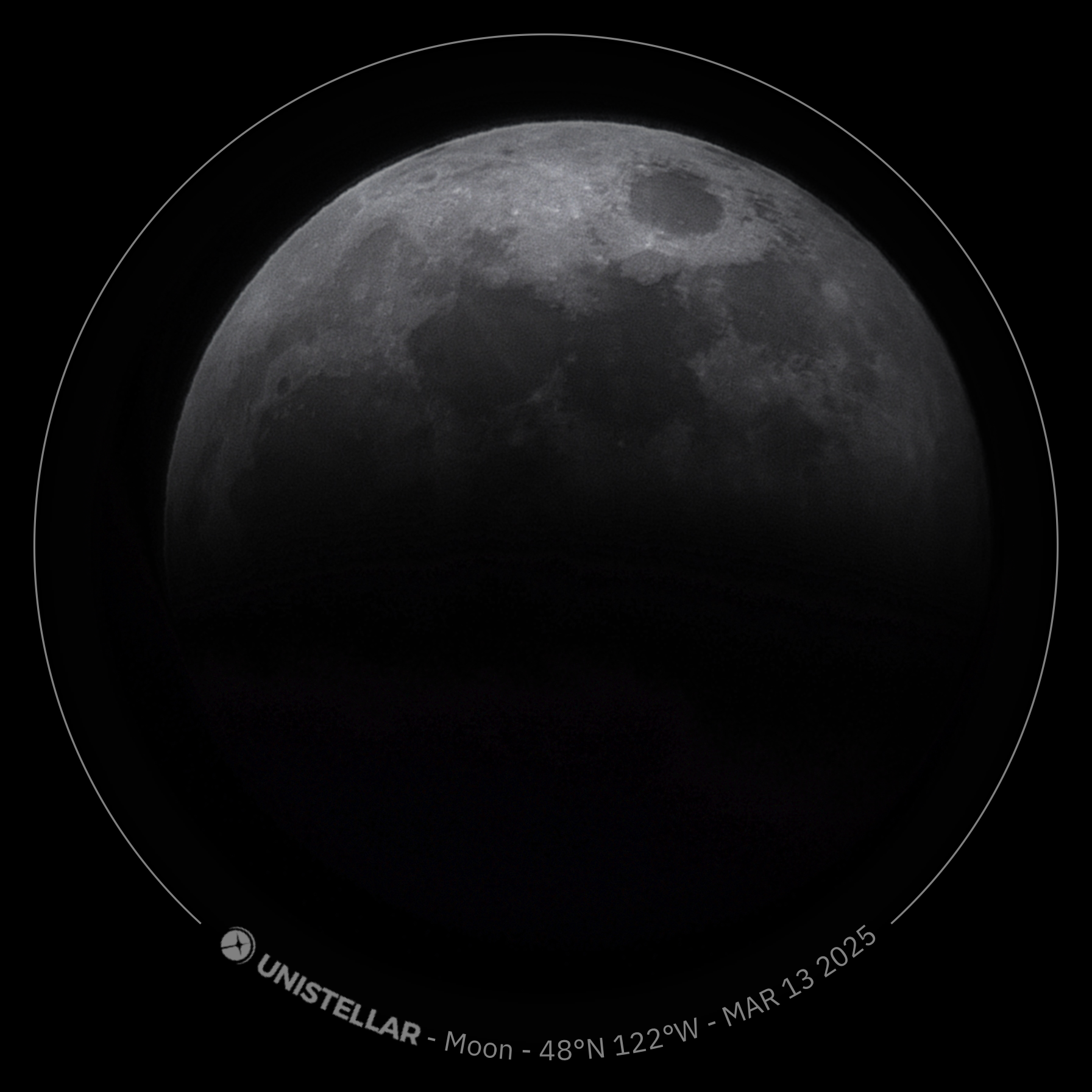
The Moon
31 arc-min

For brightness, what your telescope can capture varies a lot based on your location. I’ve only really used the telescope from within the Seattle city limits, which is a poor environment from the standpoint of both (a) how close I am to sea level and therefore have a LOT of atmosphere to get through, and (b) the significant amount of light pollution. For reference, brightness is measured opposite to your expectations – the larger the number, the DIMMER it is. Bright stars like Polaris (the north star) is almost exactly 2, the brightest star (Sirius) is -1.46 (yes, negative, meaning really bright), and so on. Furthermore, it’s logarithmic, but not base-10 or base-e or anything – each step up is 2.5(ish) times dimmer than the last. So a brightness 3 star is 2.5 times dimmer than a brightness 2 star; a brightness 6 nebula is 2.5 times brighter than a 7. You can read up as to why – it involves the ancient Greeks and Victorian British astronomers, so it’s a bit of a convoluted tale.

Ultimately, my goal with the pictures below was to get a pretty good sense of the impacts of both brightness and size, and how much they matter for this particular telescope. What I learned was that brightness for nebula is based on their TOTAL brightness. That means that large nebula which I’ve tried to catch before (like the California Nebula or the North American Nebula or the Elephant Trunk Nebula), even though they have high brightness numbers, have very low brightness at any given pixel. So even with long dwell times, in a light-polluted environment, you’re going to lose a lot of the details at the scales I’m trying to observe with this telescope.

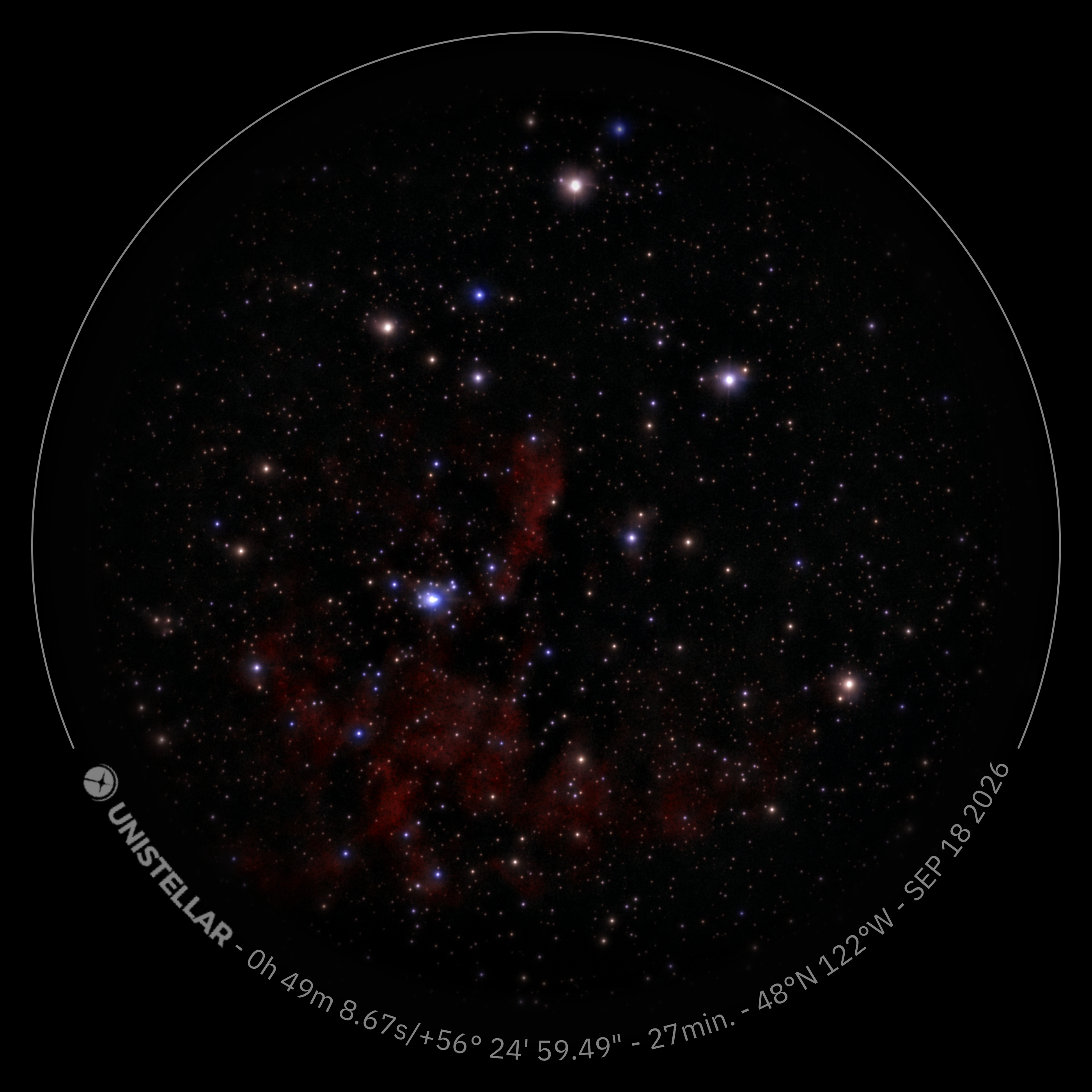
NGC 281 – Pacman Nebula

27m

2026-09-18

At an angular size around 35 arc-minutes, it’s sized nicely for the telescope. But at a brightness around 7.4, and given that size, only the brightest elements show up.

Compare the above to the Horsehead Nebula (6.8, or 1.75 times brighter) or the Lagoon Nebula (which varies from 4.6 to 6, so up to 13 times brighter), and you can see why there is so little detail in the Pacman. Even the Ring Nebula has a much lower brightness (8.8), but since it’s so small, it shows up quite distinctly because the brightness is so much more concentrated.

Caldwell 9 – Cave Nebula

35m

2026-09-19

At a brightness of 7.7, this is one of the dimmest objects I can observe, and at 50 arc-minutes across, it’s extremely diffuse. This might be worth revisiting in a remote location with low light pollution.

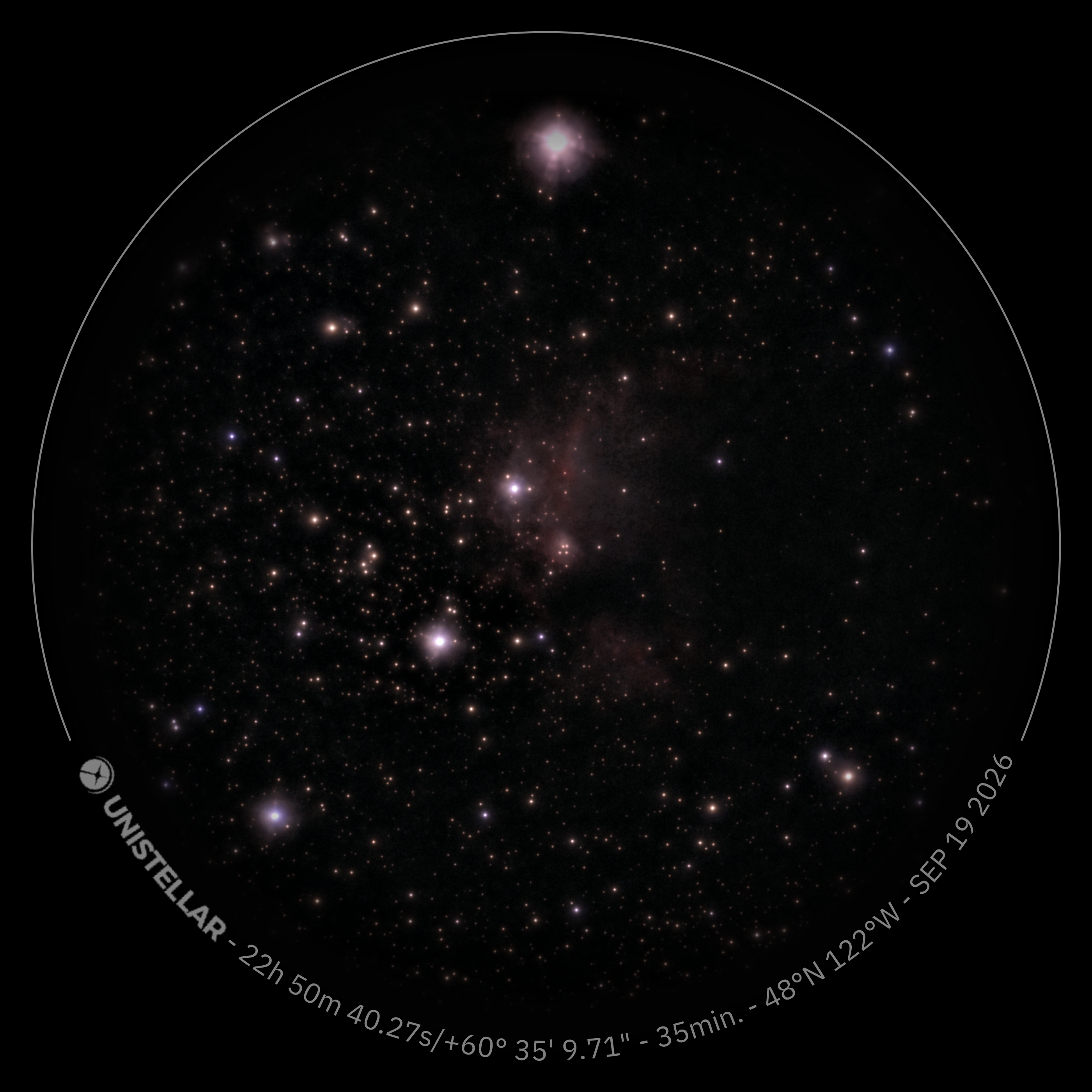
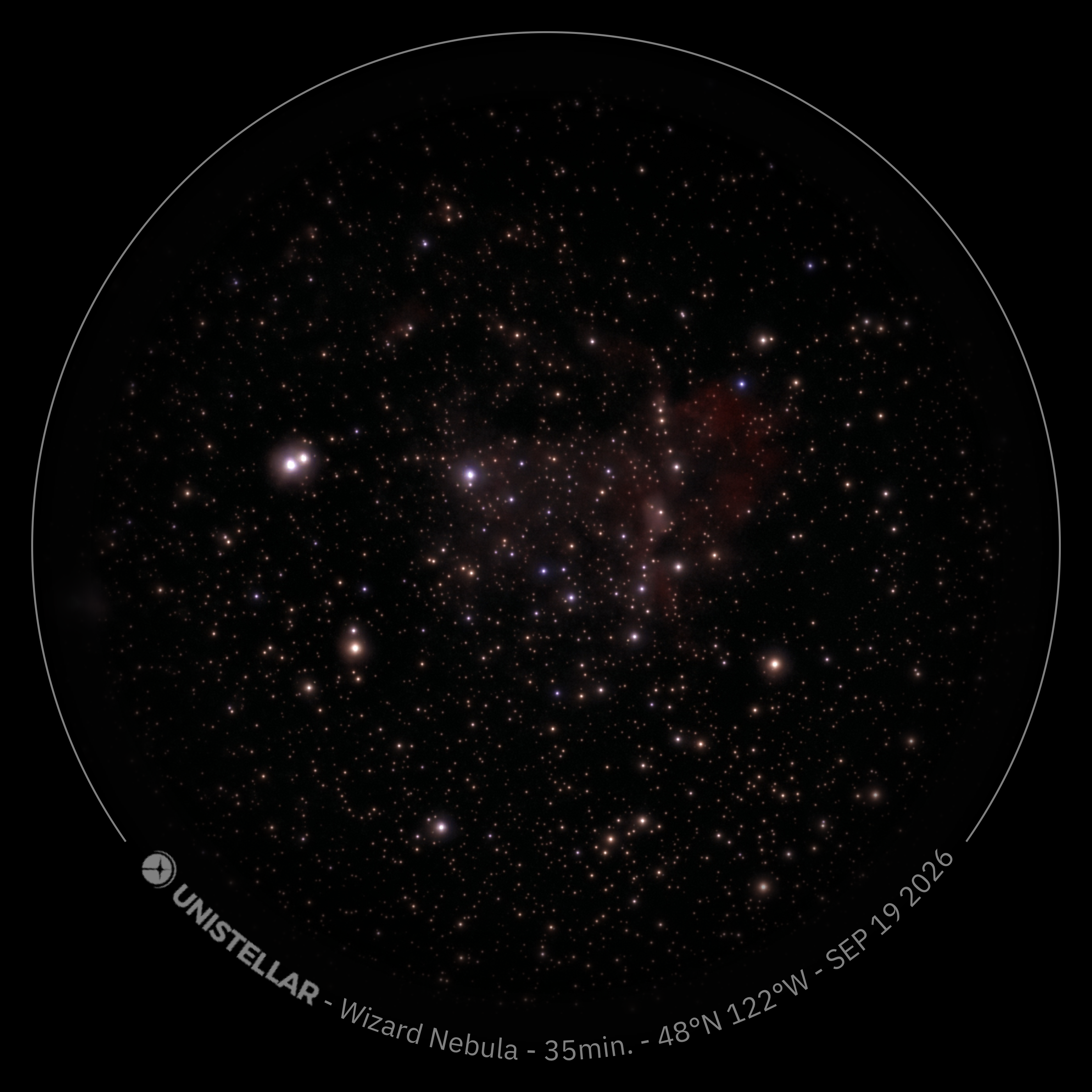
NGC 7380 – Wizard Nebula

35m

2026-09-19

At a max brightness of 7.2, you can make out some of the brighter elements, but miss a lot of the detail. Its size of 25 arc-minutes make it almost ideal, though. Probably worth revisiting in a low-light area.

Another example where size (25 arc-minutes) and magnitude (7.2) interact, so that the actual brightness at any given point is pretty low.

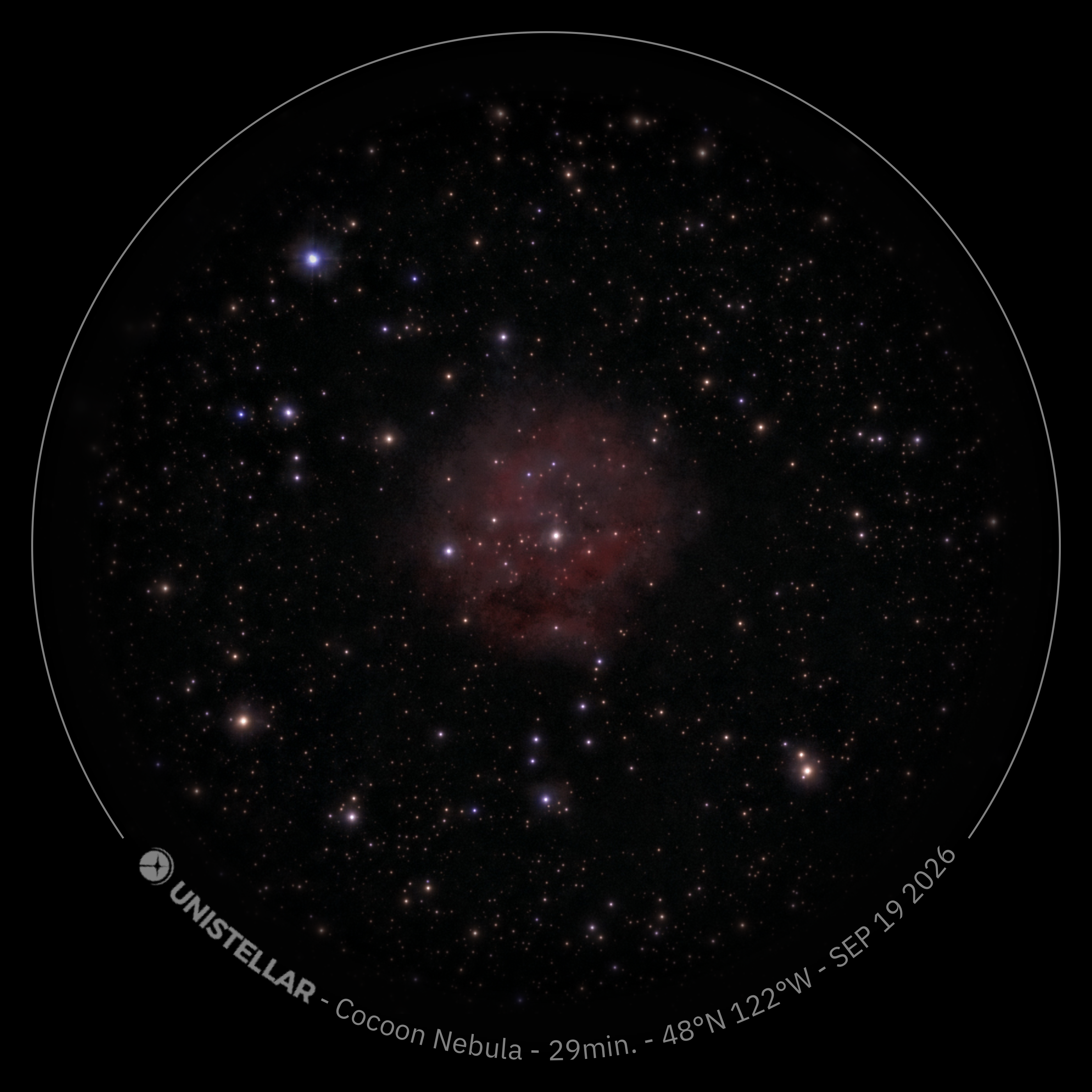
IC 5146 – Cocoon Nebula

29m

2026-09-19

I like this one, because even though the brightness is only 7.2, it’s consistently bright enough to make out a lot of the detail. At 12 arc-minutes across, it’s a great target for the eVscope, too.

A perfect example: compare how bright the Cocoon Nebula is to the Wizard Nebula – they’re the same numeric brightness, but since the Cocoon is less than half the size of the Wizard, it’s brighter at any given point.

Posted in Space on the back porch | Tagged , , , , , , , , , , , , , , , , , , , , , | Leave a comment

Lotsa Little Galaxies

I’ve been using a sky chart, looking for objects not highlighted by the eVscope software, but visible and perhaps notable. It’s been a bit hit-and-miss, but I’ve captured a few interesting ones over the last couple weeks.

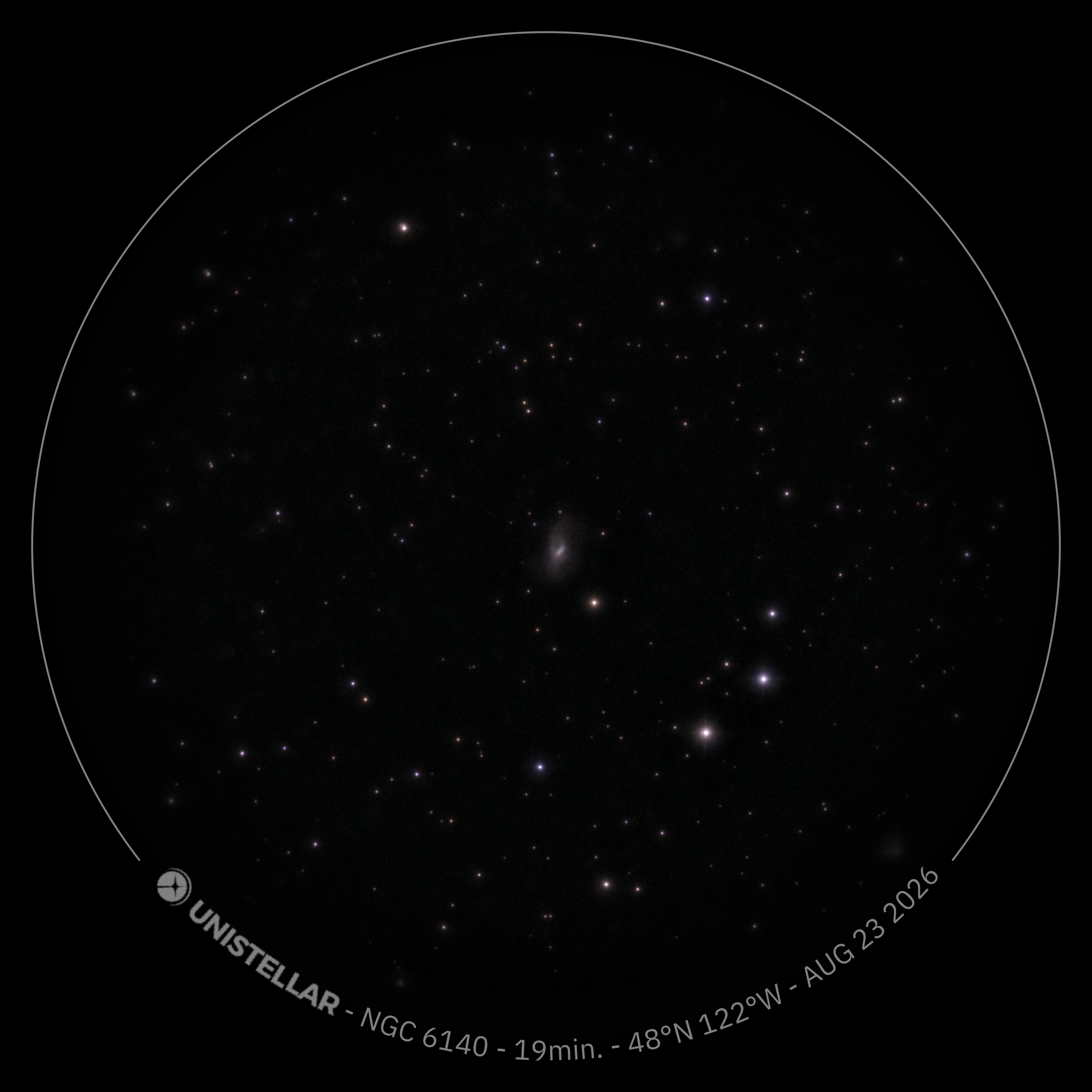
NGC 6140

19m

2026-08-23

Tough to catch, this diffuse spiral is nice, but probably needs a much longer dwell time.

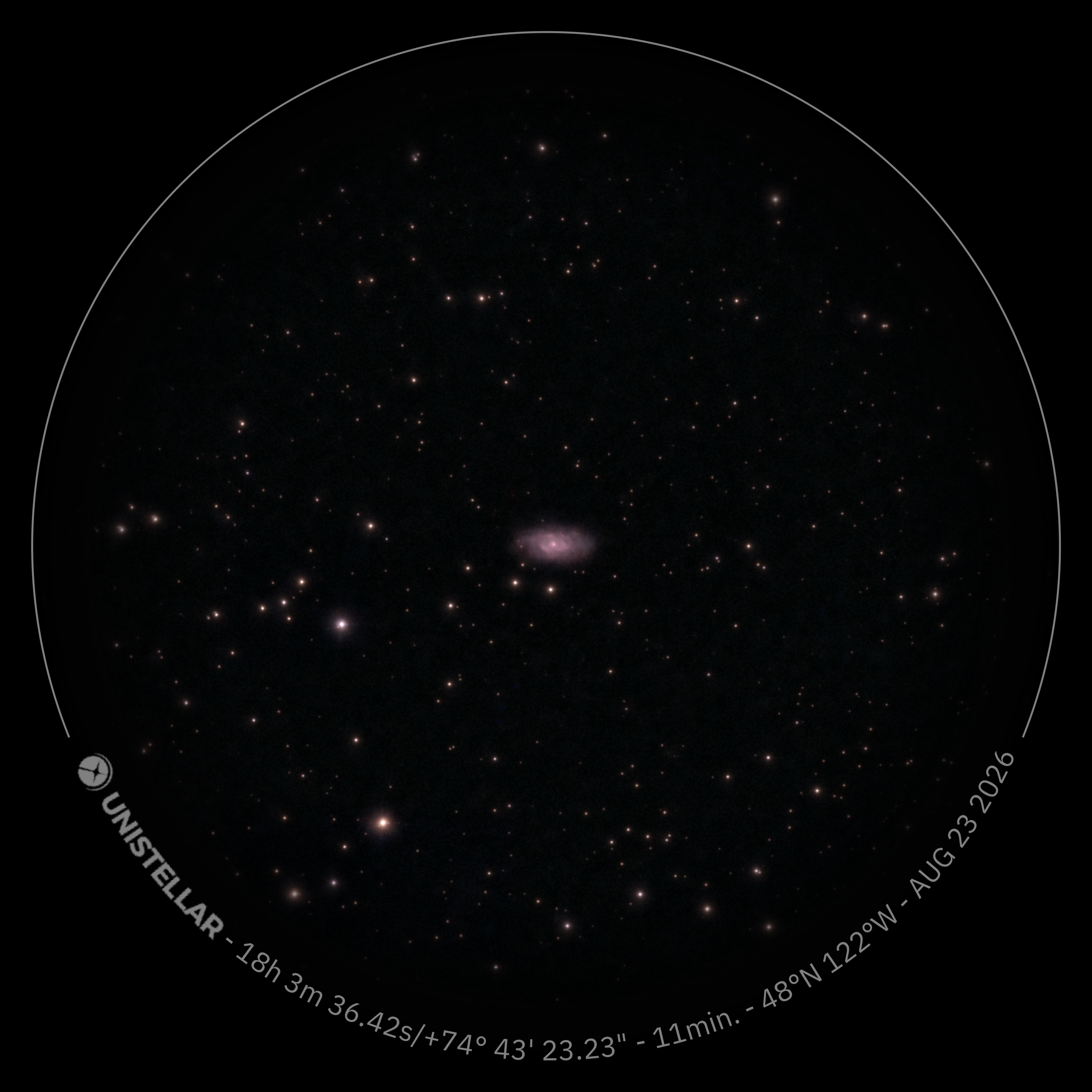
NGC 6643

11m

2026-08-23

A small, tight spiral in the Draco constellation, around 65-75 million light-years away.

NGC 5689

14m

2026-08-24

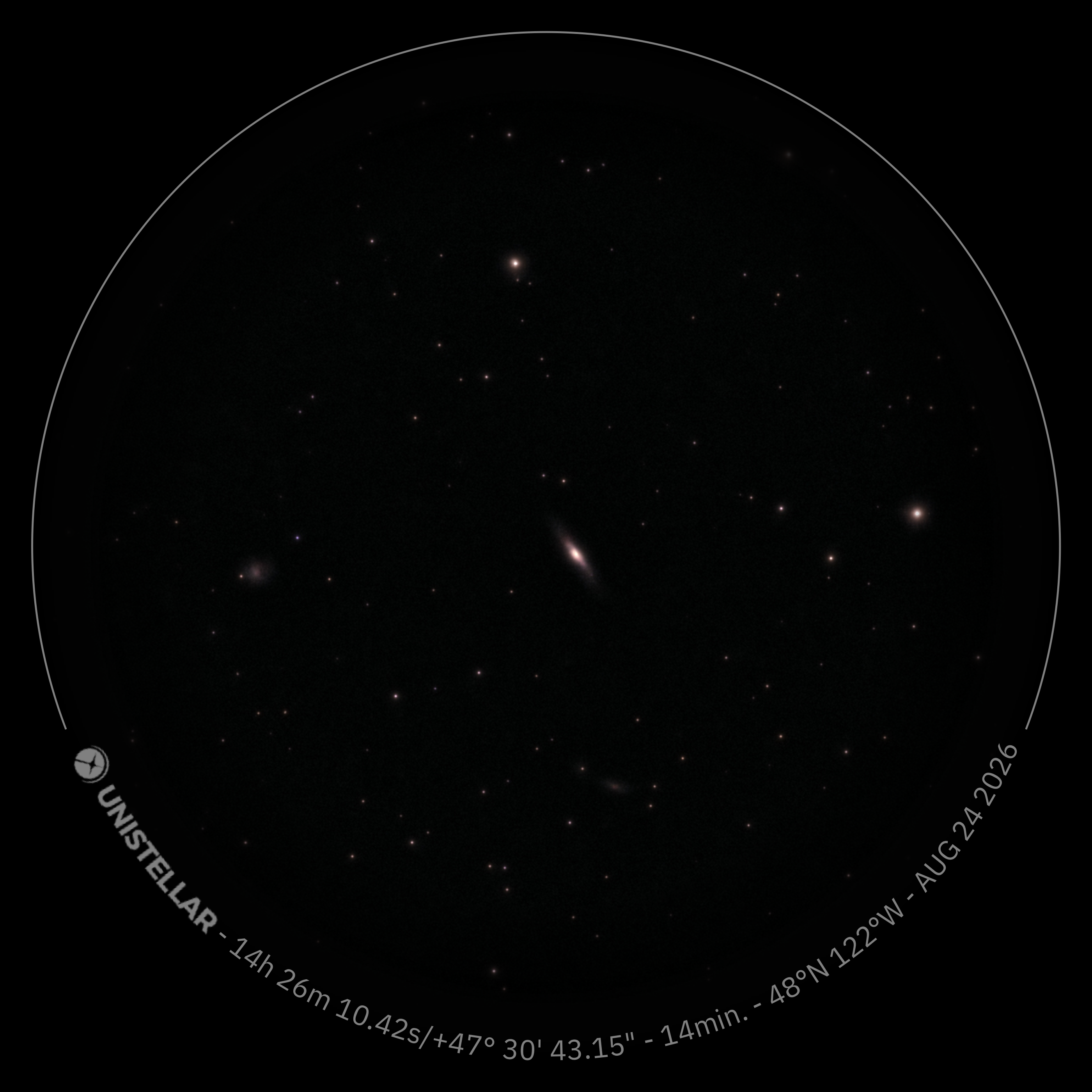
At a magnitude of around 12.5, this is about as dim as I can get. But it’s a 3-fer: 5689 is in the center, on the left is NGC 5693, and towards the bottom, near the 5-o’clock, is a faint little NGC 5682.

NGC 6070

33m

2026-09-08

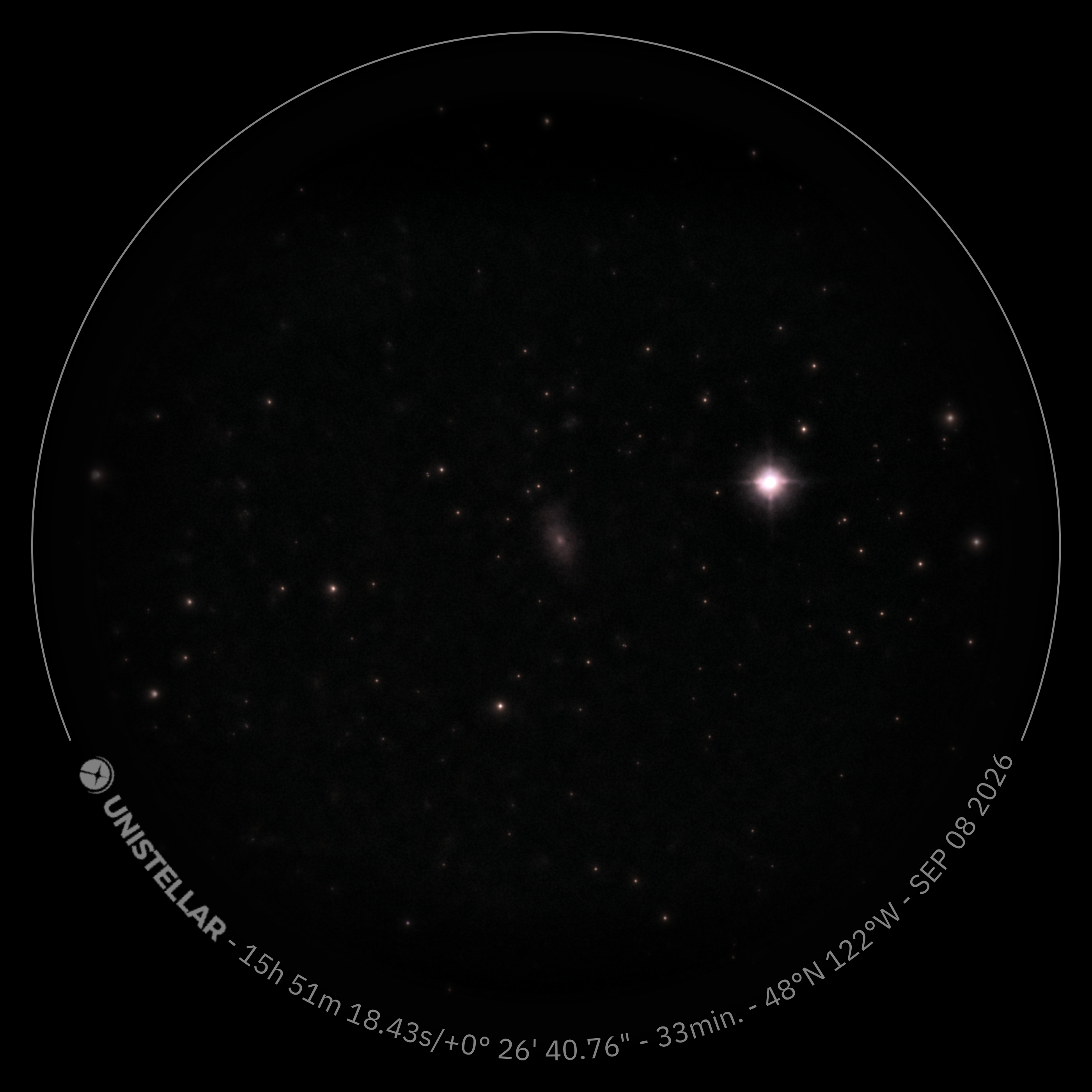
This is at the edge of detectable for the eVscope in an urban environment, with an apparent magnitude around 12.5.

NGC 5905 and NGC 5908

48m

2026-09-08

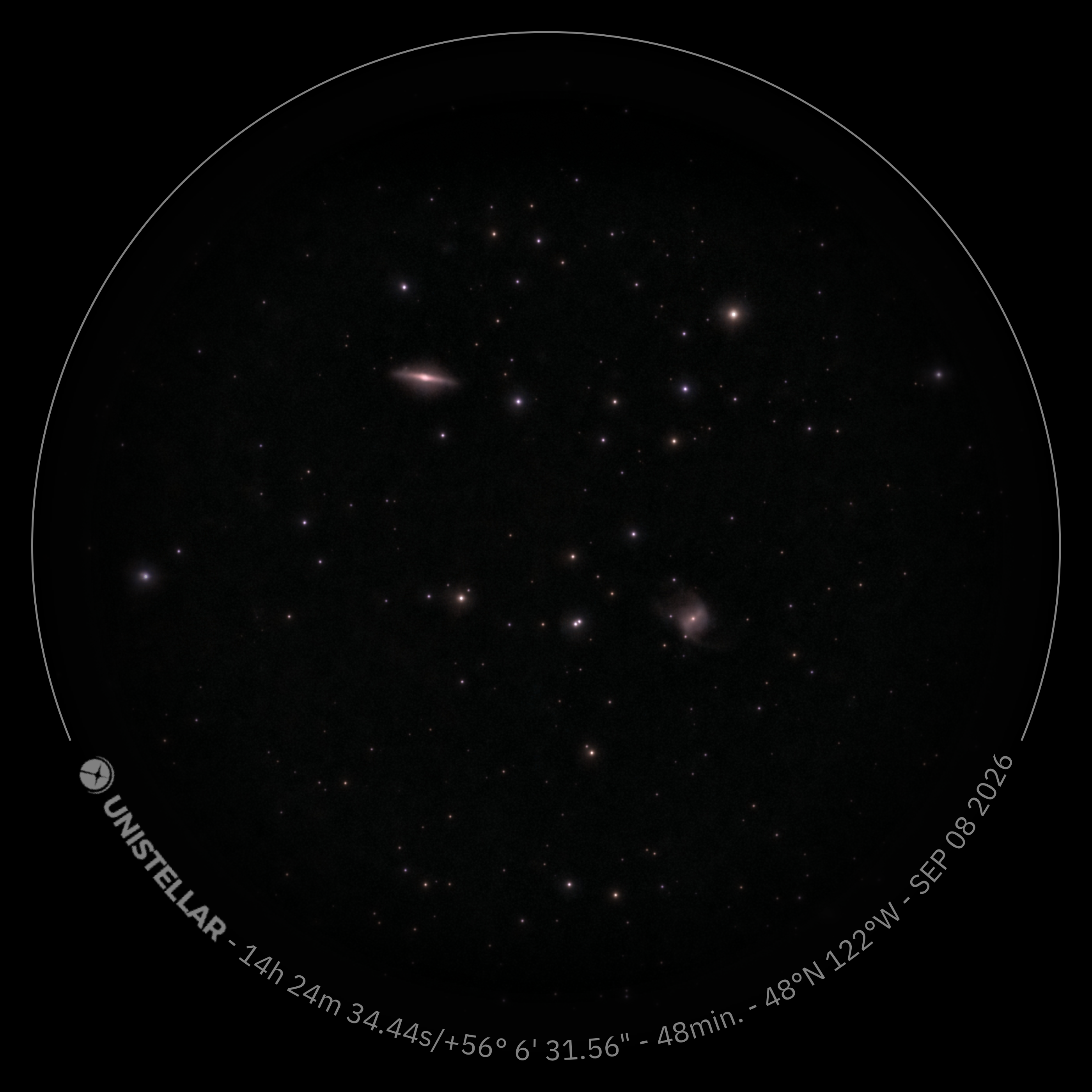
5905 is the face-on spiral, and 5908 is the edge-on spiral. I like these! They’re small, but they’re distinct and bright enough to catch.

M102

27m

2026-09-08

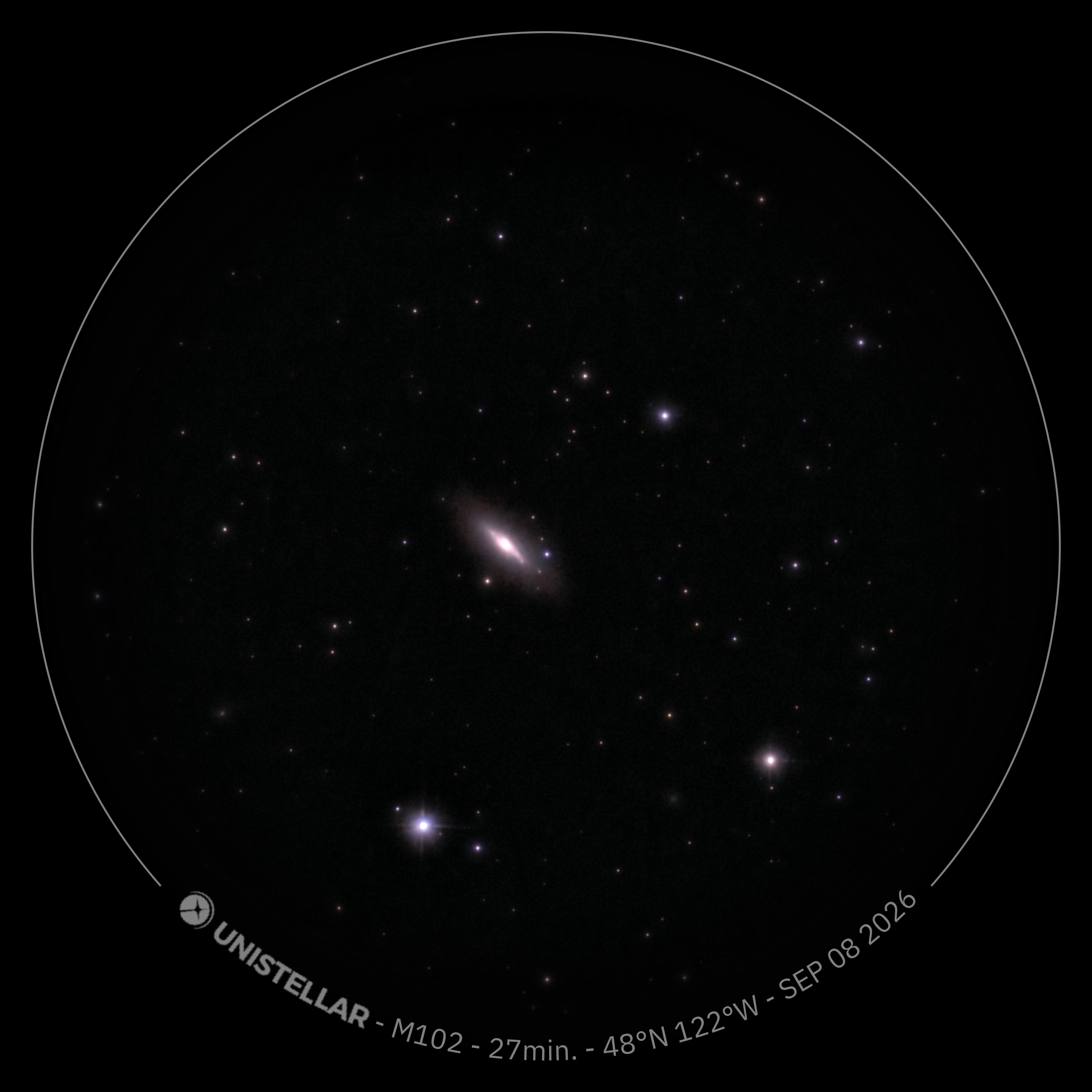
Also labeled as NGC 5866 and called the spindle galaxy, this is small but bright, at a distance of around 45-50 million light years away.

Posted in Space on the back porch | Tagged , , , , , , , , , , , | Leave a comment

A few pictures through the smoke

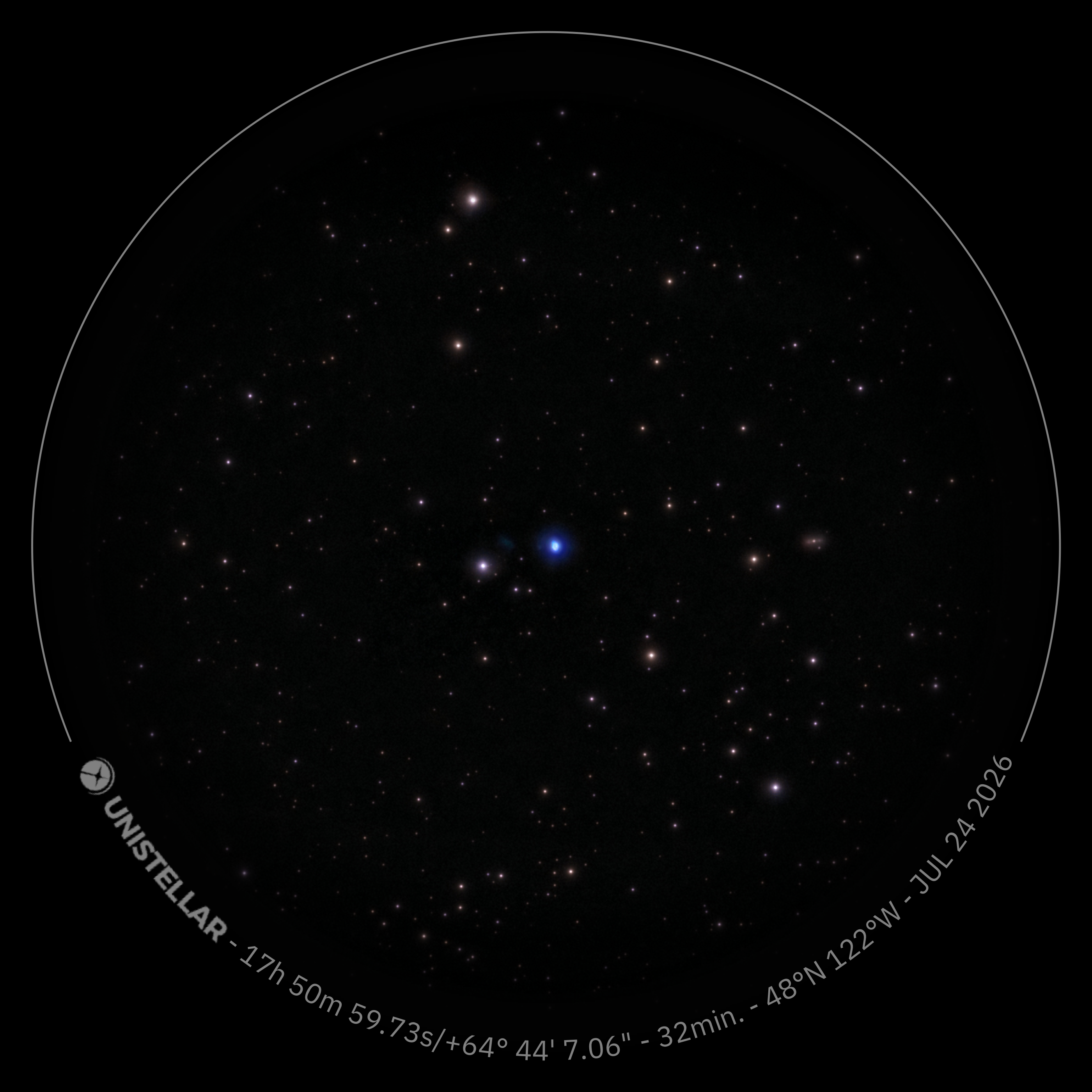
It’s been a while since I was able to get out and get some pictures with the telescope, partially due to the high-level smoke from the wildfires across the plains & Canada (and partially since I’ve been busy). I got a few pictures back in late July, but forgot about them because they were mostly ones I already had. But looking back, there was one, included below for posterity: the Cat’s Eye Nebula. It’s not a good one, mind you, but I’m including it in case you’re thinking of trying yourself.

Finally, we had a small break in the smoky haze last night (it’s hazy again today) and I got a couple nice pictures. Nothing new, but it was nice to get the telescope back out and capture some pretty pictures.

NGC 6543 – Cat’s Eye Nebula

32m

2026-07-24

This is a tiny, dim nebula. You can find great pictures of it online, but you’ll never get a good one with the eVscope. You can probably get a better one than this, since I live in a city, but you’ll never be able to zoom in (sadly).

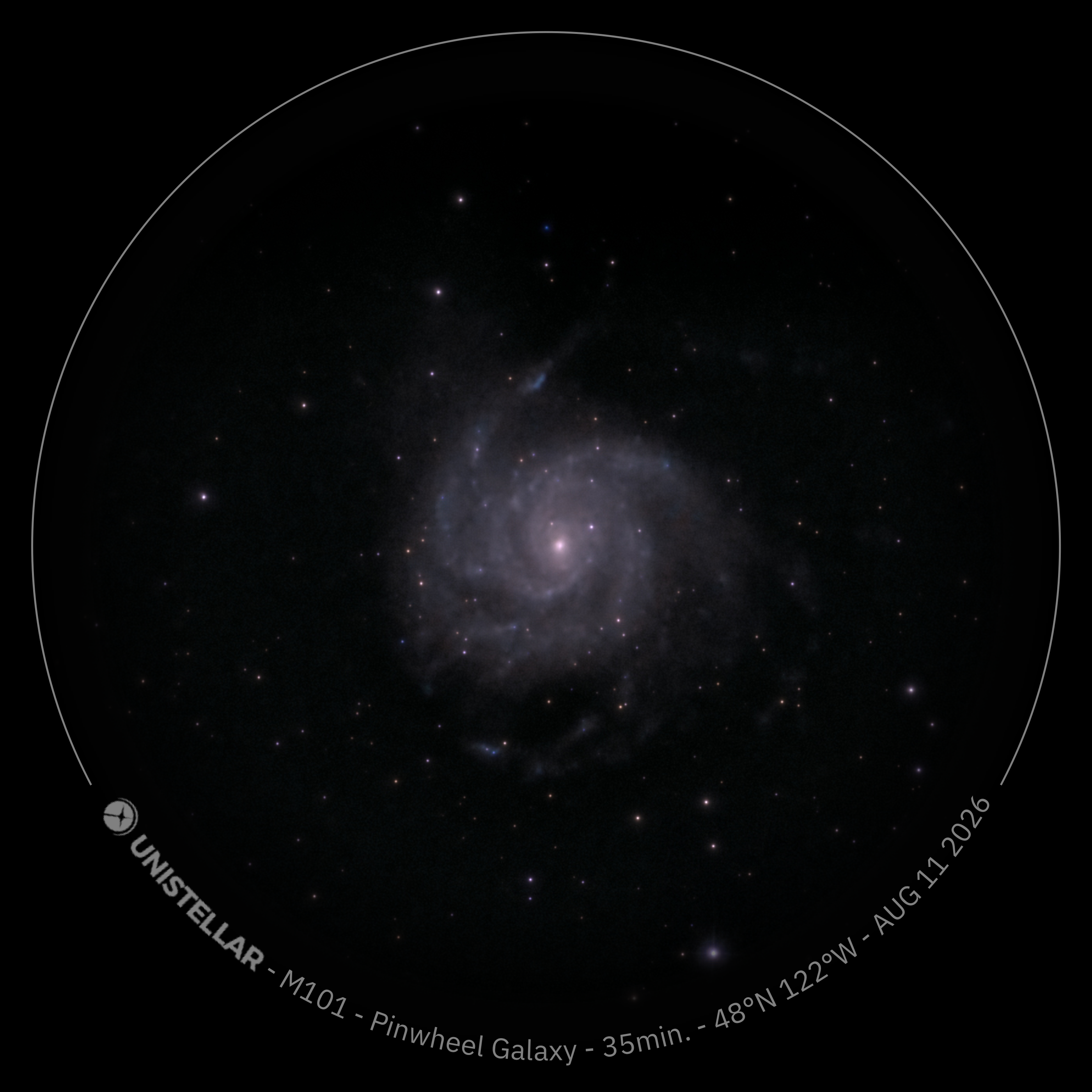
M101 – Pinwheel Galaxy

35m

2026-08-11

A favorite of mine, due to the supernova back around July of 2023. I wish we had the enhanced vision back then, because it’s so much better with it than without.


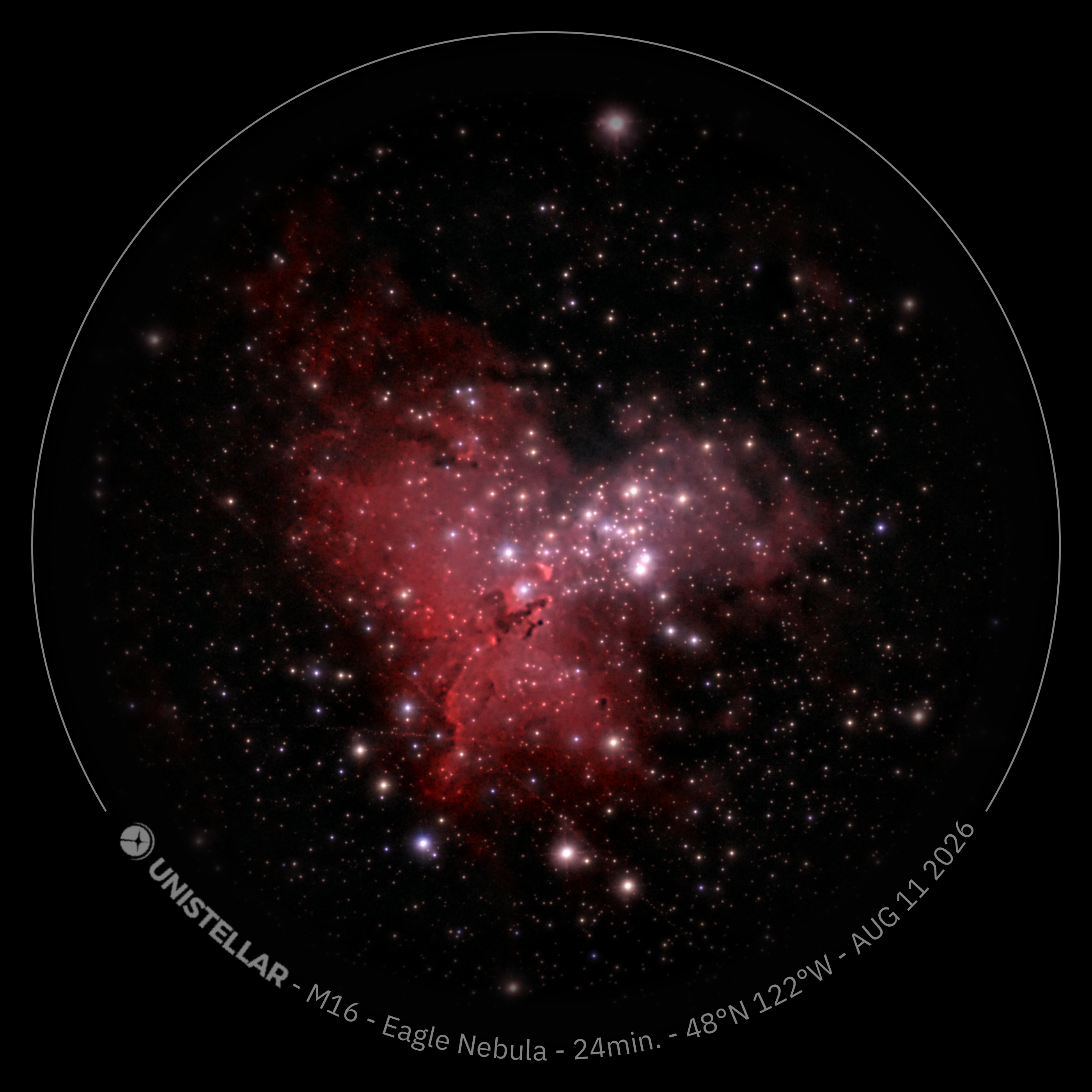
M16 – Eagle Nebula

24m

2026-08-11

It’s never bad to get a picture of this nebula with the eVscope. It’s sized almost perfectly, with the right level of detail, to really stand out.

Posted in Space on the back porch | Tagged , , , , , , , , , , , , , , | Leave a comment

The Tale of Twoshirts Now Available on Royal Road

So I signed up for Royal Road, on the suggestion from a friend. I have no idea how it’ll go, but I’m hoping I can get good feedback and some followers and maybe some momentum. If you want to follow along, I’m posting a chapter every M/W/F through mid-October, at which point the entire book will be available: https://www.royalroad.com/fiction/185498/the-tale-of-twoshirts

I’ve spent my free time over the last couple weeks working on Twoshirts book 1. Based on the very limited feedback I got from the agents & publishers I reached out to, nobody’s really interested unless it’s a full novel, and a full fantasy novel is at least 60k words.

So I did that – I added a few scenes, tweaked the wording and descriptions, and a few days ago, I finally got it to exactly 60,355 words. Woohoo!

I also started going over book 2, which is still just under, at only 56k. I’m actually less concerned about getting book 2 to 60k words than I was for book 1. But seeing how much I liked the new scenes, and what they added to book 1, I’m excited to learn what I haven’t yet discovered in book 2.

I’ve also been noodling about book 3, as well as a spinoff book, which I’m tentatively calling Puffer’s Tale. I think that one’s going to be hard, but to understand why, you’ve basically gotta read book 2.

So go sign up for Royal Road, read my book, leave some feedback, and I’ll do my best to make it a better book! You can also go to my subreddits, https://www.reddit.com/r/TheTaleofTwoshirts/ and https://www.reddit.com/r/Twoshirts/ — there’s not much there yet, but hey, everything’s gotta start somewhere, right?

Posted in Twoshirts | Tagged , , , , , , , , , , , , , , , , , , , | Leave a comment

Amazon and LGBTQ+, Again

Another LinkedIn post that I’m cross-posting here. Original source is here.

One of the reasons I left Amazon was because they explicitly and intentionally removed all mention of LGBTQ+ and black people from their public-facing DEI documentation shortly after the current “administration” took over. Sadly, I got yet more confirmation of the unfortunate reality, when a friend (and still-Amazon employee, who’s in one of my D&D groups) asked on our shared Discord about who to talk to, because their friend and coworker wanted to wear a pride flag to a public event, but their management was telling them not to.

During pride month? Seriously? Don’t wear a pride flag, because …?

I know it’s vague and “friend-of-a-friend”-ish, but I’m doing that intentionally. I wish it wasn’t true, but it is.

We recommended GLAMAZON, but I don’t have high hopes.

I wish there was more kindness in the world.

Good leaders don’t just make space at the table, they show others that they’re doing so. Amazon’s not only not making space, they’re telling others they’re not.

Posted in Being a Good Leader | Tagged , , , , , , , , , , , , | Leave a comment

The Emerging AI-Driven SDLC: Ultra-Kanban

I nerd out about lots of stuff, one of which is software development lifecycle (SDLC) methodologies.

I started my career in the world of waterfall. I developed and authored requirements and test plans. I was the process engineer at an aerospace consulting company that was trying to get DO-178B level C certification, and … hey, wake up, it’s not that boring.

I got a job with Amazon and learned about Scrum and Agile Development. I read books, took classes, learned Kanban, tried both Scrum and Kanban on my teams, and taught classes about Scrum and Kanban and the differences between them.

But now, I’m working in a post-AI world, and I think a new SDLC model is developing. It’s not quite vibe coding. It’s more swarming, or swarm-and-storming, but it’s also not that.

I’m seeing tiny groups of people – literally two or three – get together, take an epic, and burn through the equivalent of a two-week sprint’s worth of work in 3 days. They use their LLM of choice to refine their requirements, create the stories, and write the code, all in –dangerously-skip-permissions mode.

I’m seeing a product owner, a product manager, and a developer in a Slack channel, doing 2-day hackathons that spit out production code.

I’ve heard the term “10xing” (pronounced ten-ex-ing), and truth be told, I don’t like it. I think it’s more like Ultra-Kanban.

You’re putting one unit of work in the pipeline, and burning it down with the burner turned on max while pouring liquid oxygen over it.

The process engineer in the back of my head is screaming. The QA manager is crying in the corner of my subconscious. The current me is terrified, but curious, because I’ve been telling people for years that AI is the future of computer science, so doesn’t that mean I should embrace it?

I think we’re seeing the shift to a new software development paradigm, similar to the shift from waterfall to agile, but WAY more dangerous. You need better requirements, better testing, more robust pipelines, and easy rollbacks when there’s a production issue. I think if you can manage the cost of a defect in testing, deployment, and post-production (see: Boehm, 1981), then the advantage you get in the development time can easily offset the risk, while creating more opportunities for the big wins you need to grow a company.

I don’t know what it’s called yet, and I don’t know what the best practices it’s going to steal from Scrum, Kanban, and waterfall. I think someone’s going to write (probably already writing?) a book about how to do it right. The fundamentals still hold: know your customer, verify AND validate your requirements, invest in quality at the beginning of the lifecycle, quantify and mitigate your risks, and expect production failures.

But how? And how fast? Thoughts?

Posted in Being a Good Leader | Tagged , , , , , , , , , , , , , , , | Leave a comment

I Caught a Pelican!

I had a good night last week, and decided to go nebula hunting. I tried two new ones and two old favorites; the favorites worked great (of course), but only one of the two new ones panned out.

IC 4592

10m

2026-06-12

An attempt to capture the reflection nebula in Scorpius that proved ultimately unsuccessful. Likely too faint to catch with the eVscope, at least within a city.

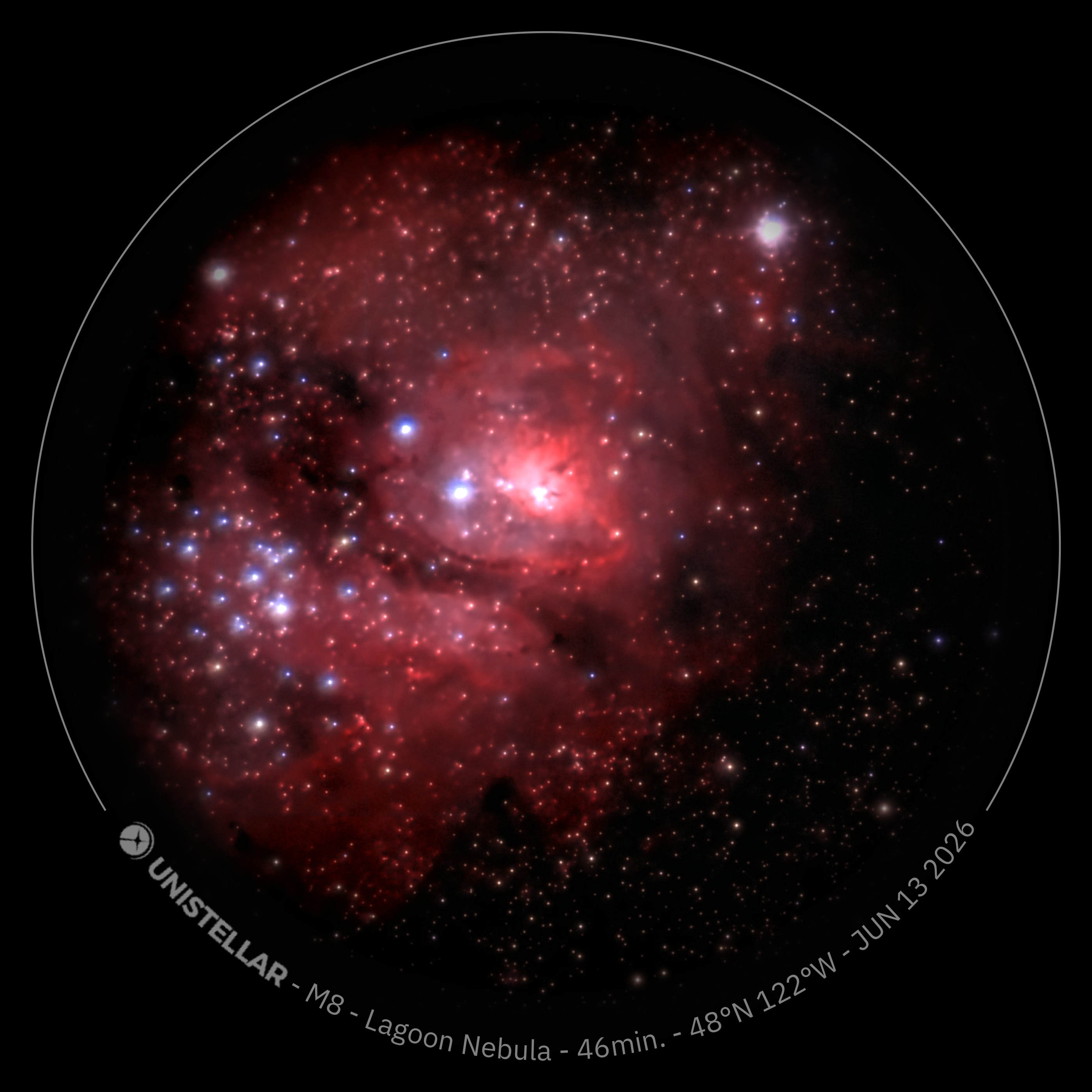
M8 – Lagoon Nebula

46m

2026-06-13

One of the best and brightest that you can capture on the eVscope, the Lagoon is a great place to visit.

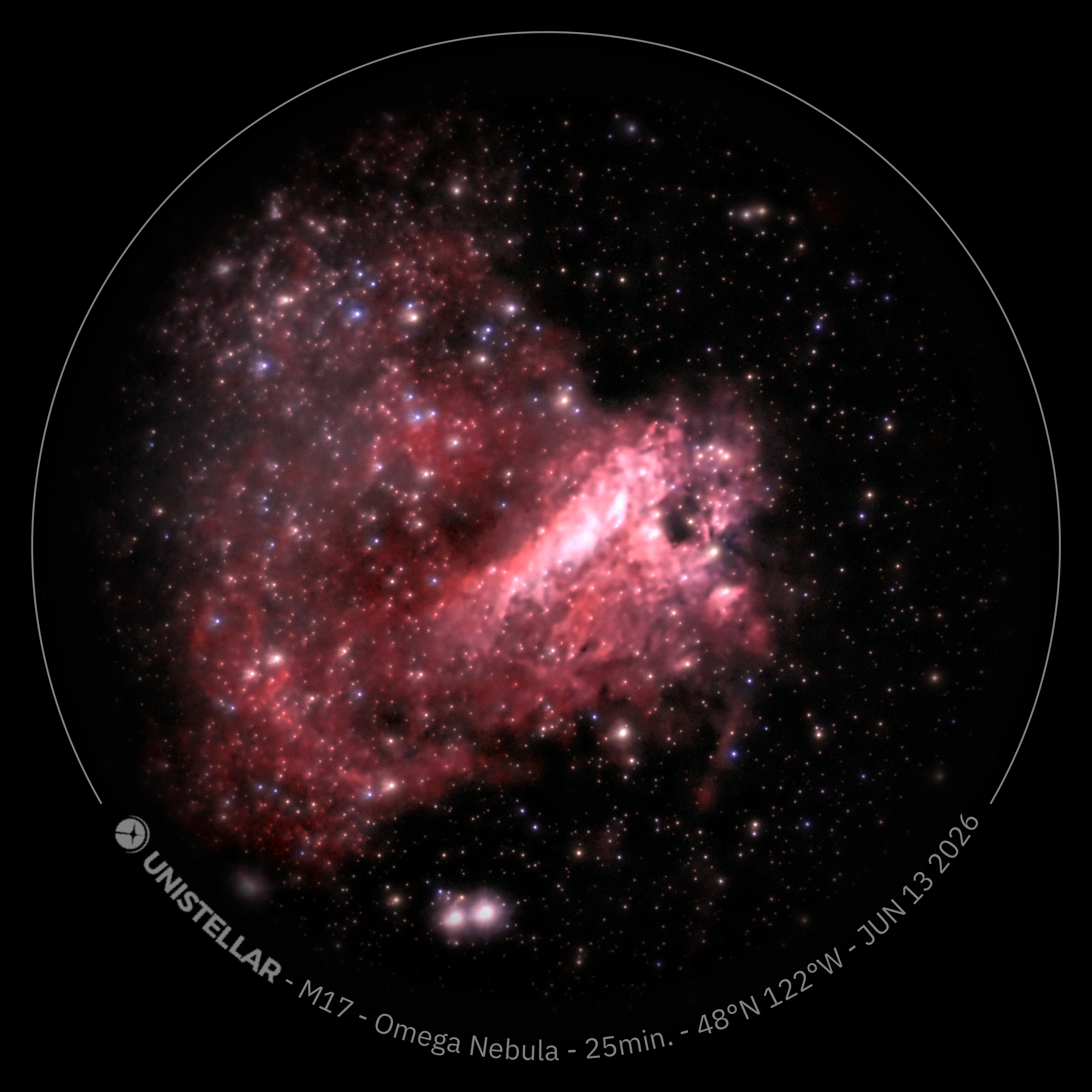
M17 – Omega Nebula

25m

2026-06-13

One of the brightest nebulae that you can catch, it looks great, but is actually much larger than the field of view. I think if I ever get around to doing composite images, this (along with Andromeda) is one I should focus on.

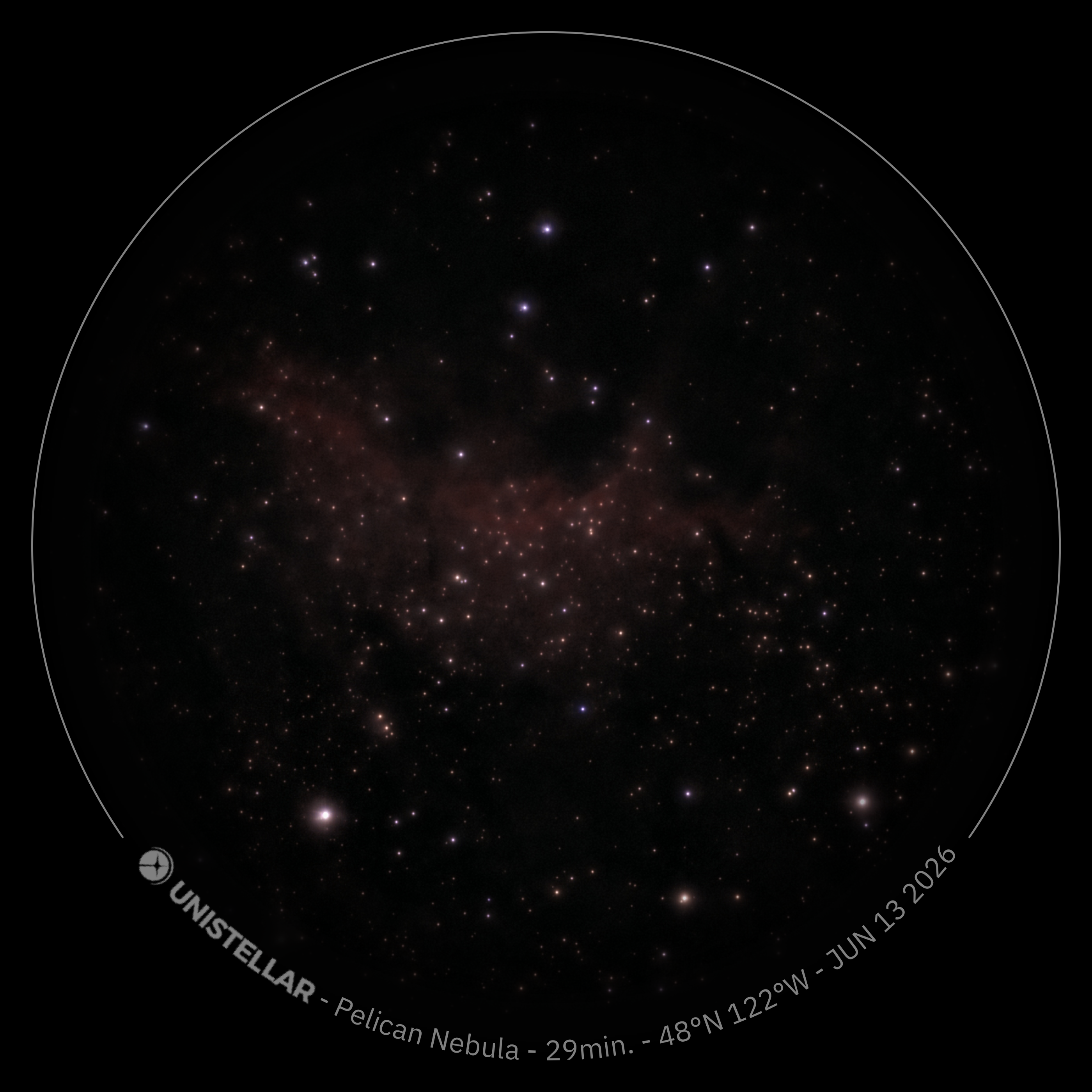
IC 5070 – Pelican Nebula

29m

2026-06-13

Much dimmer than some of the other nebulae that you can capture, but still bright enough to be seen, the Pelican is part of the larger North American nebula complex.

Posted in Space on the back porch | Tagged , , , , , , , , , , , , , , | Leave a comment

It’s Triplets!

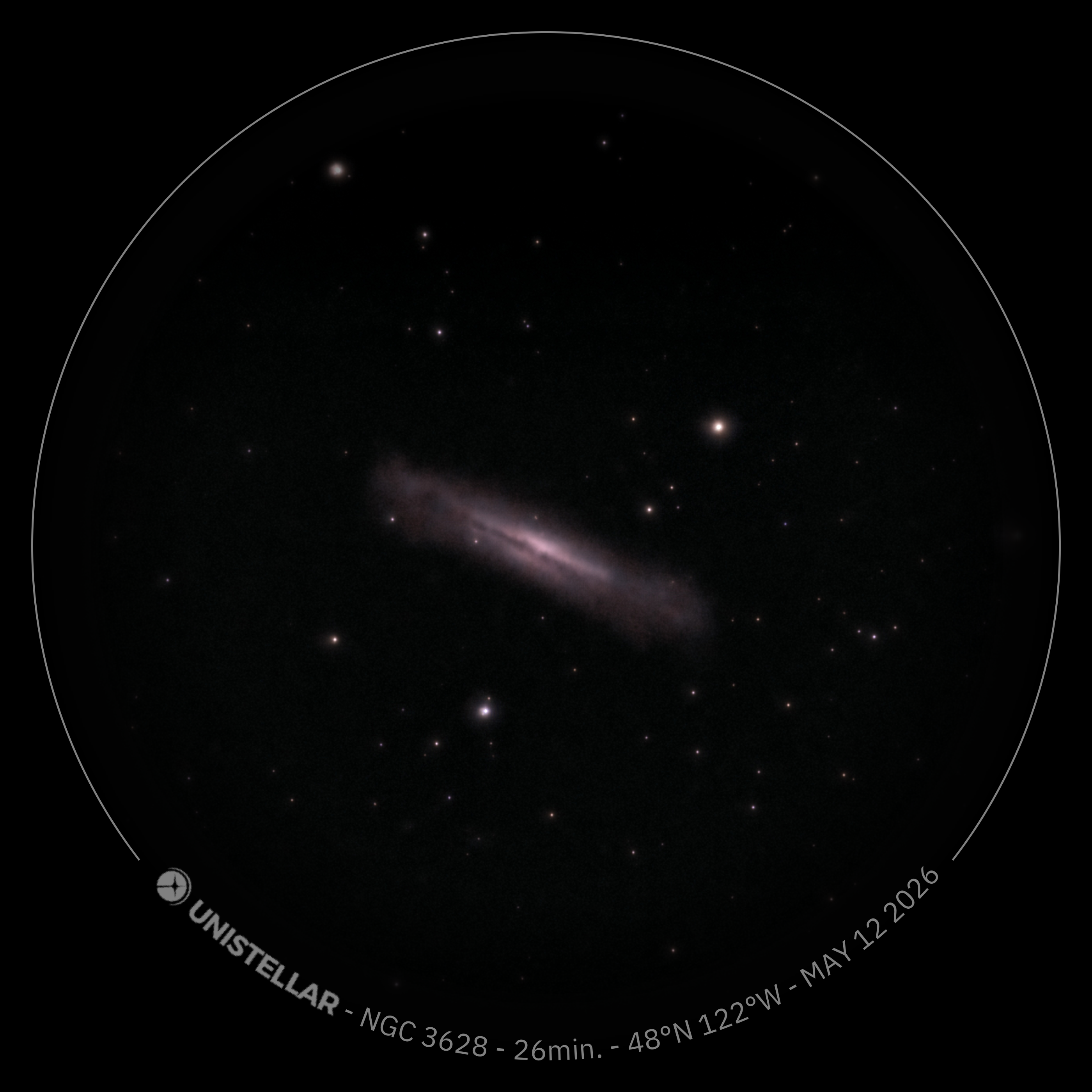
The Leo Triplets are M65, M66, and NGC 3628. They’re gravitationally bound together, and are very close in the night sky to one another – just not quite close enough to get them all in one shot with the eVscope. All are great targets for it, though, as you can see below.

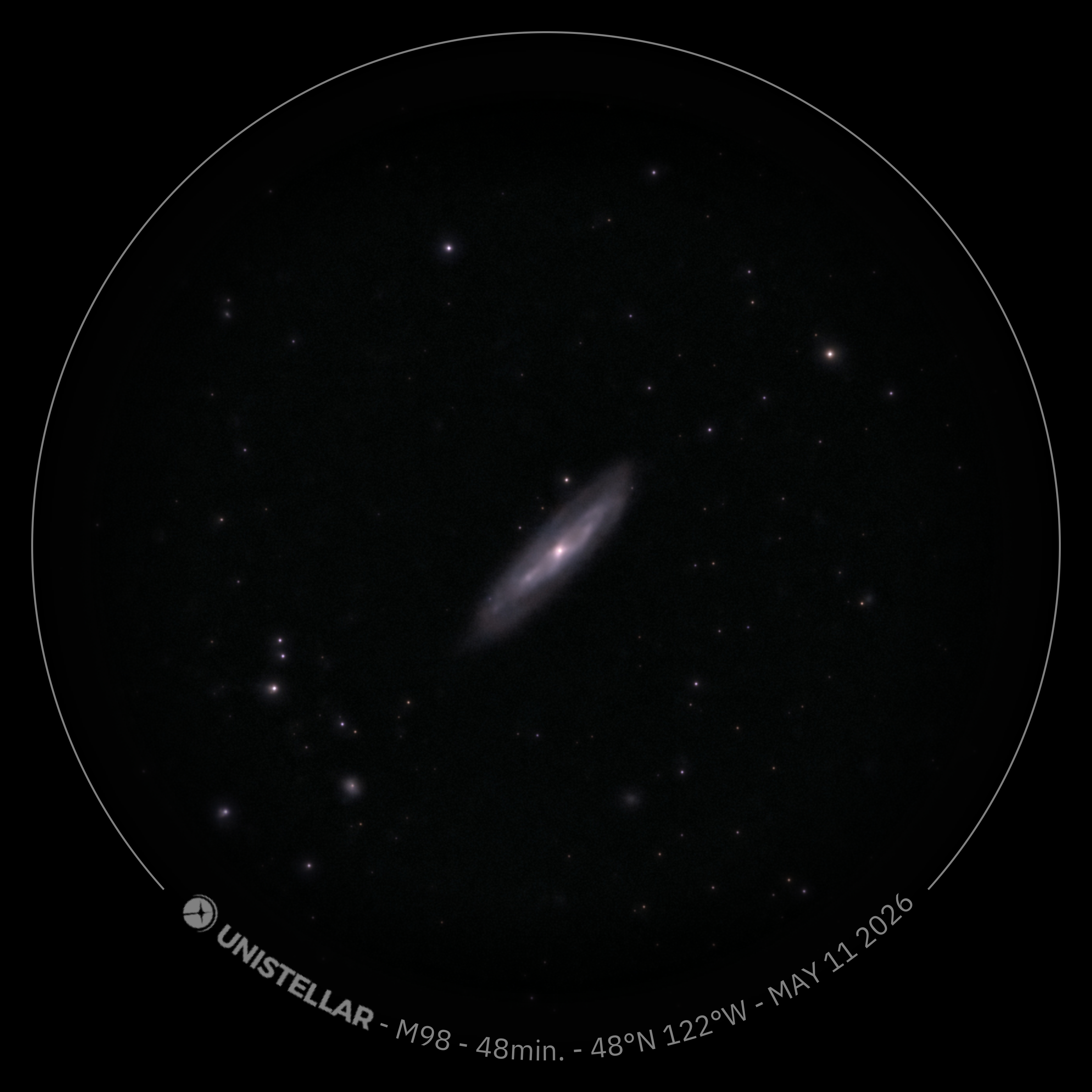
Plus M98. I’d wanted a better shot of it, and I got it.

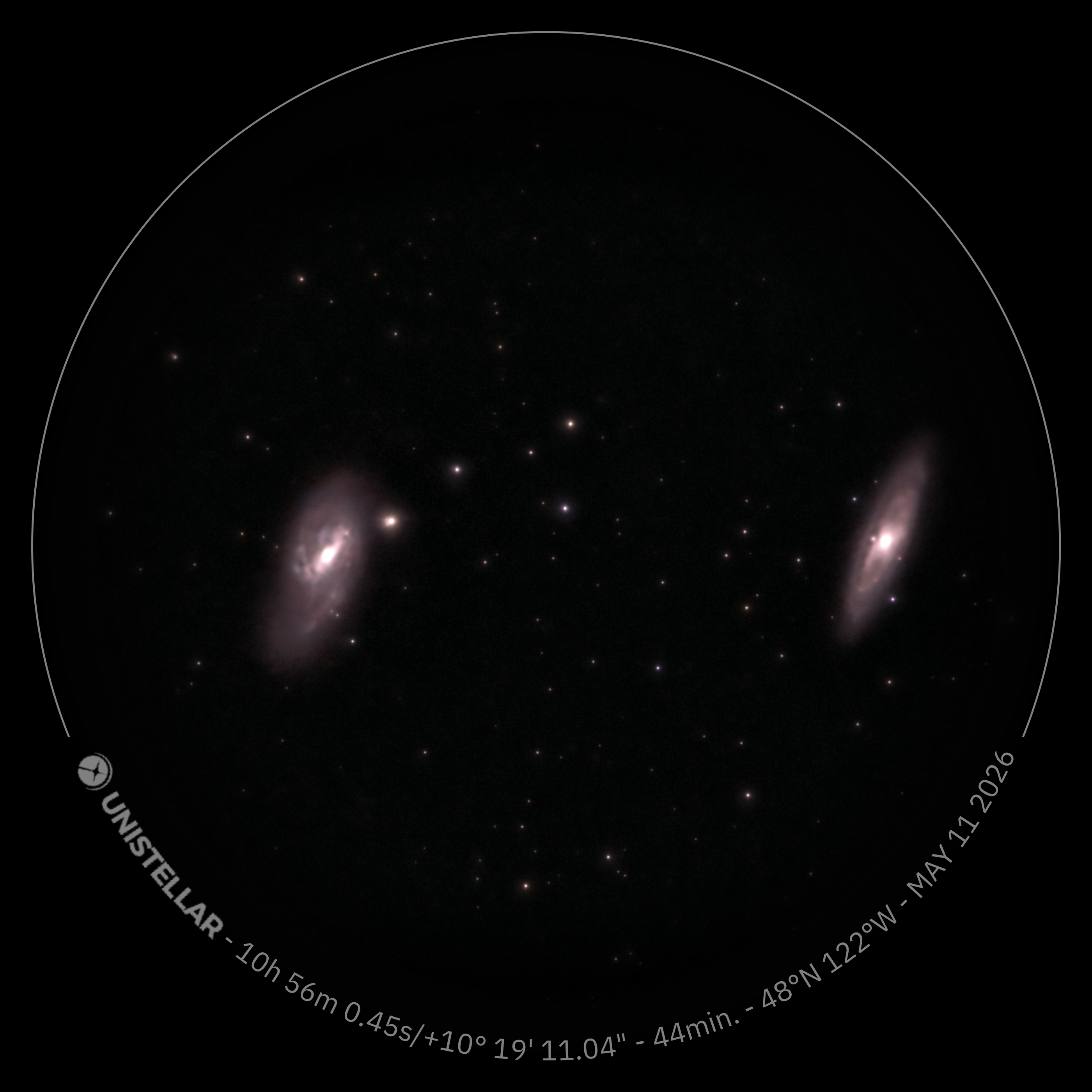
M65 and M66

44m

2026-05-11

Two-thirds of the Leo Triplet in one shot. I wanted a longer dwell that my previous attempt, and it was a good night.

NGC 3628

26m

2026-05-12

Another shot of one of my faviorites, with its slightly-off-kilter disk. Excellent details and colors with a reasonably good dwell time.

M98

48m

2026-05-11

I wanted a re-visit, and it’s a good one. It looks to me like 4 disks – a teeny bright one in the middle, a slightly less-bright one surrounding it, and each one dimmer than the last.

Posted in Space on the back porch | Tagged , , , , , , , , , , , , , , , , | Leave a comment

A Few Good Spring Nights in Seattle

Apologies for the lack of recent updates – I did get out once in April, and now that we’re into May, we’ve had a couple good nights in a row. Nothing new, other than my third (and probably final) attempt at the North American Nebula, but some old favorites make a nice showing.

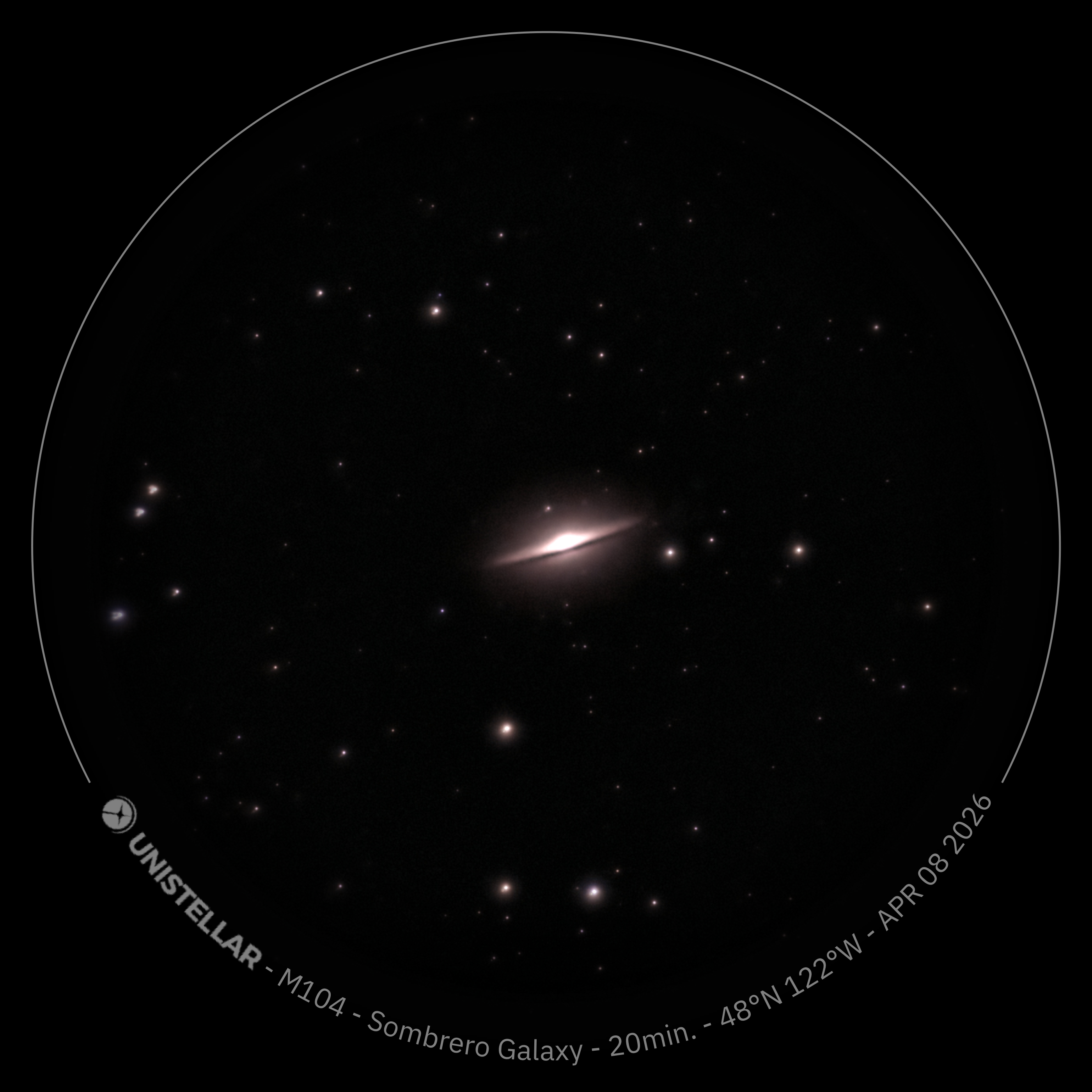
M104 – Sombrero Galaxy

20m

2026-04-08

The Sombrero is a great galaxy for the eVscope, you kinda can’t go wrong with it.

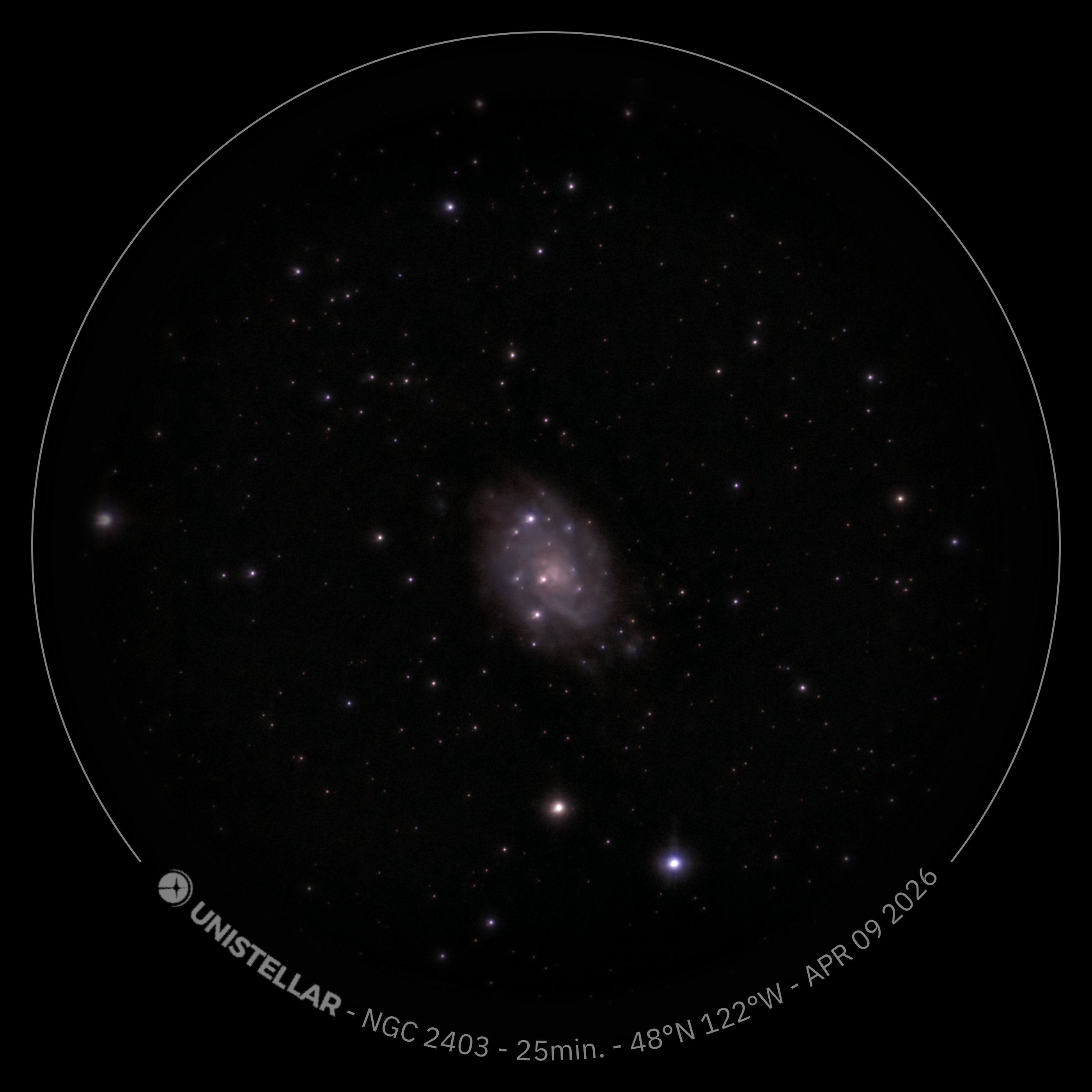
NGC 2403

25m

2026-04-09

One of the better ones of this compact spiral galaxy.

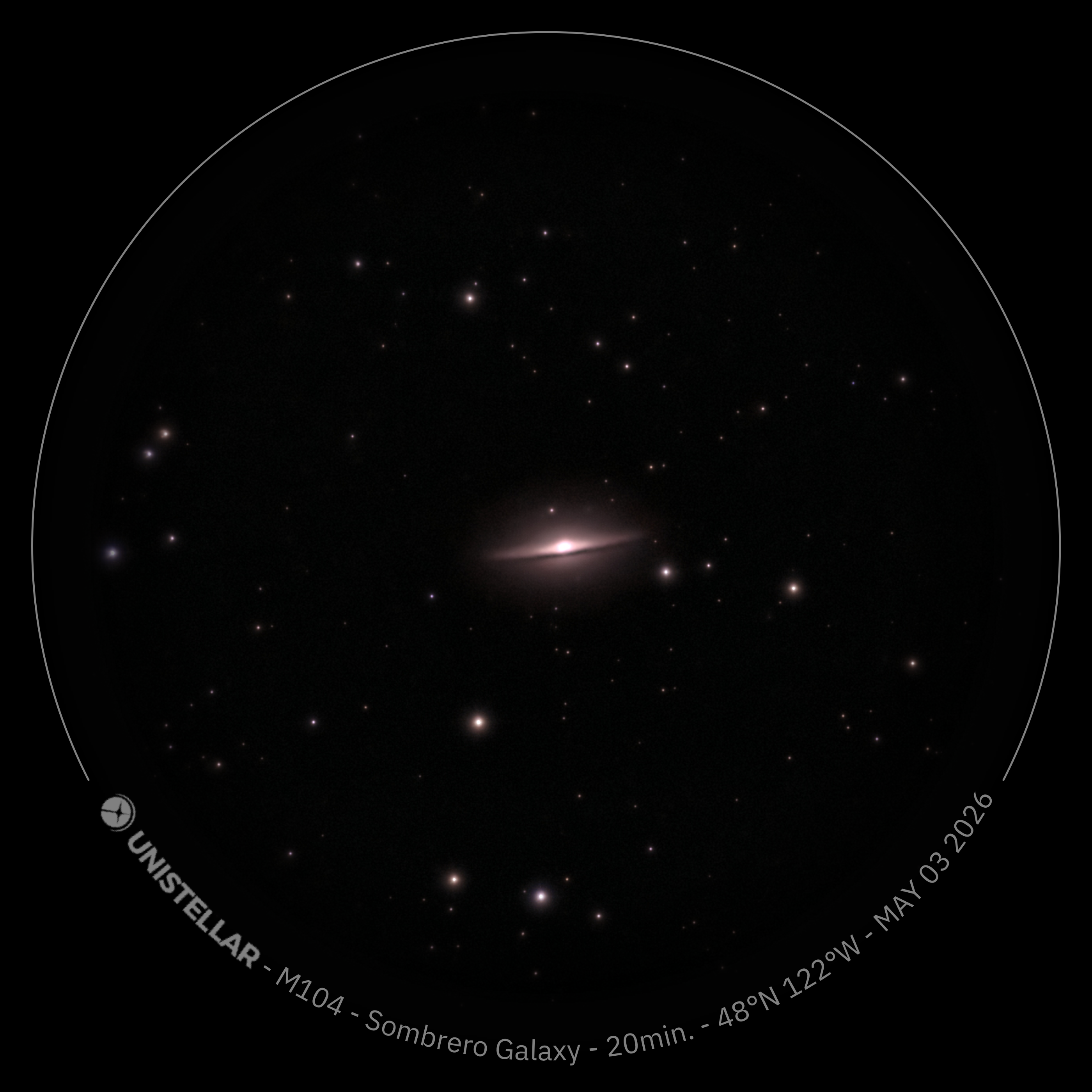
M104 – Sombrero Galaxy

20m

2026-05-03

Less bright than some of my other shots of the Sombrero, but perhaps a bit sharper?

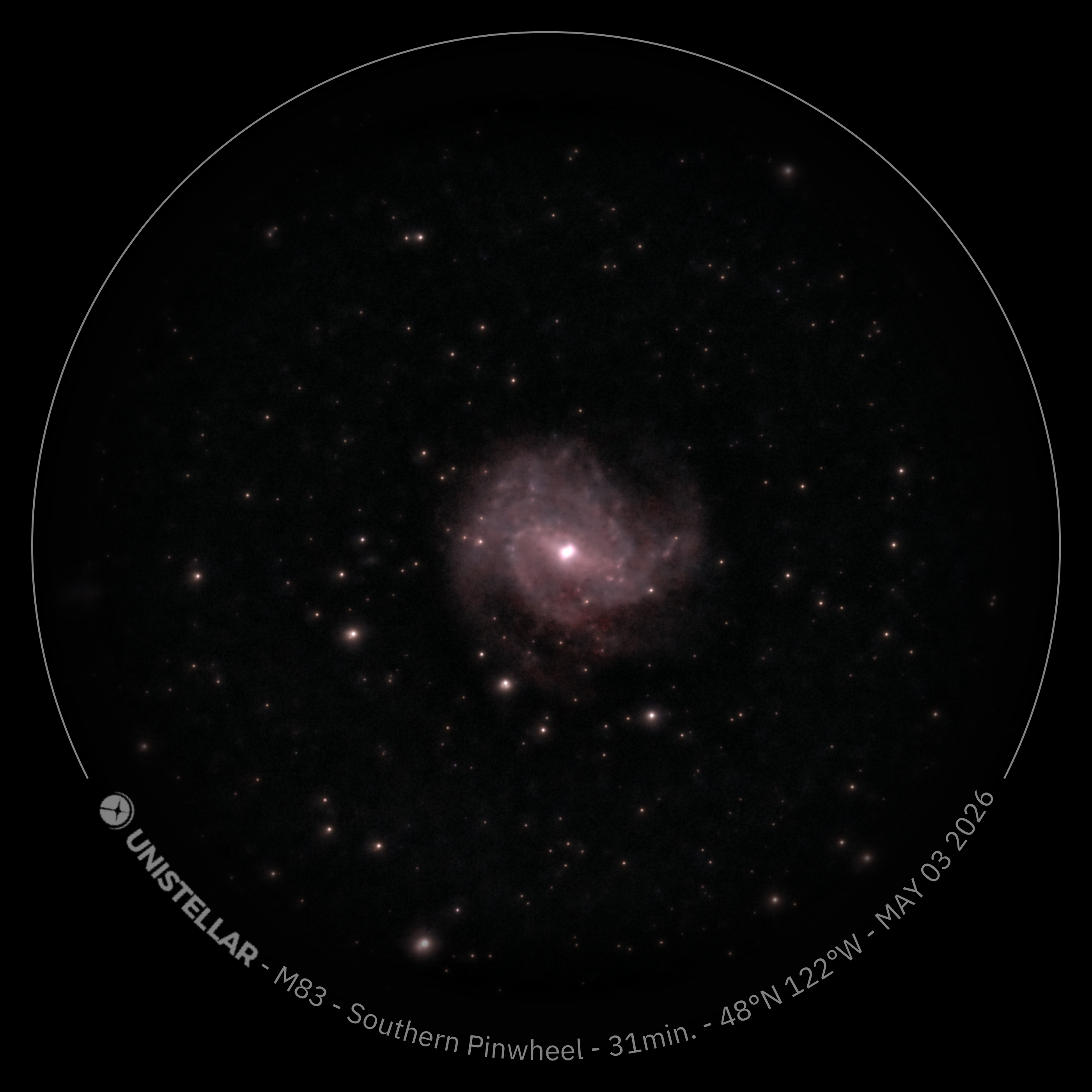
M83 – Southern Pinwheel Galaxy

31m

2026-05-03

A much nicer shot of this galaxy, you can really make out some of the finer detail.

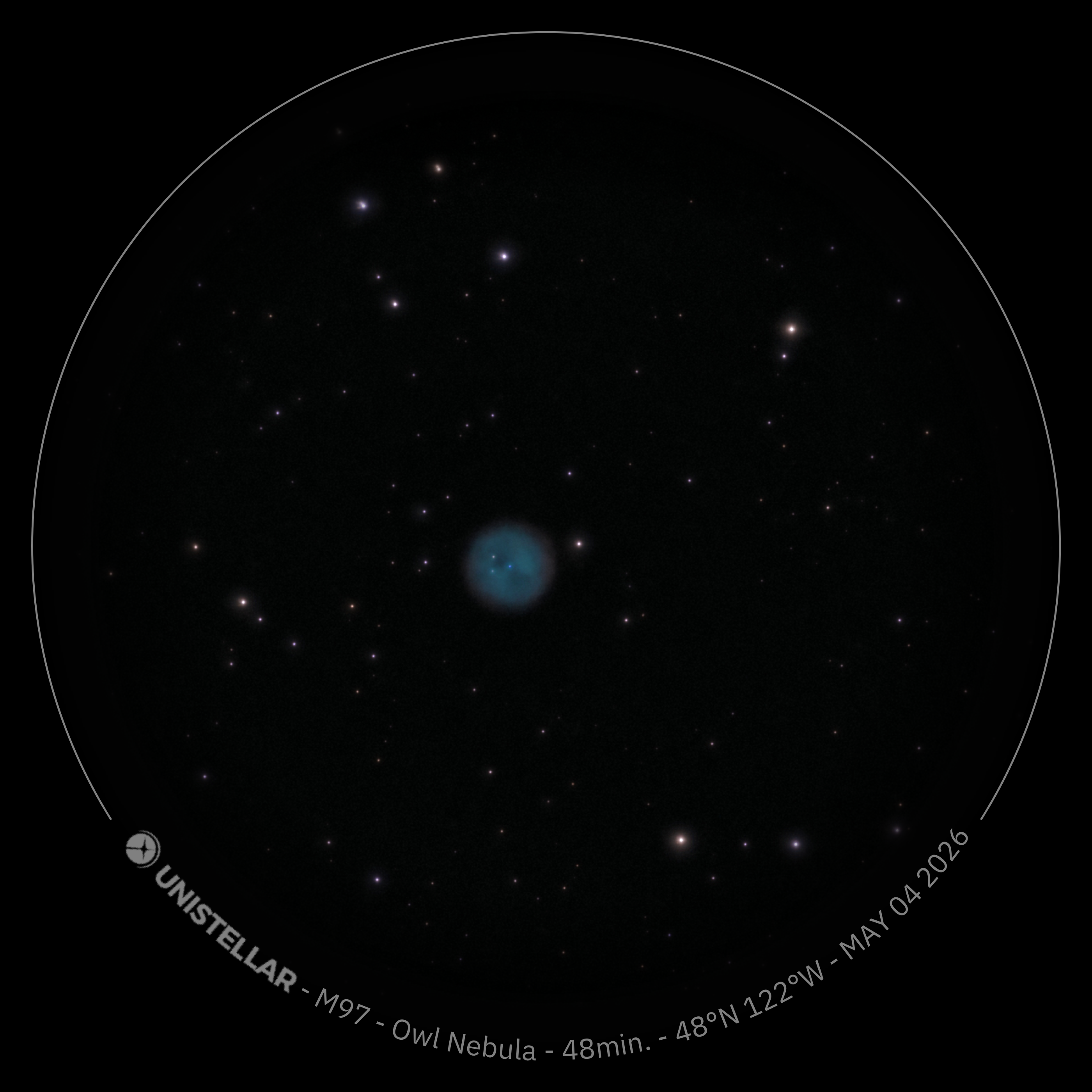
M97 – Owl Nebula

48m

2026-05-04

The Owl needs a clear night and a long dwell, but it’s a nice reward if you can catch it.

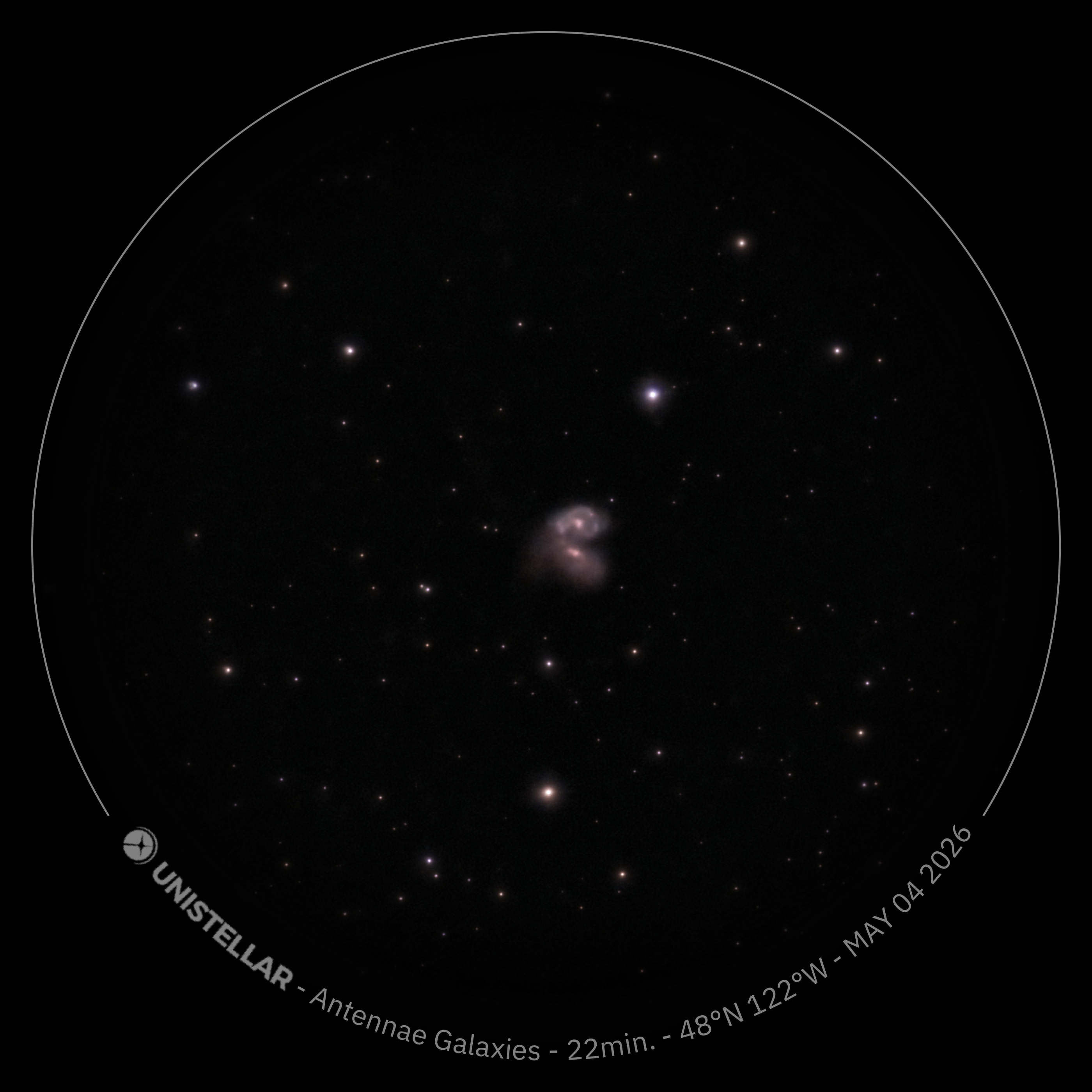
NGC 4038 and NGC 4039 – Antennae Galaxies

22m

2026-05-04

Still no Antennae on these galaxies, unfortunately. On a clear night, far from city lights, perhaps; but not in Seattle.

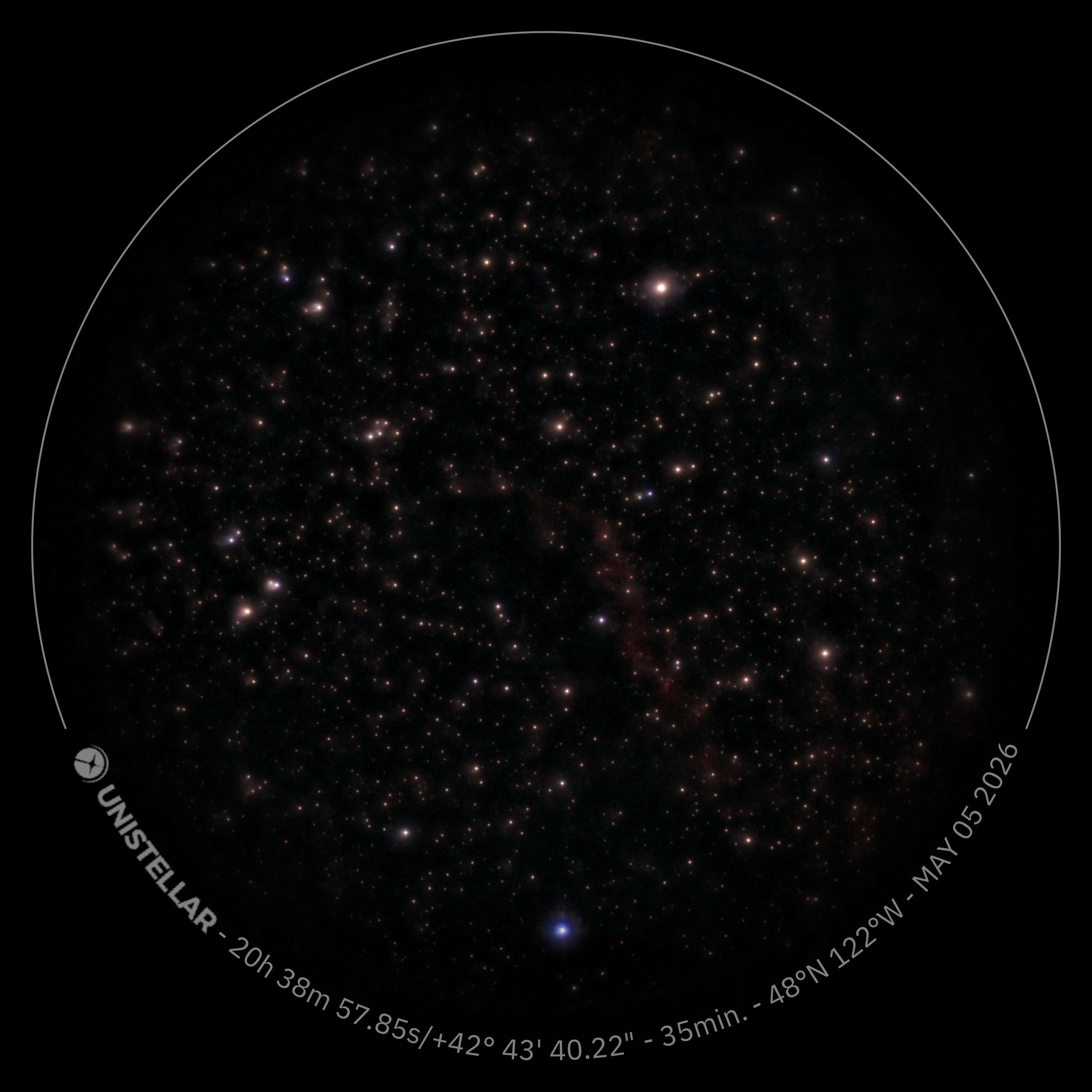
NGC 7000 – The North America Nebula

35m

2026-05-05

Another attempt, this time at 20h38m58s / 43:40:22, and again, not a great result. There’s a tiny bit of there there, but it’s pretty obvious this particular nebula is too dim to pick up, with the eVscope, in Seattle.

Posted in Space on the back porch | Tagged , , , , , , , , , , , , , , , , , , , | Leave a comment